

 Most people never think about electricity until it disappears.
On a normal day, power feels permanent. You wake up, charge your phone, make coffee,
check messages, and move through life without thinking much about where energy comes from.
We trust that the lights will turn on and that outlets will always work.
Then disaster happens.
It could be an earthquake. A flood. A hurricane. A wildfire. Or even something larger,
like war.
Suddenly, the systems that support daily life begin to fail. Roads become crowded.
Stores empty quickly. Internet service becomes unstable. Power lines stop working.
Phones lose signal. Cities become quieter in strange ways.
And then people notice something they usually ignore:
Their batteries are running out.
Not food.
Not water.
Power.
This may sound small at first. After all, a dead phone does not seem as serious as
an empty refrigerator or a lack of drinking water.
But modern life works differently than it did twenty years ago.
Today, electricity is tied to almost everything we do.
Our phones are no longer just phones. They hold maps, emergency contacts, bank access,
medical records, news updates, and communication tools. During an emergency, a smartphone
can become one of the most important survival devices a person owns.
When Your Phone Becomes a Survival Tool
Imagine being in a city after a major disaster.
You need to know where evacuation centers are located. You need updates from local
authorities. You need to contact family members. You may need GPS because roads have
changed or transportation systems are down.
Now imagine your battery reaching one percent.
That small number suddenly feels very important.
History has shown this many times. After earthquakes and hurricanes, large areas have
remained without electricity for days. During conflicts and wars, power stations and
infrastructure often become damaged or unavailable. Entire communities can face long
periods without reliable energy.
When this happens, people search for ways to recharge devices.
- Cars become charging stations.
- Long lines form around public power sources.
- Portable generators become valuable.
- Anything with electricity becomes important.
Why a Solar Power Bank Is Different
This is where a solar power bank starts to become more than just another gadget.
Under normal conditions, many people see it as an outdoor accessory. Something hikers
carry in a backpack or travelers keep for convenience.
But in emergency situations, its value changes.
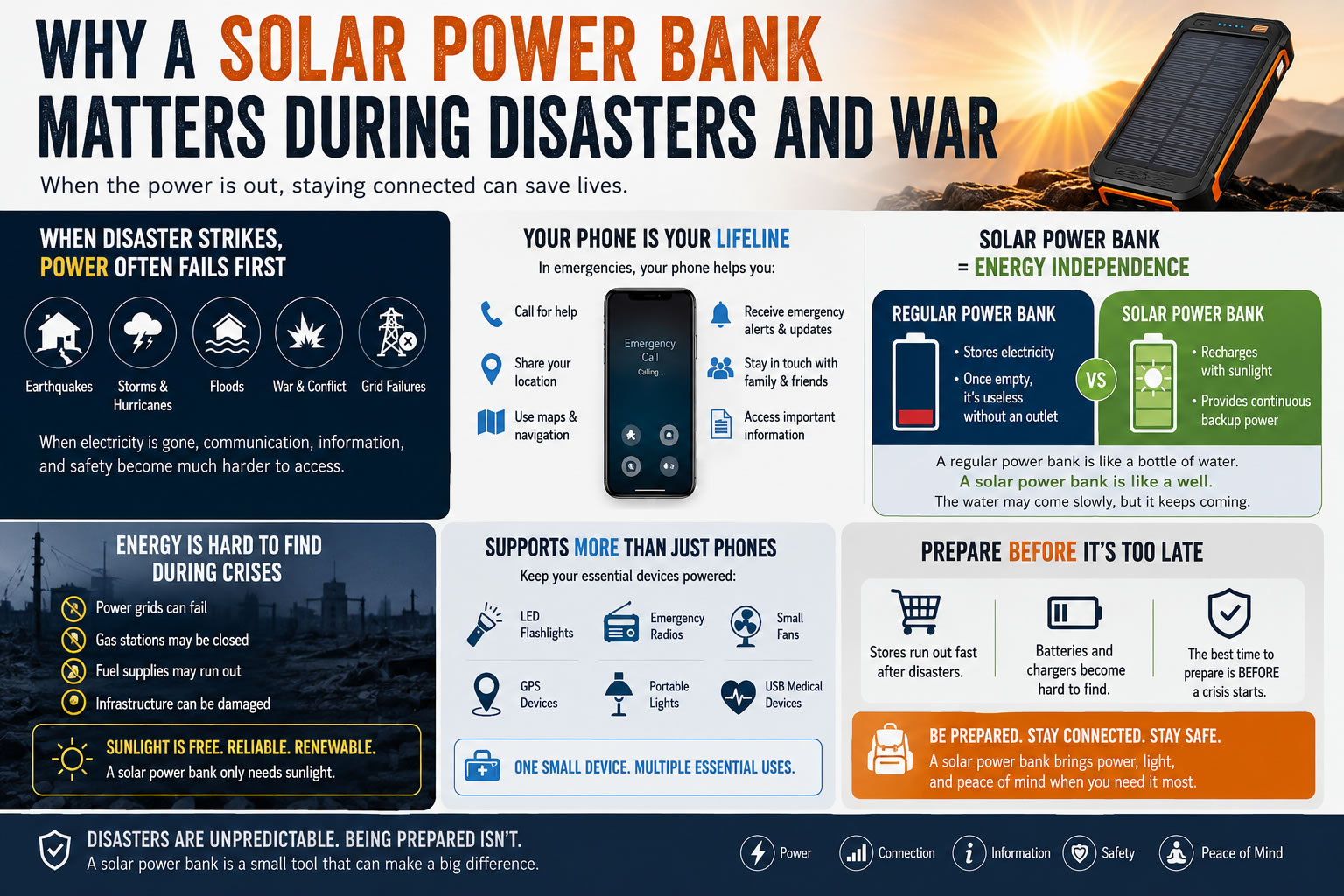
A regular power bank only stores electricity. Once the battery is empty, it becomes
another device waiting for a wall outlet.
A solar power bank works differently.
It offers a small level of energy independence.
That independence matters because disasters often remove choices. People lose access
to stores, fuel, transportation, and public services. The more independent tools you have,
the more flexible you become.
A solar power bank does not create unlimited energy. It is not meant to replace a home
electrical system.
But that is not its purpose.
Its purpose is to keep essential tools alive.
- One charged phone can provide communication.
- One flashlight can provide safety at night.
- One radio can provide information.
Small amounts of power can create large differences.
The Hidden Risk: Panic
There is also another factor that people often forget:
Panic.
When emergencies begin, stores empty quickly. Batteries disappear. Flashlights sell out.
Portable chargers become difficult to find.
People prepare after a disaster starts.
Experienced emergency planners prepare before one begins.
This is why many survival experts talk about the idea of layers:
- Food
- Water
- Medicine
- Communication
- Energy
Energy supports everything else.
Without power, information becomes harder to access. Communication becomes weaker.
Uncertainty grows.
More Than a Power Bank
A solar power bank may spend most of its life sitting quietly in a drawer, a backpack,
or an emergency kit.
You may rarely think about it.
You may not use it for months.
But if the day comes when the power grid fails, when charging outlets disappear,
or when communication becomes critical, its role changes completely.
At that moment, it is no longer just a power bank.
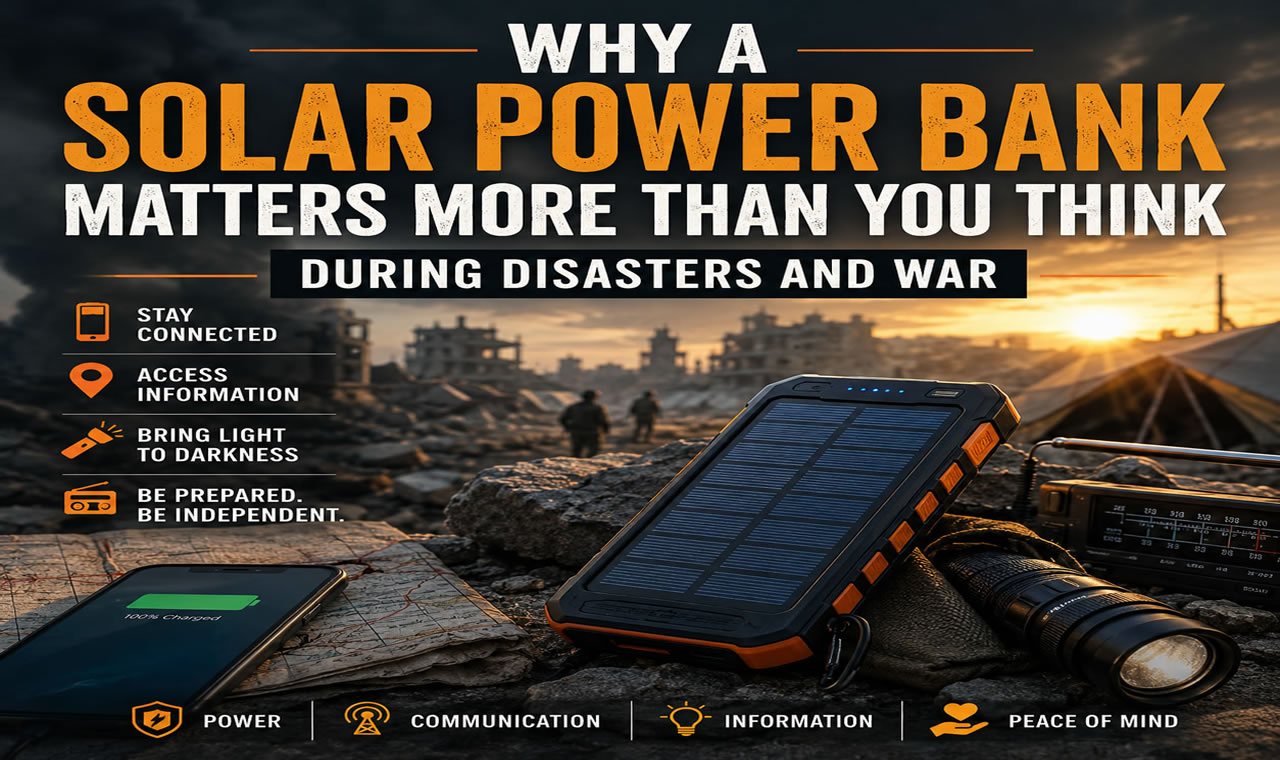
It becomes connection.
It becomes information.
It becomes light.
And in difficult situations, sometimes small things become far more important than
we ever expected.
Final Thoughts
Most people buy emergency tools hoping they will never need them.
That is exactly the point.
Preparation is not about fear.
It is about reducing uncertainty.
A solar power bank will probably spend years sitting unused. But on the day you truly
need it, it may become one of the most valuable things you own.
Because when the lights go out, power is no longer convenience.
Power becomes survival.
Stay ready before you need it. Emergencies rarely send warnings.