

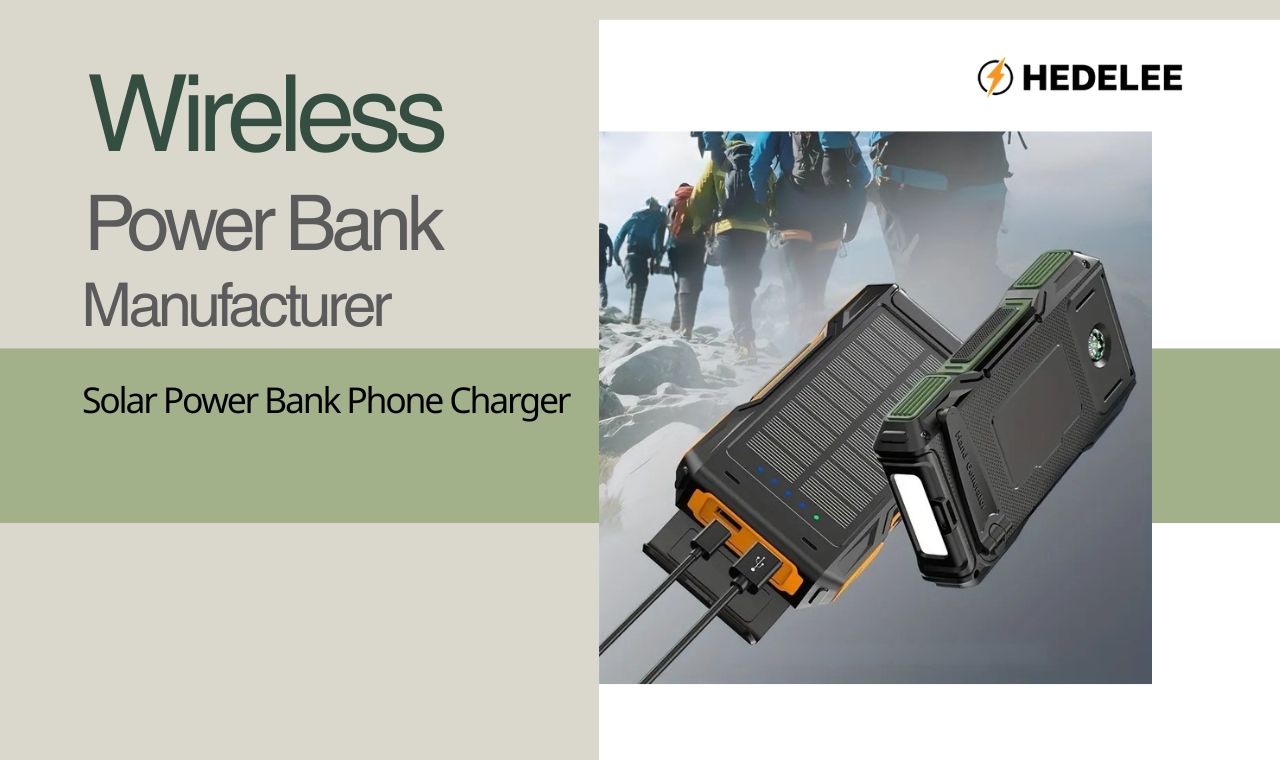
A regular USB power bank works well until the battery is empty and there is no wall outlet, vehicle socket, or generator nearby. For outdoor products, emergency kits, travel accessories, and utility-focused retail lines, that limit can affect the product’s practical value.
A solar power bank phone charger adds a solar panel to a rechargeable battery pack. It still charges phones through USB, USB-C, wireless charging, or built-in cables, but it can also collect a modest amount of energy from sunlight. This added charging path gives users more flexibility when mains power is unavailable. For product teams and procurement professionals, the comparison is less about replacing USB charging and more about adding resilience, outdoor relevance, and useful product features.
What is a solar power bank phone charger?
A solar power bank phone charger is a portable battery pack with an integrated solar panel. Users normally charge the internal battery through USB or USB-C before leaving home, then charge phones and other small devices from the stored energy. When sunlight is available, the panel can replenish the battery slowly.
It is not the same as a large folding solar generator or rooftop solar system. Most compact models have small panels, so solar input is intended as a backup or maintenance source rather than the main way to fill a large battery quickly.
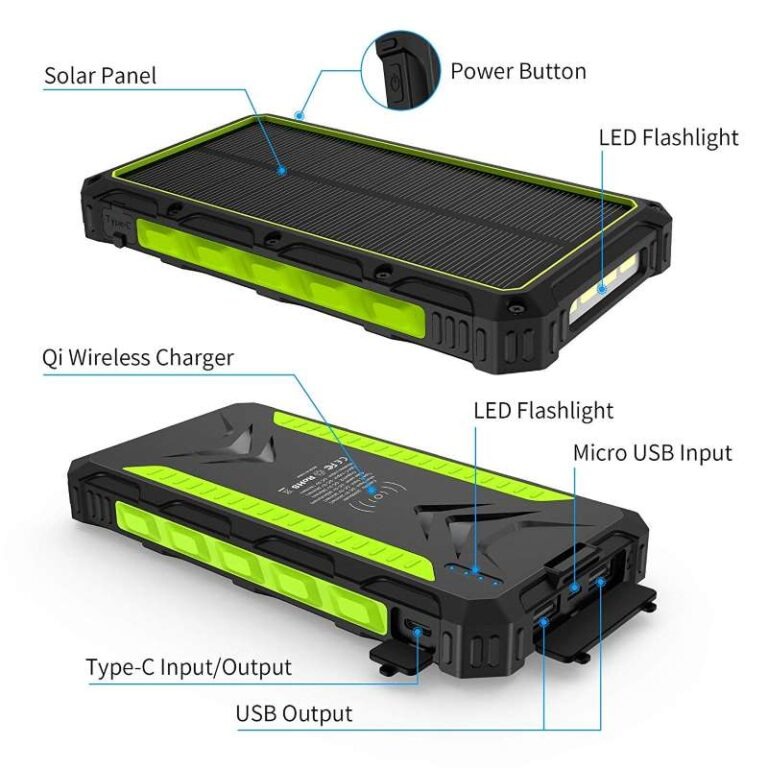
A typical unit may include:
-
A lithium battery pack with capacities from 10,000 mAh to 42,000
-
One or more solar panels
-
USB-A and USB-C output ports
-
USB-C, Micro-USB, or Lightning-compatible input options
-
Qi wireless charging on selected models
-
Built-in charging cables
-
LED flashlights or SOS lighting
-
Water-resistance features for outdoor handling
-
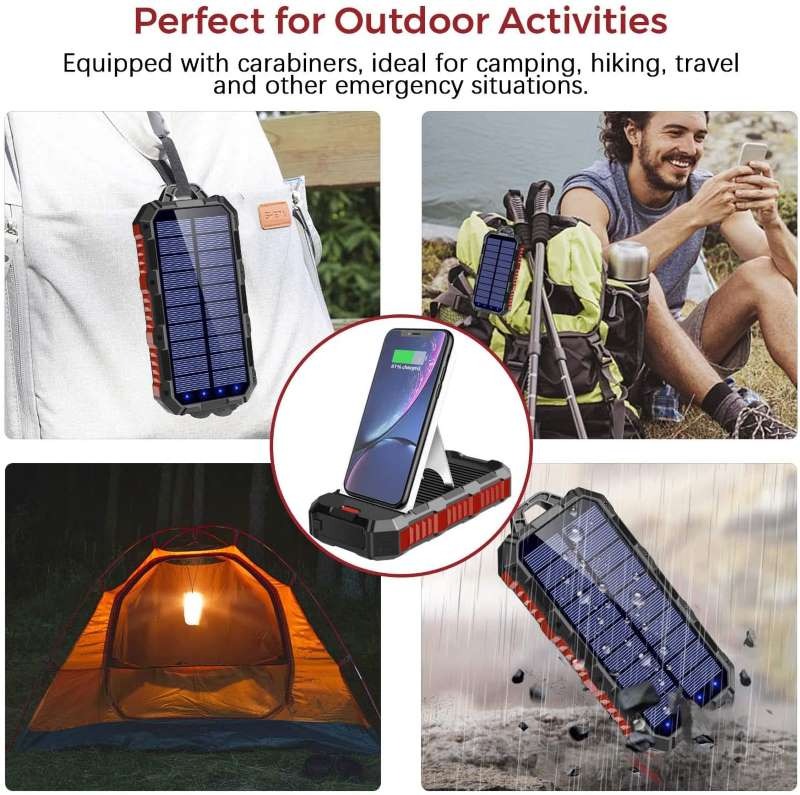
Protective housing with a carabiner attachment point
The phrase solar power bank is often used broadly. However, buyers should check whether a product has a small built-in panel, a foldable multi-panel design, or a detachable solar panel. Each format serves a different user need.
For example, a compact solar phone charger is useful for a day hike or emergency bag because it offers portable stored power and basic solar recovery. A foldable solar powered power bank may be more appropriate for campers who spend several days outdoors and can place a larger panel in direct sun.
Why USB charging remains the main charging method
A common misunderstanding is that a solar panel will recharge a large battery pack in a few hours. In reality, a compact built-in panel produces limited power. Weather, panel angle, shade, temperature, and daylight hours all affect output.
USB charging remains the fastest and most reliable preparation method. Solar charging is the added advantage: it extends usability when conventional charging is not available.
For technical context, the U.S. Department of Energy’s solar photovoltaic guidance explains how photovoltaic cells convert sunlight into electricity. That same principle applies to portable solar charging products, although at a much smaller scale.
Why a solar power bank phone charger offers more flexibility
The main advantage over a standard USB power bank is flexibility. A regular power bank depends fully on stored energy. Once that energy is used, the product cannot help until the user reaches an electrical source.
A solar power bank phone charger gives users two energy paths:
-
Charge the battery from a wall adapter, laptop, car charger, or power station before travel.
-
Use sunlight to regain some charge when no conventional source is available.
This distinction is valuable in environments where access to power is uncertain. Outdoor workers, campers, festival visitors, delivery teams, road travelers, and emergency-preparedness customers may all face periods away from a socket.
The solar feature also changes how customers see the product. It is not only a phone accessory. It becomes part of an outdoor, travel, safety, or preparedness product assortment.
1. Backup charging during outdoor use
A regular USB charger is useful for commuting, flights, and short trips. A solar mobile phone charger is more relevant for activities where users may be off-grid for longer periods.
Common use cases include:
-
Hiking and mountain trekking
-
Camping and fishing trips
-
Roadside emergencies
-
Outdoor work sites
-
Festivals and sports events
-
Disaster-preparedness kits
-
Remote travel and field inspections
-
Boat trips and recreational vehicles
The solar panel does not need to carry the full energy load to add value. Even partial charging can help maintain access to navigation, communication, photos, weather updates, or emergency contacts.
2. Better fit for emergency product categories
Power loss is often unexpected. Severe weather, grid disruptions, road delays, and travel problems can leave people without a conventional charging option. A solar cell phone charger gives users a method to gather energy during daylight, even if that process is slow.
For emergency-oriented products, buyers often look for a practical combination:
-
Large battery capacity
-
Multiple output ports
-
Built-in flashlight
-
Water-resistant enclosure
-
Strong hanging loop or carabiner
-
Solar replenishment capability
-
Cables that reduce the need to carry extras
A standard power bank may still have a place in this category. Yet a solar model communicates wider readiness because it is designed for conditions beyond everyday indoor charging.
3. More visible retail appeal
Solar panels are visually recognizable. Shoppers can quickly understand the outdoor purpose of the product from the panel, rugged casing, and flashlight layout. This helps online listings, shelf displays, and product photography communicate a clear use case without lengthy explanation.
The product should still be marketed honestly. Avoid claims that imply rapid solar recharging if the panel is compact. Clear wording builds trust: “Solar backup charging for outdoor and emergency use” is more accurate than promising full same-day solar charging in every weather condition.
How solar charging works in real conditions
Solar charging begins when sunlight reaches the photovoltaic cells on the panel. The panel converts light into electricity, and the power-management circuit sends that electricity to the internal battery.
However, solar performance varies far more than USB charging. Procurement teams should understand these variables before setting product claims, choosing packaging statements, or briefing sales staff.
Sunlight intensity and panel positioning
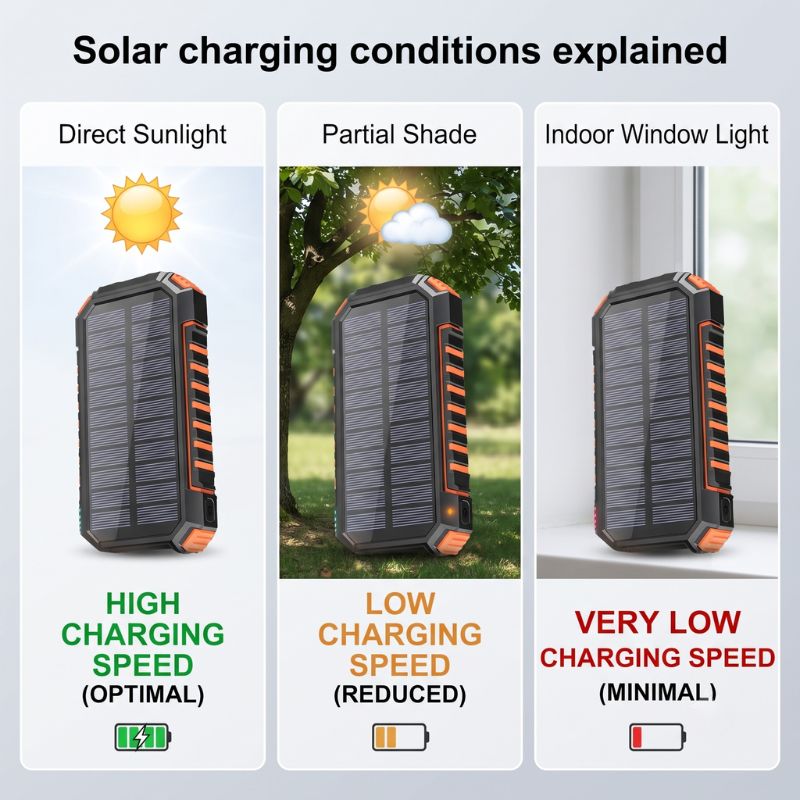
Direct sunlight produces the strongest output. A panel laid flat in partial shade will generate far less power than one angled toward clear sun.
Users can improve solar collection by:
-
Placing the panel in direct sunlight
-
Removing dirt, water droplets, or stickers from the panel
-
Repositioning the product as the sun moves
-
Avoiding shade from tents, trees, backpacks, or vehicle roofs
-
Keeping the battery pack from overheating in extreme conditions
Solar panels can still react to bright daylight when the sun is not fully visible, but output decreases. Indoor light and shaded conditions generally provide very limited charging.
Battery capacity and realistic recharge expectations
Larger capacities store more energy, but they also require more energy to recharge. A 20,000 mAh battery pack can support several phone charges, depending on the phone battery, cable losses, temperature, and charging protocol. A small integrated panel may take many daylight hours to add a useful amount of energy.
This is why a solar power bank battery charger should be positioned as a dual-input product:
-
Fast primary charging through USB or USB-C
-
Slow backup charging through solar exposure
Foldable designs with multiple panels can collect more solar energy than compact single-panel products. For buyers building a camping range, this difference can guide assortment planning.
Safety and battery management
Quality design is not only about capacity. It also includes battery protection, circuit control, connector durability, and heat management. Lithium battery packs need safeguards against overcharge, over-discharge, short circuits, and excessive current.
For general consumer guidance, the U.S. Consumer Product Safety Commission’s lithium-ion battery safety information is a useful reference. It reinforces practical handling rules: use suitable charging equipment, avoid damaged batteries, and keep products away from excessive heat.
For import programs, buyers may request documentation based on their target market and product configuration. Common requests can include battery transport documentation, material declarations, and test reports related to applicable electrical and safety requirements. Requirements differ by destination, so the supplier and buyer should confirm the final specification before production.
7 advantages over a regular USB power bank
A conventional USB power bank remains a useful and economical product. Yet a solar model offers additional functions that can justify a different market position. Here are seven practical advantages.
1. It provides a second source of energy
The built-in panel gives users a way to collect power from daylight. This can be valuable when a wall outlet, car charger, or generator is not available.
2. It supports longer outdoor trips
Camping, trekking, fishing, and remote travel can last longer than the stored charge of one battery pack. Solar recovery may extend phone availability between standard charging opportunities.
3. It strengthens emergency readiness
A solar cell phone charger is useful in emergency kits because it can provide stored power immediately and gather some backup energy during daylight. The flashlight function found on many models adds further utility.
4. It creates a more complete outdoor product
Many solar models include multiple USB outputs, wireless charging, built-in cables, LED lights, and water-resistant housings. These functions reduce the number of accessories a user must carry.
5. It supports multiple devices
A dual-USB or USB-C model can charge phones, earbuds, GPS units, headlamps, portable fans, and other low-power devices. Output specifications must be checked, especially if fast charging is required.
6. It offers stronger visual differentiation
The solar panel, outdoor casing, and lighting features help a product stand apart from ordinary rectangular battery packs. This can support merchandising in camping, travel, automotive, emergency, and promotional accessory ranges.
7. It aligns with practical energy awareness
Many customers appreciate a product that can use sunlight, particularly when they travel or spend time outdoors. The useful message is energy independence in limited-power situations, not exaggerated environmental claims.
A solar powered iphone charger can be included in this product category, provided it uses compatible outputs or a suitable cable. Wireless charging is another option for compatible phone models, although wired charging is often more efficient and stable in outdoor condition.
Where a regular USB charger still performs better
A fair product comparison should include the limits. A regular USB power bank often costs less, weighs less, and has no solar panel to protect. If customers only need backup power for indoor commuting, business travel, or short city use, a standard model can be the more appropriate choice.
Solar products also need clear user education. A small panel cannot provide the same output as a wall charger. If product pages leave this unclear, users may form unrealistic expectations.
Common trade-offs to consider
A power bank for solar use is not automatically water-resistant, impact-resistant, or suitable for every climate. Product teams should check the stated IP rating, port covers, battery temperature range, panel construction, and drop-resistance expectations.
Avoid inaccurate performance claims
Marketing language should match the actual panel and battery design. Good claims focus on function:
-
“Recharge by USB before travel; use solar as a backup charging source.”
-
“Designed for outdoor charging support in daylight.”
-
“Built-in LED light for camping and emergency use.”
-
“Multiple outputs for compatible small devices.”
Claims to avoid include:
-
“Fully charges in a few hours from sunlight” without verified conditions
-
“Works in all weather” without a relevant IP rating and test evidence
-
“Unlimited solar charging” because daylight and battery capacity are finite
-
“Charges every device” because device requirements vary
Clear claims reduce return risk and help wholesale customers build reliable product pages.
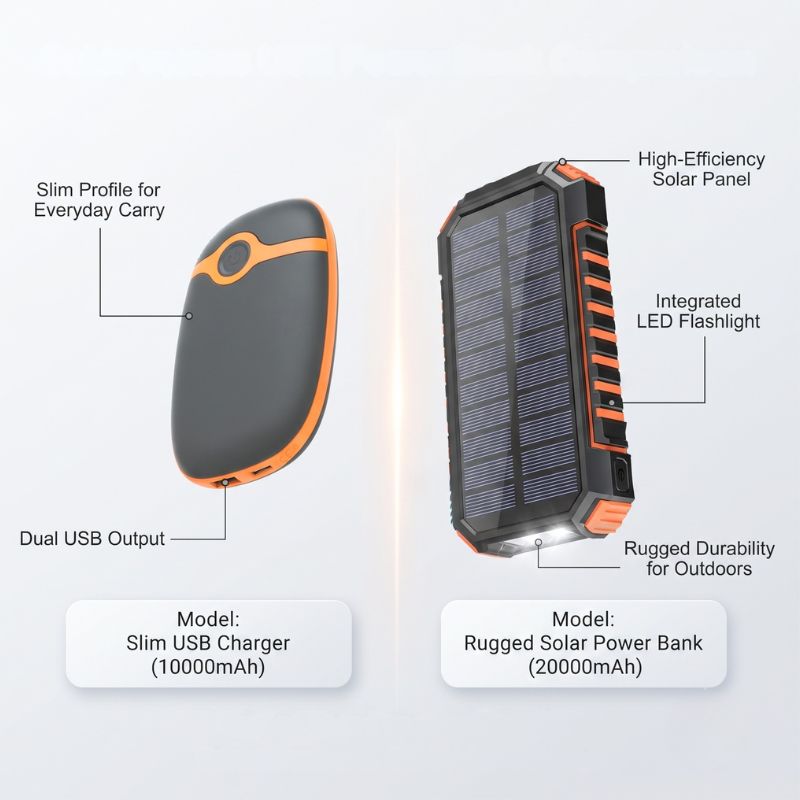
How to choose a solar power bank phone charger
Product selection should begin with the intended user scenario. Capacity alone does not define the right item. A compact model may fit a giveaway, commuter accessory, or emergency pouch, while a larger model may fit outdoor retail or camping bundles.
Start with capacity and output requirements
Capacity is usually shown in milliamp-hours, written as mAh. A higher number indicates more stored battery energy, though actual delivered charging capacity is lower because voltage conversion and normal energy loss occur.
Use these ranges as a starting point:
-
10,000 mAh: Compact daily carry, short outdoor use, lighter gift programs
-
20,000 mAh: Balanced capacity for travel, camping, and outdoor accessory ranges
-
25,000 mAh to 30,000 mAh: Multi-device use and longer trips
-
36,000 mAh to 42,000 mAh: Extended outdoor use, larger emergency kits, higher-capacity product lines
Output ports are equally relevant. Check the number of outputs, USB-C support, charging protocol, total output, and whether the product can charge multiple devices at the same time.
Choose practical feature combinations
Popular feature combinations include:
-
Wireless charging for compatible phones
-
Built-in Type-C, Micro-USB, and Lightning-compatible cables
-
Dual USB outputs for two devices
-
LED flashlight and SOS mode
-
Waterproof or water-resistant casing
-
Foldable solar panels for expanded collection area
-
Carabiner clip for backpack attachment
-
Battery display or percentage indicator
A model with built-in cables can reduce accessory loss. The HDL-529 solar power bank with four built-in cables and wireless charging combines a large listed capacity with integrated lighting and convenient cable management. Buyers looking for a compact outdoor solution may prefer the 10,000 mAh wireless solar charger, which offers strong LED lighting in a lightweight design. Meanwhile, the 42,000 mAh solar power bank with four built-in cables is better suited for emergency preparedness, camping, and extended outdoor use where higher battery capacity is important.
Review compliance and shipping needs early
Lithium battery products require careful planning for transport. Buyers should discuss battery capacity, destination market, labeling, packaging, and requested documentation before finalizing an order.
Ask suppliers about:
-
Battery cell type and rated capacity
-
Protection-board functions
-
Available safety and transport documentation
-
Product labeling options
-
Packaging design and carton specifications
-
Destination-specific compliance support
-
Sample lead time and mass-production lead time
-
Inspection standards before shipment
These questions help product managers avoid late specification changes and allow import teams to coordinate shipping more effectively.
Product formats for different sales programs
A broad range allows wholesalers and importers to match products with their customer segment rather than relying on one battery capacity or feature set.
Compact and everyday outdoor models
Compact products are easier to carry and can fit travel accessory lines, outdoor gift sets, and basic emergency ranges.
-
The HDL-218 20,000 mAh solar power bank with wireless charging, dual inputs, and flashlight is designed around portable capacity and common charging functions.
-
The HDL-519 outdoor solar charger for electronic devices fits camping-oriented product positioning.
-
The waterproof 20,000 mAh solar panel power bank with fast charging may suit travel and outdoor categories where water resistance is part of the selection brief.
Foldable solar charging designs
Foldable panels provide more surface area than a compact integrated panel. They can suit users who spend longer periods in direct daylight and are willing to carry a larger product.
-
The foldable 20,000 mAh outdoor solar charger with LED lights is suitable for camping-focused ranges.
-
The HDL-519X solar panel power bank with dual USB ports and LED light provides another outdoor-oriented configuration.
Higher-capacity and cable-integrated models
For more feature-rich lines, higher-capacity units can support multi-device and emergency use positioning.
-
The HDL-531 wireless solar power bank with three cables and dual flashlights is built for high-capacity outdoor product assortments.
-
The 25,000 mAh solar charger with dual USB ports offers a capacity range often selected for travel and emergency products.
-
The HDL-528 30,000 mAh Qi wireless solar charger with USB-C combines wireless charging, USB-C connectivity, and an IP65-rated format.
Browse the complete solar power bank product collection to compare capacities, housing styles, port arrangements, cable options, and lighting configurations.
What procurement teams should request from a manufacturer
Product photos and capacity claims are only the first part of supplier evaluation. A capable manufacturer should be able to discuss the product structure, battery configuration, input and output design, production controls, packaging, and customization options.
Request product information that can support your internal review:
-
Product dimensions, weight, and materials
-
Battery capacity and rated energy details
-
Solar panel type and rated input information
-
Input and output specifications
-
Fast-charging and wireless-charging compatibility
-
Water-resistance rating, where applicable
-
Cable type, cable length, and connector options
-
Available color and logo customization
-
Retail packaging and instruction manual options
-
Sample availability and estimated production schedule
-
Quality inspection process and shipment documentation
It also helps to define intended use from the start. A promotional travel item, a camping accessory, and an emergency power product may all use a solar power bank battery charger, but they require different capacity, packaging, feature, and price decisions.
Customization that supports product clarity
Customization should improve product usability and brand presentation, not only add a logo. Depending on the model and order specification, useful options may include:
-
Printed logo placement on the housing
-
Custom color combinations
-
Retail box artwork
-
Multilingual user instructions
-
Branded inserts with solar charging guidance
-
Custom cable combinations
-
Packaging for gift, retail, or bulk distribution programs
User instructions should explain that solar charging works most effectively in direct sunlight and is intended as a backup input on compact-panel models. This reduces confusion and supports a better ownership experience.
Manufacturer capability and supply planning
Shenzhen Hedeli Technology Co., Ltd. has worked in mobile accessories and consumer electronics for about 10 years, with a focus on innovative, dependable solar power bank products. The company has more than 100 employees, headquarters in Shenzhen, China, and an office and showroom in Guangzhou.
Its Dongguan factory has a monthly capacity of approximately units. This production base supports importers, distributors, and wholesalers that need consistent supply planning, product customization discussions, and factory-direct communication.
A manufacturer relationship is especially helpful when your team needs to compare housing options, feature combinations, packaging formats, and order schedules before launch.
Frequently Asked Questions
1. What order quantities are available for solar chargers?
Order quantities depend on the selected model, customization needs, packaging, and production schedule. Share your target product and sales market to receive an accurate quotation and order discussion.
2. Can we add our logo and packaging?
Yes, logo printing, color selection, retail boxes, and instruction materials may be available depending on the model. Reach out with your artwork, expected quantity, and packaging requirements for detailed specifications.
3. How long does solar charging usually take?
Compact built-in panels charge more slowly than wall USB input, and results depend on direct sunlight, panel size, weather, and battery capacity. Most users should fully charge the unit by USB before travel and treat solar input as backup charging.
4. What compliance documents can buyers request?
Requested documents vary by product configuration and destination market. Buyers commonly ask about battery transport documentation, test reports, labeling, and product safety information; contact us to discuss your market requirements.
5. Do you provide samples before mass production?
Samples can help your team review capacity, ports, housing, lighting, solar panel layout, and packaging quality before a larger order. Contact us to request samples and confirm sample availability for your preferred model.