

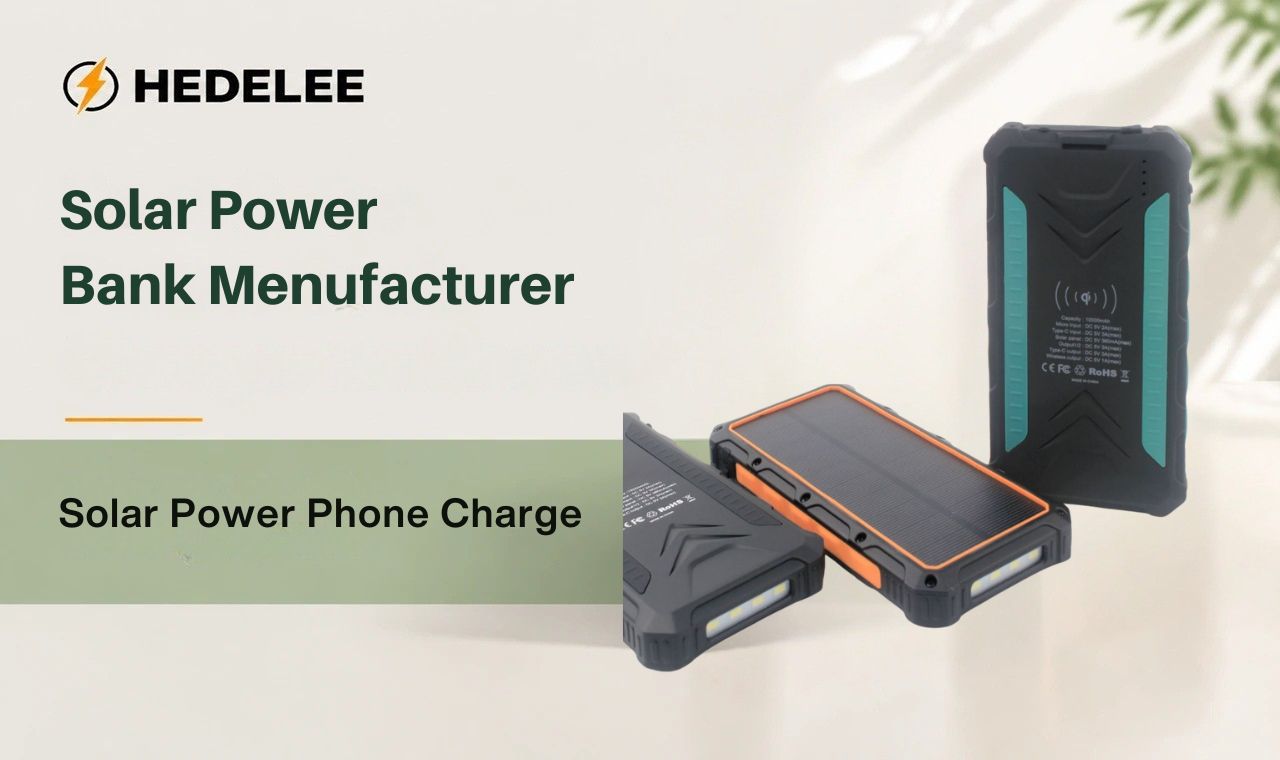
A buyer once sent our team a screenshot from a competing listing: “Charges your phone in 8-12 hours by solar.” Her question was simple — can a solar power phone charge really happen that fast, or is it marketing math?
The honest answer: sometimes. But almost never in the way listings suggest.
Those 8-12 hour figures come from laboratory sun — a perfect 1,000 W/m² light source, a fixed panel angle, and a mild 25°C day. Real sunlight rarely cooperates like that. Clouds drift. The sun moves across the sky. Panels heat up and lose output.
For importers, distributors, and product managers, this gap between claim and reality carries real costs: returns, poor reviews, and support tickets.
As a manufacturer that builds and tests solar charging products every day, we’ll walk through the actual numbers — how solar charging works, what independent tests show, which designs deliver on the promise, and what to check before you place an order.
What the 8-12 Hour Solar Power Phone Charge Claim Really Means
Most charging-time claims trace back to Standard Test Conditions, or STC. That’s a lab setup with 1,000 watts of light per square meter, a cell temperature of 25°C, and a panel aimed squarely at the light. Under STC, a small panel performs at its rated wattage. Under real sky, it almost never does.
Here’s the basic math. A typical single-panel solar cell phone charger carries a 1.5 to 2-watt panel. At 5 volts, that panel delivers roughly 300-400mA in perfect sun. A modern phone battery holds 3,000-4,000mAh. So yes — 8 to 12 hours of flawless, perpendicular, midday sun could fill that phone. The claim is technically possible. It’s also nearly impossible to reproduce on a Tuesday afternoon with drifting clouds.
There’s a second layer of confusion, and it trips up even experienced buyers. Listings often blur three different numbers:
Solar recharging the power bank’s internal battery — the slowest process, often measured in days for small panels
The power bank charging your phone from stored energy — fast, usually 1-2 hours, same as any wall-charged bank
The panel charging your phone directly — possible only with larger multi-panel units
When a listing says “8-12 hours,” it usually describes the third scenario under lab sun, while buyers read it as the first. That mismatch is where disappointment begins.
How a Solar Power Bank Converts Sunlight Into Stored Energy
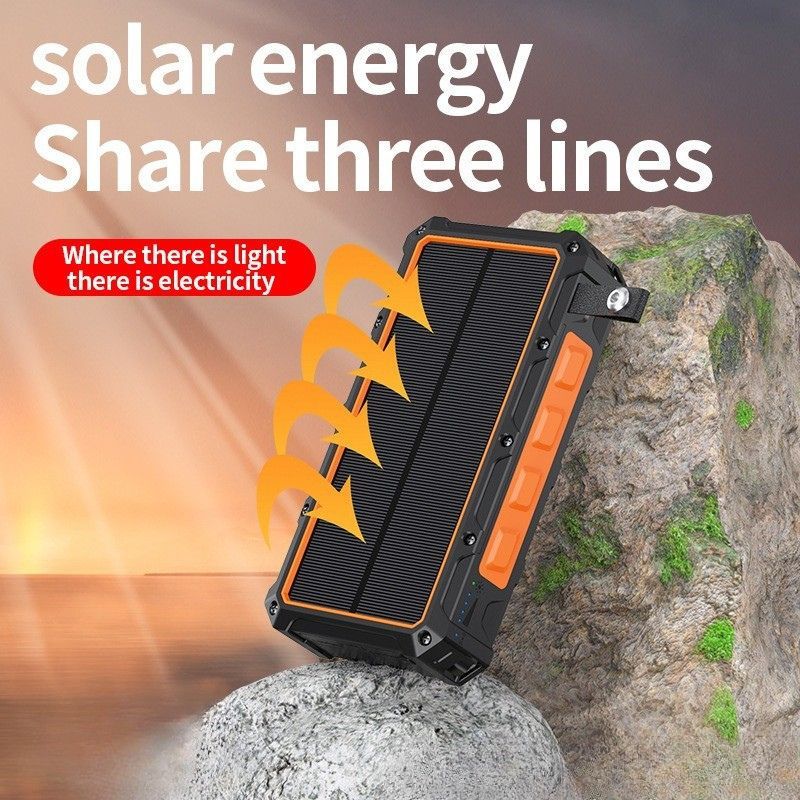
To judge any charging claim, it helps to follow the energy path. A solar powered power bank moves energy through four stages, and every stage takes a small cut.
Solar panel. Photovoltaic cells absorb photons and release electrons, creating direct current. The U.S. Department of Energy’s primer on PV cells explains this process well. Monocrystalline cells, the common choice in better chargers, convert about 20-23% of incoming sunlight.
Charge controller. This circuit regulates voltage and current so the battery charges safely. Expect 5-10% loss here.
Lithium battery. Charging a lithium-polymer cell is roughly 90% efficient; some energy leaves as heat.
Output stage. A boost converter raises battery voltage to 5V USB (or 9V/12V for fast charging). Another 10-15% disappears.
Stack those losses and the picture gets clear: of every 100 units of solar energy hitting the panel, only about 15-18 reach your phone. This is why panel wattage — not battery capacity — decides how fast any solar mobile phone charger performs in the sun. The mAh figure tells you how much energy the bank stores. The wattage tells you how fast sunlight refills it.
This also explains a design detail worth asking about: dual inputs. Well-designed units pair the solar panel with a USB-C or micro-USB wall input, so the bank charges fully from an outlet before a trip and uses the sun as a top-up source. That hybrid approach is how these products work in practice, and honest suppliers will say so.
Real Charging Times: Lab Numbers vs. Field Results
Independent testing paints a consistent picture. In OutdoorGearLab’s long-running solar charger tests, one popular integrated power bank needed about 29 hours of strong midday sun to recharge itself. Field data from other testers shows 20,000mAh banks typically need 12-18 hours of clear, full sun — and far longer when clouds move in. Units with small 6W-class panels can need 60-80 hours of direct exposure for a full self-recharge.
Here’s how the main product types compare when the marketing claim meets real sky:
Two patterns stand out. First, the 8-12 hour promise holds up only for higher-wattage, multi-panel designs in strong sun — or for panels charging a phone directly rather than refilling a big internal battery. Second, battery capacity works against solar speed: a 30,000mAh bank takes roughly 50% longer to refill than a 20,000mAh bank on the same panel.
So when you evaluate a listing, ask a different question. Not “how many mAh?” but “how many watts of panel, and what current did you measure in real sun?” A supplier who can answer with measured output current — say, 800mA at 5V in clear conditions — is giving you something you can sell against.
Single-Panel Power Banks vs. Foldable Solar Chargers
These two product families solve different problems, and mixing them up is the most common sourcing mistake we see.
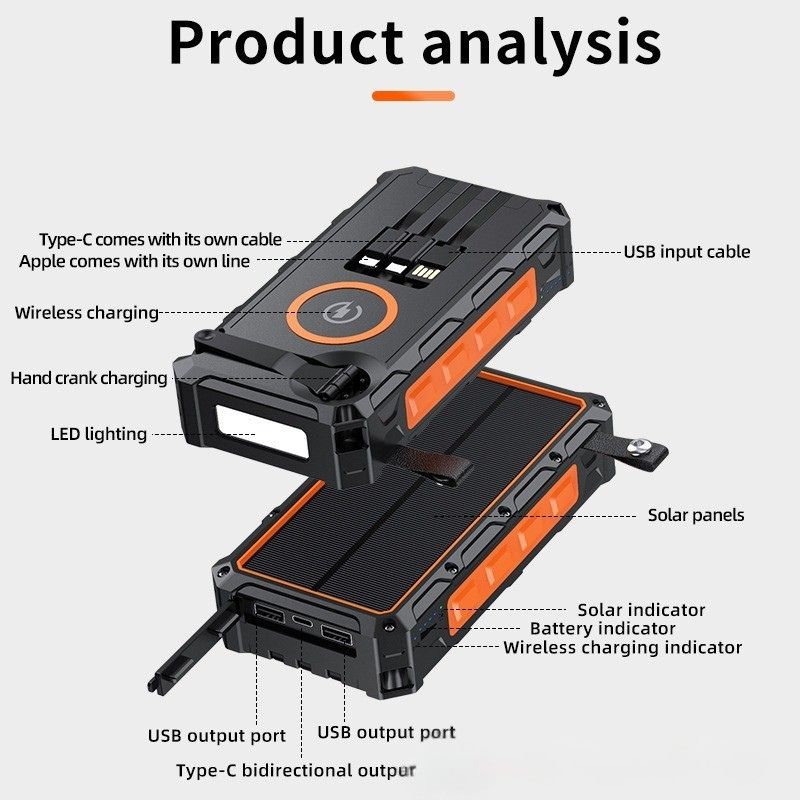
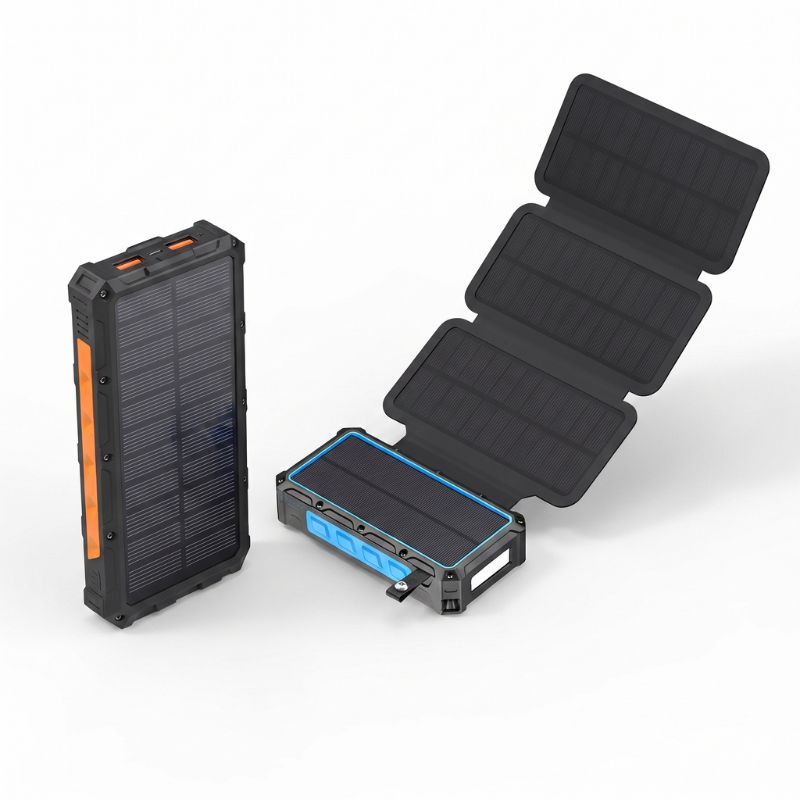
A single-panel unit is best understood as a regular power bank with a solar emergency feature. Its panel can add 10-20% charge over a sunny day — enough to make a call or send messages when nothing else is available. That’s genuinely useful, and it’s honest to sell it that way.
A foldable solar charger for camping is a different tool. Unfolded, its panels collect enough energy to charge a phone directly in a few hours of good sun. Our foldable 20,000mAh solar charger with LED lights is built for exactly this scenario — panel area first, battery second.
For buyers choosing a power bank for solar recharging as the main use case, panel wattage should lead the spec sheet. For buyers whose customers mostly need a wall-charged bank with an emergency solar option, a well-made single-panel unit at a sharper price point will outsell the foldable every time.
When a Solar Phone Charger Makes Sense — and When It Doesn’t
A solar phone charger earns its place in specific situations. Matching the product to the scenario is what separates strong sell-through from a returns pile.
Solar charging makes sense for:
Camping, hiking, and overlanding, where outlets don’t exist and trips last days
Emergency and disaster-preparedness kits, especially in regions with hurricanes, earthquakes, or unstable grids
Fieldwork — construction crews, agricultural teams, logistics drivers, and surveyors who spend all day outdoors
Off-grid retail markets, where end users charge phones away from reliable electricity
Festival, beach, and travel retail, where the solar feature is part of the product’s appeal
Wall charging wins for daily urban use. A 20W wall charger refills a phone in about an hour — ten times faster than any portable panel. Fleets, office workers, and commuters should charge from outlets and treat solar as the backup layer.
This framing also protects your reviews. Resellers who position solar as “emergency backup plus outdoor freedom” see far fewer one-star ratings than those who echo “charges in 8-12 hours” claims. The product hasn’t changed. The expectation has — and expectation is what customers review.
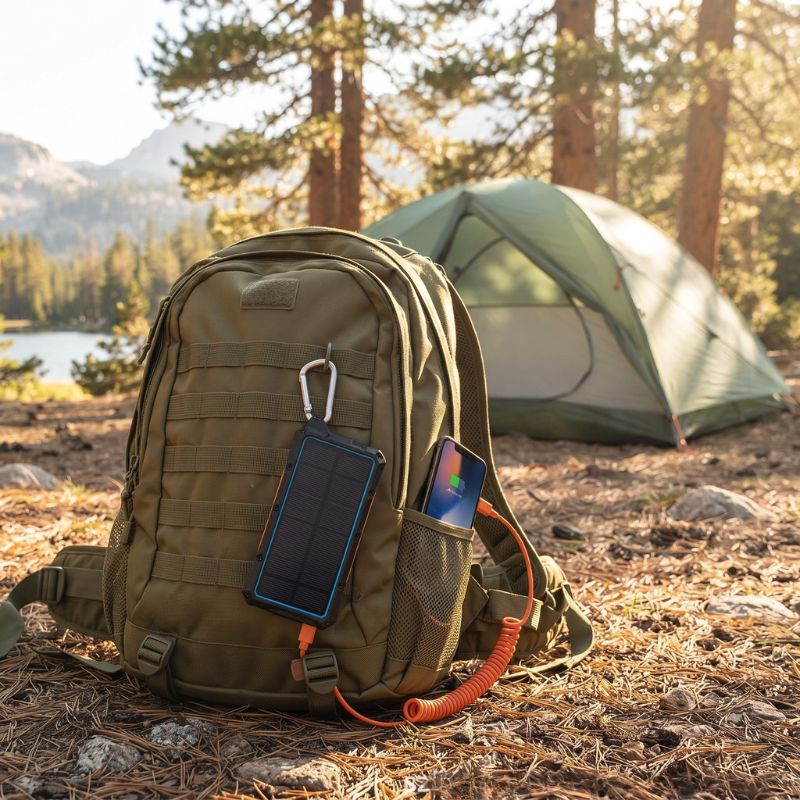
How to Evaluate a Solar Powered iPhone Charger Before Ordering
Whether your customers carry iPhones or Android devices, the evaluation checklist is nearly the same. iPhones simply add two specifics: they negotiate best with stable 5V/2.4A or USB-C PD output, and Qi wireless models work with iPhone 8 and later. Here’s what to verify before committing to any solar powered iPhone charger or universal model:
Panel wattage in watts, not just mAh. Ask for the rated panel power and the measured output current in clear sun.
Honest battery capacity. Request the rated versus actual capacity test report. A trustworthy 20,000mAh unit delivers close to its rating at 5V output.
Output specifications. Look for 5V/2A minimum; 5V/3A or PD support future-proofs the line.
Dual inputs. USB-C or micro-USB wall input alongside the panel is what makes the product practical.
Ingress protection. IPX4 handles splashes and rain; IP65 adds dust-tight sealing for harsher markets.
Certifications. CE, FCC, and RoHS documentation should be available on request.
Practical extras. Built-in cables, wireless charging, and LED flashlights raise perceived value in retail.
A few examples from our own range show how these specs combine. The 20,000mAh wireless solar power bank with dual inputs and waterproof body (HDL-218) covers the outdoor-retail sweet spot. The 24,000mAh wireless model with three built-in cables (HDL-531) suits buyers whose customers hate carrying cables. For higher capacity, the 30,000mAh Qi wireless solar power bank with USB-C input and IP65 rating (HDL-528) and the 42,000mAh solar battery pack with four built-in cables (HDL-628) serve extended-trip and emergency-kit markets.
Then test a sample yourself. Leave it in direct sun for four hours with a USB meter inline. A solar power bank battery charger that gains a measurable, consistent charge in your own climate is one you can sell with confidence — because your customers will test it the same way.
What to Ask Your Supplier Before You Commit
Spec sheets tell you what a product should do. Good questions tell you whether it will. Before placing a volume order, ask any supplier these:
What is the panel’s rated wattage, and what output current did you measure in real sunlight?
Are the cells monocrystalline or polycrystalline, and who makes the battery cells?
What is the rated cycle life of the battery, and can you share capacity test reports?
Which certifications do current production units carry — CE, FCC, RoHS?
What are your MOQ, sample cost, sample lead time, and mass-production lead time?
What customization do you support — logo printing, housing colors, retail packaging, bundled cables?
The answers matter, but so does how quickly and specifically they arrive. Vague replies to question one are a warning sign; a factory that tests its own panels answers in numbers.
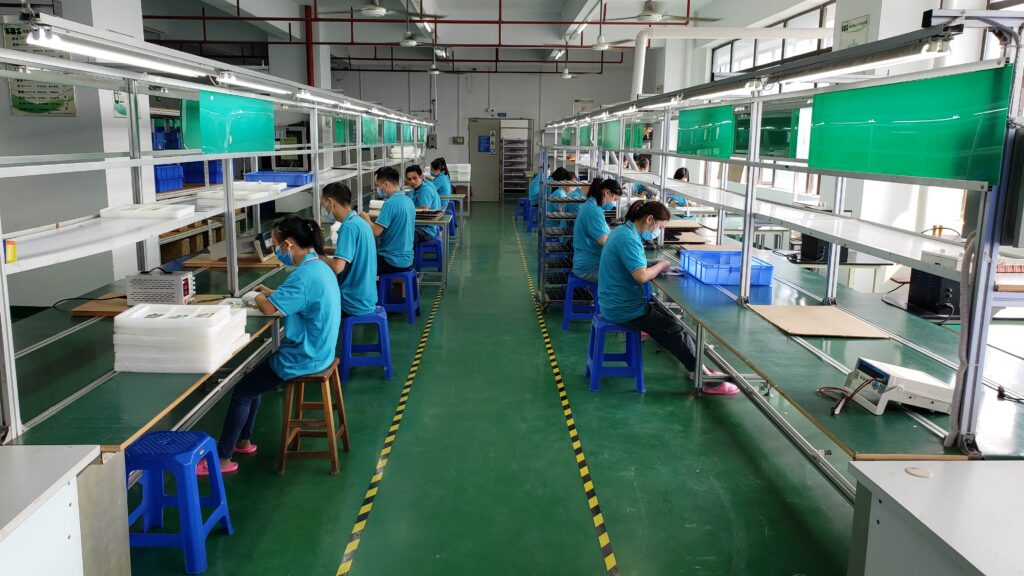
This is where working directly with the original manufacturer changes the conversation. Shenzhen Hedeli Technology Co., Ltd. has spent about 10 years in mobile accessories and consumer electronics, with a mission to bring dependable, innovative products to buyers worldwide. Our team of more than 100 people works from headquarters in Shenzhen, with an office and showroom in Guangzhou where you can handle and test current models. The Dongguan factory produces up to 50,000 units per month, so importers, distributors, and wholesalers get consistent supply even in peak season. You can browse the complete solar power bank category to see current capacities, panel designs, and feature combinations.
The Honest Answer on 8-12 Hour Solar Power Phone Charge Claims
So, can a solar charger fill your phone in 8-12 hours? Under laboratory sun, with a multi-panel charger or a small phone battery, yes. As an everyday expectation for a single-panel power bank, no — and the independent test data backs that up.
For your product line, the winning approach is honest specs matched to real use cases. Sell single-panel banks as dependable wall-charged units with a solar safety net. Sell foldable chargers as genuine off-grid power. Ask suppliers for measured panel output, and test samples in your own market’s sunlight.
If you’d like that kind of straight answer on any model — panel wattage, measured current, capacity reports, customization options — talk to us. You’re reaching the original manufacturer, not a trading layer, so specifications, samples, and pricing come directly from the source. Send your target specs or market requirements, and our team will respond with samples, test data, and a factory-direct quote built around your order.
Frequently Asked Questions
1. What is your minimum order quantity for solar power banks?
Our standard MOQ is flexible and depends on the model and customization level. Stock models start at lower quantities, while custom branding or packaging requires a slightly higher minimum. Reach out with your target volume for exact figures.
2. Can we customize logos, colors, and packaging for bulk orders?
Yes, we support logo printing, custom housing colors, and retail-ready packaging on volume orders. Our team can share mockups within a few working days. Contact us to request samples of past custom projects.
3. Which certifications and compliance tests do your chargers carry?
Current production models carry CE, FCC, and RoHS documentation, with test reports available on request. We can also discuss additional market-specific requirements during the quoting stage. Ask us for the full compliance file for any model.
4. How long do samples and full production orders usually take?
Samples typically ship within a few days, and mass production runs about 15-25 days depending on order size and customization. Our Dongguan factory’s 50,000-unit monthly capacity keeps lead times stable in peak season. Send your requirements for a confirmed schedule.