

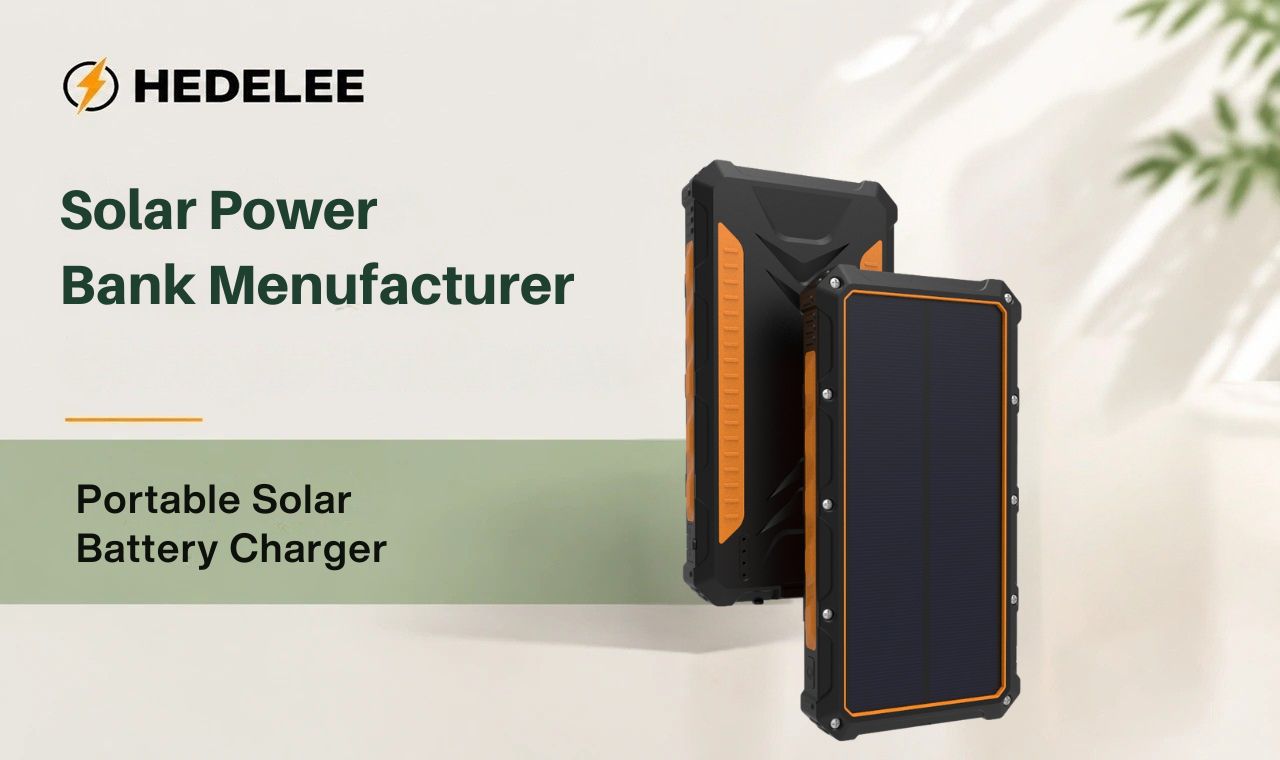
Here’s a scene we hear about often: a customer buys a 20,000mAh solar power bank before a camping trip, leaves it on the picnic table in full sun, and comes back eight hours later expecting a full battery. It has gained maybe 12%.
That gap between expectation and reality causes returns, bad reviews, and endless support tickets. It comes from one missing piece of information: what a portable solar battery charger can actually deliver in a given amount of sunlight. The short answer is that a full solar charge takes anywhere from roughly 25 to 100 hours of accumulated sunshine when you rely only on the small built-in panel, or 4–12 hours when the power bank is paired with a larger external panel. The longer answer — the math, the variables, and the honest expectations worth building into your product listings — is all here.
We’ve spent about ten years manufacturing solar power banks and related charging gear, so we can walk you through both the physics and the practical side: what end users should expect, and what procurement and product teams should verify before committing to a model.
What Is a Portable Solar Battery Charger?
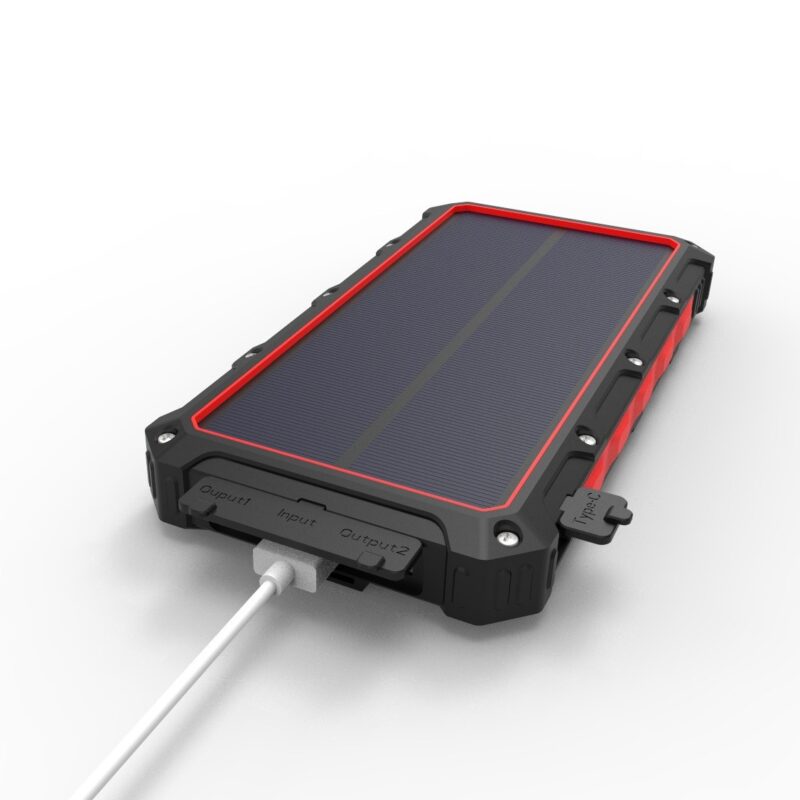
A portable solar battery charger is a power bank with one or more small photovoltaic panels built into its housing. Sunlight hits the panel, the panel converts it into direct current, and a charge controller feeds that current into the internal lithium cells. A USB-C or micro-USB port handles fast charging from a wall outlet, while the solar input works as a slow, steady backup.
People search for this product under many names. Some type “solar phone charger” or “solar cell phone charger,” others look for a “solar powered power bank,” and a few even enter phrases like “bank power solar” into a search bar. They all describe the same category: a battery you can refill from the sun when an outlet isn’t available.
Three components determine how well any solar power bank performs:
The panel — its size, cell type, and rated wattage set the ceiling on how fast sunlight becomes stored energy.
The battery cells — grade-A lithium polymer cells hold capacity longer and survive more charge cycles than cheaper alternatives.
The charge controller and protection circuit — this regulates input, prevents overcharging, and keeps the whole unit safe.
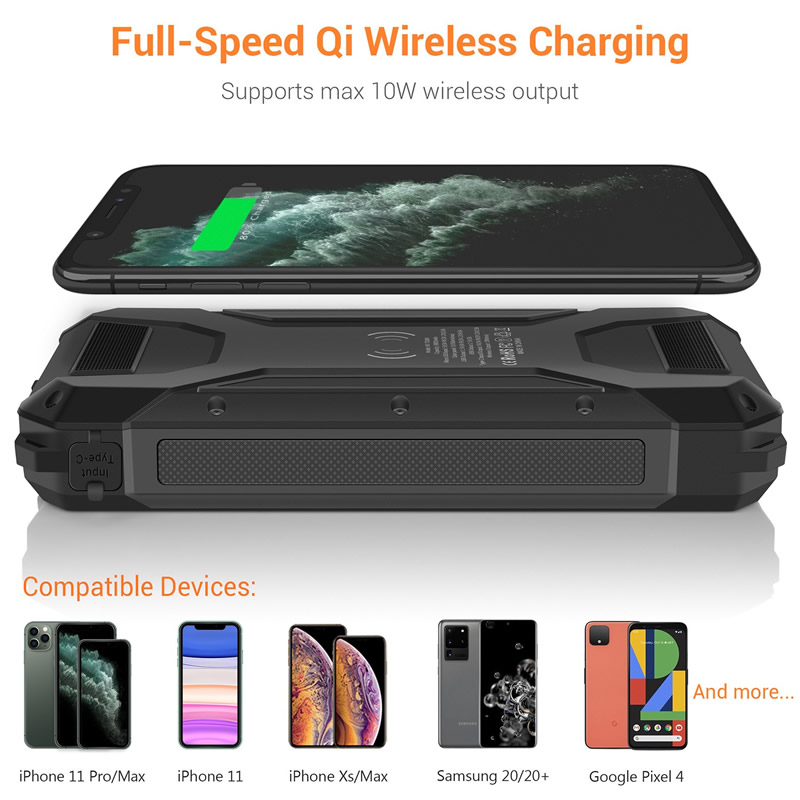
The category has matured a lot in the past decade. Early models carried small panels that were almost decorative. Current designs — like the models in our solar power bank collection — pair meaningful panel area with wireless charging, built-in cables, and waterproof housings.
How Long Does It Take to Charge a Portable Solar Battery Charger?
The honest, numbers-first answer: it depends on the panel, not just the battery. This is where most product listings go wrong, because they advertise capacity in mAh and stay silent about panel wattage.
Here’s the math for a typical 20,000mAh solar power bank:
20,000mAh at 3.7 volts equals 74 watt-hours of stored energy.
Charging losses of roughly 20–30% mean the panel needs to deliver about 90–100Wh to fill it.
A small built-in panel rated at 1.5W produces closer to 1W under real sunlight.
100Wh ÷ 1W = about 100 hours of good sun for a full charge from the built-in panel alone.
That’s why we describe built-in solar as a trickle top-up, not a primary charging method. It keeps a battery alive over several days outdoors, and it can genuinely rescue a dead phone in an emergency, but nobody should expect a two-hour solar refill.
The picture changes completely with external panels. A foldable 20W panel can fill a 20,000mAh unit in 6–8 hours of decent sun, and USB-C fast charging does it in about 3–4 hours from a wall outlet.
What Affects How Fast a Solar Power Bank Charges?
Five variables decide real-world charging speed. When buyers compare models, these are the details worth checking.
Panel Size and Wattage
Panel area is the single biggest factor. A panel twice the size gathers roughly twice the energy in the same light. Cell type matters too: monocrystalline SunPower cells reach around 22% efficiency, while cheaper polycrystalline cells sit closer to 15–17%. The U.S. Department of Energy explains how panel efficiency works if you want the full technical background.
Sunlight Intensity, Angle, and Shade
Midday sun delivers several times the energy of early morning or late afternoon light. A panel lying flat at noon in summer collects far more than the same panel at a shallow angle in winter. Shade is the silent killer: even a small shadow across one cell can cut output dramatically — tests regularly show a 10% shaded panel losing up to half its power.
Temperature
Counter to intuition, hot panels produce less. Solar cells lose efficiency as their temperature rises, so a cool, bright spring day often outperforms a scorching August afternoon. This is good news for markets like the UK and Northern Europe.
Battery Capacity and Cell Quality
A 10,000mAh unit fills roughly twice as fast as a 20,000mAh unit from the same panel. Cell quality affects everything downstream: grade-A cells accept charge efficiently for 500+ cycles, while low-grade cells lose capacity quickly and turn slow solar charging into even slower solar charging.
Charge Controller and Circuit Design
A well-designed controller safely manages the weak, variable current a small panel produces. A poor one wastes much of it. This is invisible on a spec sheet, which is exactly why supplier verification matters — more on that below.
Solar Charging Times by Capacity: Realistic Estimates
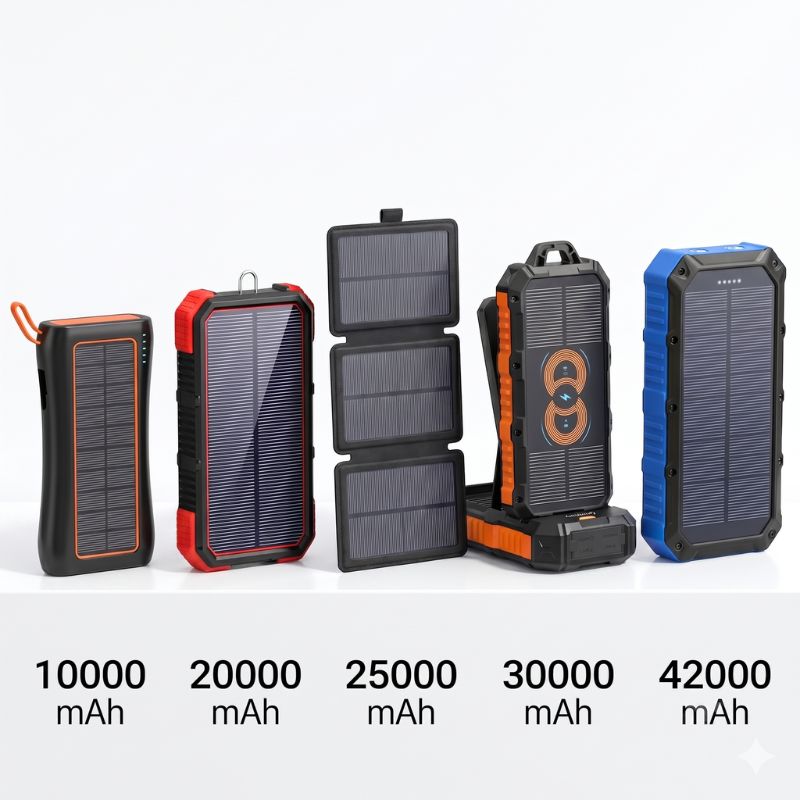
Capacity claims dominate product listings, so here’s how capacity translates into realistic sunlight hours. These figures assume strong, direct midday sun and a standard built-in panel of roughly 2W, with an external 20W foldable panel shown for comparison.
Two honest footnotes belong next to any table like this one. First, rated capacity differs from usable capacity — voltage conversion means a “20,000mAh” unit typically delivers 12,000–13,500mAh to your phone. Second, bigger isn’t automatically better for every customer: a compact 10,000mAh wireless solar power bank travels lighter than a 42,000mAh model with four built-in cables, and the smaller one refills from the sun far sooner.
For mid-range needs, the 25,000mAh dual-USB waterproof solar charger and the 30,000mAh Qi wireless IP65 model both balance capacity against portability — a balance worth testing with your own customers before committing to volume.
How to Charge a Solar Power Bank Faster
You can’t change the weather, but you can get noticeably more from the panel you have. These seven habits consistently speed things up:
Aim the panel directly at the sun. Flat is only correct at solar noon. Tilting the panel to face the sun can raise output by 20–30% through the day.
Move it with the sun. A panel left in one position all day loses hours of good light. Re-angling every couple of hours adds up.
Eliminate every shadow. A hand, a mug, or a tree branch over part of the panel can halve output. Give the panel clear sky.
Keep the panel clean. Dust, fingerprints, and salt spray form a film that blocks light. A quick wipe with a soft cloth restores output.
Let it stay cool. Charging in shade won’t work, but avoiding the hottest afternoon hours and keeping airflow around the unit helps both panel and battery.
Start early, end late. Every extra hour of daylight is free energy. Morning through late afternoon beats one long midday session alone.
Pair solar with USB-C. Many users treat a solar power bank battery charger as a hybrid device: wall charging before a trip, sunlight to keep it topped up on the trail. That combination works far better than either alone.
One more habit worth breaking: charging a device while the bank is in the sun. It works, but it splits the incoming current, so both jobs finish slower.
Do Solar Power Banks Work on Cloudy or Cold Days?
Yes — better than most people expect, though slower.
Modern monocrystalline panels still produce a meaningful share of their peak output under thin clouds — often up to 60% under light overcast. Under thick, dark clouds, output drops far lower, but it rarely falls to zero. Over a full day, those weak currents still add up to a partial charge.
Cold weather is a different story, and a better one. Panels perform more efficiently in cooler temperatures, so a crisp, bright autumn or winter day can outperform a heat-soaked summer one. The real winter penalty is daylight: fewer sun hours simply mean less total charging time, and low sun angles reduce what each hour delivers.
For markets in northern climates — the UK and Northern Europe are good examples — the winning product story is honesty plus hybrid charging: USB-C as the weekday method, solar as the weekend and emergency method. Retailers who set that expectation see fewer returns than those who imply all-day sun equals a full battery.
How to Choose a Solar Power Bank Your Customers Will Love
For product and procurement teams, choosing a model is about matching honest capability to a target customer. Three product families cover most market segments:
A few selection checkpoints that separate models that sell from models that come back:
Real panel area. Ask for panel dimensions in centimeters, not just “solar charging supported.” More area means fewer disappointed customers.
Rated vs. usable capacity. Confirm the mAh rating refers to the cell, and expect 60–70% of it to reach the phone.
Protection and durability. IPX4 handles splashes; IP65 handles rain jets. Match the rating to the use case — see our IP65-rated 30,000mAh wireless model versus the splash-resistant HDL529 with built-in cables.
Built-in cables. Models like the HDL-531 with three attached cables remove the “forgot my cable” failure mode entirely — a strong selling point for emergency and roadside channels.
Certifications and shipping rules. CE, RoHS, and FCC cover market access. UN38.3 certification matters for air freight of lithium batteries, which IATA’s lithium battery rules govern. Airlines also cap carry-on batteries at 100Wh, so 20,000mAh (74Wh) flies while 42,000mAh generally doesn’t — useful positioning for travel-focused customers.
For camping-specific assortments, the HDL519 camping gear solar charger and the foldable 20,000mAh model with LED lights both package solar capability with lighting, which converts well in outdoor retail.
What Should Buyers Ask a Supplier Before Ordering Solar Chargers?
Spec sheets tell you what a supplier wants you to know. These questions surface what they might not volunteer:
What is the actual panel wattage and area? If the answer is vague, the panel is probably small.
Are the cells grade-A, and what is the rated cycle life? Anything below 500 cycles deserves scrutiny.
Can you share real test data for solar charging time? Trust a supplier who quotes ranges under stated conditions, not one promising miracle speed.
What protection circuits are included? Overcharge, over-discharge, short-circuit, and temperature protection should all be present.
Are IP rating claims backed by test reports? Ask for the documentation, not just the label.
What is the sample policy? Ordering samples before committing volume is standard practice, and a factory that resists it is telling you something.
What are the customization options and lead times? Logo printing, packaging design, color, and capacity variants usually carry minimum quantities — get the numbers in writing.
The pattern behind all seven questions is the same: a supplier who answers plainly, with numbers and documents, is nearly always the one whose products behave as advertised.
From Our Factory Floor to Your Warehouse
We’re Shenzhen Hedeli Technology Co., Ltd. — most customers know us as Hedelee — and we’ve spent about ten years building mobile accessories and consumer electronics: power banks, TWS earbuds, Bluetooth speakers, USB chargers and cables, car chargers, and car phone holders, alongside the solar range this guide focuses on.
Our headquarters sits in Shenzhen, with an office and showroom in Guangzhou where visiting customers can handle samples before committing. Production happens at our own factory in Dongguan, where more than 100 employees build up to 50,000 units per month — capacity that keeps importer, distributor, and wholesale orders moving on schedule.
Because we manufacture what we sell, a conversation with us skips the trading-company layer. You talk directly with the people who source the cells, mount the panels, and run the tests. That means accurate answers on real panel wattage, honest guidance on which models fit your market, and a single point of accountability from sample to shipping.
If you’re planning a solar charger assortment — or want a model adapted to your brand, packaging, or target price — send us your specifications and expected volumes. Our team will respond with matching models, current pricing, and samples you can test in your own sunlight before you commit. When you’re ready, we’ll be glad to show you around the Guangzhou showroom or walk you through production for your order.
Frequently Asked Questions
1. What is your minimum order quantity for solar chargers?
Minimum order quantities vary by model and customization level, and standard models generally carry lower minimums than fully customized ones. Reach out with the models you’re considering, and we’ll confirm exact numbers along with tiered pricing.
2. Can we order solar power banks with custom branding?
Yes. We offer logo printing, custom colors, tailored packaging, and capacity or cable configurations to match your brand. Contact us to request samples so your team can evaluate quality before placing a production order.
3. Which certifications do your solar chargers include?
Our solar chargers are built to carry CE, RoHS, and FCC marks, with UN38.3 documentation available for lithium battery shipping. Ask our team for the test reports relevant to your destination market.
4. How long do samples and bulk production take?
Samples typically ship within a few days of confirmation. Bulk orders usually complete in two to four weeks depending on quantity and customization, backed by our monthly capacity of 50,000 units.
5. Can a solar phone charger power devices while charging?
Yes, most of our models support pass-through charging, though charging speed for the battery slows while it shares current with your device. It works well in a pinch but charges faster when used one job at a time.