

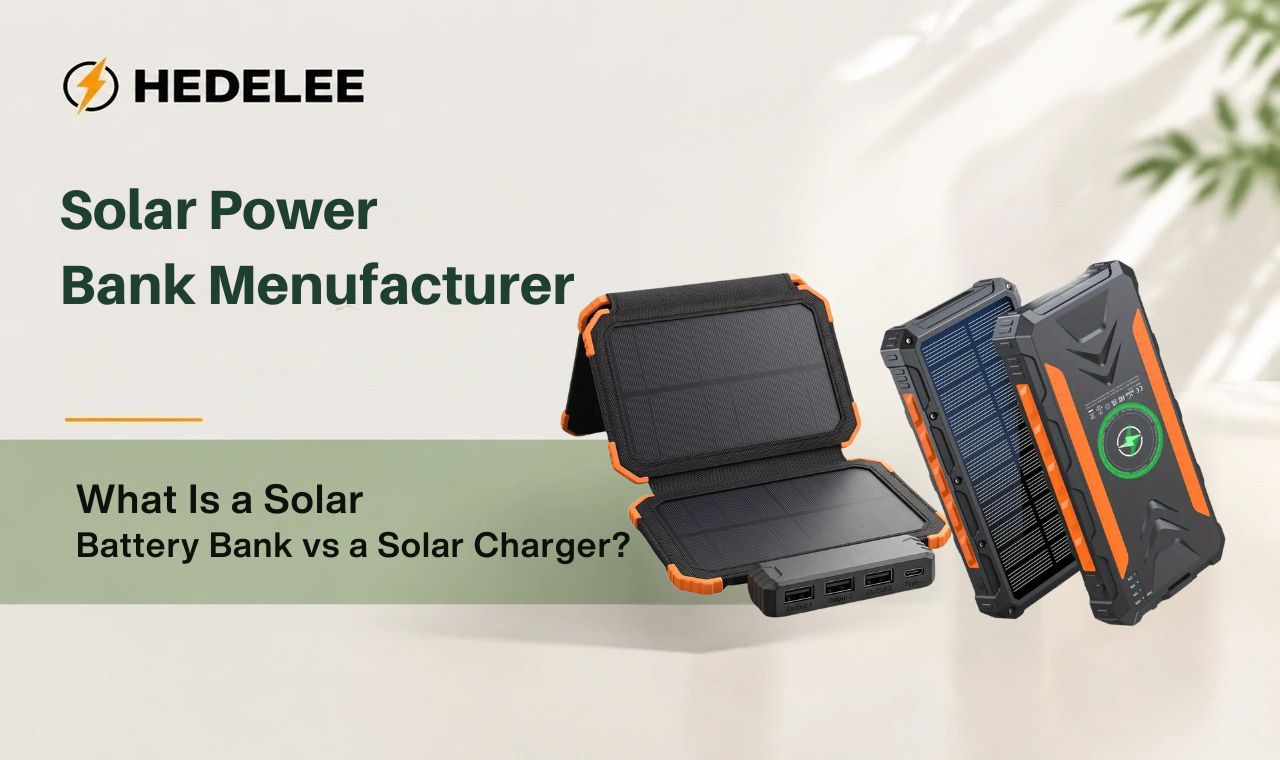
A buyer orders 2,000 “solar chargers” for a camping kit, then the first field report lands: phones die after sunset. The units had panels, but no stored energy. That mix-up is common, and it is expensive.
A solar battery bank stores energy in an internal pack and can top itself up from sunlight. A panel-only solar charger feeds a device only while the sun hits the cells. If you source for outdoor programs, emergency kits, or wholesale assortments, that storage line is the first spec you should lock.
Shenzhen Hedeli Technology Co., Ltd. (Hedelee) has spent about 10 years making mobile accessories and consumer electronics. Our factory in Dongguan builds portable charging products for importers, distributors, and wholesalers, with a monthly capacity of about 50,000 units. The notes below are written for people who write RFQs, compare samples, and own the after-sales cost when a SKU is named poorly.
What Is a Solar Charger and How Does It Work?
A solar charger, in the strict sense, is a photovoltaic panel with a USB (or similar) output. Sunlight hits the cells. The circuit regulates voltage. Power moves straight into a phone, tablet, GPS, or another small device. There is no meaningful energy store inside the unit.
Wikipedia’s overview of a solar charger draws the same line many labs use: some products charge a phone directly from the panel; others charge an internal battery first, then the phone.
Think of the energy path like this:
Sunlight → panel → regulator → device
If a cloud covers the panel, output drops. If the user walks into shade, charging may stop. After sunset, a panel-only unit does almost nothing.
What a solar phone charger can and cannot do
A solar phone charger is useful when three conditions are true at the same time: the user is outdoors, the sky is reasonably clear, and the device can stay connected while the panel faces the sun. Day hikes, festival stalls, and short field jobs often fit that pattern.
It cannot do these jobs well:
Charge after dark
Hold a reserve for an emergency kit
Keep output stable when light keeps changing
Replace a wall charger for a full overnight fill
A solar cell phone charger with no battery also asks more of the user. The panel must stay aimed. The cable must stay connected. Dust, backpack straps, and moving shade all cut the current.
For a solar mobile phone charger sold into retail, that behavior needs honest packaging. If the box implies “charge anytime,” returns rise. If the box says “daytime top-up from sunlight,” the product matches the promise.
Typical panel-only traits buyers should record
Weight is low because there is no cell pack
Cost per unit is often lower than a storage model
Output varies with irradiance, angle, and temperature
Many units still need a voltage regulator so bright sun does not push unsafe voltage into a phone
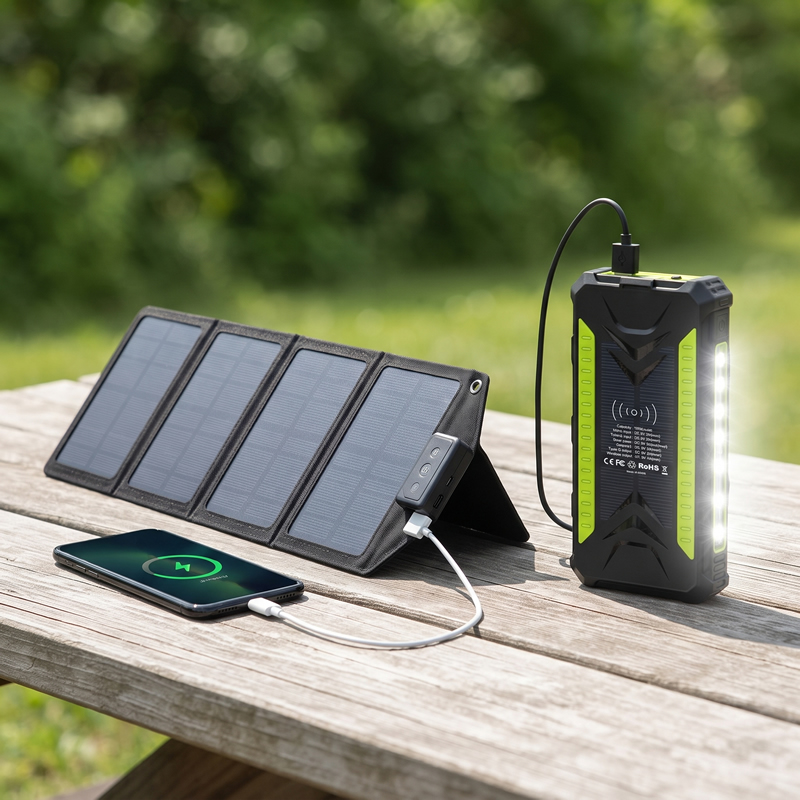
Foldable panels raise wattage, but they still do not store energy
A foldable outdoor solar charger can be a strong companion SKU. It is not the same product as a pack with cells inside. Keep those two lines in different rows of your catalog, even if the factory can ship both.
What Is a Solar Battery Bank?
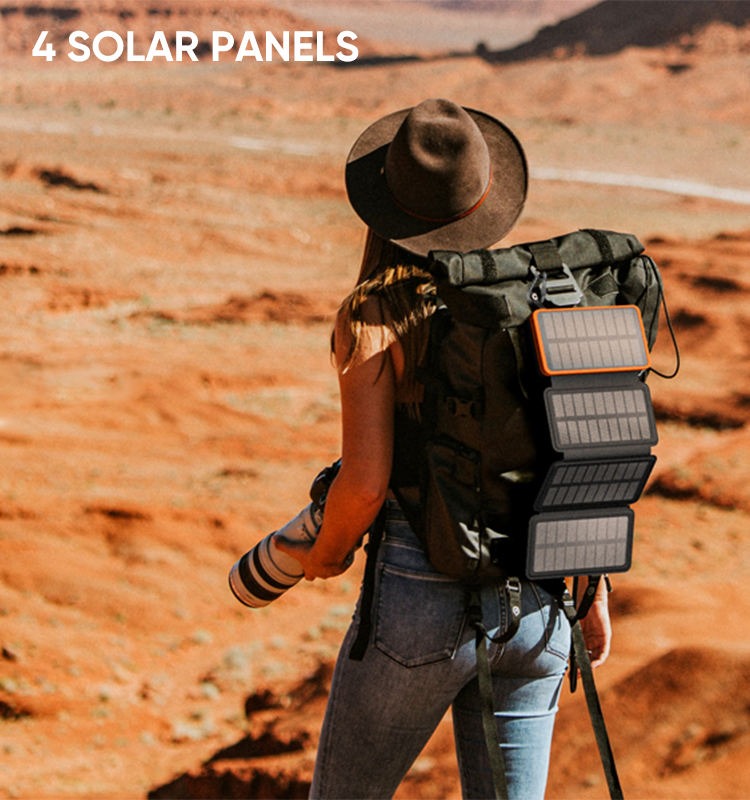
A solar battery bank is a rechargeable pack with an internal lithium cell group plus a solar panel (built-in or attachable). The panel can add charge to the cells. The cells then feed USB, USB-C, or wireless output when the user needs power, including at night and indoors.
Energy path:
Sunlight → panel → charge circuit → internal battery → device later
You will also see the same product called a solar power bank, a solar powered power bank, or a solar power bank battery charger. Some marketplace listings even tag the SKU as bank power solar. The hardware idea is the same: generation plus storage in one portable housing.
What sits inside a typical unit
Lithium-polymer or lithium-ion cells (capacity often printed in mAh)
Protection circuit: over-charge, over-discharge, short, and often temperature cut-off
USB-A and/or USB-C outputs; some models add Qi wireless
Micro-USB and/or USB-C inputs for wall or car charging
One or more PV panels, from a small face panel to several fold-out wings
LED fuel gauge; many outdoor models add a flashlight or SOS mode
Housing with some water and dust rating (IPX4, IP65, and similar)
Hedeli’s solar power bank range follows this architecture across 10,000mAh to 42,000mAh class models. The panel is a support charger. The cells are the product the user actually lives on.
Why storage changes the buying decision
Storage turns solar from a “now only” tool into a reserve. A ranger can fill the pack from a wall outlet on Monday, use it on a night shift, and let the panel trickle during the day. A relief kit can sit in a cupboard and still deliver USB power during an outage, then recover some charge if staff can place it near a window.
That is why procurement teams should not treat “solar charger” and “solar power bank” as synonyms on a purchase order. One ships a panel. The other ships a battery with a panel.
A portable solar battery pack also carries transport rules that a panel-only charger may not. Lithium cells need UN38.3 test evidence for air freight, watt-hour labels, and packing that matches IATA battery guidance. We will come back to that in the compliance section.
How a Solar Battery Bank Differs From a Solar Charger
The hardware difference is storage. Almost every other difference follows from that one fact.
Five spec mix-ups that create returns
Name on the PO does not match the BOM. “Solar charger” is printed, but the sales sample had a 20,000mAh pack. Or the reverse. Freeze the words: panel-only vs storage model.
Printed mAh is treated as solar speed. A 20,000mAh label describes the cells, not how fast the panel fills them.
Wireless is assumed on every SKU. Qi sits on selected housings, not on every dual-USB shell.
IP words are copied from a sibling model. IPX4 splash resistance is not IP65 jet resistance. Ask for the test method.
Airline limits are ignored. Capacity in Wh, not only mAh, decides what travelers can carry.
How fast does solar actually fill the pack?
Use round numbers so a product manager can sanity-check a supplier claim.
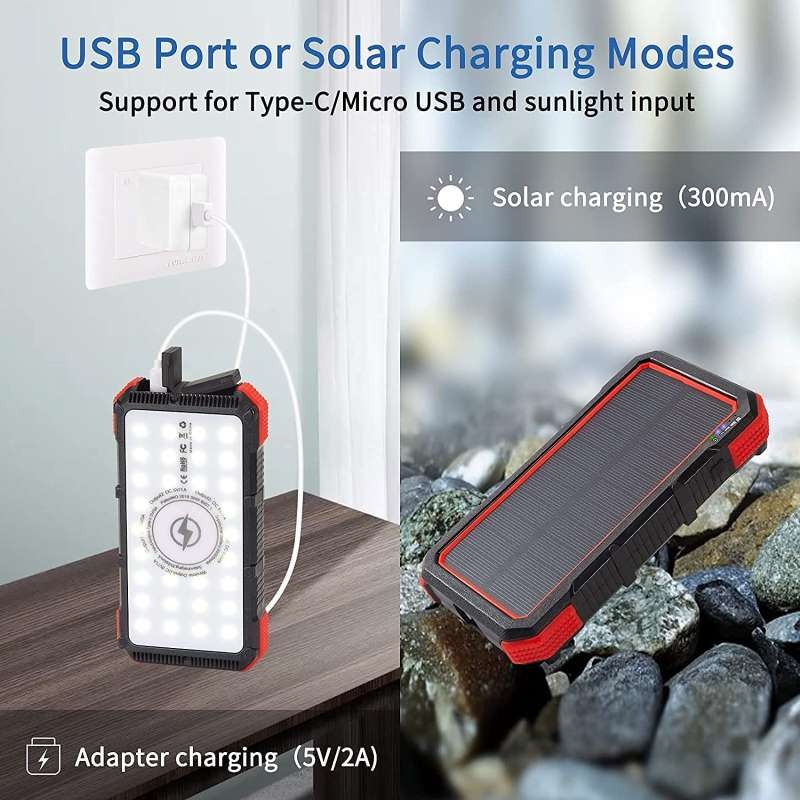
A 20,000mAh pack at 3.7V holds about 74Wh. A small face panel that delivers 5V × 1A under strong sun is about 5W. Even in generous light, a full solar fill can take many hours. Four larger panels help. They still will not match a 5V/2A or USB-C wall adapter.
So a fair way to brief sales teams is:
Wall or car input: primary fill
Solar input: daytime recovery and emergency top-up
Device output: comes from the stored pack, on the user’s schedule
If a factory promises “full solar charge in two hours” on a 20,000–30,000mAh class unit with a palm-size panel, ask for the test setup: irradiance, temperature, angle, and measured watts.
When Should You Choose Each Product Type?
Choose with the use case, not with the prettier panel photo.
Choose a panel-only solar charger when
The brief is ultra-light daytime charging
Users can keep the panel in open sun
You want a lower cell-risk SKU for freight
The assortment already includes a regular power bank
Choose a solar powered power bank when
Users need power at night or in tents
The kit must work after a storm day
You want one SKU that accepts wall, car, and sun
Merchandising needs a flashlight, SOS LED, or wireless pad
A hybrid buy is common: foldable panels for camp, storage packs for pockets. Hedeli can support both, including a foldable 20,000mAh outdoor solar charger and compact packs such as the 10,000mAh outdoor wireless model.
How to Specify Capacity, Panels, and Ports
This is the section that belongs in your RFQ template. Write numbers, not adjectives.
1. Lock capacity in mAh and Wh
mAh is the retail habit. Wh is the shipping and safety habit.
Approximate Wh = (mAh × 3.7) / 1000
10,000mAh ≈ 37Wh
20,000mAh ≈ 74Wh
25,000mAh ≈ 92.5Wh
30,000mAh ≈ 111Wh
42,000mAh ≈ 155Wh
Many airlines treat spare lithium packs above 100Wh with extra limits, and packs above 160Wh are generally not carried as passenger spare batteries. Confirm current IATA lithium battery rules with your forwarder before you print travel claims on the box.
Ask the factory for:
Cell brand and model
Series/parallel layout
Rated Wh on the silkscreen
Protection IC list
A 20,000mAh wireless waterproof pack with flashlight (HDL-218) sits in a widely used travel band. A 42,000mAh HDL-628 is a base-camp style reserve, not a pocket travel SKU.
2. Treat solar watts as a separate line
Do not let “four solar panels” stand alone. Request:
Open-circuit voltage
Peak current in a defined sun test
Panel type (mono, poly, amorphous)
Whether the panel charges the pack, the phone, or both
The 25000mAh dual-USB solar charger lists a higher solar input than a tiny face panel. That is the kind of claim to verify on a sample, outdoors, with a USB meter.
3. Map ports to the devices in the program
Write the port map in the RFQ:
USB-A output current (e.g. 5V/2.1A)
USB-C in/out, and whether it is charge-only or PD
Wireless pad wattage, if any
Built-in cables (Lightning / Type-C / Micro / USB-A)
Pass-through: can it charge a phone while the pack is on a wall adapter?
Built-in leads cut accessory SKUs. Models such as HDL-529 with four cables and dual LED and HDL-531 with three cables are aimed at outdoor users who lose loose cables.
A wireless solar power bank helps users who want to drop a phone on the pad in a tent. Confirm Qi version and foreign-object detection on the sample, not only on the artwork.
4. Set the housing and lighting brief
Outdoor buyers usually ask for:
Hook or carabiner point
Compass (optional; test it away from speakers)
LED flashlight and SOS
IP rating that matches rain, not only a wet-wipe demo
Button feel with gloves
Compare splash-focused packs such as HDL519X dual-USB waterproof with higher sealing targets such as the HDL528 30,000mAh IP65 Qi model. IP65 and IPX4 are not interchangeable.
5. Agree the charge story you will print
A clean retail line:
“Charge from a wall adapter before the trip. Use the solar panel to add power in daylight. Charge phones from the stored battery whenever you need.”
That sentence prevents the most common solar disappointment: expecting panel current to behave like a home charger.
Image for this section
Image title: RFQ spec board for solar power banks
Image description: Close-up of ports, mAh label, IP icon, and a USB power meter on a white inspection bench.
SEO-friendly file name: solar-power-bank-battery-charger-spec-check.jpg
Alt text: Solar power bank battery charger ports, capacity label, and USB meter on a QC bench
Aspect ratio: 1:1
AI image generation prompt: Square 1:1, quality-control bench in a factory, solar power bank with dual USB and Type-C ports, technician using a USB power meter, capacity and IP icons visible on housing, photorealistic, no readable brand name, no text overlay.
What Compliance and Labeling Should Buyers Request?
Lithium packs are electrical products and dangerous goods. The paperwork is part of the product.
Cell and pack safety
Ask for current reports, not photos of old certificates:
UN38.3 for transport of the cell/pack
IEC 62133-2 (or the market equivalent) for rechargeable cell safety
IEC 62368-1 for the finished USB device in many retail programs
EMC / RED if you add wireless charging or Bluetooth in some regions
RoHS / REACH declarations for EU-bound goods
UN38.3 is a test series for altitude, heat cycle, vibration, shock, short, impact, overcharge, and forced discharge. It is not a marketing badge. Match the report to the exact cell model in your mass-production BOM.powerbanktests+1
What to put on the housing and carton
Rated capacity in mAh and Wh
Input and output ratings
Cell chemistry
Manufacturer name and origin
Warning set for lithium handling
Batch / date code for traceability
If you sell into travel channels, print the Wh figure at a size people can read at an airport tray.
Factory questions that catch weak quotes
Are the UN38.3 cells the same brand as the sample?
Who owns the PCB layout, Hedeli or a trading company?
What is the aging / discharge test before packing?
What is the drop-test height for the retail carton?
Can you share a solar-input curve, not only a peak mA number?
Hedeli’s head office is in Shenzhen, with an office and showroom in Guangzhou, so buyers who visit China can review samples against these documents instead of trusting a listing photo.
Which Hedeli Models Fit Common Outdoor Programs?
Use models as starting points, then freeze color, logo, and port map on the golden sample.
A practical loading example
A field team issues one phone per person, plus a shared GPS and a small LED lantern.
One 20,000mAh pack can often cover a phone for several cycles, depending on the phone battery and screen time
Wireless is a convenience, not a faster charge
Flashlight mode is a real feature in blackout kits; test runtime so artwork does not over-claim
If two devices must charge at once, dual USB is the requirement, not a nice extra
For rain-heavy channels, prefer a documented IP rating and sealed buttons. For cable-loss complaints, prefer built-in leads even if the housing is thicker.
Custom work usually includes logo print, color, gift-box design, and sometimes cable mix. Share the target retail price band early so the cell grade and panel size stay honest.
Request Factory Specs, Samples, and Quotes
If you are comparing factories, look past the panel photo. Ask who owns the mold, who buys the cells, and who signs the test reports. Shenzhen Hedeli Technology Co., Ltd. is the original manufacturer for these Hedelee charging products. Our Dongguan factory supplies importers, distributors, and wholesalers on a monthly run of about 50,000 units, with support from Shenzhen headquarters and a Guangzhou showroom.
Send the use case, target capacity, port list, IP need, logo files, and destination market. You will be speaking with the source, which shortens sample loops and keeps the mass-production BOM aligned with the unit you approved. For current storage models, start with the solar power bank category and mark the SKUs that match your program.
Frequently Asked Questions
1. What order quantity do you accept?
MOQ depends on color, logo, and whether the SKU is a running model or a new mold. Running solar power bank items can often start lower than a full custom housing. Share your first-run quantity and we will confirm against current cell stock. Reach out for detailed specifications.
2. Can we customize logo and packaging?
Yes, logo print, color, manual, and gift box are common requests. Port layout and panel count can also be discussed when volume supports a tooling change. Send your artwork and target retail date so engineering can check print area and drop-test cartons.
3. How long do sample units take?
Stock-color samples are usually faster than custom-color or new-logo samples. Custom finishes need extra print-proof time. Contact us to request samples of the capacity class you plan to list.
4. Do you provide UN38.3 test reports?
Reports can be prepared for the cell/pack used in mass production, together with the other documents your market requires. Ask for the file that matches the exact cell model, not a generic sister SKU. Reach out for detailed specifications before you book freight.
5. Can solar input replace wall charging?
Solar input is a top-up path, not a full substitute for a wall adapter on most pocket-size panels. Fill the pack from USB before a trip, then use sun to recover some charge. That is the usage pattern we recommend you print for end users.