

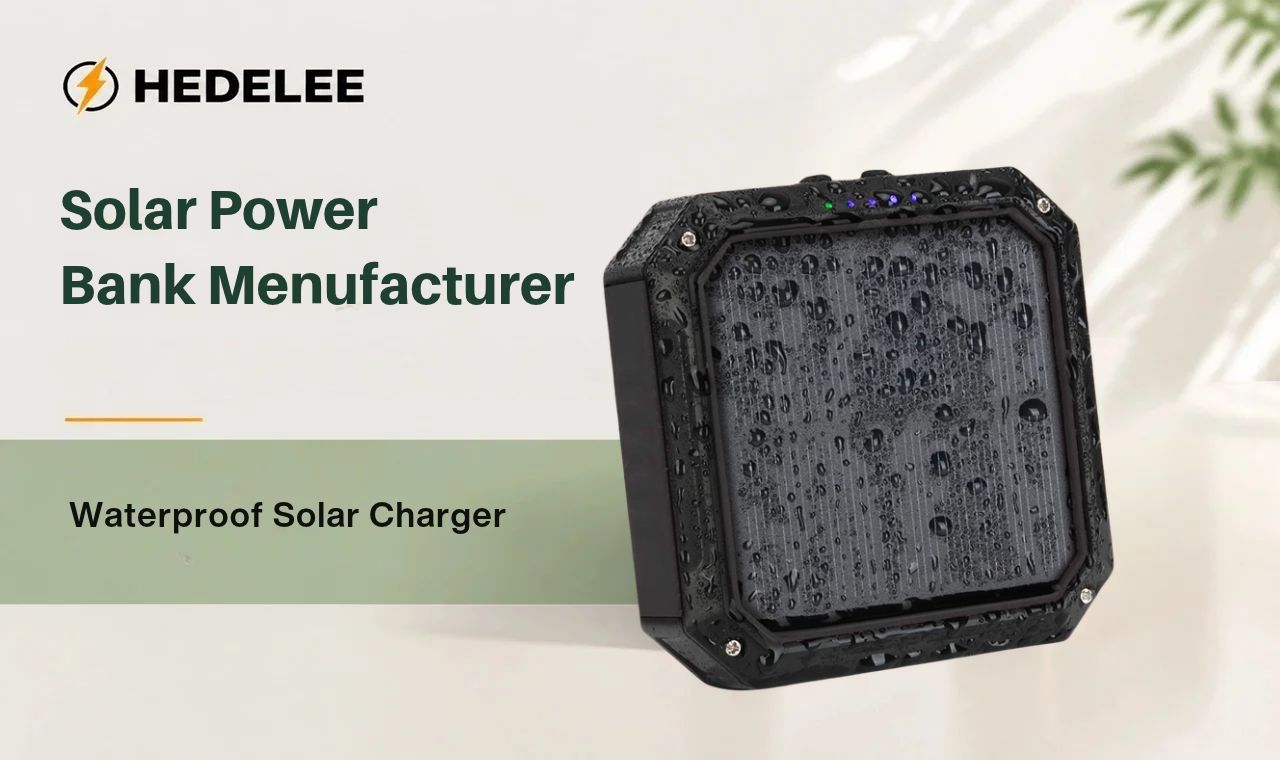
A solar power bank spends its life in exactly the conditions that destroy electronics: rain, river crossings, boat spray, damp backpacks, and mud. So when a customer asks whether a product is safe outdoors, the answer can’t be a shrug. If a unit is sold as a waterproof solar charger but only survives a light drizzle, returns pile up, warranty claims follow, and your brand takes the hit.
Here’s the short version: not every solar power bank is waterproof. Many are only water-resistant, and the difference lives in a small code printed on the spec sheet — the IP rating. Once you know how to read that code, and how to verify it with a supplier, you can stock outdoor power products with confidence.
This guide explains what “waterproof” legally and practically means, how IP ratings work, how to choose models for outdoor retail, and what a dependable manufacturing partner should provide.
What Makes a Waterproof Solar Charger Actually Waterproof?
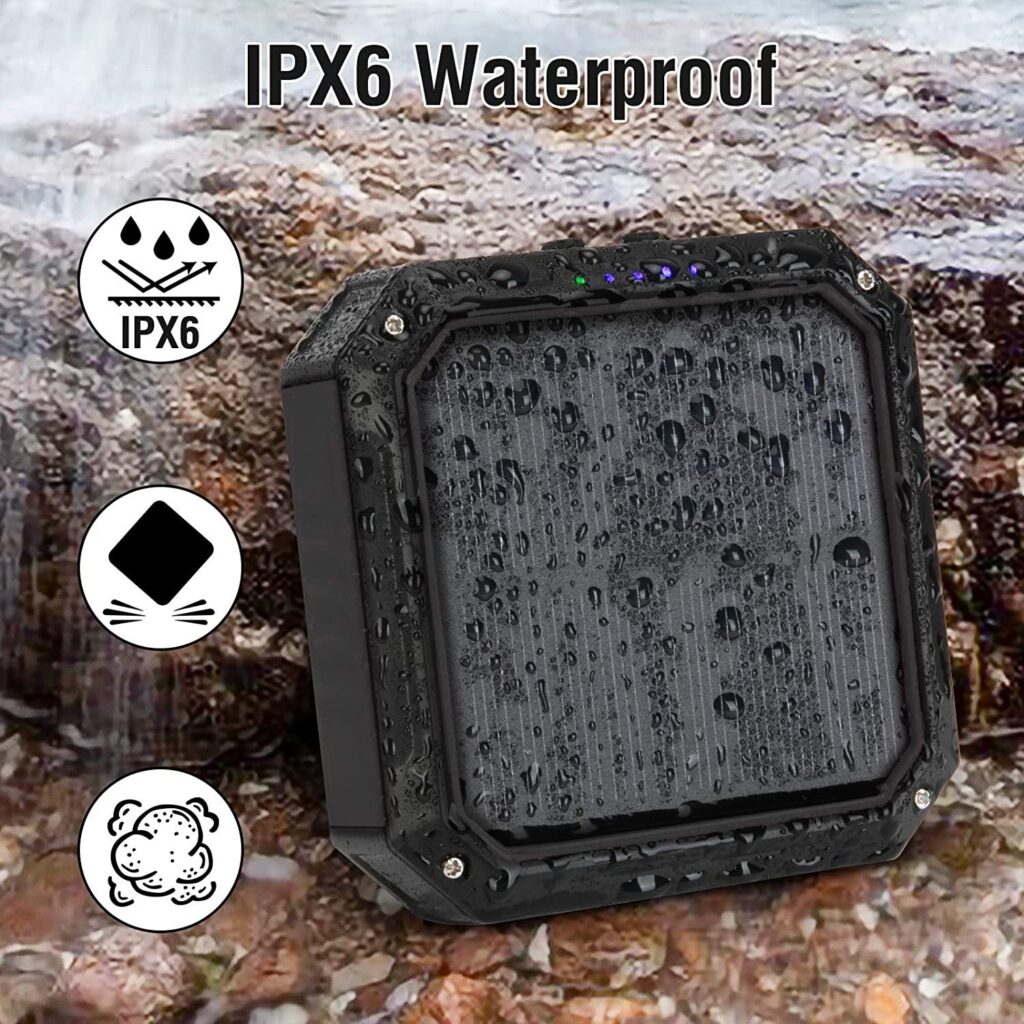
“Waterproof” is a technical claim, not a mood. A product earns that label through its Ingress Protection (IP) rating, defined by the IEC 60529 standard published by the International Electrotechnical Commission. The rating has two digits:
The first digit rates protection against solid objects like dust and sand (0–6).
The second digit rates protection against water (0–9).
For outdoor electronics, the two digits you’ll see most often are 5, 6, and 7 on the water scale:
A genuine waterproof solar charger normally carries IP67 or IP68. Models rated IPX4 through IP66 are better described as weather-resistant or water-resistant — useful, but not submersion-proof. You can read the standard’s details directly from the IEC 60529 standard documentation.
One point worth pressing with any supplier: ask whether the rating covers the whole unit including ports, or only the sealed body. Rubber-sealed USB ports, gasketed seams, and covered buttons are what keep water out of the circuitry where damage actually happens.
Waterproof vs. Water-Resistant: What the Labels Really Mean
These two words get used interchangeably in listings, and that’s where most buying mistakes happen. Here’s the practical split:
For retail and wholesale planning, the two categories serve different customers. A commuter who charges a phone on the train needs splash protection at most. Someone backpacking for a week — the customer who reads spec sheets before buying — is shopping specifically for a solar phone charger that survives a downpour.
Stocking both tiers makes sense, but only when each product is labeled honestly. If a unit is IP65, market it as weather-resistant. Buyers forgive honest ratings; they don’t forgive a soaked, dead device and an inflated claim.
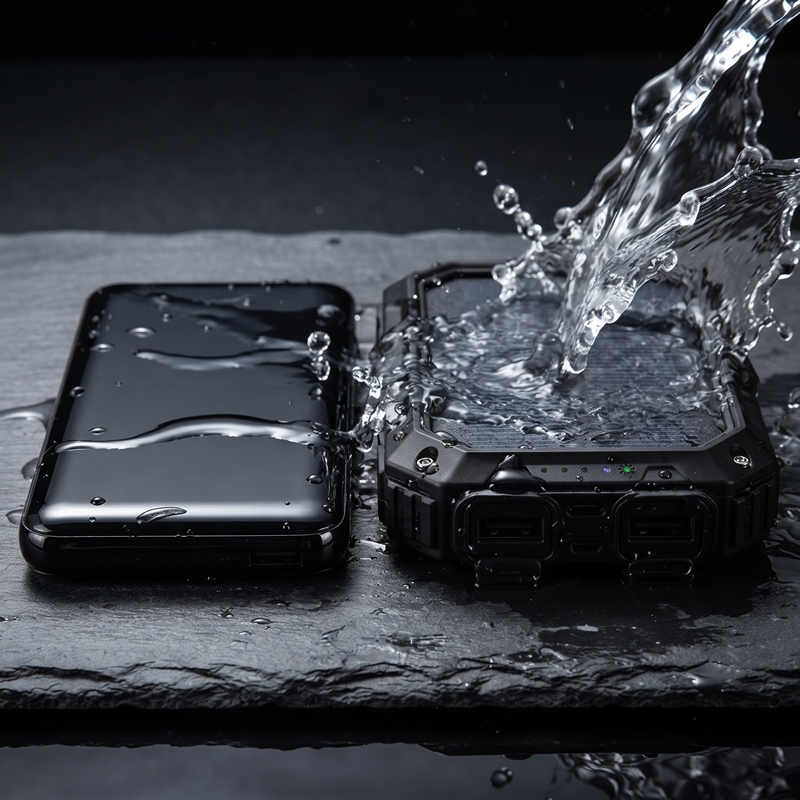
Why IP Ratings Matter When You Order Solar Power Banks
For buyers and procurement teams, the IP rating is more than a spec-sheet line. It’s a shorthand for how a product will perform after it leaves your warehouse — and how many support tickets it will generate.
Three practical reasons to check it closely:
Returns and reputation. Water damage is one of the top causes of power bank complaints. A model that survives its rated conditions produces far fewer warranty claims than one that can’t.
Compliance and shipping. Lithium-battery products face transport rules — the UN 38.3 test requirements cover safe shipment of lithium cells, and you can review the UNECE transport guidance for lithium batteries for the full picture. Reliable suppliers supply test reports without being chased.
Listing accuracy. Marketplaces increasingly check whether claims like “waterproof” are backed by documentation. A mismatch can get a listing pulled.
A quick verification habit pays off: request the IP test report for the exact model you’re buying, not a generic certificate for a product family. Ask which lab issued it, and whether the ports were covered during testing. A solar power bank battery charger tested with open ports and one tested with sealed ports are different products wearing the same rating.
How to Choose a Waterproof Solar Charger for Your Product Line
Beyond the rating itself, a handful of specs decide whether an outdoor solar product sells well and stays sold:
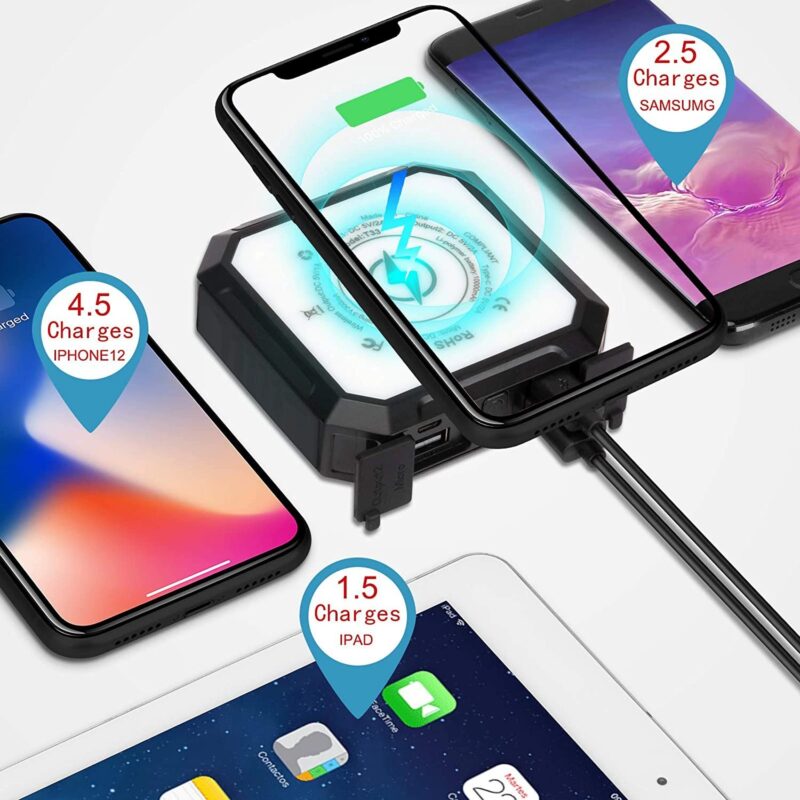
Battery capacity. 10,000mAh covers roughly two full phone charges and keeps the unit light. 20,000mAh suits multi-day trips and buyers who want redundancy.
Charging speed. Fast-charge USB output (18W or higher, PD/QC support) is now an expectation, not an upgrade.
Wireless charging. A Qi pad on the back adds convenience for the newest phones and differentiates a listing.
Panel wattage. Built-in solar panels charge slowly by nature; treat solar input as a backup feature, not the main charging method.
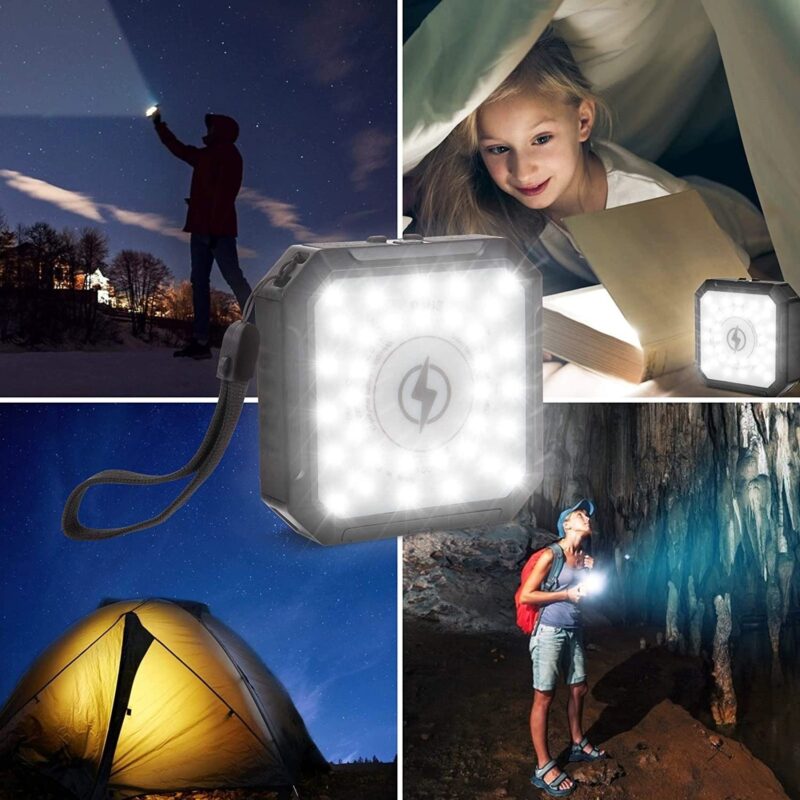
Durability details. Sealed ports, reinforced corners, and an attached LED light or carabiner round out an outdoor-ready design.
The category is also searched in surprisingly varied ways. End customers type everything from “solar powered power bank” and “solar mobile phone charger” to scrambled variants like “bank power solar” before landing on the product they want. That variance is a reminder to write listings around how people actually search — a solar cell phone charger, a solar phone charger, an outdoor power bank — rather than one fixed phrase.
For a concrete comparison, here’s how two popular models stack up:
The waterproof 20000mAh solar power bank fits buyers who need maximum capacity in wet conditions, while the 10000mAh outdoor solar power bank with wireless charging targets the lighter, convenience-focused segment. You can browse the full range on the solar power bank category page.
What a Reliable Supplier Should Provide
Specifications only matter if the factory behind them is consistent. When you evaluate who to order from, look at capacity, history, and transparency together.
Shenzhen Hedeli Technology Co., Ltd. has spent about ten years in mobile accessories and consumer electronics, with a product range spanning power banks, TWS earbuds, Bluetooth speakers, USB chargers, USB cables, car chargers, and car phone holders. The company runs with more than 100 employees, headquarters in Shenzhen, and an office plus showroom in Guangzhou. Production happens at a factory in Dongguan with a monthly output of 50,000 units — enough volume to keep importer, distributor, and wholesale orders on schedule.
What that means for you as a buyer:
Direct manufacturing access. Working with the source factory removes markup layers and shortens the feedback loop on spec changes.
Consistent output. A 50,000-unit monthly capacity signals production lines that won’t stall on mid-size orders.
Showroom verification. A Guangzhou showroom you can visit, or request live video walkthroughs of, builds trust faster than any brochure.
Bundled categories. Sourcing power banks alongside cables, chargers, and audio products from one factory reduces vendor management work.
Ask any candidate supplier the same four questions: Can you share IP and battery test reports for this exact model? What’s your sample policy? What are the MOQ and lead time at my volumes? Can you handle custom branding and packaging? Clear, fast answers to those questions tell you most of what you need to know.
How to Care for a Solar Powered Power Bank Outdoors
Even a sealed IP67 unit lasts longer with basic care — and care instructions make excellent FAQ and packaging content that reduces returns. Pass these habits along to end customers:
Keep port covers closed whenever the unit isn’t charging.
Dry the device fully before plugging in a cable, so moisture never reaches the connector pins.
Use a dry bag or pouch around lakes, rivers, and beaches, even with a waterproof model.
Don’t leave the unit exposed in a heavy downpour — solar panels charge poorly when wet anyway.
Rinse or wipe sand and dirt off the port seals regularly so grit doesn’t break the seal.
A solar powered power bank that gets this level of care will typically outlast its battery’s natural lifespan. These tips also answer a question every outdoor buyer eventually asks, which makes them worth printing on a small card inside the box.
Do Solar Panels Work in the Rain?
Yes, but only slightly — and that honest answer builds more trust than hype ever could. Solar panels collect a small amount of energy from ambient daylight even under cloud cover, but output drops hard when light is limited or the panel surface is wet. Expect trickle-level charging on overcast days, not a full recharge.
That’s why well-designed products treat solar input as a backup. The practical pattern outdoors: charge fully from mains before a trip, then use the panel to top up during the day. A waterproof solar charger with a 20,000mAh cell charged at home can run a phone for days in the field, with solar input stretching that runway even further.
For your listings, present solar charging honestly — “emergency top-up power,” “off-grid backup” — and the product’s real strength, stored capacity plus weather protection, does the selling.
Get Specs, Samples, and Pricing From the Source
Choosing the right waterproof solar charger for your catalog comes down to three verifiable things: an honest IP rating, specs that match how your customers actually use the product, and a factory that can prove both. Hedeli is the original manufacturer of these products — which means when you send an inquiry, you’re talking to the people who build the units, not a reseller passing messages along.
Request samples of the 10,000mAh and 20,000mAh models, test the seals yourself, and run them through a rainy weekend. Then ask for a quote at your target volume. You’ll get spec sheets, test reports, customization options, and lead times directly from the source — with a factory in Dongguan shipping up to 50,000 units a month behind every answer.
Frequently Asked Questions
1. What Is the Minimum Order Quantity for Waterproof Solar Power Banks?
Minimum order quantities depend on the model and level of customization. Standard models typically carry lower minimums than custom-branded versions. Reach out with your target volume and we’ll confirm the exact MOQ and unit pricing.
2. Can You Add Our Logo and Custom Packaging?
Yes. We support logo printing, custom colorways, and retail-ready packaging for wholesale orders. Contact us to request samples and packaging mockups before committing to a full run.
3. Which Compliance Tests Do Your Solar Power Banks Pass?
Our products are built to meet IP rating standards for water and dust protection, along with lithium battery transport and safety testing such as UN 38.3, CE, and RoHS depending on the destination market. Ask us for the test reports for the specific model you’re evaluating.
4. What Is the Typical Lead Time for Wholesale Orders?
Standard production runs usually complete within two to four weeks after order confirmation, backed by our 50,000-unit monthly capacity. Custom branding may add time; we’ll give you a confirmed schedule with your quote.
5. Can We Order Samples Before Placing a Bulk Order?
Absolutely. Samples are available so your team can test charging speed, sealing, and build quality firsthand. Contact us to request samples and detailed specification sheets for the models you’re considering.