

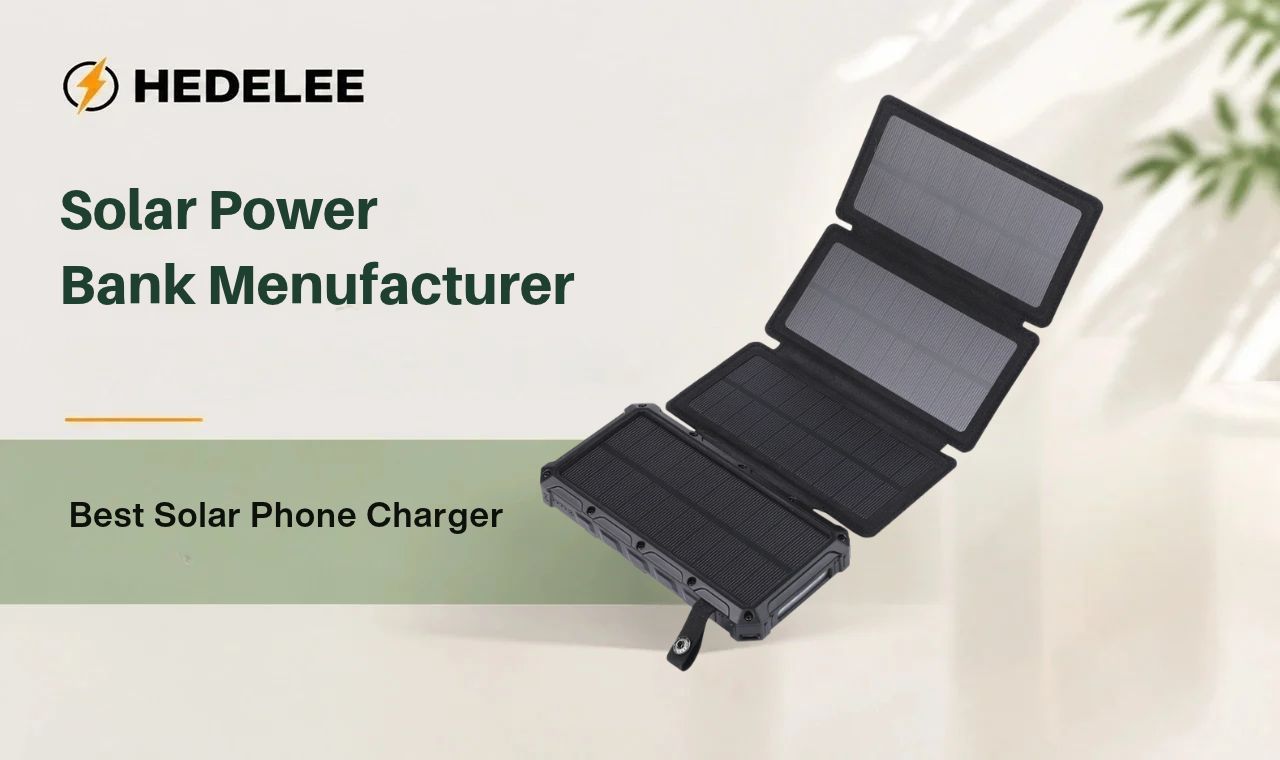
A returned pack rarely fails because the panel cracked. It fails because the lithium cell spent too many hot afternoons at a full charge. Retail buyers notice the drop in the second season, when a unit that once covered two phone charges barely covers one. Shoppers type best solar phone charger when they want sun backup for a phone. The panel is only half of what they receive.
The cell, the charge circuit, and the storage habit decide whether the line earns repeat orders or warranty notes. Shenzhen Hedeli Technology Co., Ltd. has worked in mobile accessories and consumer electronics for about 10 years. Headquarters sit in Shenzhen. A Guangzhou office and showroom are available for sample reviews. The Dongguan factory is set up for about 50,000 units a month, supplying importers, distributors, and wholesalers on a planned schedule.
The pages below cover the same points we review before a seasonal purchase order. You will see why sun-charged packs fade, how to brief a retailer, and which lines to lock on a spec sheet. Hedelee’s related lines include power banks, TWS earbuds, Bluetooth speakers, USB chargers, USB cables, car chargers, and car phone holders. The solar range is the focus here, because outdoor use is harder on a cell than a desk drawer.
Why listings for a best solar phone charger see early returns
The sales story is simple. Sunlight goes in. Power comes out. The box art shows a tent, a ridge, and a full battery icon. That story is not false, but it skips the part that creates returns. A solar power bank is a lithium pack with a small panel attached. The panel can keep working for many years. The cell is the part that ages, and it ages fastest in the exact place the product is meant to sit: full sun.
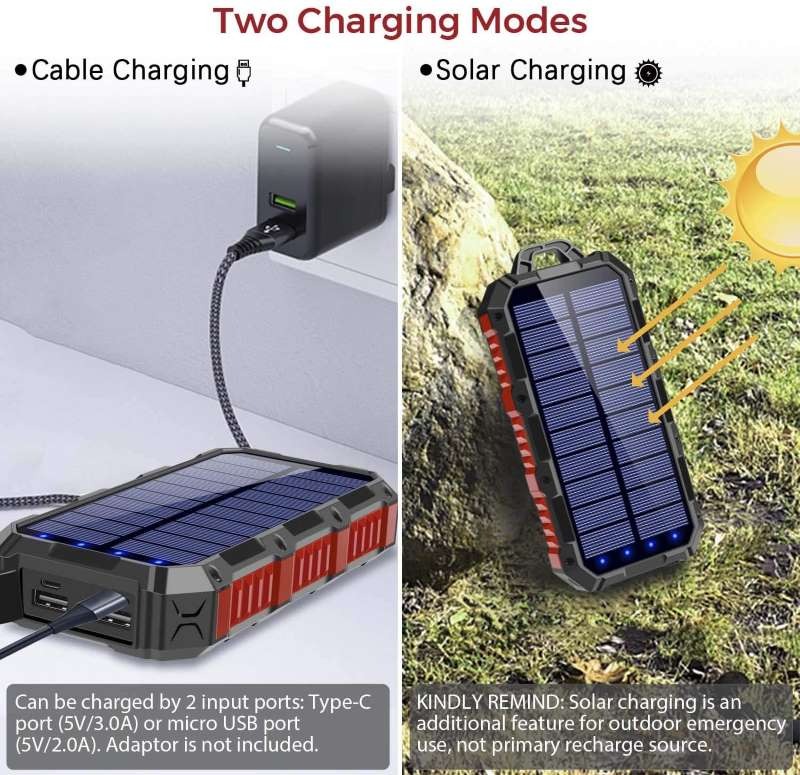
Most portable panels on a pocket unit are small. They trickle energy in. They do not replace a wall adapter. Phone and pack charge times stretch when the only source is that small surface, clouds pass, or the panel sits at a poor angle. Filling the pack’s own cell first, then charging a phone from the pack, adds another step. Buyers who expect a lunch-break refill from a palm-sized panel will call the product slow. The product is doing what a small panel can do.
A clearer promise protects the brand. Tell the channel that wall power fills the pack before a trip, and the sun stretches runtime. Tell them the panel is a top-up, not the main charger, unless the spec sheet shows a larger fold-out surface and a tested wattage. That wording costs nothing on a hang tag. It prevents the review that says the solar phone charger “does not work,” when the real issue was a 2-hour window and a tiny panel.
Returns also come from capacity fade that looks like a defect. A pack can still turn on, still light the LEDs, and still pass a quick bench check, while holding far less energy than the label. Heat plus a high charge level does that. It is calendar aging, not a cracked housing. If your quality team only tests new units at room temperature, you will miss the failure mode your customers create in July.
What sits inside a solar power bank
Treat the product as two devices sharing one shell. The first is a photovoltaic surface. It turns light into a modest current. The second is a lithium-ion or lithium-polymer cell, plus a circuit board. That board limits charge voltage, blocks a short, and presents a stable USB output. Those two parts do not age on the same clock.
The panel is comparatively patient. Dirt, deep scratches, and a broken hinge matter. Ordinary camping heat does not “use up” the cells of the panel the way it uses up the battery. The battery is the opposite. It loses capacity when it is hot, when it sits full, and when it is cycled hard. A solar powered power bank lives in the first two conditions more often than a pack that never leaves an office.
There is also a naming split that confuses purchase orders. Some units charge a phone only while the panel is in the light. They have little or no storage. A true solar power bank stores energy and can run after dark or indoors. Importers should not mix those two SKUs under one retail claim. A no-battery panel is lighter and has no cell to cook. It also dies when a cloud sits on the ridge. A bank is more useful at night and more sensitive to heat.
Output rating and solar input are different numbers. A listing may show a 5V 3A USB output. That is 15 watts at the port, available when the cell is charged. The panel on the same housing may deliver only a fraction of that in ideal sun. If a buyer divides pack energy by the USB wattage, they will predict a fast solar refill that the panel cannot provide. Ask for tested panel watts in full sun, then do the hour math from watt-hours, not from the USB logo.
Here is the math we ask buyers to use. If the cells are rated at a 3.7 volt nominal voltage, watt-hours equal milliamp-hours times 3.7, divided by 1,000. A 20,000mAh rating is about 74 watt-hours at the cell. USB output watt-hours will be lower after conversion. A small panel measured at 3 watts would need many clear hours to refill that pack, even before clouds and angle losses. The formula is simple. The missing input is the panel wattage on the spec sheet. Do not print a “charges in X hours” line until that test exists.
Heat and a full solar powered power bank
Heat is the stress people underestimate, because the product is sold as a sun tool. Lithium-ion does not enjoy that assignment. Battery University’s charging-temperature notes state that Li-ion can be fast charged from 5°C to 45°C (41°F to 113°F). Below 5°C the current should be reduced. Charging is not permitted at freezing, because the anode cannot accept lithium ions safely at that point.
A dark housing on a rock, a car dash, or a tent fly in midday sun can move past that fast-charge ceiling. You do not need a lab to spot the risk. If the shell is uncomfortable to hold, stop charging and let it cool. Charging a hot cell stacks two stresses: temperature and current. Leaving it full while it is hot stacks a third.
Battery University’s guide to prolonging lithium-based batteries is direct about storage. A pack dwelling above 30°C (86°F) is in elevated temperature. For most Li-ion, a voltage above 4.10 volts per cell is a high-voltage state. Keeping a full pack hot can age it more than ordinary cycling. The same source estimates recoverable capacity after storage. The figures below are for common cobalt-based cells. Not every cell matches the table. Use it as a planning range, not as a warranty promise.
Read the last row as a warehouse warning. A full pack in a hot container, a closed car, or a sunlit stockroom can lose a large share of capacity in a season. The same pack stored nearer 40% charge, in a cooler room, keeps far more. Consumer Li-ion is often specified around 300 to 500 full cycles. Cycle count is not the whole story. A pack can fade on the shelf if it sits full and warm, even if nobody cycles it.
Partial use is kinder than a full empty-to-full swing. Battery University’s cycle estimates rise as depth of discharge falls. A retailer insert does not need the voltage table. It needs one habit: do not park the pack at 100% in the sun, and do not store it that way between trips.
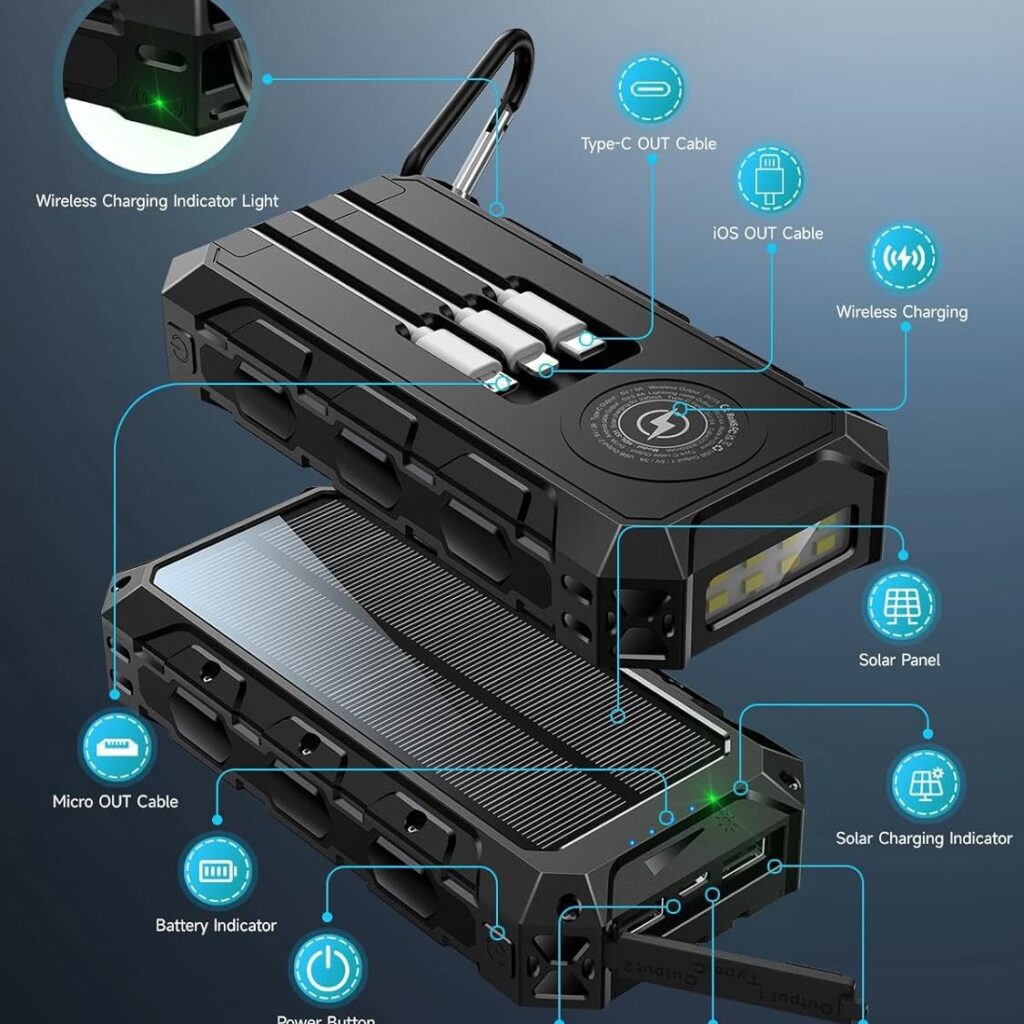
Wireless charging adds another heat path. A Qi pad turns some energy into warmth in the phone and in the pack. Doing that on a sunlit picnic table stacks pad heat on top of ambient heat. Shade the pack first. Then use the pad. If the shell is already hot, use a cable later, after it cools, or wait.
Field habits for a best solar phone charger
The useful habit is physical, not clever. Put the panel in the sun. Keep the cell in the shade. On a fixed-shell unit, that means a hat, a pack shadow, a light cloth over the battery side, or a spot under the tent edge, with the panel face still exposed. On a design with an external panel, run the lead so the surface bakes and the pack does not. You give up almost no charge speed. You remove the stress that shortens the cell.
A fold-out surface helps because area drives current. More surface, more watts, in the same sunlight. It does not remove the need to keep the cell cool. Confirm on the sample whether the battery stays in the shaded half or rides inside the hot panel assembly. If the cell is trapped against the panel, the hang tag should still say: pause charging when the pack is hot to the touch.
A simple camp routine is easy to print on an insert. Product managers can hand the same card to retail trainers.
Before the trip, fill the pack from the wall. Stop around 80 to 90% if the trip is short. A screaming 100% plus a hot afternoon is the harsh combination.
At camp, face the panel to the sun. Tuck the pack in shade. Connect them if the design allows a lead.
At midday, touch the shell. If it is hot, stop the charge and let it cool. Do not “finish” a full icon while the housing hurts to hold.
Use the pack. A unit that moves between roughly 40% and 80% ages more gently than one that sits pinned at full.
After the trip, bring a very full pack down by using it, then store it cool. Do not leave it full in a trunk “for next weekend.”
Watch the shell. A swollen pack is a retire-it sign, not a curiosity. Do not puncture it. Do not toss it in household trash. Lithium cells are a fire risk in ordinary waste. Your channel partners need a local take-back note for the markets you ship into.
Direct sun on a phone, fed by an unregulated panel, is a separate risk. Panel voltage rises in bright light. A proper pack buffers that and holds a USB-range output. When you write the claim for a solar phone charger, say the phone should charge from the regulated ports, not from raw panel leads. That sentence belongs on the insert next to the shade rule.
How a solar phone charger differs from a plain pack
The chemistry is the same family you already buy in a pocket power bank. What changes is the environment and the idle pattern. A plain pack lives indoors, gets grabbed often, and rarely sits on a dash. A solar unit is marketed for trails, cars, and emergency bins. It spends long stretches full, hot, or forgotten. Lifespan follows those habits more than the word “solar” on the shell.
Use this table in a line review. If the solar SKU will sit in a car kit, the storage row matters more than peak USB watts. If it will sit in a hiking shop, the shade instruction matters more than a wireless pad. A wireless pad is a nice demo. It is also extra heat. Match the feature to the channel instead of loading every listing with every option.
A plain pack still needs a charge limit and a cool shelf. Do not let a buyer think only solar units age. The solar unit simply meets the worst storage case more often, because people leave it where the light is.
How to spec a solar cell phone charger
Start with energy, not with adjectives. Ask for rated cell capacity, nominal voltage, and measured output watt-hours at a stated USB current. Then ask for panel watts at a stated test condition. Those three numbers let a product manager compare a 10,000mAh trail pack with a 30,000mAh car kit without arguing about marketing titles.
Catalog language is messy. Some marketplaces still reverse the words and list a bank power solar unit. It is the same family. A solar mobile phone charger, a solar cell phone charger, and a solar phone charger are usually the same search, not three inventions. Your box can use clear language: portable solar power bank for phones. Keep the rated milliamp-hours and the panel watts in a spec table so a buyer is not forced to decode the title.
Capacity bands, in plain use, look like this. Confirm each figure on the current sheet before you print it.
A 10,000mAh class is easier to keep cool and easier to refill from a small panel, because there are fewer watt-hours to replace. A 20,000mAh class is the common weekend size. Larger packs make sense for group kits and longer trips. They also take longer to refill from the sun, and some transport rules treat large lithium packs more strictly. Do not stamp “airline friendly” on a carton until the watt-hour figure and the carrier rule are checked for that route.
Waterproof claims need the same discipline. IPX4 generally means splash resistance. IP65 generally means dust-tight and protected against water jets. Neither code means the pack is a dive light. If a listing says waterproof, attach the test level and tell users to close the port covers. A missing rubber door is how a “waterproof” return happens.
Built-in cables reduce the accessory SKU a retailer must stock. They also freeze the connector choice. Phone ports shift. Ask whether the sample’s leads match the markets you sell this year, and whether a spare USB-C port remains if one lead fails. A flashlight is useful at camp. It is also a load and a heat source if someone leaves it on inside a closed pack. The insert should say to switch the light off before storage.
These Hedelee listings are a practical short list. Titles on some pages mix more than one capacity figure. Treat the title as a clue, and lock the number from the specification sheet and a sample discharge test.
20000mAh wireless solar power bank HDL-218 — wireless output, dual inputs, flashlight, waterproof claim to confirm.
Foldable 20000mAh outdoor solar charger — foldable surface and LED lights; check whether the cell can sit apart from the panel.
HDL-531 outdoor wireless pack with three cables — the public title mixes several capacity figures. Confirm the rated cell capacity before packaging.
20000mAh pack with external panels, HDL519X — external panels make the shade habit easier to teach.
10000mAh outdoor pack with a strong light — lighter class, wireless and fast-charge claims to verify on the sheet.
25000mAh dual-USB waterproof solar charger — dual ports; confirm the waterproof level.
30000mAh Qi pack HDL528, listed 5V 3A and IP65 — separate the 15-watt USB claim from panel watts.
Camping solar charger HDL519 — outdoor kit positioning; match the insert to camp use.
HDL529 with four cables, wireless pad, and IPX4 listing — title mixes capacity figures. Confirm both the cell rating and the splash rating.
Waterproof 20000mAh fast-charging solar panel pack — fast charge is a port feature; still publish solar input separately.
42000mAh pack HDL-628 with four cables and a dual LED light — high energy. Check watt-hours against the shipping mode you plan to use.
The wider solar power bank range is the right place to compare shells, lights, and cable sets in one pass. Bring the questions above to that review. A sample in the hand answers more than a title string.
How to store a solar power bank battery charger
Most units spend far more weeks in a closet, a stockroom, or a trunk than they spend on a trail. Storage is where calendar aging adds up. The harsh case is a full charge in heat. The kinder case is a partial charge in a cool, dry room.
For long warehouse storage, aim near a 40% charge rather than 100%. That is the level Battery University’s one-year table treats as the gentler column. For a retailer who will sell within a few weeks, a mid charge is still wiser than topping every carton to full “so the demo looks alive.” A demo unit on a sunlit shelf is a fade machine. Charge the demo in the morning, shade it, and do not leave it pinned at full under a spotlight.
Self-discharge rises with temperature and with a high charge level. A pack left for months will drift down. That drift is normal. The danger is letting it fall so low that the protection circuit sleeps, or that a cell sits at a damaging empty state. A quarterly check, with a small top-up back toward a partial charge, is enough for seasonal inventory. Do not trickle a stored pack at 100% on a windowsill.
Shipping adds rules of its own. Lithium-ion cells and packs are dangerous goods in transport. UN 38.3 is the test section carriers expect before a new design moves by air, sea, rail, or road. The finished pack needs its own test summary. A cell that passed does not automatically cover the pack built from it. Air cargo of lithium-ion batteries shipped alone is commonly limited to a 30% state of charge. Build that into the factory release plan so cartons are not held at the forwarder.
Heat in transit is the twin issue. A container yard in summer can hold full cartons at temperatures that match the ugly row of the storage table. Partial charge before a long ocean leg is not only a paperwork habit. It is how you protect the capacity you promised on the box. Ask the forwarder about peak temperatures on the route you actually use. A cool departure port does not describe the yard at the other end.
Between retail seasons, the same rule fits a distributor’s cage. Do not store solar cartons against a south-facing metal wall. Do not store them in a van. A plain indoor shelf, partial charge, and a date on the carton beat a complicated process. When a lot ages out of spec, recycle it through a lithium channel. Do not rework a swollen pack into a new gift box.
What to confirm before you place a bulk order
A good sample is a starting point. A repeatable order needs documents tied to that exact build. Ask for these before the deposit, not after the first complaint.
UN 38.3 test summary for the finished pack, not only the bare cell.
A safety report aligned with IEC 62133-2 for portable sealed lithium systems, if your destination market expects it.
Cell specification: chemistry, nominal voltage, rated capacity, and cycle claim, with the test method named.
Panel test: watts in a stated irradiance, open-circuit voltage, and the charge current into the pack.
USB and wireless ratings measured on the sample, including what happens when two ports are used together.
Ingress rating and the lab method, plus photos of port covers.
Charge-temperature cutoff. A board that pauses charge when the cell is too hot is worth more than a brighter LED.
Packaging text in the destination language, including the shade rule and the storage charge.
Watt-hour marking for the shipping mode you will use.
IEC 62133-2:2017 sets safety requirements for portable sealed secondary lithium cells and batteries under intended use and reasonably foreseeable misuse. It is a product-safety conversation. UN 38.3 is a transport conversation. You often need both. Neither replaces a capacity discharge on your own bench. Pull one unit from the sample lot, charge it from the wall, and discharge it at a stated current. Compare watt-hours with the claim. If the title and the sheet disagree, the sheet and the test win.
Customization sits in the same review. Logo, color, cable set, flashlight, retail box, and insert card are normal factory conversations. Connector choice should follow the phones your retailers actually sell. A private logo does not fix a hot cell. Put the shade rule and the storage charge on the insert even if the box art is yours. That card is part of the product.
Lead time and order quantity depend on the build: stock shell, custom color, or a new cable set. We do not publish a single number here, because a wireless IP-rated pack and a simple dual-USB pack do not move through the line on the same clock. Ask for the date against the exact SKU. Samples are available so your team can run the heat, capacity, and port checks before a seasonal commitment. Reach out for detailed specifications when you want the sheet next to the sample.
Shenzhen Hedeli Technology Co., Ltd. is the original manufacturer behind this range. An inquiry reaches the source: Shenzhen headquarters, a Guangzhou showroom if you want to handle the sample, and Dongguan production with monthly capacity around 50,000 units. Importers, distributors, and wholesalers can ask for a quote on the capacity, cable set, seal level, and packing their channel needs. You will be speaking with the factory side, with room to match the insert text to the way your customers actually camp and store the pack.
Frequently Asked Questions
1. What order quantity can you support?
Order quantity depends on the exact build, from a listed shell to a custom cable set or box. Contact us to request samples and a quantity matched to your season. A stock-facing pack and a new private-label carton do not share one minimum.
2. Can buyers request custom logos and cables?
Yes. Logo, color, cable set, and retail insert can be reviewed on a sample before a bulk run. Reach out for detailed specifications so the connector mix matches the phones your retailers sell. Confirm the lead time against that custom set, not against a generic pack.
3. Which compliance tests should we request?
Request a UN 38.3 test summary for the finished pack, plus any IEC 62133-2 report your market requires. A cell-only pass does not replace the pack test. Ask for the watt-hour mark that matches your shipping mode before cartons leave Dongguan.
4. How should we store bulk inventory?
Store cartons indoors, away from sunlit walls and vehicles, at a partial charge near 40% for long holds. Check the lot every few months so packs do not drift to empty. Do not leave demo units at full charge under a hot shop window.
5. Do you supply samples before production?
Yes. Samples let your team check capacity, port output, seal covers, and heat behavior before you commit. Contact us to request samples of the capacity and cable layout you plan to sell. Bring the shade-and-storage insert text to that same review.