

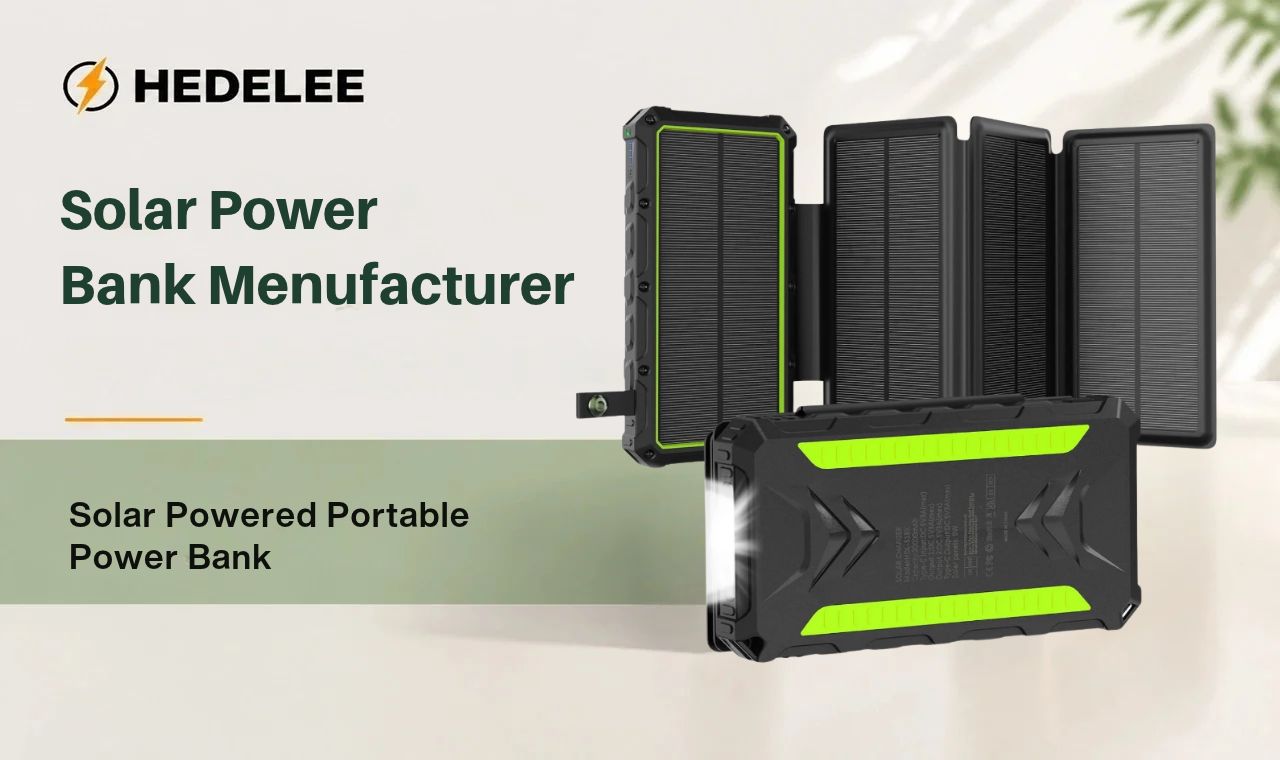
A container of power banks arrives, the first reviews come in, and half of them say the same thing: “The solar panel doesn’t charge it.” The product worked as designed. The listing simply promised more than a palm-sized panel can deliver.
That gap between expectation and physics is the main reason a solar powered portable power bank gets returned. Buyers who close the gap early sell more units and handle fewer complaints.
So here is a practical look at how these products work, which specifications to compare, what to ask a factory, and how OEM customization fits in. The examples come from our own production line in Dongguan, where we build solar models from 10,000mAh to 42,000mAh.
What Is a Solar Powered Portable Power Bank?
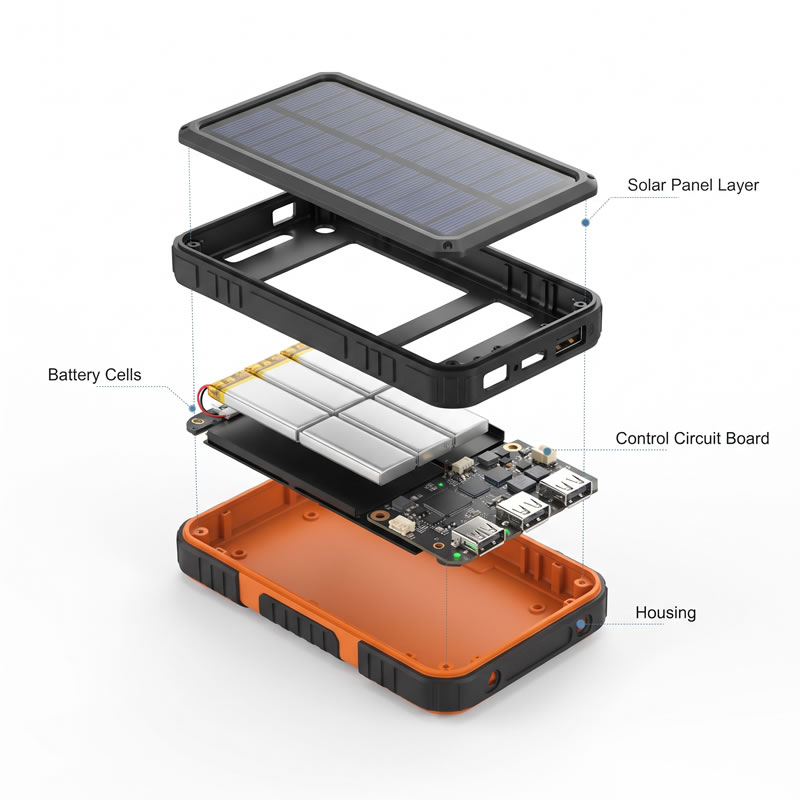
A solar powered portable power bank is a rechargeable battery pack with a built-in solar panel. It stores energy in lithium cells and releases it through USB ports, built-in cables, or a wireless charging pad. You may also see it listed as a solar power bank battery charger or a solar powered power bank. The product is the same.
The four main parts
- Battery cells. Usually lithium polymer. They set the capacity, weight, and most of the cost.
- Solar panel. One fixed panel on the housing, or several panels that fold out.
- Control board. Manages charging, discharging, and protections against overcharge, short circuit, and overheating.
- Housing. Typically ABS or ABS with a rubberized shell, often with sealed port covers and LED lights.
How it charges
Every unit has two ways to refill:
- Wall or USB input. This is the main method. A Type-C or Micro USB input fills the battery in hours.
- Solar input. This is the backup method. The panel adds energy slowly whenever light is available.
Think of it as a wall-charged battery with a solar safety net. When your product page says exactly that, customers are satisfied. When it implies the sun does all the work, they are not.
How Much Power Does the Solar Panel Add?
This is the question end users ask first, so your team should have a clear answer.
A single panel built into the housing usually produces around 1 to 2 watts in direct sun. A 20,000mAh battery holds about 74 watt-hours. With five good sun hours a day, a full refill from solar alone would take a week or more, and often longer once heat and angle losses are counted.
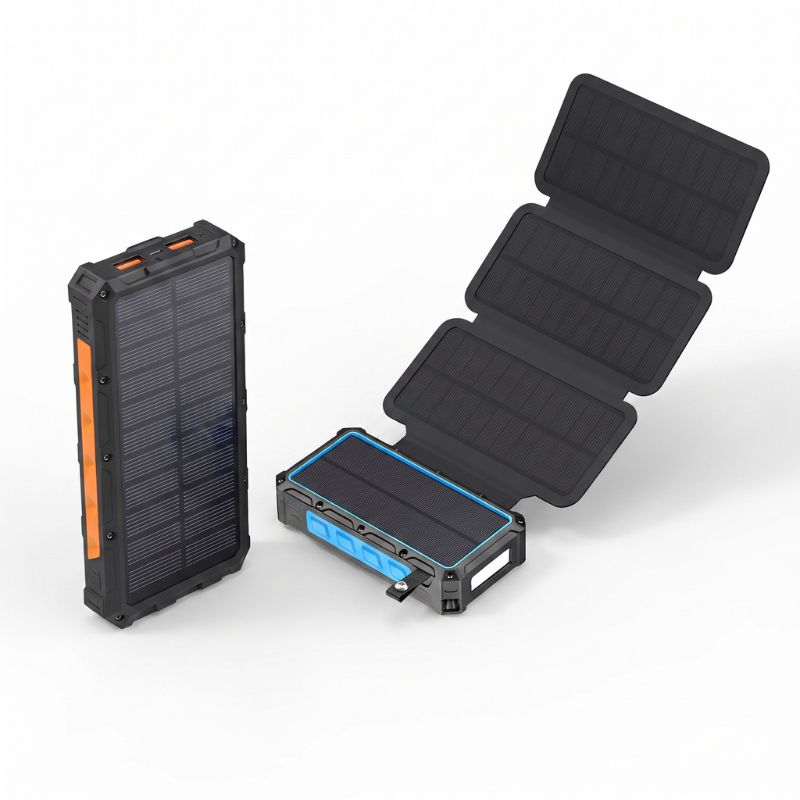
Fold-out designs change the math. Four panels collect several times more light than one, so a day outdoors adds a useful amount of charge. Therefore, panel format should match the customer you are selling to.
| Panel format | Solar input | Size and weight | Fits these users |
|---|---|---|---|
| Single built-in panel | Low, emergency top-up | Compact, pocket or bag size | Commuters, travelers, emergency kits, gift programs |
| Foldable multi-panel | Several times higher | Larger when open, thicker when closed | Hikers, campers, field workers, off-grid users |
What to tell end users
- Charge fully from a wall outlet before a trip.
- Use the panel to extend runtime, not to replace the outlet.
- Hang or lay the unit facing the sun, and avoid leaving it on a hot dashboard.
For example, our 20,000mAh foldable outdoor solar charger with LED lights suits retailers whose customers spend whole days outside. A single-panel unit is the easier sell for everyday carry.
One practical tip: ask any supplier for measured solar input current under stated light conditions. A number on a test sheet is worth more than “fast solar charging” on a box.
Solar Power Bank Capacity: Which mAh Level Fits Your Market?
Capacity drives price, weight, and shipping rules. It also sets whether a traveler can carry the unit on a plane.
Airlines measure lithium batteries in watt-hours. To convert, multiply mAh by 3.7 and divide by 1,000. Under the IATA lithium battery guidance, power banks travel in carry-on bags only. Units up to 100Wh need no approval, and units from 100Wh to 160Wh need airline approval. Some carriers apply tighter rules, so advise customers to check before flying.
| Rated capacity | Approx. energy | Typical phone charges* | Air travel (carry-on) | Typical buyer |
|---|---|---|---|---|
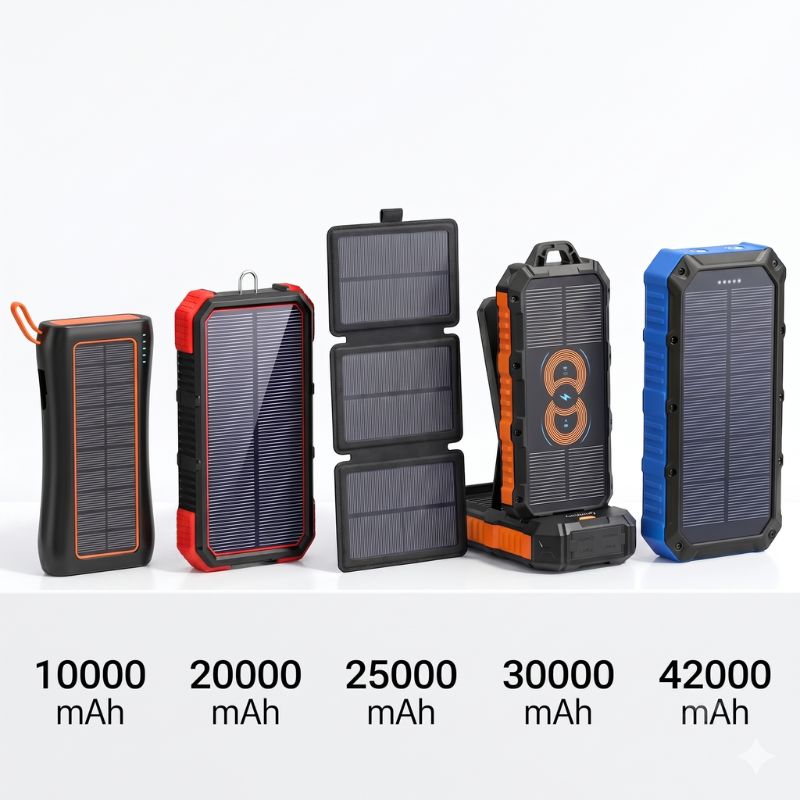
| 10,000mAh | 37Wh | About 2 | Allowed | Daily carry, promotions |
| 20,000mAh | 74Wh | About 4 | Allowed | Travel, general retail |
| 25,000mAh | 92.5Wh | About 5 | Allowed | Outdoor retail |
| 30,000mAh | 111Wh | About 6 | Airline approval needed | Camping, field work |
| 36,000mAh | 133Wh | About 7 | Airline approval needed | Multi-day trips |
| 42,000mAh | 155Wh | About 8 | Airline approval needed | Group and emergency use |
*Estimates for a phone with a 3,000 to 4,000mAh battery. Actual results depend on the device and conditions.
Rated capacity versus real output
Cells store energy at about 3.7V, while USB delivers 5V or more. The voltage conversion and heat use up part of the stored energy. In practice, a pack delivers roughly 60% to 70% of its rated mAh to the device.
This is normal for every power bank on the market. However, it becomes a problem when a supplier prints a capacity the cells cannot support. Always ask for a discharge test report, then verify it on samples.
Matching capacity to channel
- Travel and airport retail: stay at or under 25,000mAh.
- Outdoor and camping stores: 20,000mAh to 36,000mAh sells well.
- Emergency preparedness and group use: 36,000mAh and above.
Our 42,000mAh solar power bank with four built-in cables (HDL-628) sits at the top of that range. At the compact end, the 10,000mAh outdoor solar power bank with wireless charging keeps weight and unit cost low.
Solar Phone Charger Compatibility: iPhone, Android and More
End users rarely search by technical name. They type “solar phone charger,” “solar cell phone charger,” or “solar mobile phone charger,” depending on the country. All three phrases describe the same need: keep a phone alive away from an outlet.
Your listing should therefore answer one question fast. Will it charge my phone?
As a solar powered iPhone charger
A solar powered iphone charger needs the right connection for the model:
- iPhone 15 and later use USB-C.
- Earlier models use Lightning.
- iPhone 8 and later support Qi wireless charging.
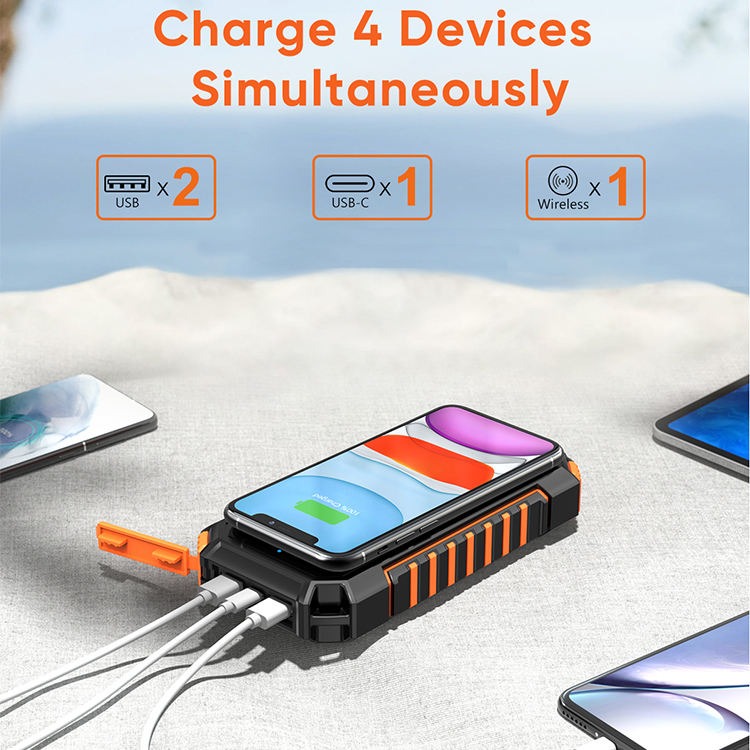
A unit with a wireless pad covers most recent iPhones without any cable. The 30,000mAh Qi wireless solar charger with IP65 protection (HDL528) is one example. It also offers Type-C input and a 5V 3A output.
For Android phones and other devices
Most Android phones charge through USB-C, and many support Qi. In addition, the same ports power earbuds, GPS units, action cameras, headlamps, and small tablets.
Ports, built-in cables, or both?
| Output type | Advantage | Trade-off |
|---|---|---|
| USB-A and USB-C ports | Works with any cable the user owns | User must carry a cable |
| Built-in cables | Nothing to forget or lose | Connector mix must suit your market |
| Wireless pad | Cable-free, simple to demonstrate in store | Slower, and the phone must stay in place |
Built-in cables sell well in gift and travel channels. Still, confirm the connector mix before ordering, because the right split between Type-C, Lightning, and Micro USB varies by region. The 24,000mAh model with four built-in cables and dual LED flashlight (HDL529) shows how cables, ports, and a wireless pad can sit in one housing.
Waterproofing, Lights and Outdoor Build
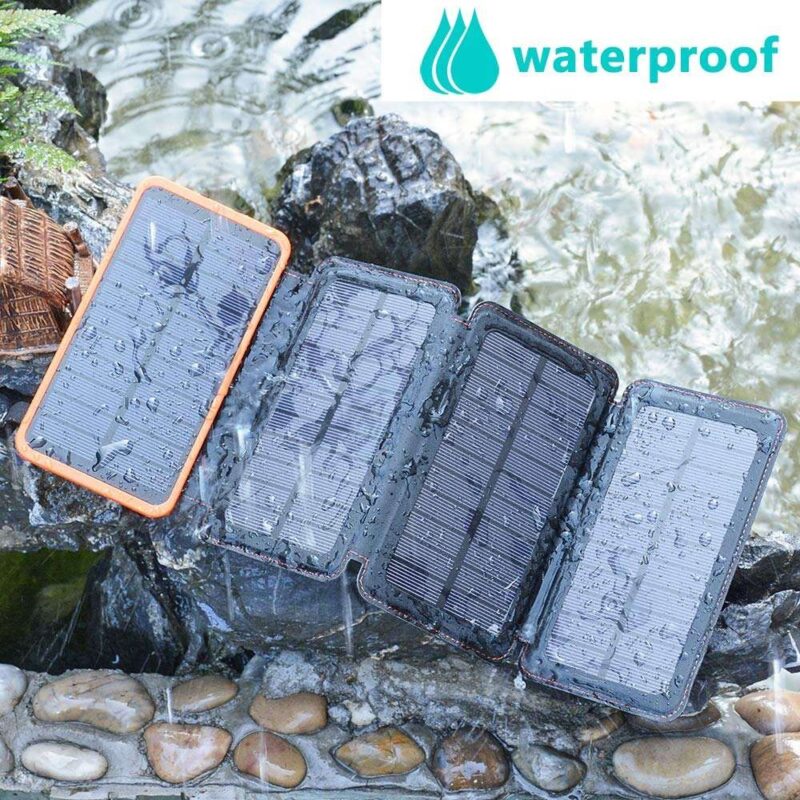
Outdoor buyers judge these products by how they survive rain, dust, and drops. Listings often say “waterproof” without a rating, and that invites disputes.
Reading IP codes
The IEC IP rating system uses two digits. The first covers dust, and the second covers water. An X means that property was not rated.
- IPX4: protected against splashing water from any direction.
- IP65: dust tight and protected against water jets.
Neither rating means the unit can be submerged. Port covers must also be closed for the rating to apply. Put both points in your manual and you will prevent a common claim.
Features that sell outdoors
- LED flashlight. Often with steady, SOS, and strobe modes.
- Carabiner or lanyard loop. Lets users hang the panel on a backpack.
- Rubberized corners. Absorb drops on rock or concrete.
- Charge indicator lights. Show battery level and solar input status.
Several of our models were designed around these needs:
- The 20,000mAh wireless solar power bank with dual inputs and flashlight (HDL-218)
- The dual USB 20,000mAh waterproof model with LED light (HDL519X)
- The camping solar charger power bank (HDL519)
Solar Power Bank Models at a Glance
The table below pairs each model with the buyer it usually suits. Specifications come from the product listings, so request the current spec sheet before finalizing an order.
| Model | Capacity | Main features | Good fit for |
|---|---|---|---|
| 10,000mAh outdoor wireless model | 10,000mAh | Wireless and fast charging, strong light | Promotions, daily carry |
| HDL-218 | 20,000mAh | Wireless, dual inputs, flashlight | General retail |
| HDL519X | 20,000mAh | Dual USB, waterproof, LED light | Price-sensitive channels |
| Waterproof 20,000mAh fast charging model | 20,000mAh | Fast charging, waterproof | Travel retail |
| Foldable 20,000mAh charger | 20,000mAh | Fold-out panels, LED lights | Hiking and camping stores |
| HDL519 | See spec sheet | Camping design | Outdoor gear ranges |
| 25,000mAh dual USB model | 25,000mAh | Dual USB, waterproof | Travelers wanting more capacity under 100Wh |
| HDL528 | 30,000mAh | Qi wireless, Type-C, IP65 | Field work, wet climates |
| HDL529 | 24,000mAh, 36,000mAh option | Four built-in cables, wireless, IPX4 | Gift and travel channels |
| HDL-531 | 24,000 / 30,000 / 36,000mAh | Three built-in cables, wireless | Ranges with capacity tiers |
| HDL-628 | 42,000mAh | Four built-in cables, wireless, dual LED | Emergency and group use |
You can browse the full solar power bank product range for more options.
7 Checks Before Ordering a Solar Powered Portable Power Bank Wholesale
Most sourcing problems with this category repeat. These seven checks catch them before money moves.
1. Verify real capacity
Request a discharge test report for the exact model and capacity. Then run the same test on samples with a USB load tester. If the delivered figure falls far below 60% of the rating, ask why.
2. Ask for measured solar input
Get the panel’s rated wattage and the measured charging current in direct sun. Use that figure in your listing so the claim holds up.
3. Confirm protection circuits
The control board should cover overcharge, over-discharge, overcurrent, short circuit, and temperature. Ask which protections are included and how each one is tested.
4. Check transport and compliance documents
Lithium batteries cannot ship without the right paperwork. Commonly requested documents include:
- UN38.3 test summary
- MSDS (safety data sheet)
- CE, FCC, or RoHS reports, depending on your market
Request current copies for each model, and check that the model number on the report matches the product you are buying.
5. Test the waterproof claim
Ask for the IP test report. Next, test samples yourself with the port covers closed. A splash test takes minutes and tells you a lot.
6. Review production capacity and lead time
A supplier’s monthly output shows whether a peak-season order will ship on schedule. Ask how capacity is shared across models and what lead time applies to custom orders.
7. Agree on quality terms in writing
Before production, set the inspection standard, the acceptable defect rate, and the warranty process. Finally, keep a signed approval sample so both sides share the same reference.
OEM and Private Label Options for a Power Bank for Solar Charging
Private label is where margins and brand identity come from. A power bank for solar use has more surface area than a standard pack, so there is room to make it yours.
What can be customized
- Logo. Silk print, laser engraving, or molded branding.
- Housing color. Stock colors or a custom match to your brand.
- Capacity tier. Several models share one housing across capacities.
- Cable mix. Connector types on built-in cable models.
- Packaging. Gift box, retail hang box, or plain carton, with your artwork.
- Manual and inserts. Language, warranty card, and usage tips.
A typical OEM workflow
- Share your target market, capacity, features, and price range.
- Review recommended models and receive a quotation.
- Evaluate samples and run your own tests.
- Confirm artwork for the product and packaging.
- Approve the pre-production sample.
- Mass production with in-line inspection.
- Final inspection, then shipment.
A clear brief shortens every stage. Include your sales channel as well, because a product for outdoor specialty stores needs different packaging than one for corporate gifts.
Why Source Directly From Shenzhen Hedeli Technology
Buying from the factory that builds the product removes a layer of cost and a layer of guesswork. Questions about cells, panels, or test data go to the people who run the line.
Shenzhen Hedeli Technology Co., Ltd. has worked in mobile accessories and consumer electronics for about 10 years. A few facts help buyers assess fit:
- Team: more than 100 employees.
- Headquarters: Shenzhen, China.
- Office and showroom: Guangzhou, where you can handle the products in person.
- Factory: Dongguan, with a monthly capacity of 50,000 units.
- Customers: importers, distributors, and wholesalers.
Because the factory is ours, samples, test reports, and custom requests are handled by the same team that manages production.
If a solar range is on your plan for the coming season, send us your target capacity, features, and quantity. We’ll reply with suitable models, a quotation, and sample options. You’ll be dealing with the original manufacturer from the first message, so every answer comes straight from the source.
Frequently Asked Questions
1. What is the minimum order quantity for wholesale?
It depends on the model and the level of customization. Stock designs with standard packaging generally allow smaller orders than custom colors or printed boxes. Send us your model and target quantity for an exact figure.
2. Can you add our logo and custom packaging?
Yes, logo printing and custom packaging are available. Housing color, cable mix, and manuals can also be adjusted. Share your artwork and we’ll confirm the options for your chosen model.
3. How long does solar charging take in sunlight?
Solar alone is slow, and a full refill can take a week or more with a single panel. The panel works as a backup that extends runtime outdoors. Foldable multi-panel models charge noticeably faster.
4. Do your solar power banks have shipping test reports?
Lithium battery products need documents like a UN38.3 test summary and an MSDS to ship. Reach out for the current reports on any specific model. We’ll also advise on what your destination market usually requires.
5. Can we get samples before a bulk order?
Yes, samples are available for evaluation. We recommend testing capacity, solar input, and waterproofing yourself. Contact us to request samples of the models you are comparing.