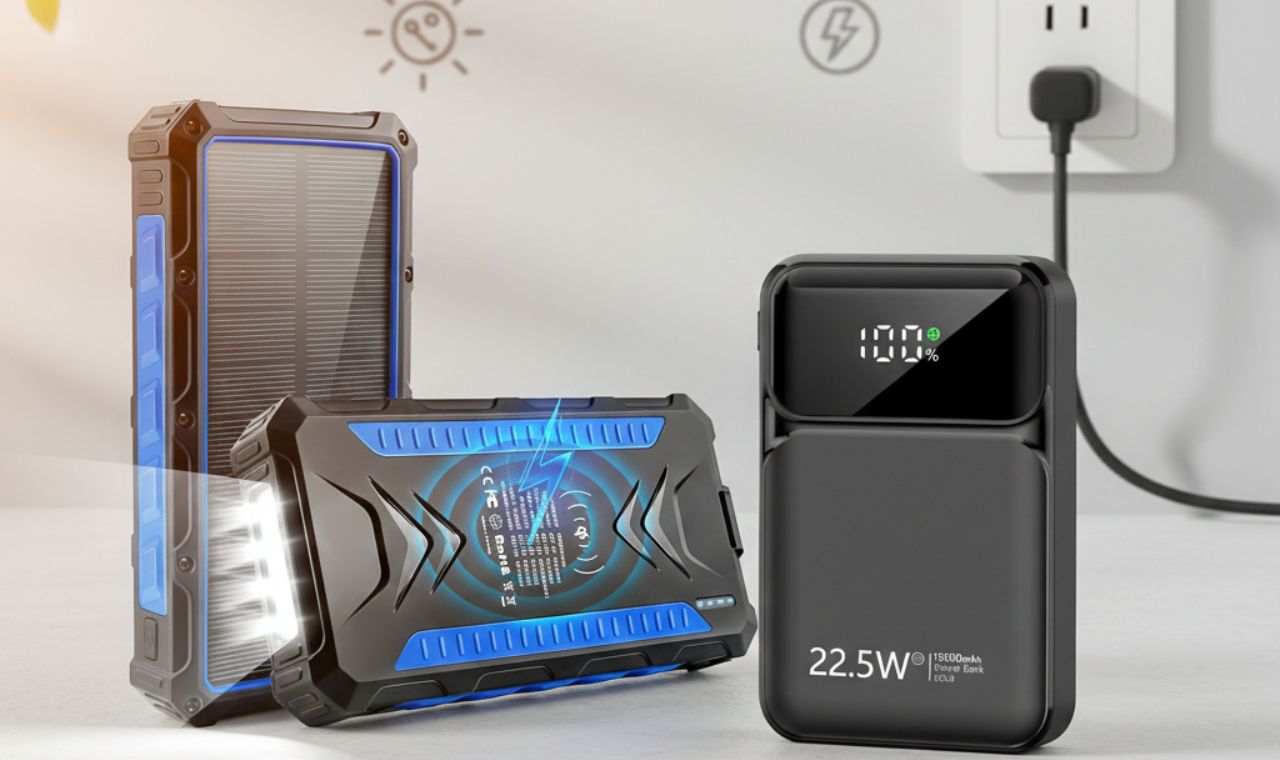
A “solar battery pack” sounds like it should solve charging problems anywhere. In real sourcing, the decision is rarely that simple. A power bank solar power bank may add resilience for field teams and outdoor buyers, but it also adds new expectations around charging speed, testing documents, and honest labeling. If you’re choosing products for a catalog, a promotion, or a long-term supply program, you’ll want to know where solar adds value—and where a regular power bank still does the job better.
Below is a practical, buyer-focused comparison with plain-language specs, realistic solar performance, and a procurement checklist you can use with suppliers.
Solar battery pack vs power bank: what terms mean
People use “solar battery pack,” “solar charger,” and “solar power bank” as if they’re the same product. In sourcing, it helps to separate the ideas:
- Regular power bank: A rechargeable battery (usually lithium-ion or lithium polymer) with USB outputs. You charge it from wall power, then use it to charge phones and other devices.
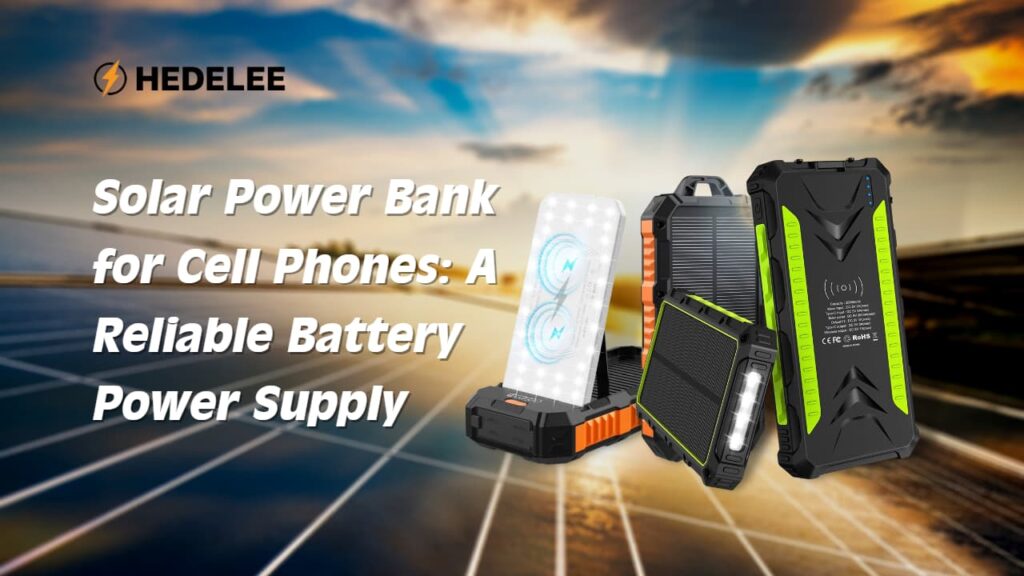
- Solar power bank: A power bank that can also take some energy from a built-in solar panel (or sometimes an attached panel). It still charges mainly from USB input.
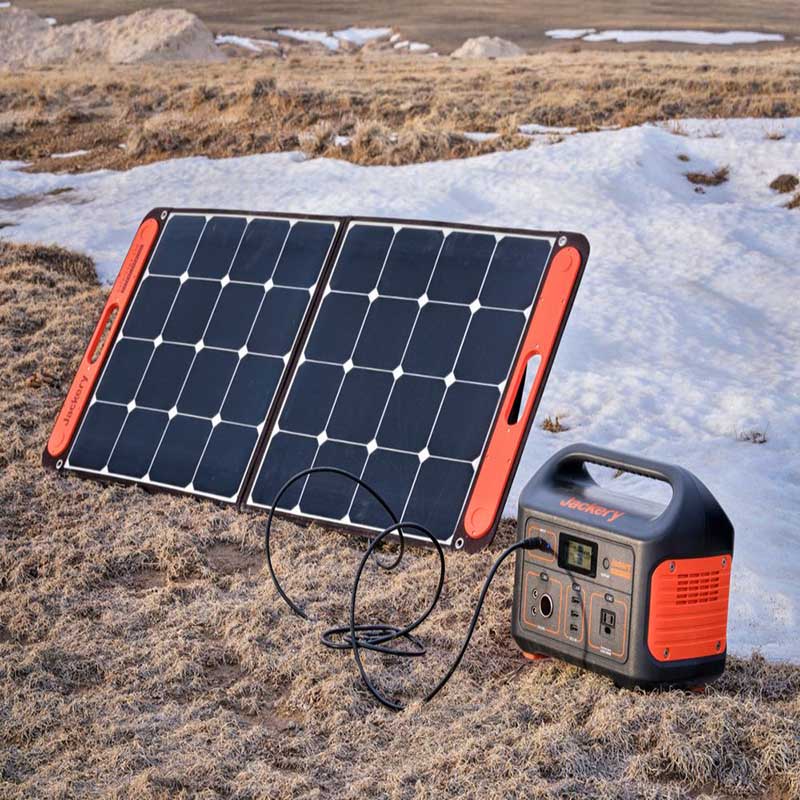
- Portable solar charger (panel-only): A folding solar panel that outputs USB power but has little or no battery storage.
- Large “solar battery pack” (portable power station): A much bigger unit (often 100Wh to 1000Wh+) designed for AC/DC outputs. This is a different category from pocket power banks.
For most wholesale and consumer electronics assortments, the real decision is: standard power bank vs solar power bank (with a small panel).
Why this distinction matters for buyers
A built-in panel changes how the product is used and how it should be marketed:
- Solar power banks are often used for emergency top-ups, not full daily charging.
- The panel adds perceived value, but it also adds questions:
- “How long to recharge in sun?”
- “Does it still fast charge?”
- “Is the solar input tested and safe?”
- “Can it ship smoothly by air or sea?”
If you want to browse typical styles and capacities, start with this solar power bank product category:
More details : Solar Power Bank category selection
What changes in real use: charging speed and availability
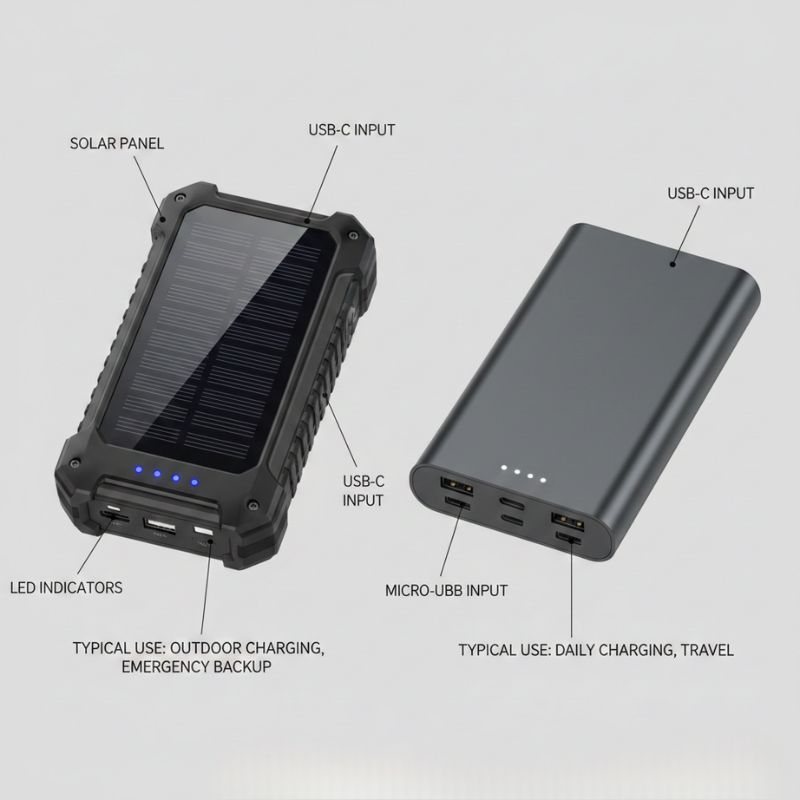
The simplest way to compare: regular power banks store energy; solar power banks store energy and can slowly refill it when you don’t have a socket.
Quick comparison table
| Topic | Regular power bank | Solar power bank |
|---|---|---|
| Main charging source | USB wall charger / USB port | USB wall charger first, solar as backup |
| Refill speed | Predictable (depends on input watts) | Predictable by USB; solar varies by weather and panel size |
| Best fit | Daily commuting, retail bundles, travel | Outdoor kits, emergency bags, field use, gift programs |
| Buyer expectations | “Fast and reliable” | “Works anywhere” (needs education) |
| Risk if oversold | Low | Higher (sun performance misunderstandings) |
A plain reality check on “solar”
Most compact panels on a power bank are small. That means:
- Solar input is limited by surface area
- Shade, clouds, and angle change the result a lot
- Solar is a useful backup, not a full replacement for USB charging
This is why some search terms like bank power solar or power bank for solar can be misleading. Many shoppers expect a tiny panel to refill a large battery fast. Procurement teams can reduce returns by choosing products that clearly state realistic solar behavior.
When a power bank solar power bank is the right tool
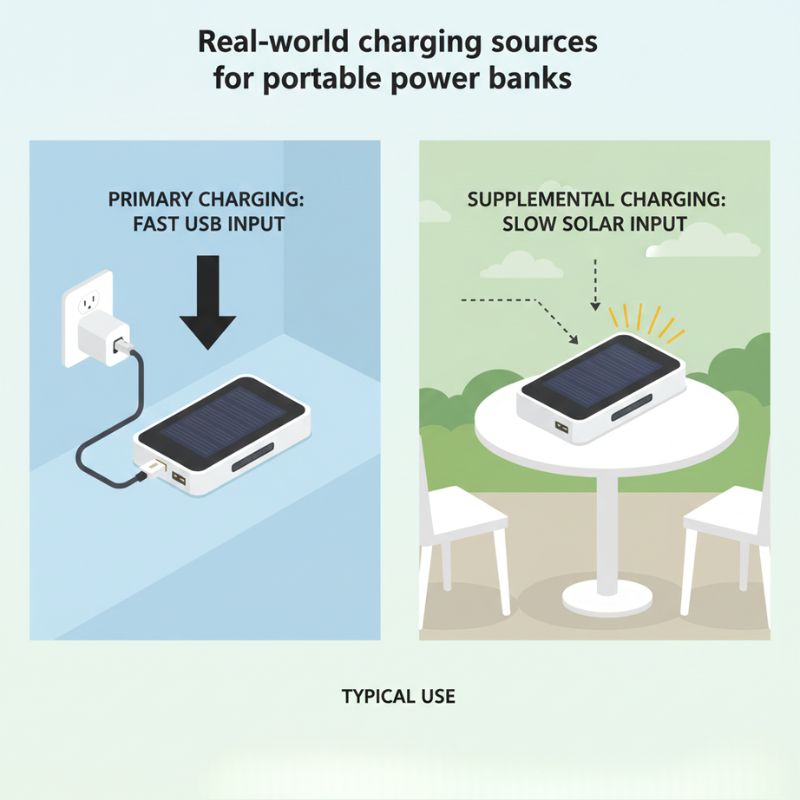
A power bank solar power bank earns its place when the buyer has one of these real constraints:
1) No guaranteed wall power for long periods
Common examples:
- Hiking and camping retail bundles
- Disaster preparedness programs
- Field sales teams, survey teams, or outdoor events
- Importers serving rural areas with unstable electricity
Solar becomes a “keep-alive” option that can provide small boosts over time.
2) Emergency phone-only charging matters more than speed
In emergency use, people often need:
- 10–30% phone battery to make calls, use maps, or message
- Light for a short period (LED flashlight features)
In these cases, even small solar input can help across multiple days.
3) Rugged housing and water resistance are part of the value
Many solar power banks are designed with:
- Textured, grippy casings
- Port covers
- Lanyard loops or hooks
- Outdoor-friendly indicator lights
If your assortment needs “outdoor-ready” positioning, solar models often match that expectation better than slim aluminum designs.
4) Your customers ask for “solar phone charger” products
Search demand is real. Many listings get traffic from phrases like:
- solar phone charger
- solar cell phone charger
- solar mobile phone charger
A solar power bank can serve this demand better than a panel-only item, because it stores energy for later use.
When regular power banks are the better pick
A solar panel is not always a benefit. In many programs, regular power banks win on value and predictability.
Regular power banks are usually better when:
- Fast refill time is the main promise
If users expect a quick recharge from a wall adapter, a standard power bank with strong USB-C input specs is often the cleanest solution. - Weight and pocket size are key
Solar designs often use thicker housings and rugged textures. That’s great for outdoor kits, less ideal for fashion retail or daily commuting. - Your product story is “fast charging” first
You can still choose rugged regular models, but you avoid the “why is solar slow?” complaint. - Price sensitivity is high
Solar adds materials and assembly steps. If the category is very price-driven, a regular model may deliver better sell-through.
A practical sourcing note
If your customers rarely use products outdoors, they won’t benefit from solar. In that case, it can be better to invest budget in:
- better cells
- better protection circuits
- better USB-C input/output performance
- clearer wattage labeling
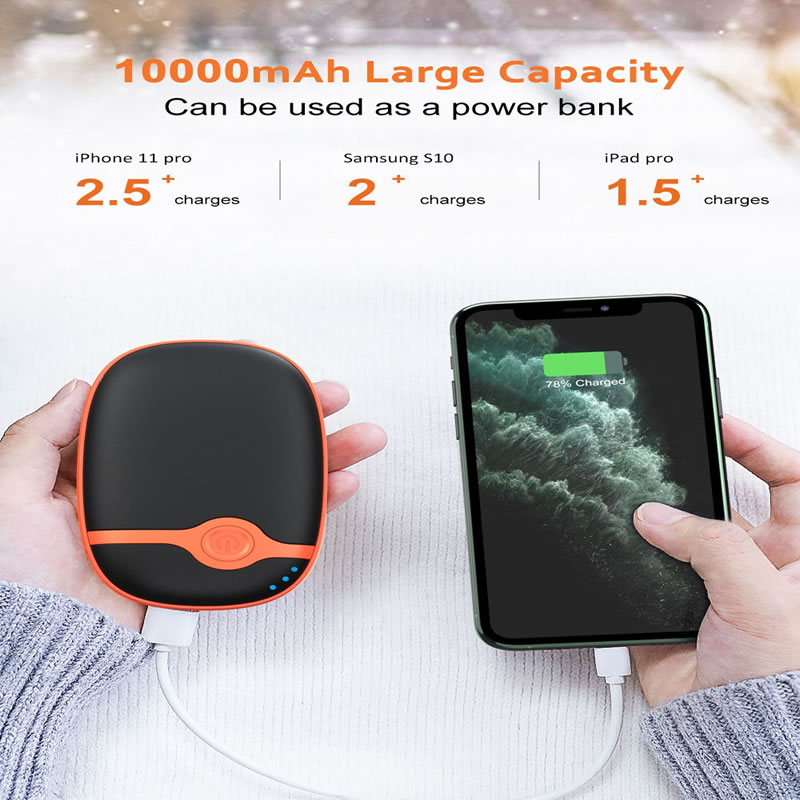
Solar charging explained with simple numbers
This is where many product specs get misunderstood. A quick, simple model helps teams explain the truth without technical overload.
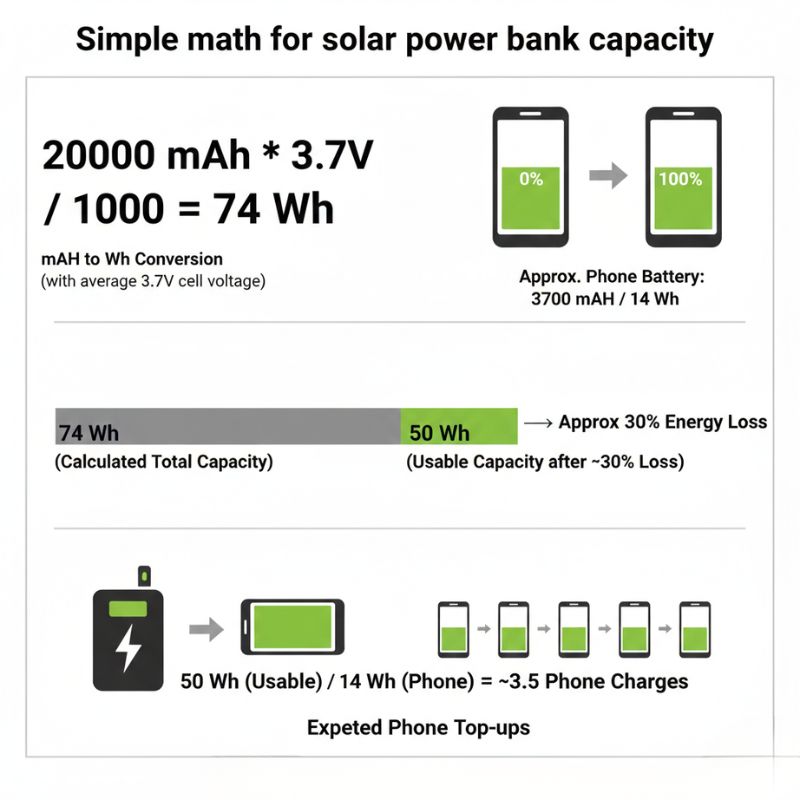
Step 1: Convert “mAh” into watt-hours (Wh)
Power banks often list capacity in mAh (milliamp-hours) at the internal cell voltage (often around 3.7V). Energy is better understood in Wh:
- Wh ≈ (mAh × 3.7) ÷ 1000
Example:
- 10,000mAh → (10,000 × 3.7) ÷ 1000 ≈ 37Wh
Phones don’t get all of that due to conversion loss. A realistic usable range might be 60–80%, depending on design.
Step 2: Understand how small panels behave
A small built-in panel on a compact solar power bank may produce limited power in ideal sun. Real output varies by:
- sunlight intensity
- panel angle
- temperature
- surface cleanliness
- power management circuit behavior
If a panel produces only a small amount of power, it can take many hours to refill a large battery. That doesn’t make it “bad.” It just defines the role: backup energy, not main energy.
Step 3: Use “top-up thinking” for solar
A practical way to position solar:
- USB charging: “refill the bank”
- Solar charging: “extend the bank”
This also applies to any solar power bank battery charger design: it’s a power bank first, with solar refill assistance.
Safety, compliance, and shipping documents to request
For procurement and product managers, the buying decision is not only performance. It’s also: Can it ship smoothly and pass your compliance checks?
1) UN 38.3 transport testing (common requirement)
Lithium batteries used in products shipped commercially often need testing under UN Manual of Tests and Criteria subsection 38.3 (commonly referenced as UN 38.3). This is widely used in transportation readiness discussions for lithium cells and batteries.
What to request from a supplier:
- UN 38.3 test report (or summary)
- Battery specification and cell model references
- Packaging method used for shipment (especially for air)
2) IEC 62133 family safety standard (portable rechargeable batteries)
IEC 62133 is commonly referenced for safety requirements and tests for portable rechargeable lithium batteries used in devices.
What to request:
- Test reports or declarations aligned to your target market needs
- Clear labeling and traceability for cells and packs
3) Airline and travel handling guidance (for consumer messaging)
Power banks are typically treated as spare batteries in travel contexts, and guidance often emphasizes preventing short circuits by protecting terminals and checking airline rules.
If your customers travel a lot, consider including:
- short handling instructions in the user manual
- a small protective pouch or terminal protection guidance
- IATA guidance for travelers carrying batteries (iata.org)
- USB-IF overview of USB Power Delivery (usb.org)
4) Other documents commonly requested by importers
Depending on destination market and channel, buyers may request:
- MSDS (battery)
- CE/FCC-related declarations (market dependent)
- RoHS (restricted substances) declarations
- IP rating evidence (if waterproof/dustproof claims are used)
A simple buyer habit that prevents issues: tie every marketing claim to a document or test reference (even if it’s an internal lab report plus a third-party report for key items).
Procurement checklist for power bank solar power bank programs
Use this section as a practical template when comparing suppliers or finalizing a spec sheet for a power bank solar power bank product line.
A) Performance checks (what users will feel)
- USB-C input rating (5V/2A, 9V/2A, etc.)
- Total output watts (single-port and multi-port)
- Heat behavior during fast charge
- Conversion efficiency (real usable capacity)
- Solar input behavior (does it charge steadily in sun, or only under perfect conditions?)
B) Build and durability checks
- Housing material feel and scratch resistance
- Port cover fit (if outdoor positioning is used)
- Button and LED indicator reliability
- Drop test expectations (define your own standard if not provided)
C) Labeling and truth-in-marketing checks
- Does the listing clearly say “solar is supplemental” where appropriate?
- Are capacity and outputs stated clearly (mAh and/or Wh)?
- Are waterproof claims tied to an IP rating test or documented method?
Simple sourcing comparison table
| Check item | What “good” looks like | What causes complaints |
|---|---|---|
| USB-C input | Clear wattage and stable charging | Vague “fast” claims without numbers |
| Output ports | Matches customer device mix | Too few ports or confusing shared output |
| Solar claim | Stated as backup/top-up | Implied as full recharge method |
| Documents | Reports available on request | No test references, only marketing text |
| Packaging | Protects ports and casing | Scratches, denting, missing manuals |
Feature-by-feature comparison buyers ask for
This is the part that shapes your SKU plan. The same capacity can behave very differently depending on ports, charge protocols, and small design choices.
1) USB-C input/output and “fast charging”
Instead of relying on the word “fast,” align on:
- input voltage/current options
- output voltage/current options
- whether output is shared across ports
USB Power Delivery (USB PD) is a widely used approach for flexible power over USB-C connections.
USB-IF also publishes compliance testing documentation for USB Power Delivery products.
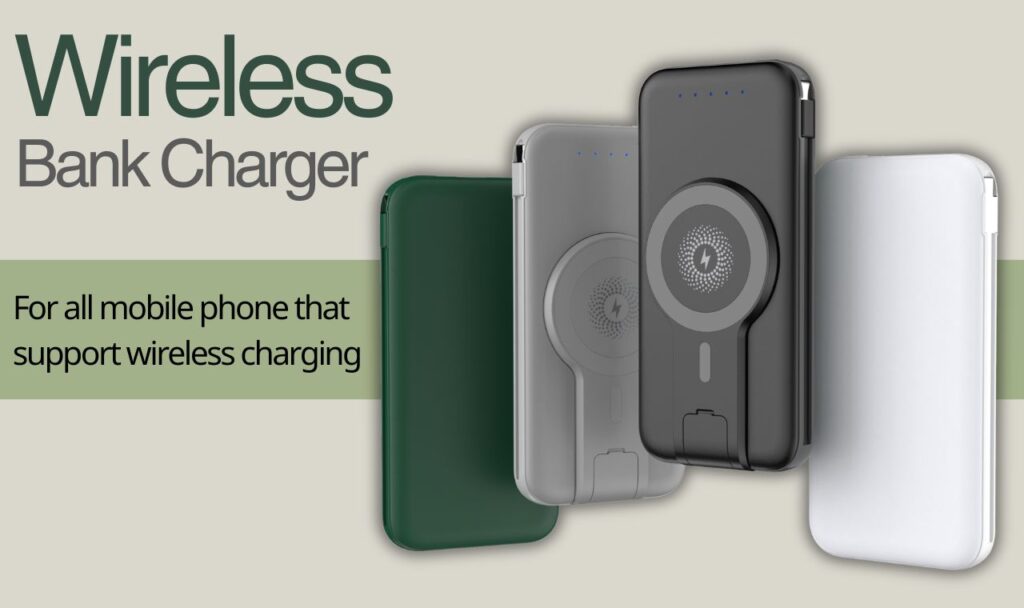
2) Wireless charging
Wireless charging can reduce cable needs, which helps:
- gift programs
- travel sets
- emergency kits
It can also increase heat. For procurement, confirm:
- wireless output rating
- whether wireless + wired outputs can run at the same time
- thermal protection behavior
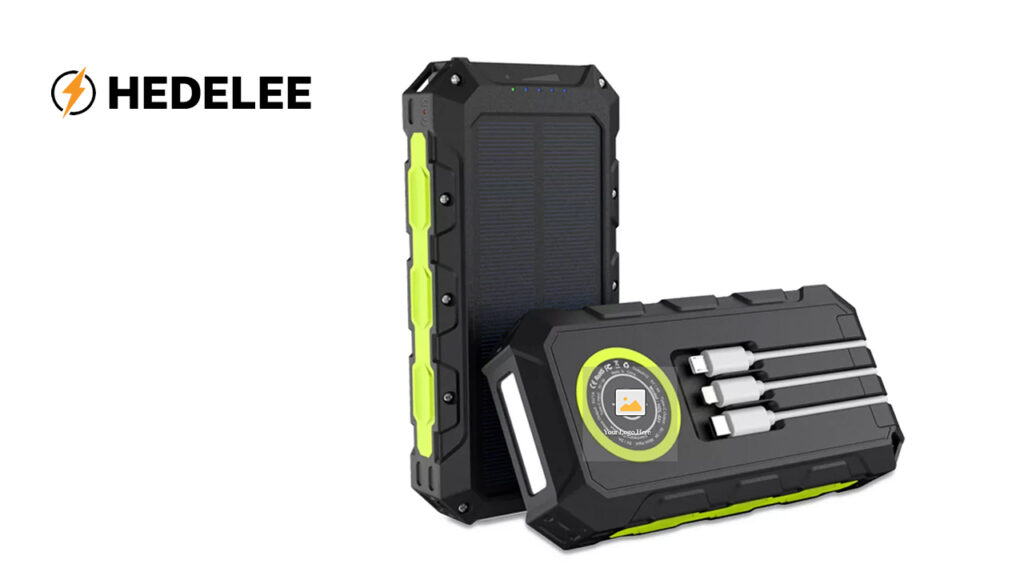
3) Built-in cables (when they help)
Built-in cables can be a win when:
- end users lose cables often
- retail packaging aims to be “ready to use”
- the product is used in vehicles or outdoor kits
Tradeoff:
- cable wear becomes part of warranty risk
4) Waterproof positioning and IP ratings
If the product claims waterproofing:
- define the IP level expected
- request evidence or test references
- ensure port cover design matches that claim in real use
Feature comparison table (solar vs regular)
| Feature | Solar power bank | Regular power bank |
|---|---|---|
| Panel | Adds backup energy | No panel, simpler design |
| Typical housing | Often outdoor styled | Often slim, travel focused |
| Messaging needed | Higher (set expectations) | Lower |
| Best channel fit | Outdoor, emergency, gift | Travel, commuter, bundle |
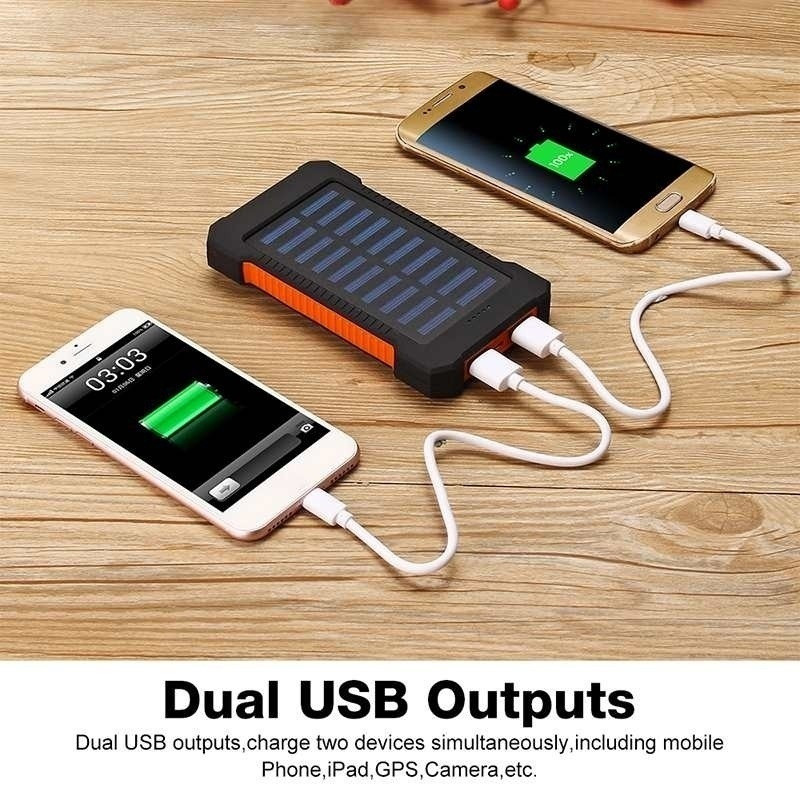
Sizing guide: match mAh to real device needs
Capacity labels can mislead teams who don’t work with batteries every day. Here’s a simple sizing guide you can use in specs and sales training.
A) Typical device battery sizes (rough ranges)
- Phones: ~3,000–5,000mAh
- Small tablets: ~6,000–8,000mAh
- Large tablets: ~8,000–12,000mAh
- Earbuds: often small, but frequent recharges
Because of conversion loss, a 10,000mAh bank does not equal “two full phone charges” for every phone. It depends on the phone size and efficiency.
B) Practical SKU sizing table (buyer-friendly)
| Power bank size | Realistic positioning | Typical buyer use |
|---|---|---|
| 10,000mAh | 1–2 phone top-ups | Travel kits, entry bundles |
| 20,000mAh | Multi-device day use | Wholesale core SKU |
| 24,000–30,000mAh | Heavy use / multi-day | Outdoor and field teams |
| 36,000mAh+ | Longer trips, group use | Outdoor-focused programs |
C) Solar-specific guidance for sizing
If solar is a key selling point, larger capacity can still make sense—but messaging must be honest:
- Solar helps extend use across days
- be honest:
- Solar helps extend use across days
- USB charging remains the fastest refill method
This is also where the keyword mix shows up in search behavior. Many shoppers type “solar cell phone charger” expecting a panel-first product. In your content and packaging, clarify: “battery storage first, solar backup.”
Product examples from our solar power bank range
If you’re planning a line-up, it helps to map models to use cases instead of only capacity. Here are practical picks from our range (all from the same product family for consistent sourcing and documentation).
To explore the full assortment first:
Internal link: Solar power bank models and options
Outdoor compact with wireless (10,000mAh)
- Best when you want a lighter outdoor SKU with wireless charging support.
Product link: Outdoor solar power bank 10000mAh with wireless charging and light
20,000mAh “core SKU” options (popular wholesale capacity)
- A common balance for multi-device day use and emergency kits.
Product links:
Higher-capacity multi-day range (24,000–30,000mAh)
- Useful for outdoor retailers, camping kits, and longer trips where solar top-up is a selling point.
Product links:
Very high capacity with built-in cables (36,000–42,000mAh range)
- Fits programs where “ready for anything” positioning is needed and size/weight is acceptable.
Product links:
How to use this list as a buyer
Instead of picking only one model, many distributors stock:
- a compact wireless solar unit (10,000mAh)
- a core 20,000mAh bestseller range
- one higher-capacity outdoor-focused model for margin and differentiation
That structure also helps when customers compare a solar model to a regular bank: you can show clear reasons for each tier.
Sourcing notes from the original manufacturer
For buyers building repeatable programs, consistency is often worth more than chasing the lowest unit price. Shenzhen Hedeli Technology Co., Ltd. has worked in mobile accessories and consumer electronics for about 10 years, with a team of 100+ people, headquarters in Shenzhen, and an office and showroom in Guangzhou. Our Dongguan factory supports a monthly capacity around 50,000 units to serve importers, distributors, and wholesalers with steady supply.
What you can standardize to reduce returns and support tickets
- Clear spec sheet format (inputs, outputs, cable types, wireless rating)
- Packaging that matches the channel (retail hang box vs bulk carton)
- User instructions that set solar expectations (solar as backup energy)
- Labeling consistency across cartons, manuals, and product body
Customization options that usually make sense
- Logo printing (housing and packaging)
- Color and casing texture selection for outdoor positioning
- Bundle decisions (built-in cables, lanyard, pouch)
- Manual language and compliance inserts for target markets
A natural close for procurement teams
If you’re deciding between a solar battery pack concept and a regular power bank program, start by defining the user’s real constraint: no wall power vs fast refill. From there, shortlist 2–3 models and align on the documents and labeling before mass production.
If you’d like, share your target market, capacity tier, and expected order volume. We can recommend a focused SKU set, provide detailed specifications, and support sampling—so you’re sourcing from the original manufacturer, with clear documentation and stable production planning.
Frequently Asked Questions
1. What is your typical minimum order quantity?
MOQ depends on the model and customization. Share your target capacity and logo needs, and we’ll confirm MOQ and pricing options.
2. Can we add our logo and custom packaging?
Yes. Logo printing and packaging customization are common. Reach out for artwork guidelines and packaging templates.
3. Do you provide compliance documents for import?
Yes, we can provide common documentation requested by importers. Ask for the document list for your market and the specific model you plan to ship.
4. How long does production take after sample approval?
Lead time depends on order volume and customization. Once the sample is confirmed, we’ll provide a production schedule aligned to your shipping plan.
5. Can we request samples before bulk ordering?
Yes. Contact us to request samples and detailed specifications so your team can test charging performance and build quality.