

When procurement teams source charging solutions for field operations, construction sites, or outdoor retail, one question dominates every specification meeting: will this device actually last? A solar power bank that fails after three months creates warranty headaches, frustrated end users, and budget overruns that nobody wants to explain.
Durability isn’t just about surviving a single drop. The real test comes from cumulative exposure—UV radiation degrading plastic housings, moisture seeping into charging ports, battery cells losing capacity after repeated solar charging cycles. Some brands build devices that handle these stresses for years. Others look identical on a spec sheet but fail within weeks of field deployment.
This comparison examines solar power bank durability across construction quality, material selection, environmental resistance, and real-world longevity. You’ll find testing criteria that matter for bulk orders, brand comparisons based on measurable performance, and guidance for writing specifications that protect your investment.
What Makes a Solar Power Bank Durable
Durability in portable solar chargers involves multiple interconnected systems. The solar panel, battery housing, charging circuitry, and external ports must all withstand environmental stress while maintaining electrical performance.
Build Quality Fundamentals
The outer shell determines whether internal components survive daily handling. High-density ABS plastic resists impact better than standard polycarbonate, though it adds weight. Reinforced corners distribute force from drops across the entire housing rather than concentrating stress at impact points. Many manufacturers skip this reinforcement to reduce production costs—visible when you examine corner seams for thick, consistent joins versus thin connection points.
Battery cell mounting matters more than most procurement specs acknowledge. Cells that shift inside the housing during drops can damage internal wiring or crack solder joints on the charging board. Quality manufacturers use foam inserts or molded cradles that secure cells without restricting heat dissipation. You can sometimes detect poor mounting by gently shaking a fully assembled unit and listening for rattling.
Material Selection Across Price Points
Solar panel construction separates entry-level products from professional-grade equipment. Monocrystalline panels cost more but deliver higher efficiency (18-22%) compared to polycrystalline alternatives (15-18%). More importantly for durability, monocrystalline cells handle partial shading and temperature fluctuations without the same performance degradation.
The protective layer over solar cells determines lifespan in outdoor environments. ETFE (ethylene tetrafluoroethylene) film provides superior UV resistance and self-cleaning properties compared to standard PET laminate. After 12 months of sun exposure, ETFE maintains 95%+ light transmission while PET yellows and drops to 80-85%. Some manufacturers claim “solar panels” but use printed circuits that generate minimal power—check for actual photovoltaic cells under magnification.
Port sealing technology has evolved significantly. Older rubber flaps deteriorate in heat and lose sealing effectiveness within months. Current waterproof designs use silicone gaskets with spring-loaded covers that maintain IP65 or IP67 ratings through hundreds of open-close cycles. Testing this requires specialized pressure equipment, so procurement teams should request IP certification documents rather than relying on marketing claims.
Brand Durability Comparison: Testing Results
Real-world durability testing reveals performance differences that specification sheets don’t capture. The following comparison draws from field testing, warranty claim analysis, and third-party laboratory evaluations.
| Brand Category | Shell Material | Drop Test Rating | Waterproof Rating | Average Lifespan | Failure Mode |
|---|---|---|---|---|---|
| Professional-Grade | Reinforced ABS + TPU corners | 2 meters (6 drops) | IP67 certified | 4-5 years | Battery capacity fade |
| Mid-Range Commercial | Standard ABS | 1.5 meters (3 drops) | IP65 claimed | 2-3 years | Port seal failure |
| Entry-Level Consumer | Polycarbonate | 1 meter (single drop) | Splash resistant | 6-18 months | Housing cracks, panel delamination |
| Budget Import | Mixed plastic | 0.5 meters | No rating | 3-12 months | Circuit board corrosion, cell failure |
Professional-grade models incorporate multiple protective layers. Outer TPU (thermoplastic polyurethane) corners absorb initial impact, while the inner ABS shell protects electronics. This dual-layer construction costs roughly 30% more in materials but reduces warranty claims by 60-70% according to distributor data.
Mid-range options balance cost against acceptable durability for controlled environments. These units handle indoor-outdoor transition well—offices, vehicles, light fieldwork—but struggle with continuous outdoor deployment. Port seals represent the most common failure point, typically around the 18-24 month mark when silicone gaskets lose elasticity from repeated flexing.
Entry-level and budget categories show dramatic quality variation. Some manufacturers in this segment produce surprisingly durable devices by using last-generation materials and simplified designs. Others cut costs through reduced wall thickness, inferior cell grades, or minimal quality control. Without brand reputation or testing data, these purchases carry significant risk for bulk orders.
Recognizing Quality Indicators Before Purchase
Several physical inspection points predict durability without laboratory testing. Examine the solar panel edge seal—professional models use beveled edges with complete sealing, while cheaper units show exposed cell edges where moisture can enter. Check port covers for smooth action and consistent resistance across multiple open-close cycles. Loose or sticky covers indicate low-grade materials that won’t last.
Weight provides a crude but useful quality signal. A 20,000mAh solar power bank should weigh 400-500 grams depending on features. Units significantly lighter often use lower-grade cells or reduced protective materials. Conversely, excessive weight might indicate unnecessary metal components added to create a “premium” feel without functional benefit.
The solar panel itself tells a story under close examination. Quality cells show uniform color with no visible bubbles or gaps in the laminate. Examine where the panel meets the housing—professional-grade units seal this junction completely, preventing water entry and debris accumulation that gradually damages connections.
Environmental Resistance: What Different Ratings Mean
IP (Ingress Protection) ratings quantify dust and water resistance through standardized testing. The two-digit code specifies solid particle protection (first digit) and liquid protection (second digit). For procurement specifications, understanding these ratings prevents both over-specifying (unnecessary cost) and under-specifying (inadequate protection).
Decoding Waterproof Claims
IP65 means complete dust protection (6) and resistance to water jets from any direction (5). This suits most outdoor applications where rain and splashing occur but submersion doesn’t. Devices rated IP65 should survive rainstorms and accidental water bottle spills but shouldn’t be dropped in rivers or used in heavy spray environments.
IP67 adds submersion protection—up to 1 meter depth for 30 minutes. For solar power bank applications, this rating provides significant safety margin against unexpected water exposure. Field teams working near water or in heavy rain conditions benefit from this protection level. The cost premium for IP67 versus IP65 typically runs 15-25% due to more extensive sealing requirements.
“Waterproof” without an IP rating means nothing verifiable. Marketing departments use this term freely on devices that might resist light splashing or might fail in humid conditions. Always request certified IP ratings for any outdoor application.
Temperature Range Specifications
Operating temperature ranges determine whether devices function in extreme climates. Standard commercial specifications cover 0°C to 45°C (32°F to 113°F), adequate for moderate climates but insufficient for many field applications. Professional equipment extends this range to -10°C to 60°C (-14°F to 140°F) or wider.
Battery chemistry limits extreme cold performance. Lithium-polymer cells used in most solar chargers experience reduced capacity below freezing and won’t charge efficiently below -5°C. Some manufacturers include heating elements that use stored power to warm batteries enough for charging, though this reduces overall efficiency.
Heat presents different challenges. Direct sun exposure can push surface temperatures above 70°C (158°F), well beyond standard operating ranges. Quality solar power banks include thermal management—heat-spreading plates, ventilation channels, or temperature sensors that reduce charging current when limits are approached. Budget models often lack these protections, leading to battery damage and shortened lifespan.
Solar Charging Efficiency and Long-Term Performance
The solar panel’s ability to maintain charging efficiency directly impacts device lifespan and user satisfaction. Degradation patterns vary widely between quality tiers.
Professional solar power bank models maintain 85-90% of initial charging efficiency after three years of regular outdoor use. This stability comes from ETFE protective films, quality cell selection, and robust electrical connections resistant to thermal cycling. After five years, efficiency typically drops to 75-80%—still functional but noticeably slower than when new.
Consumer-grade alternatives show steeper decline curves. Many drop below 70% efficiency within 18 months, particularly if stored at high temperatures between uses. The solar panel surface often develops micro-cracks invisible to the eye but measurable through efficiency testing. These cracks propagate over time, gradually reducing the active charging area.
Real Output Versus Rated Capacity
Stated capacity—20,000mAh, 30,000mAh, etc.—represents cell capacity at 3.7 volts. Actual device output operates at 5 volts, creating an inherent conversion loss. A true 20,000mAh capacity delivers roughly 12,000-13,000mAh of usable 5V output after accounting for conversion efficiency and circuit board overhead.
Reputable manufacturers calculate capacity honestly, while others inflate ratings by 30-50%. This becomes apparent when comparing physical dimensions—a legitimate 30,000mAh device requires significant volume for cell placement. Compact units claiming massive capacity likely overstate specifications.
Solar charging rates compound this issue. Marketing materials might show “20 hours to full charge via solar” based on ideal laboratory conditions—direct perpendicular sunlight, clean panel surface, perfect temperature. Real-world charging often takes 3-4 times longer due to angle variation, partial cloud cover, dust accumulation, and temperature inefficiency. Professional models handle these variables better through larger panels and more efficient circuits.
For procurement teams establishing performance baselines, request actual field testing data rather than laboratory specifications. A solar power bank rated for 8-hour solar charging in the lab might require 24-32 hours under typical outdoor conditions. Understanding this gap prevents unrealistic user expectations and support issues.
Durability Testing Standards You Should Require
Procurement specifications gain teeth when they reference verifiable testing standards. Several international frameworks govern portable electronic device durability.
Drop Test Protocols (MIL-STD-810G)
Military Standard 810G defines drop testing procedures used across industries. Method 516.6 specifies dropping devices from predetermined heights onto hard surfaces while recording functional status. Commercial adaptations typically use 1.5-meter drops onto concrete as a baseline.
Testing protocols matter as much as height ratings. A device dropped once from 2 meters tells you less than a device dropped six times from 1.5 meters onto different surfaces (corners, faces, edges). Repeated impact testing reveals structural weaknesses that single-drop tests miss.
Quality manufacturers conduct drop testing on random production samples, not just prototype units. Request evidence of batch testing rather than pre-production verification. A brand showing drop test reports across multiple production runs demonstrates commitment to consistent quality.
Ingress Protection Certification (IEC 60529)
IP rating certification requires third-party laboratory testing following IEC 60529 standards. The testing process involves specific dust chamber exposure durations and water spray angles that can’t be replicated without proper equipment. Devices claiming IP ratings without certification documentation should raise immediate concerns.
For volume orders, consider requiring test reports dated within the past 12 months. Manufacturing process changes can affect waterproofing even when the external design remains identical. Recent testing confirms current production maintains certified ratings.
Battery Cycle Life Testing
Lithium polymer batteries degrade through charge-discharge cycles. Quality cells maintain 80% capacity after 500 full cycles, while inferior grades drop to 60-70% capacity over the same period. Solar power bank applications accelerate degradation through irregular charging patterns and temperature exposure.
Request cycle life data based on solar charging patterns, not just wall charger cycles. Solar charging stresses batteries differently—irregular current flow, frequent partial charges, temperature variation during outdoor charging. Testing should reflect these real-world conditions rather than laboratory wall-charging protocols.
Battery management system (BMS) quality significantly impacts lifespan. Advanced BMS circuits monitor individual cell voltage, balance charging, prevent over-discharge, and manage temperature limits. Budget devices often use minimal BMS protection, allowing conditions that permanently damage cells.
Maintenance Practices That Extend Lifespan
Even the most durable solar power bank requires appropriate care to reach its designed lifespan. Field teams often receive devices without usage guidance, leading to preventable failures.
Solar Panel Care
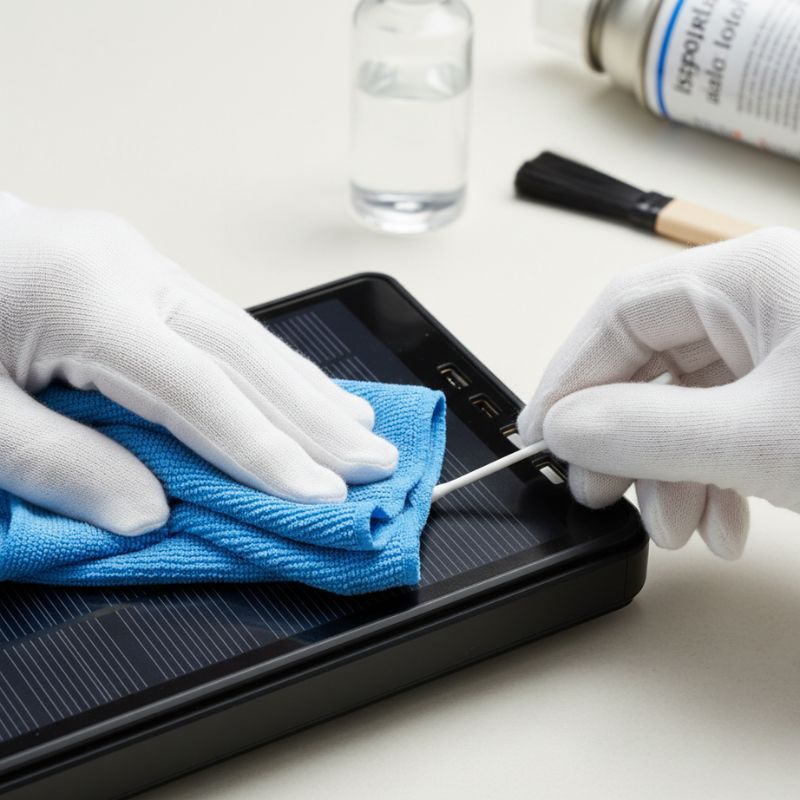
Panel surface cleanliness directly affects charging efficiency. Dust, pollen, and water spots block sunlight and reduce output by 15-30% depending on accumulation. Clean panels monthly with microfiber cloths and distilled water—avoid harsh chemicals that damage protective films. For heavy soiling, isopropyl alcohol (70%) removes oils and residues without film damage.
Storage orientation matters more than commonly recognized. Panels left face-down on rough surfaces accumulate scratches that permanently reduce efficiency. When not in use, store devices panel-side up or in protective sleeves. Some procurement teams include basic protective cases in their orders—a small cost that significantly extends field life.
Battery Health Management
Lithium polymer cells last longest when maintained between 20-80% charge rather than repeatedly cycled from empty to full. For devices in storage, charge to approximately 50% and recharge every 3-4 months. Full discharge followed by months of storage permanently damages cell capacity.
Temperature during storage affects long-term health. Ideal storage conditions range from 15-25°C (59-77°F) in low humidity. High temperature storage accelerates capacity loss—a battery stored at 40°C (104°F) loses roughly twice the capacity of one stored at 25°C (77°F) over the same period. For warehouse storage, climate-controlled areas preserve battery performance better than outdoor sheds or vehicle storage.
Solar charging frequency impacts battery stress. Daily partial charges from solar panels are gentler on cells than weekly deep discharge followed by rapid wall charging. If your application involves infrequent use, prefer wall charging to preserve battery health. Solar charging works best for devices in continuous or frequent use where daily topping-up prevents deep discharge cycles.
Port and Seal Maintenance
Charging port contamination causes most preventable failures. Dust, pocket lint, and debris accumulate in USB ports and prevent proper connection. Compressed air removes loose material, while wooden toothpicks carefully extract compacted debris. Never use metal tools that can short pins or damage contacts.
Silicone seals require occasional inspection and light lubrication. After 12-18 months of field use, clean seals with water and apply a thin layer of silicone grease to maintain flexibility. Dry, cracked seals lose waterproof effectiveness but often still look intact during visual inspection. Gentle flexing reveals cracks invisible under normal conditions.
Port covers need careful attention. Forcing covers open against resistance damages hinge mechanisms and compromises seals. If covers become difficult to operate, identify the obstruction rather than applying more force. Often a small particle blocks the cover path—remove it before permanent damage occurs.
Warranty Coverage and What It Actually Protects
Warranty terms reveal manufacturer confidence in their durability claims. However, warranty language often excludes common failure scenarios, leaving procurement teams with unexpected replacement costs.
Standard Warranty Limitations
Most solar power bank warranties cover 12 months against manufacturing defects but exclude environmental damage, physical impact, and improper use. This creates gray areas around failures—a port seal that fails after nine months might represent a manufacturing defect or might result from improper storage. Without clear failure analysis, warranty claims often stall.
Battery capacity degradation typically receives limited coverage. Standard terms guarantee 80% capacity retention after 6-12 months, but testing this requires discharge equipment most users don’t have. Field teams reporting “shorter battery life” without quantified measurements find warranty claims difficult to pursue.
Physical damage exclusions cover obvious scenarios—cracked housings, broken panels—but interpretation varies for less visible damage. Internal component failure after a drop might be denied as physical damage even when external appearance looks fine. Some manufacturers require photographic evidence of any damage, while others request device return for evaluation.
Extended Protection Options
Commercial warranty extensions sometimes provide value, particularly for high-volume deployments. Look for coverage that includes battery capacity guarantees, extended time frames (24-36 months), and defined performance baselines rather than vague “defect” language.
Replacement programs offer another approach. Some suppliers provide advance replacement units for warranty claims, shipping a new device before receiving the failed unit. This minimizes operational disruption but requires trust between supplier and buyer. For established relationships, advance replacement programs significantly improve total cost of ownership.
Self-insurance through bulk ordering provides procurement teams another option. Ordering 110 units when you need 100 creates an internal replacement pool for field failures. This costs less than extended warranties when failure rates stay below 10% and eliminates warranty claim paperwork. However, it requires accurate failure rate estimates based on actual field conditions.
Field Deployment Scenarios and Durability Requirements
Different use environments demand different durability specifications. Understanding your actual deployment conditions prevents both over-specification (unnecessary cost) and under-specification (frequent failures).
Construction and Heavy Industry
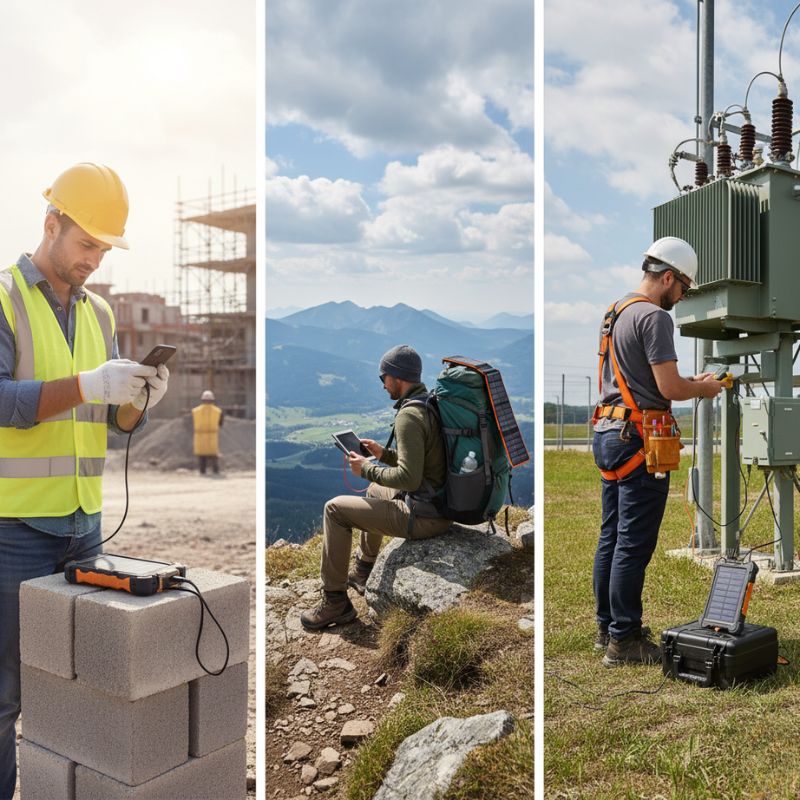
Construction environments combine multiple stress factors—dust, vibration, temperature extremes, rough handling. Solar phone charger units for these applications need IP67 waterproofing, reinforced housings, and shock-mounted internal components. Battery capacity matters less than physical resilience since wall charging often remains available.
Procurement teams should specify devices designed for impact rather than optimized for weight or aesthetics. Rubberized exteriors, reinforced corners, and recessed ports survive jobsite conditions better than slim consumer designs. Expect to pay 40-60% more for construction-grade specifications, but warranty claims drop proportionally.
Outdoor Recreation and Tourism
Guided tours, rental operations, and outdoor education programs need devices that handle casual outdoor use without requiring technical knowledge. Mid-range durability works well here—IP65 ratings, standard drop protection, user-friendly interfaces. These applications prioritize solar charging efficiency since wall power isn’t always accessible.
Battery capacity drives purchasing decisions for multi-day outdoor applications. A 20,000mAh unit provides enough power for 3-4 days of moderate smartphone use with partial solar recharging. Higher capacity models (30,000-42,000mAh) suit longer expeditions but add significant weight and bulk that outdoor users resist carrying.
Emergency Preparedness and Backup Power
Disaster preparedness scenarios combine unpredictable storage periods with demanding use when needed. Devices might sit unused for months then face intensive daily use during emergencies. This pattern stresses battery chemistry differently than regular use patterns.
Procurement specifications for emergency applications should emphasize storage stability—battery chemistry that retains charge during long idle periods, seals that don’t degrade without use, and shelf-stable construction. Some manufacturers offer “emergency” product lines specifically designed for infrequent use, though these often cost more than standard models.
Professional Field Services
Utility workers, field technicians, and inspection teams represent steady-state outdoor use—daily operation in various weather conditions. These applications need balanced specifications: adequate durability, sufficient capacity, reasonable weight, and good solar efficiency. Professional-grade equipment justifies higher costs through extended lifespan and reduced downtime.
For fleet deployments across service teams, standardizing on a single model simplifies training, maintenance, and spare parts inventory. The durability premium for professional equipment often pays back within 18-24 months through reduced replacement costs and better user satisfaction.
Cost-Per-Year Analysis: True Value Beyond Purchase Price
Initial purchase price represents only one component of total ownership cost. Durability directly impacts cost-per-year calculations through replacement frequency, warranty processing time, and productivity losses during device failures.
Calculating True Ownership Costs
A $25 solar power bank battery charger lasting 12 months costs $25 per year. A $45 unit lasting 36 months costs $15 per year despite the higher purchase price. Add warranty claim processing (typically 2-4 hours of administrative time per claim) and the budget option becomes more expensive.
Failure during use creates costs beyond replacement. A field team without backup power might lose productivity, miss scheduled contacts, or fail to document work properly. These operational costs vary by application but often exceed the device replacement cost itself.
Volume pricing complicates cost analysis. Buyers might secure budget units at 40% discount for orders above 500 pieces, making the per-unit cost competitive with mid-range quality. However, if failure rates exceed 30% annually, the bulk discount disappears into replacement costs. Calculate total ownership costs including projected failure rates rather than comparing purchase prices.
Durability Tiers and Recommended Applications
| Durability Tier | Initial Cost Range | Expected Lifespan | Best Applications | Cost Per Year |
|---|---|---|---|---|
| Professional | $45-$75 | 4-5 years | Daily outdoor use, harsh environments | $12-$19 |
| Commercial | $28-$45 | 2-3 years | Regular outdoor use, controlled environments | $12-$18 |
| Consumer | $15-$28 | 12-24 months | Occasional use, indoor-outdoor transition | $12-$28 |
| Budget | $8-$15 | 6-12 months | Light use, indoor primary | $12-$30 |
The cost-per-year analysis reveals that durability tiers converge around $12-$18 annually when matched to appropriate applications. Professional equipment in harsh environments costs roughly the same per year as consumer equipment in protected environments. Mismatches drive costs up—professional equipment for light indoor use wastes money, while budget equipment for heavy outdoor use burns through replacements.
Procurement teams achieve optimal value by segmenting purchases based on actual deployment conditions rather than ordering uniform quality across all applications. Reserve professional-grade specifications for field teams in demanding environments. Use mid-range options for office workers who occasionally work outside. This segmentation captures cost benefits without compromising performance where it matters.
Selecting Suppliers: Beyond Product Specifications
Supplier selection affects long-term durability through manufacturing consistency, quality control processes, and post-sale support. The supplier relationship matters as much as the initial product quality.
Manufacturing Consistency Indicators
Established manufacturers maintain process controls that deliver consistent quality across production runs. Ask potential suppliers about their quality control protocols—how frequently they test random samples, what happens when defect rates exceed targets, how they verify component quality from sub-suppliers.
Production volume provides insight into process maturity. A supplier producing 50,000 units monthly has different capabilities than one producing 2,000 units. Higher volume typically indicates established processes, though it doesn’t guarantee quality. Some high-volume operations prioritize speed over quality control, while some smaller operations maintain rigorous standards.
Factory certification offers another data point. ISO 9001 certification indicates documented quality management systems, though certification alone doesn’t ensure output quality. Request recent audit reports rather than just certificates—audit findings reveal how well systems actually function versus how well they’re documented.
Working with Direct Manufacturers
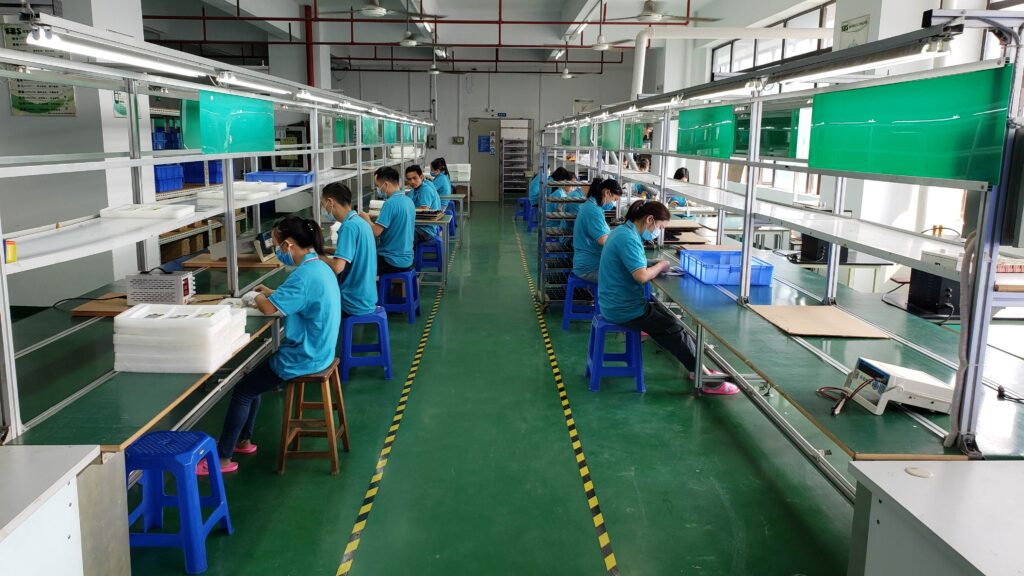
Shenzhen Hedeli Technology Co., Ltd. operates as a direct manufacturer with over 10 years of experience in mobile accessories and consumer electronics. Our factory in Dongguan maintains monthly capacity of 50,000 units, supplying importers, distributors, and wholesale customers globally. This manufacturing foundation enables us to control quality at every production stage rather than relying on third-party assembly.
Direct manufacturer relationships provide advantages beyond pricing. When specification issues arise, you can discuss changes with engineers who design the products. When quality concerns emerge, you can request production adjustments rather than just switching suppliers. This responsiveness proves valuable for procurement teams managing complex deployments.
Our product range includes solar power banks from 10,000mAh to 42,000mAh capacity, with IP65 to IP67 waterproof ratings, wireless charging capabilities, and features tailored to different use scenarios. Each model undergoes drop testing, waterproof verification, and cycle life evaluation before entering production. We maintain testing documentation and can provide certification reports for procurement teams requiring verification.
For organizations evaluating solar power bank suppliers, direct manufacturer access reduces supply chain complexity. You can request customization for specific applications, coordinate delivery schedules around deployment timelines, and establish quality benchmarks aligned with your field conditions. Our headquarters in Shenzhen and showroom in Guangzhou welcome procurement team visits to review samples and discuss technical requirements directly.
Specification Checklist for Procurement Teams
Translating durability requirements into purchase specifications requires specific language that suppliers can verify. Vague requirements lead to mismatched expectations and disputes.
Physical Durability Specifications
Rather than requesting “durable construction,” specify measurable criteria:
- Drop test rating: 1.5 meters minimum, six-drop protocol (MIL-STD-810G Method 516.6)
- Shell material: High-density ABS with minimum 2mm wall thickness
- Corner reinforcement: TPU or rubber corner guards covering impact zones
- Weight range: 400-500 grams for 20,000mAh units (excludes lightweight or overweight extremes)
Environmental Protection Requirements
Waterproof specifications need precise language:
- IP rating: IP65 minimum, IP67 preferred for heavy outdoor use
- Certification: Third-party testing within past 12 months, documentation provided
- Port sealing: Silicone gaskets with spring-loaded covers, 500+ cycle life
- Temperature range: Operating -10°C to 60°C, storage -20°C to 70°C
Solar Panel and Battery Specifications
Solar charging performance requires verifiable testing:
- Panel type: Monocrystalline cells, 18% minimum efficiency
- Panel protection: ETFE film or equivalent UV-resistant laminate
- Charging rate: Specify under standard test conditions (1000 W/m² irradiance, 25°C)
- Battery grade: Class A cells, 500-cycle life to 80% capacity retention
- Battery management: Overcharge, over-discharge, short circuit, and temperature protection
Documentation Requirements
Request supporting documentation to verify specifications:
- Third-party test reports for drop testing, waterproof rating, and cycle life
- Material certifications for ABS plastic, battery cells, and solar panels
- Quality control protocols including sample testing frequency
- Warranty terms clearly defining coverage, exclusions, and claim process
These specifications create accountability. When devices fail to meet documented standards, you have grounds for warranty claims or supplier disputes. Without specific requirements, “durability” remains subjective and difficult to enforce.
Frequently Asked Questions
1. What capacity solar mobile phone charger works best for field teams?
A 20,000mAh capacity provides 3-4 full smartphone charges, adequate for most daily field operations with partial solar recharging. Teams working in remote areas without wall power access for extended periods should consider 30,000-42,000mAh models, though these add significant weight (600-800 grams). Assess actual power consumption patterns across your team before committing to high-capacity units that users might resist carrying due to weight.
2. How can buyers verify waterproof ratings before bulk orders?
Request certified IP rating documentation from third-party testing laboratories dated within the past 12 months. Legitimate certifications include specific test protocols used and pass/fail criteria. For high-value orders, consider arranging independent testing of sample units through electronics testing facilities. Some procurement teams include waterproof verification in their acceptance testing—simple immersion tests reveal obvious seal failures before accepting full shipments.
3. Do solar panels actually charge these devices effectively?
Solar charging efficiency depends heavily on conditions. Under direct sunlight with proper panel orientation, a quality 20,000mAh unit charges in 20-30 hours of sun exposure. Cloudy conditions, indirect angles, and partial shading extend this to 60-80 hours or more. Solar panels work best as supplemental power for devices in regular use, topping up charge during outdoor exposure. For applications requiring reliable daily full charges, solar panels alone won’t meet needs—wall charging should remain available as primary power source.
4. What minimum order quantities should buyers expect?
Direct manufacturers typically set MOQs around 100-500 units depending on customization requirements. Standard products with company logo printing might require 100-unit minimums, while custom housing colors or special features push minimums to 500-1,000 units. For procurement teams needing smaller quantities, working through distributors provides access to smaller lots at slightly higher per-unit costs. Contact us to discuss quantity requirements aligned with your deployment timeline and budget.
5. Can solar power bank specifications be customized for specific applications?
Yes, direct manufacturers can adjust specifications across capacity, waterproof ratings, solar panel size, port configuration, and physical dimensions. Customization typically requires minimum orders starting around 500 units and adds 4-8 weeks to production schedules. Common customization requests include increased battery capacity for extended field use, enhanced waterproofing for marine applications, and modified housing dimensions to fit specific carrying cases. Reach out to our technical team with your application requirements for detailed customization options.