

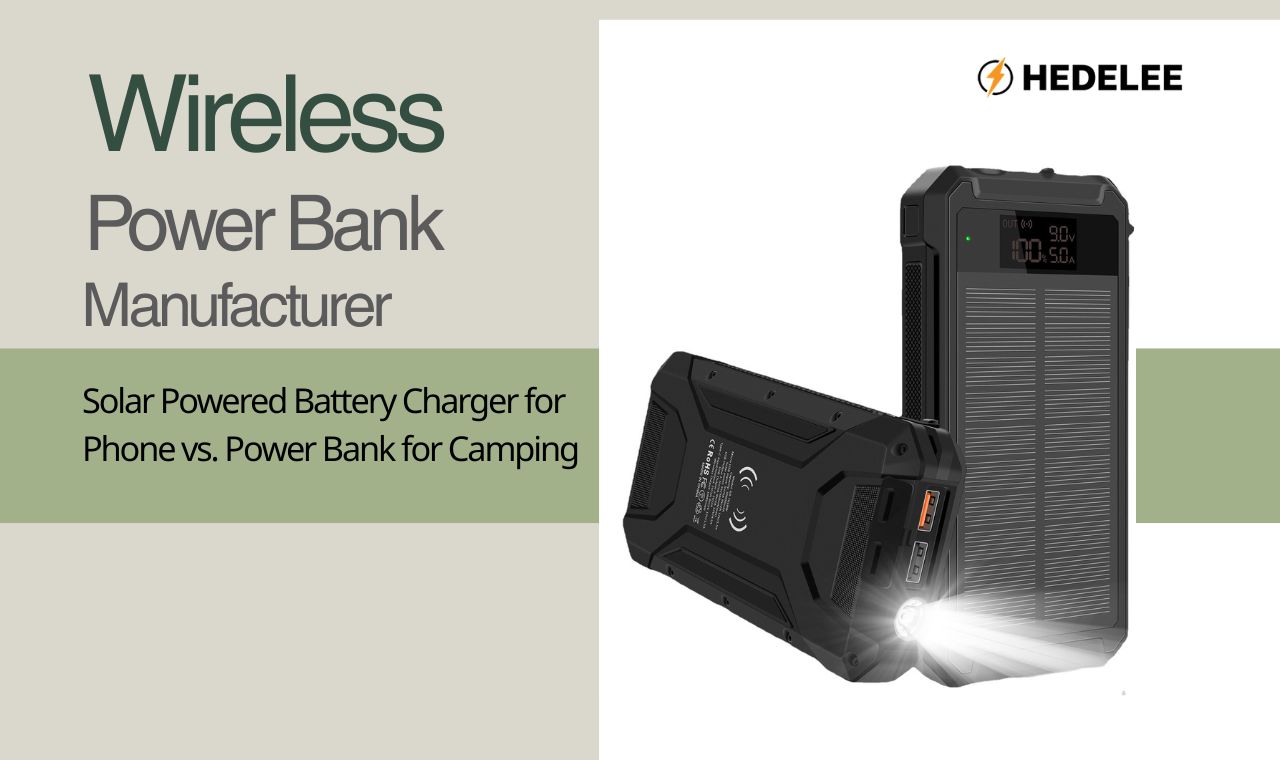
When you’re three days into a camping trip, your phone battery drops to 12%, and the nearest wall outlet is 40 miles away—what’s your backup plan? This is the exact scenario that sends outdoor enthusiasts and procurement teams alike searching for reliable portable charging solutions. A solar powered battery charger for phone offers one path, while a large-capacity power bank presents another. Each approach has distinct advantages, limitations, and use cases that matter when you’re sourcing products or planning outdoor adventures.
Shenzhen Hedeli Technology Co., Ltd. has spent nearly a decade manufacturing solar power banks and mobile charging accessories from our facilities in Shenzhen, Dongguan, and Guangzhou. We’ve seen firsthand how different charging technologies perform in real outdoor conditions. This comparison breaks down both options—large power banks and a solar powered battery charger for phone—so you can make an informed decision based on capacity needs, charging speed, durability, and value.
What Is a Solar Powered Battery Charger for Phone?
A solar powered battery charger for phone is a portable device that uses photovoltaic panels to convert sunlight into electrical energy, which then charges your phone or other small electronics. Unlike traditional power banks that you pre-charge from a wall outlet, these chargers generate their own electricity when exposed to sunlight.
Most models combine a small solar panel (typically 5W to 10W) with an internal battery that stores the energy collected during the day. You can then use that stored energy to charge your phone at night or during cloudy periods. Some designs include foldable panels for higher output, while others have compact, single-panel designs for easier carrying.
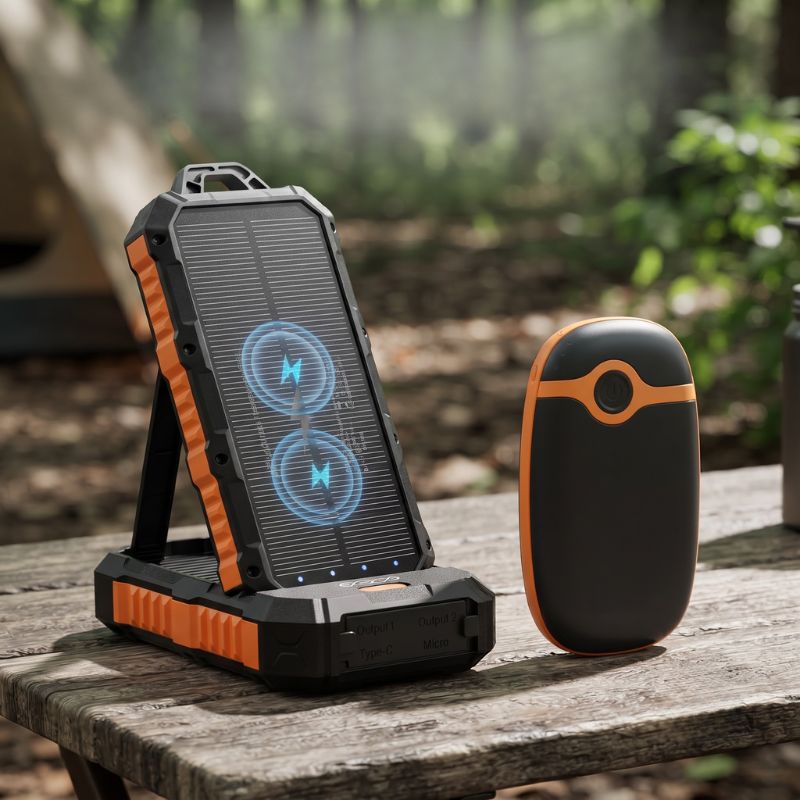
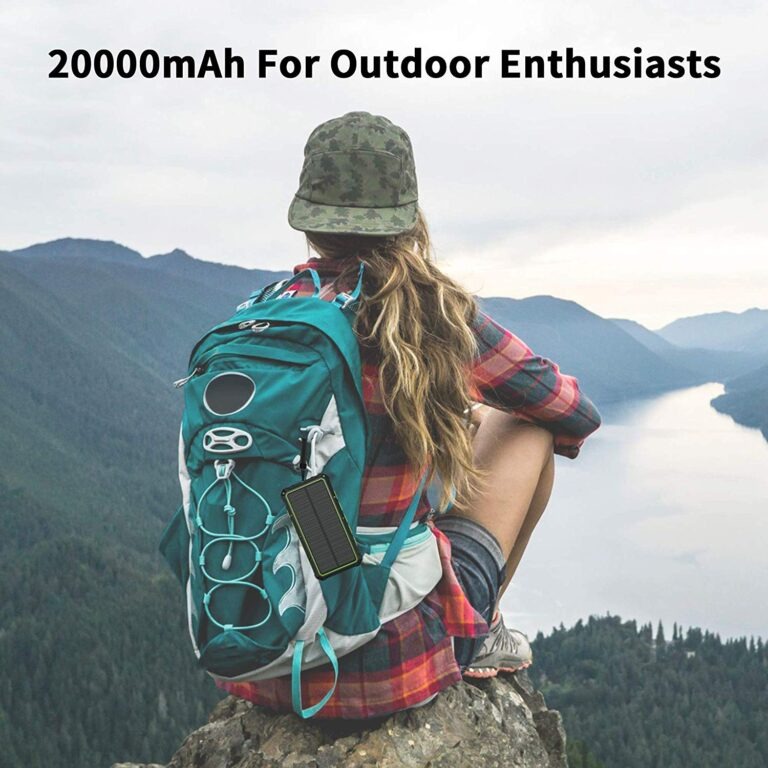
For camping trips, the appeal is obvious: as long as you have daylight, you have a power source. This makes a solar powered battery charger for phone particularly useful for extended trips where access to grid electricity isn’t available. You can strap the panel to your backpack during a hike, and by the time you set up camp, you’ve collected enough energy for an evening phone charge.
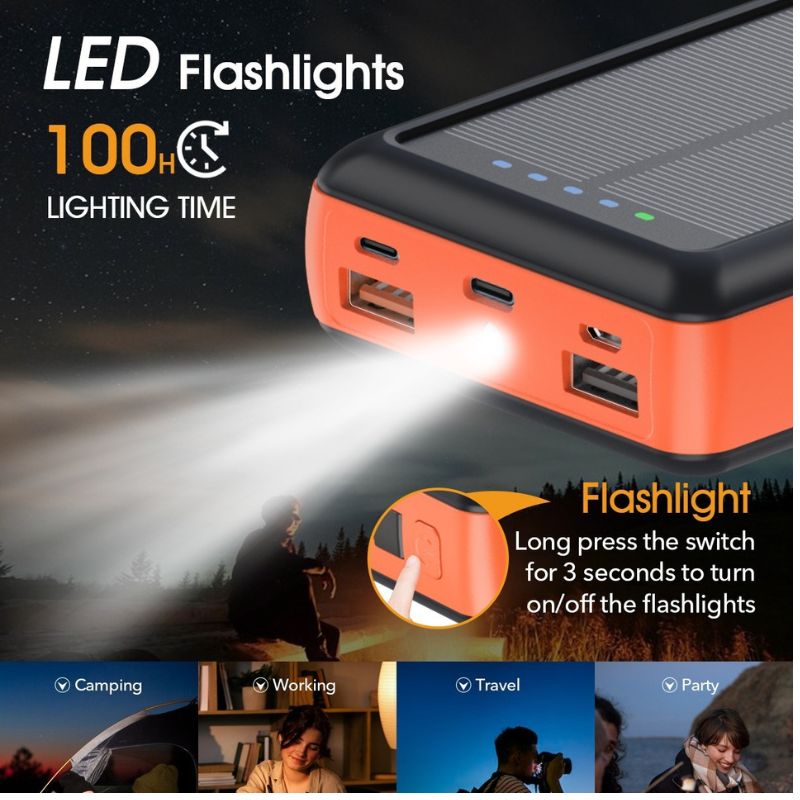
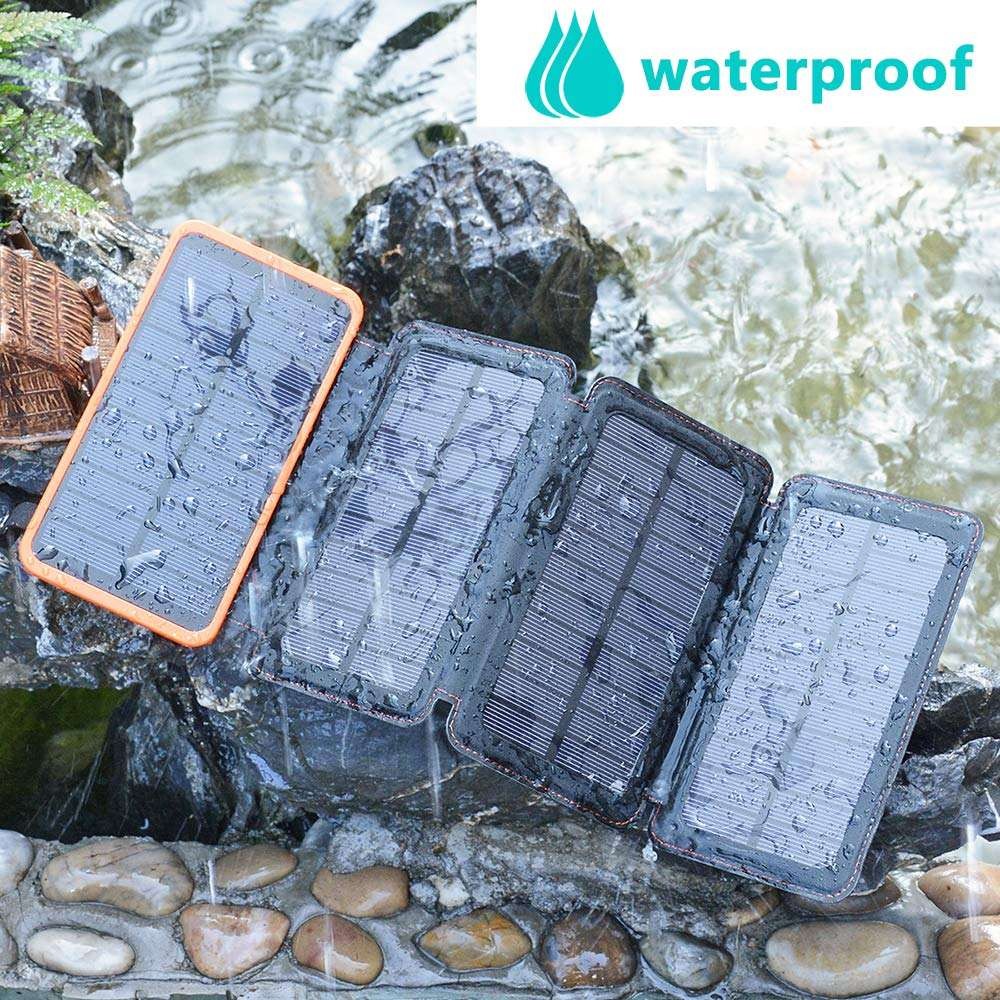
Modern solar chargers also include features that make them practical for outdoor use: waterproofing (IP65 or IPX4 ratings), LED flashlights for emergency lighting, and built-in cables so you don’t need to carry extra cords. Some models even support wireless charging, adding convenience for compatible phones.
What Is a Large Power Bank?
A large power bank is a high-capacity portable battery—typically 20,000mAh to 42,000mAh—that you charge from a wall outlet before your trip and carry with you to recharge your devices. These devices store a significant amount of energy and can charge a phone multiple times before needing a recharge themselves.
The main advantage of a large power bank is reliability and speed. You know exactly how much charge you have, how fast it outputs power, and how many phone charges you can expect. A 20,000mAh power bank, for example, can typically charge a standard smartphone 4–6 times, depending on the phone’s battery size and charging efficiency.
Large power banks also tend to charge phones faster than solar chargers. With output ratings of 5V/2.1A, 5V/3A, or even higher with fast-charging protocols like Qualcomm Quick Charge or USB Power Delivery, a power bank can charge your phone in the same time as a wall charger. Solar chargers, by contrast, often output at lower rates because they’re limited by solar panel efficiency and available sunlight.
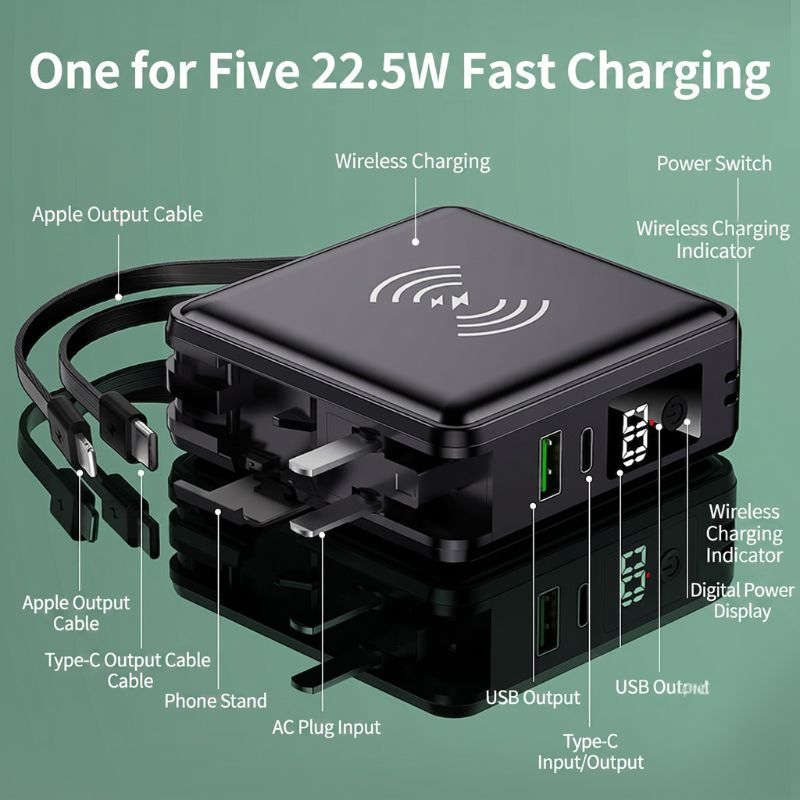
Many large power banks designed for outdoor use include rugged features: waterproof casings, shock resistance, built-in LED flashlights, and multiple USB ports for charging several devices simultaneously. Some models even include built-in cables (USB-C, Lightning, micro-USB) so you don’t need to carry separate cords.
How Do They Compare for Camping Trips?
When comparing a solar powered battery charger for phone against a large power bank for camping, several factors come into play. Here’s a breakdown of the key differences:
The comparison shows that neither option is universally better—each serves different camping scenarios. A solar powered battery charger for phone shines on longer trips where grid power is unavailable for days. A large power bank works better for weekend camping where you need fast, reliable charges and can recharge at home afterward.
For procurement teams and product managers evaluating which product to stock, understanding these use cases helps target the right customer segments. Campers heading into remote areas for extended periods need solar options. Weekend warriors and casual campers often prefer the simplicity and speed of a large power bank.
Many outdoor enthusiasts actually carry both: a large power bank for immediate charging needs and a solar charger as a backup that can recharge the power bank during the day. This combination gives you the benefits of both—fast charging when you need it and renewable energy to extend your power supply over longer trips.
Charging speed matters when you’re outdoors and need your phone for navigation, communication, or emergency situations. The speed difference between these two options is significant.
A large power bank typically outputs at 5V/2.1A (about 10.5W) or higher. With fast-charging protocols, some models can deliver 18W, 30W, or even 65W of power. This means you can charge a phone from 0% to 50% in about 30 minutes, and a full charge in 1.5 to 2 hours—comparable to a wall charger.
A solar powered battery charger for phone depends on sunlight intensity and panel efficiency. Most portable solar panels in these devices generate between 5W and 10W under direct sunlight. However, real-world output is often lower due to panel angle, atmospheric conditions, and partial shading. A solar charger might take 4–8 hours of direct sunlight to fully charge a phone directly from the panel.
Most solar chargers mitigate this by including an internal battery. The solar panel charges the internal battery during the day (which is more efficient than charging the phone directly), and then the battery charges the phone at a reasonable speed. This approach means you’re not limited to charging only when the sun is out.
For camping scenarios, this translates to a practical difference: with a large power bank, you can charge your phone quickly whenever needed. With a solar charger, you need to plan ahead—expose the panel to sunlight during the day, store energy in the internal battery, and charge your phone from that battery in the evening.
If you’re sourcing products for customers who prioritize speed, large power banks have the edge. For customers who value sustainability and extended off-grid capability, solar chargers provide a unique advantage that power banks can’t match.
What About Weight, Portability, and Durability?
Weight and portability are major considerations for campers who already carry tents, sleeping bags, food, and water. Every gram matters when you’re hiking to your campsite.
Weight Comparison
Most solar powered battery chargers for phone weigh between 300g and 600g, depending on capacity and panel size. Foldable solar chargers tend to be lighter and more compact when folded, making them easy to strap to a backpack. Compact models with integrated panels are slightly heavier but more durable since the panel is protected inside the device.
Large power banks range from 300g for a 20,000mAh model to 800g or more for a 42,000mAh version. The trade-off is clear: higher capacity means more weight. A 30,000mAh power bank typically weighs around 500g, while a 42,000mAh model can exceed 700g.
Portability Factors
Solar chargers often feature attachment points—carabiners, loops, or integrated straps—that let you secure them to a backpack or tent. Some foldable models pack down to the size of a notebook, making them easy to slip into a side pocket.
Large power banks are typically rectangular blocks that fit into a backpack pocket or side compartment. Models with built-in cables reduce the need to carry separate charging cords, which saves space and weight.
Durability and Weather Resistance
For camping use, durability is non-negotiable. Both solar chargers and power banks designed for outdoor use typically carry IP ratings:
-
IP65: Dust-tight and protected against water jets
-
IPX4: Protected against splashing water from any direction
-
IP67: Dust-tight and can be immersed in water up to 1 meter for 30 minutes
Solar chargers often have an advantage here because their solar panels are inherently weather-resistant—after all, they’re designed to be exposed to the elements. The internal battery and electronics are sealed inside a rugged housing.
Large power banks for outdoor use also feature rugged housings, often with rubberized coatings for shock resistance. The charging ports (USB-A, USB-C, micro-USB) need protective covers to prevent water and dust ingress when not in use.
When evaluating products for procurement, look for models that clearly state their IP rating and have port covers or sealed ports. Drop resistance is also worth checking—some outdoor power banks are rated for drops from 1 meter onto concrete.
How to Choose the Right Capacity for Camping
Capacity is one of the most important specifications when choosing between a solar powered battery charger for phone and a large power bank. Understanding how capacity translates to real-world phone charges helps you make the right choice.
Understanding mAh Ratings
Capacity is measured in milliampere-hours (mAh). A typical smartphone battery ranges from 3,000mAh (older or smaller phones) to 5,000mAh (modern flagships). However, due to voltage conversion losses and heat dissipation, a power bank’s rated capacity doesn’t translate directly to phone charges at a 1:1 ratio.
A practical rule of thumb: divide the power bank’s rated capacity by 1.5 to estimate actual output. So a 20,000mAh power bank delivers roughly 13,000mAh of usable charge, which can charge a 3,000mAh phone about 4 times or a 5,000mAh phone about 2.5 times.
Recommended Capacities for Different Trip Lengths
-
Weekend camping (1–2 nights): 10,000mAh is sufficient for 2–3 phone charges
-
Short trips (2–3 nights): 20,000mAh provides 4–6 phone charges
-
Extended trips (3–5 nights): 30,000mAh or combine a 20,000mAh power bank with a solar charger
-
Long expeditions (5+ nights): A solar powered battery charger for phone becomes essential, as even a 42,000mAh power bank will eventually deplete
Solar Charger Capacity Considerations
Solar chargers typically range from 10,000mAh to 30,000mAh in internal battery capacity. The key difference is that this capacity is continuously renewable—as long as you have sunlight, you can recharge the internal battery and keep charging your phone.
For a solar power bank with a 20,000mAh internal battery, you can expect:
-
4–6 phone charges per full battery
-
1–2 additional charges per day from solar panel input (depending on sunlight conditions)
This renewable capability is what makes solar chargers valuable for longer trips. Even if the initial capacity is lower than a large power bank, the ability to recharge during the day extends your power supply indefinitely.
When Should You Consider a Solar Power Bank?
A solar power bank combines both technologies: a substantial internal battery (like a traditional power bank) with integrated solar panels for recharging. This hybrid approach offers flexibility that neither a pure solar charger nor a pure power bank can match. For buyers looking for a power bank for solar recharging capability, this category bridges the gap.
Ideal Scenarios for Solar Power Banks
-
Multi-day hiking trips where you can’t carry enough battery capacity for the entire trip
-
Base camp setups where you can leave the solar panel in the sun during the day while you explore
-
Emergency preparedness kits where long-term power independence matters
-
Festival camping where you’re away from power for several days but have access to sunlight
When a Large Power Bank Makes More Sense
-
Winter camping where sunlight is limited and solar panels are less effective
-
Forest camping under dense tree canopy where direct sunlight is scarce
-
Short weekend trips where you don’t need renewable charging
-
Group camping where multiple devices need charging simultaneously and fast charging is priority
The Hybrid Approach
Many experienced campers carry a large power bank as their primary power source and a small solar charger as backup. The power bank handles immediate charging needs with fast output, while the solar charger provides emergency recharging capability for longer trips.
Some solar power banks are designed specifically for this hybrid use case. They feature large internal batteries (20,000mAh+) with fast-charging output, plus solar panels that can recharge the battery during daylight hours. This gives you the benefits of both: fast charging when you need it and renewable energy to extend your power supply.
For procurement teams evaluating which products to stock, solar power banks with 20,000mAh to 30,000mAh capacity represent a versatile middle ground that serves the widest range of camping scenarios. These models appeal to both casual campers and serious outdoor enthusiasts, making them a practical choice for product catalogs.
What Features Matter Most for Outdoor Phone Charging?
When evaluating solar powered battery chargers for phone or large power banks for camping use, specific features make a real difference in outdoor performance. Here’s what to look for:
Charging Output and Ports
-
Multiple USB ports: Allow charging multiple devices simultaneously
-
USB-C with Power Delivery: Enables fast charging for modern phones and tablets
-
Wireless charging: Convenient for compatible phones—just place the phone on the charging pad
-
Built-in cables: Reduce the need to carry separate cords; look for models with USB-C, Lightning, and micro-USB
Solar Panel Efficiency
-
Monocrystalline panels: More efficient (18–22%) than polycrystalline panels (15–18%)
-
Foldable panels: Offer more surface area for solar collection without adding much weight
-
Panel output: Look for 5W minimum for practical phone charging; 10W or higher for faster results
Durability Features
-
IP65 or higher rating: Ensures dust and water resistance for outdoor use
-
Shock-resistant housing: Protects against drops and impacts
-
Port covers: Prevent water and dust from entering charging ports
-
Built-in LED flashlight: Serves as emergency lighting and can be useful for night camping
Battery Management System (BMS)
A quality BMS protects against:
-
Overcharging and over-discharging
-
Short circuits
-
Temperature extremes
-
Voltage fluctuations
This protection extends the battery’s lifespan and ensures safe operation in varying outdoor conditions. For buyers and product managers, BMS quality is a key differentiator between budget and reliable products.
Additional Features to Consider
-
LED battery level indicators: Let you know how much charge remains
-
SOS signal mode: Some LED flashlights include an SOS pattern for emergencies
-
Compatibility with multiple devices: Check that the charger works with iPhone, Android, tablets, and other USB devices
-
Carrying case or pouch: Protects the device during transport
Real-World Camping Scenarios: Which Works Better?
Let’s look at specific camping scenarios to see how each type of charger performs in practice.
Scenario 1: Weekend Family Camping (2 Nights)
A family of four spends a weekend at a campsite. They have four phones, a tablet for the kids, and a portable speaker. Total battery capacity needed: about 20,000mAh.
Winner: Large power bank. A 30,000mAh power bank can handle all devices for two days with capacity to spare. Solar charging isn’t necessary since the trip is short, and the family can recharge the power bank at home afterward.
Scenario 2: Backcountry Hiking Trip (5 Days)
Two hikers are doing a 5-day backcountry route with no access to electricity. They need their phones for GPS navigation, emergency communication, and photos. Estimated daily phone usage: 3,000mAh per person.
Winner: Solar power bank. A solar powered battery charger for phone with 20,000mAh internal capacity provides 6–7 phone charges when fully charged. With 1–2 additional charges per day from solar input, the hikers can maintain their phone battery throughout the trip without running out of power.
Scenario 3: Winter Camping (3 Nights)
A camper spends three nights winter camping in a forested area. Daylight is limited to about 8 hours, and overcast skies reduce solar panel efficiency significantly.
Winner: Large power bank. Solar panels are much less effective in winter conditions due to shorter daylight hours, lower sun angle, and potential snow cover on panels. A 30,000mAh or 42,000mAh power bank provides reliable power regardless of weather conditions.
Scenario 4: Music Festival Camping (4 Days)
A group attends a multi-day outdoor music festival. They need to keep their phones charged for photos, communication, and mobile payments. They have access to sunlight but no reliable power outlets.
Winner: Solar power bank. The group can set up the solar panel at their campsite during the day while they’re at the festival, and charge their phones from the internal battery at night. A 25,000mAh solar power bank can handle 5–6 phone charges per day with solar input supplementing the internal battery.
Product Recommendations: Top Solar Power Banks for Camping
Based on our manufacturing experience and product testing, here are specific models worth considering for different camping needs:
For Balanced Performance: 20,000mAh Models
The 20,000mAh Solar Power Bank with Dual Inputs, Waterproof, Flashlight (HDL-218) offers a well-rounded feature set. With 20,000mAh capacity, wireless charging support, dual inputs, and a built-in flashlight, it covers the essentials for most camping scenarios. The IP65 waterproof rating ensures it survives rain and splashes.
For those who need more solar collection area, the Foldable 20,000mAh Solar Power Bank with LED Lights provides a foldable panel design that increases solar charging efficiency while remaining compact for transport.
For High Capacity: 30,000mAh+ Models
When extended trips demand more power, the 36,000mAh Solar Power Bank with Three Built-in Cables (HDL-531) eliminates the need to carry separate charging cords. The 30,000mAh Solar Charger with USB Type-C and IP65 Rating (HDL-528) adds fast USB-C charging to the mix.
For maximum capacity, the 42,000mAh Solar Power Bank with Four Built-in Cables (HDL-628) provides enough power for a week-long camping trip, with four integrated cables that cover virtually any device.
For Lightweight Needs: 10,000mAh to 25,000mAh
The 10,000mAh Outdoor Solar Power Bank is ideal for day hikers and weekend campers who want solar backup without extra weight. For slightly more capacity, the 25,000mAh Solar Charger with Dual USB Ports offers a good balance of power and portability.
For Rugged Durability
The Waterproof 20,000mAh Solar Power Bank with Fast Charging and the Dual USB 20,000mAh Solar Power Bank (HDL-519X) both feature rugged, waterproof designs built for harsh outdoor conditions.
The 24,000mAh Solar Power Bank with Built-in Cables (HDL-529) and the Camping Gear Solar Charger for Electronic Devices (HDL-519) round out the collection with versatile options designed specifically for outdoor use.
You can explore the full range of solar power bank products to find the right fit for your specific needs.
How to Get More from Solar Charging While Camping
Getting the most from a solar powered battery charger for phone requires understanding how solar panels work and optimizing their performance in outdoor conditions.
Position the Panel Correctly
Solar panels generate maximum power when they’re perpendicular to the sun’s rays. Throughout the day, the sun’s position changes, so you’ll need to adjust the panel angle periodically. A general rule: face the panel south (in the Northern Hemisphere) and tilt it at an angle roughly equal to your latitude.
Avoid Shading
Even partial shading on a solar panel can dramatically reduce output. A shadow covering just 10% of the panel can reduce power generation by 50% or more, depending on the panel’s cell configuration. Place your solar charger in a spot with full, unobstructed sunlight.
Use the Internal Battery Strategy
Instead of charging your phone directly from the solar panel, charge the power bank’s internal battery during the day, then charge your phone from the battery in the evening. This approach is more efficient because:
-
The internal battery accepts charge at varying rates, accommodating fluctuating sunlight
-
You can charge your phone at a consistent speed from the battery
-
You’re not limited to charging only when the sun is out
Keep the Panel Clean
Dust, dirt, and pollen on the solar panel reduce its efficiency. Wipe the panel clean with a soft cloth periodically, especially in dusty or windy conditions. A clean panel can generate 15–25% more power than a dirty one.
Monitor Weather Conditions
Solar panels still generate power on cloudy days, but output drops significantly—typically to 10–25% of rated capacity. Plan accordingly by ensuring your internal battery is fully charged before periods of expected bad weather.
For more technical details on solar charging efficiency, the U.S. Department of Energy’s solar energy technology basics provides useful background information on how photovoltaic technology works.
What Should Buyers Look for When Sourcing Solar Chargers?
For procurement teams and product managers evaluating solar powered battery chargers for phone, specific technical and commercial factors determine product quality and customer satisfaction.
Panel Type and Efficiency
Monocrystalline solar panels offer the highest efficiency (18–22%) and perform better in low-light conditions. Polycrystalline panels are less expensive but also less efficient (15–18%). For outdoor products where panel size is limited, monocrystalline panels provide better performance per square centimeter.
Battery Cell Quality
The internal battery cells determine the product’s lifespan, safety, and performance. Look for:
-
Lithium polymer (Li-Po) cells: Lighter, more flexible shape, and generally safer than lithium-ion
-
Lithium-ion (Li-ion) cells: Higher energy density but require more robust protection circuits
-
Cell grade: A-grade cells from reputable manufacturers (Panasonic, LG, Samsung) offer better consistency and longevity
Certifications and Compliance
Solar power banks and chargers should carry relevant certifications:
-
CE: Required for European markets
-
FCC: Required for US markets
-
RoHS: Ensures restriction of hazardous substances
-
UN38.3: Required for shipping lithium batteries internationally
-
MSDS: Material Safety Data Sheet for battery products
These certifications are not optional for legitimate international trade. They ensure the product meets safety, environmental, and transportation standards.
Manufacturing Quality Indicators
When evaluating suppliers, look for:
-
Production capacity: Can they meet your order volumes consistently?
-
Quality control processes: Do they test each unit before shipping?
-
Customization options: Can they adjust capacity, color, packaging, or branding to your specifications?
-
Lead times: What’s the typical production time for your order quantity?
-
Sample availability: Can you test products before committing to a bulk order?
Shenzhen Hedeli Technology Co., Ltd. operates a factory in Dongguan with a monthly capacity of 50,000 units, serving importers, distributors, and wholesalers. Our headquarters in Shenzhen and showroom in Guangzhou provide convenient access for inspection visits and product evaluation.
For reference on battery safety standards, the IEEE standard for portable rechargeable batteries outlines industry-standard practices for mobile device batteries.
Making the Right Choice for Your Camping Power Needs
The decision between a large power bank and a solar powered battery charger for phone comes down to your specific camping style, trip duration, and power needs.
Choose a Large Power Bank If:
-
Your trips are 1–3 days
-
You need fast charging for multiple devices
-
You camp in winter or shaded areas with limited sunlight
-
You want predictable, reliable power without weather dependence
-
You’re charging power-hungry devices like tablets or cameras
Choose a Solar Powered Battery Charger for Phone If:
-
Your trips extend beyond 3 days
-
You camp in sunny, open areas
-
You want renewable, self-sustaining power
-
You’re charging primarily phones and small devices
-
You value energy independence over maximum charging speed
Choose a Solar Power Bank (Hybrid) If:
-
You want the benefits of both technologies
-
Your trips vary in length and conditions
-
You want a single product that handles multiple scenarios
-
You’re stocking products for diverse customer needs
For most camping applications, a solar power bank with 20,000mAh to 30,000mAh capacity offers a balanced combination of power, portability, and renewable energy capability. These models serve the widest range of users and camping scenarios.
As the original manufacturer, Shenzhen Hedeli Technology Co., Ltd. offers direct access to our full range of solar power bank products without intermediary markups. Whether you’re sourcing products for retail, distribution, or brand customization, working directly with the factory means you get competitive pricing, consistent quality, and direct technical support from our engineering team. Reach out to discuss your requirements, request product samples, or get a detailed quote for your order quantity.
Frequently Asked Questions
1. What is the minimum order quantity for solar power banks?
Minimum order quantities typically start at 500–1,000 units for standard models, depending on the specific product and customization requirements. Custom branding, packaging, or color options may have higher MOQs. Reach out for detailed specifications and MOQ information for your desired model.
2. Can solar power banks be customized with our brand logo?
Yes, we offer OEM and ODM customization including logo printing, custom packaging, color options, and capacity adjustments. Sample production typically takes 7–10 days after design confirmation. Contact us to discuss your branding requirements.
3. Do solar power banks comply with international safety standards?
Our solar power banks carry CE, FCC, RoHS, and UN38.3 certifications required for international shipping and sales. Each product undergoes quality testing before shipment. Request our certification documents for any specific market requirements.
4. What is the typical production lead time?
Standard production lead time is 15–25 days for most order quantities, depending on the model and order volume. Customized orders may require additional time for sample approval and tooling. Rush production is available for urgent orders—reach out to discuss your timeline.
5. Can we request product samples before placing a bulk order?
Yes, we provide samples for product evaluation before bulk orders. Sample costs are credited toward your bulk order when confirmed. This allows your team to test performance, build quality, and charging efficiency before committing to production quantities.