

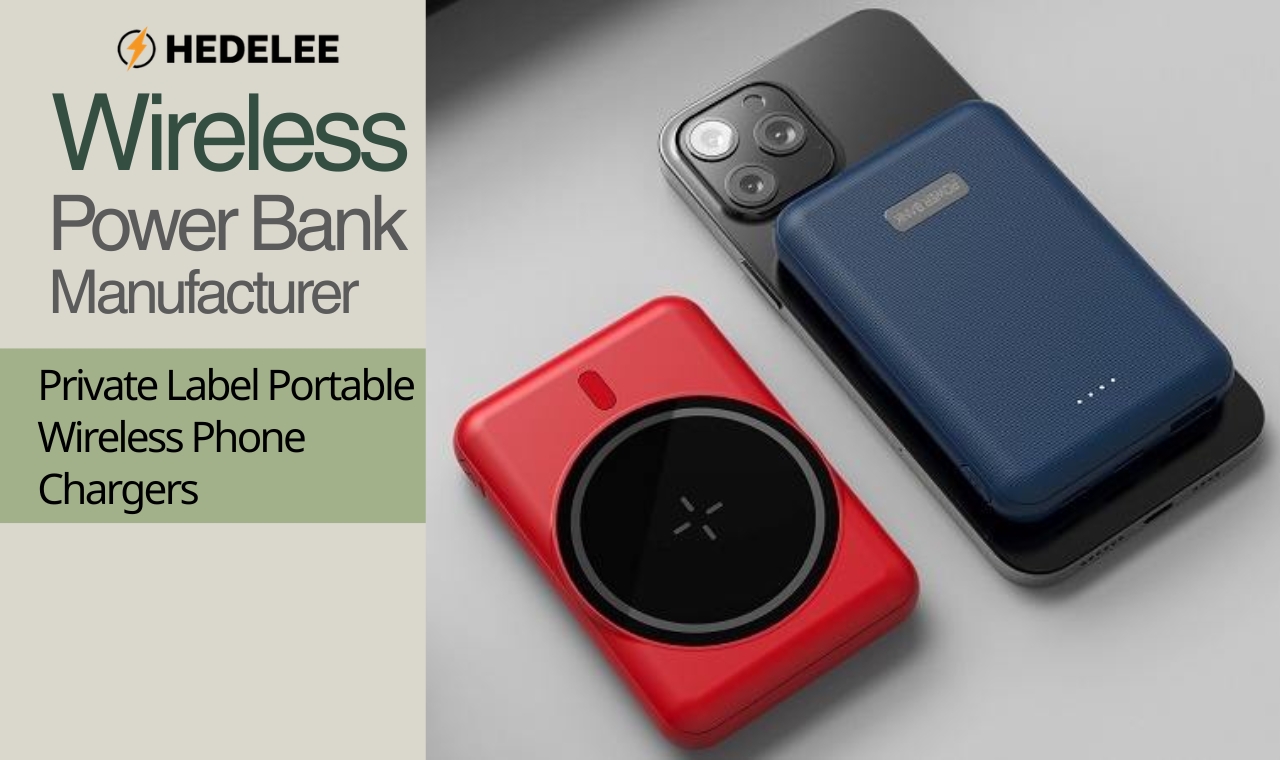
EA brand owner can bring a portable wireless phone charger to market in about 30 to 60 days by working directly with a factory. The core technology is already proven and mass-produced. Your real job is to shape it — capacity, design, logo, and packaging — into a product that clearly carries your name.
Demand for cordless charging keeps climbing. Most phones now ship with Qi and Qi2 support built in, so buyers expect a pad or power bank that simply works the moment a phone touches it. That expectation creates a steady, repeatable market for private label sellers.
This guide is written for distributors, retailers, and brand owners — not for shoppers. So we skip the “best charger to buy” tips and focus on production instead.
Below, you will learn how OEM and ODM manufacturing works, what MOQ to expect, which certifications matter for export, and how to brand a wireless power bank so it stands out on a shelf or a product page.
Quick Answer: To launch a private label portable wireless phone charger, you partner with a factory that offers OEM or ODM production, set your capacity and design, add your logo and custom packaging, then confirm export certifications such as CE, FCC, and UN38.3. Typical minimum orders start near 500 to 1,000 units.
Why Brand Owners Launch Their Own Portable Wireless Phone Charger Line
Brand owners launch a private label portable wireless phone charger because the demand is stable, the margins are healthy, and the product fits almost any store. Phone accessories sell year-round. A charger with your logo also builds loyalty, because customers see your name every single day.
The market backs this up. Global demand for power banks continues to grow as people carry more devices and travel more often. According to figures published by market research firms like Grand View Research, the power bank category has expanded steadily for years and shows no sign of slowing.
Wireless charging adds fresh appeal on top of that. The Wireless Power Consortium manages the Qi charging standard, which most modern phones now follow. Because the standard is shared, a well-built charger works across many brands at once. That reduces returns and support headaches for your customers.
There is also a branding upside. A charger is a small, everyday object. When your logo sits on it, your name travels — into offices, cars, gyms, and airport lounges. Few products give that kind of daily visibility for such a low unit cost.
OEM vs. ODM: Two Ways to Build Your Product
ODM and OEM are the two main production models. OEM (Original Equipment Manufacturer) means the factory builds a product to your exact design. ODM (Original Design Manufacturer) means you brand an existing factory design and adjust the details. Both work well, but they suit different budgets and timelines.
What OEM Means for Your Brand
With OEM, you control the design. You provide the specs, the housing shape, the circuit choices, and sometimes the tooling. The factory then builds it for you. This route gives you a truly unique wireless portable charger, but it costs more and takes longer, because new molds and testing add weeks.
OEM fits brands that want a signature look or a feature no rival has. So it works best when volume is high enough to absorb the tooling cost.
What ODM Means for Your Brand
With ODM, you start from a proven factory model and make it yours. You pick the color, add your logo, choose the packaging, and sometimes tweak the capacity. Because the base design already exists, you skip most tooling costs and launch faster.
ODM is the popular choice for first-time brand owners. Moreover, it lowers risk, since the product is already tested and certified.
| Factor | OEM (your design) | ODM (branded existing design) |
|---|---|---|
| Design control | Full — built from your specs | Partial — adjust color, logo, features |
| Tooling cost | High (new molds) | Low or none |
| Time to launch | 60–120 days | 30–60 days |
| Best for | Unique, high-volume lines | First launches and fast rollouts |
| Typical MOQ | Higher (1,000+) | Lower (500–1,000) |
| Risk level | Higher | Lower |
MOQ and Real Startup Costs for a Wireless Power Bank
Most factories set a minimum order quantity (MOQ) between 500 and 1,000 units for a private label wireless power bank. Simple logo and color changes sit at the low end. Custom molds, unusual capacities, or special packaging push the number higher. Your unit price then drops as your order grows.
Startup costs are lower than many owners fear. Beyond the units themselves, you mainly budget for logo setup, packaging design, sample fees, and certification. Let’s break down the two parts that shape your final number.
Typical MOQ Ranges by Order Type
A basic ODM order with a printed logo often starts near 500 units. A color-matched housing may need 1,000. Full OEM builds with new tooling usually begin at 1,000 to 3,000, because the factory must recover mold costs across the run.
Ordering more per run lowers your cost per piece. So many brands start small to test the market, then scale once sales prove the demand.
What Shapes Your Unit Price
Several factors move the price. Battery capacity matters most — a 5,000mAh cell costs less than a 20,000mAh one. Cell type also counts, since lithium polymer packs cost more than standard lithium-ion but run slimmer and safer.
Extra features add cost too. A built-in cable, a magnetic ring, a phone stand, or fast charging each raise the price a little. Packaging is the last lever. A plain box is cheap; a full retail package with inserts and printing costs more but lifts shelf appeal.
Customizing and Branding Your Portable Wireless Phone Charger
You can customize almost every part of a portable wireless phone charger — the capacity, the shape, the surface finish, the logo, and the box it ships in. Factories print or engrave your logo, match brand colors, and add features like magnetic alignment or a fold-out stand. These choices turn a generic unit into a branded product.
Good branding is not just a logo. It is the whole experience a customer holds. So treat the hardware and the packaging as one connected decision.
Hardware and Feature Choices
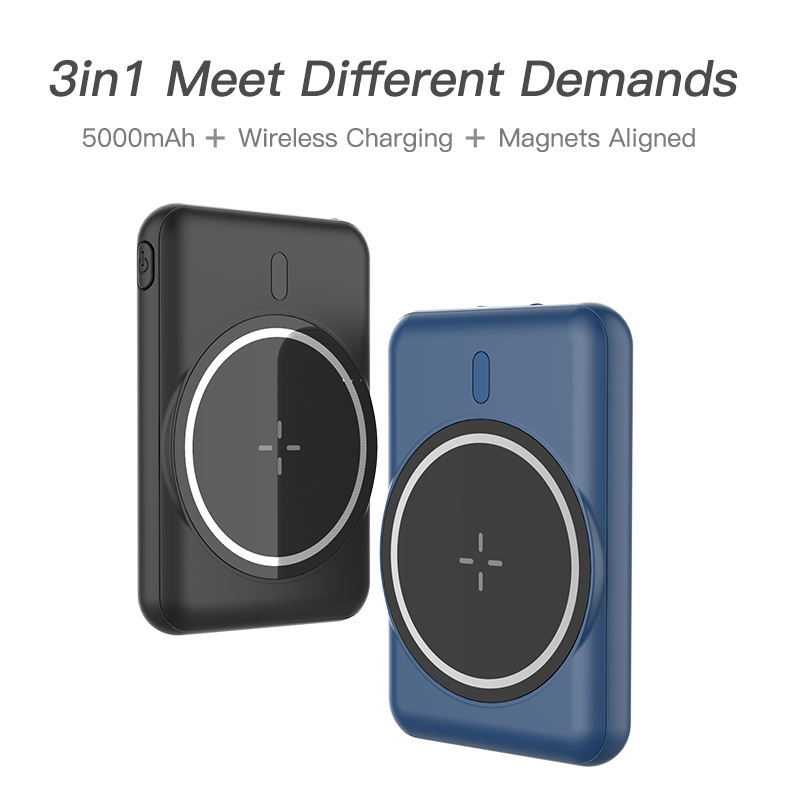
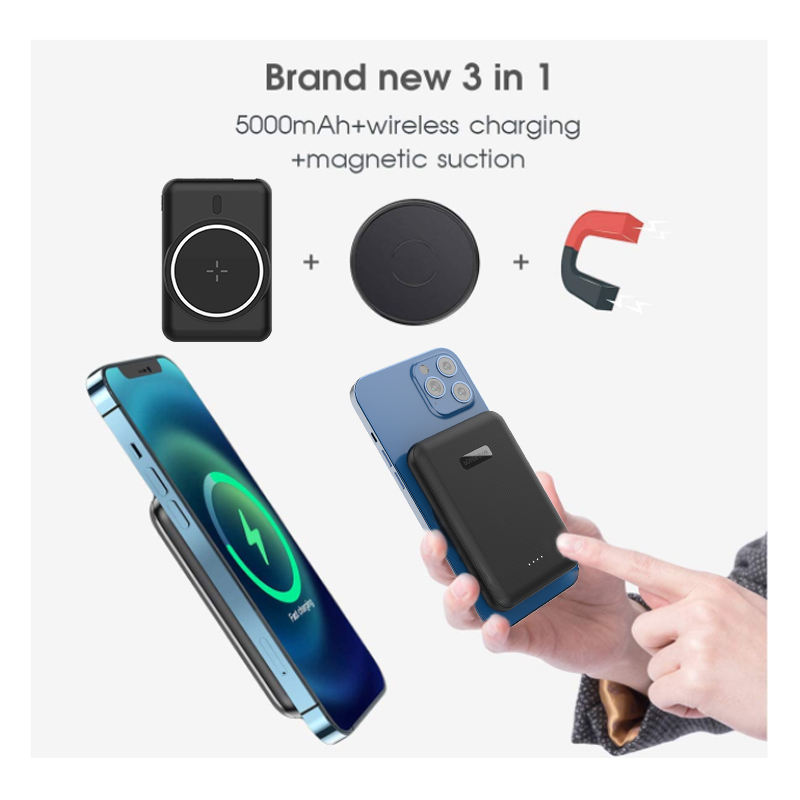
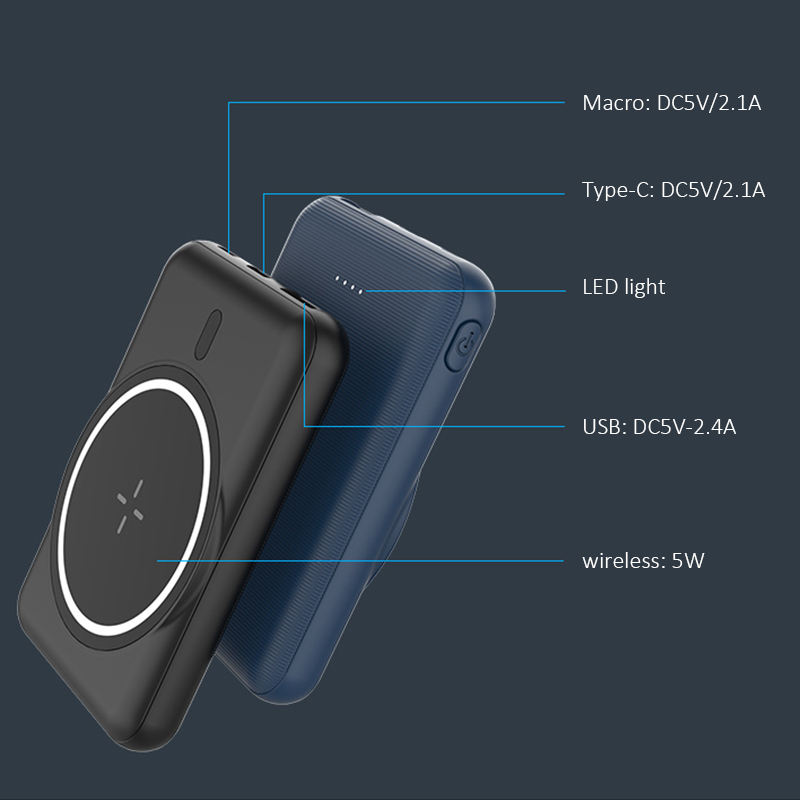
Start with capacity, because it defines the use case. A slim 5,000mAh unit suits daily top-ups, while a 20,000mAh pack suits travel and the outdoors. The magnetic 3-in-1 wireless charge 5000mAh mini power bank shows how a compact, magnet-aligned design can serve phones, earbuds, and watches at once.
Next, pick your feature set. Magnetic rings help the charging coil line up with the phone, which improves speed and reduces heat. A built-in stand adds value for video calls — the 10000mAh wireless portable charger with phone holder is a clear example of that dual-purpose design.
You can also widen your line for rugged buyers. An outdoor solar power bank with a hand-crank and built-in cable targets campers and emergency-kit shoppers, a segment most accessory brands ignore.
Logo, Color, and Packaging
Branding sits on top of the hardware. Factories apply your logo by silk-screen printing, UV printing, or laser engraving. Laser engraving lasts longest and looks clean on metal or matte finishes. Color matching follows a Pantone reference, so your product matches the rest of your brand.
Packaging carries the final impression. You can order plain boxes for online sales or full retail packaging for stores. Custom inserts, printed manuals, and branded cables all lift the perceived value. Because that unboxing moment shapes reviews, it is worth the small extra cost.
Certifications Your Wireless Portable Charger Needs to Sell Abroad
A private label wireless portable charger needs safety and compliance certifications before it can ship across borders. The core set includes CE for Europe, FCC for the United States, RoHS for hazardous substances, and UN38.3 for lithium battery transport. A reliable factory handles most of this testing for you.
These are not optional. Customs, retailers, and shipping carriers all check them. So confirm each certificate before your first bulk order leaves the factory.
| Certification | Region / Purpose | Why It Matters |
|---|---|---|
| CE | European Union | Legal to sell in the EU market |
| FCC | United States | Controls electromagnetic interference |
| RoHS | EU + widely accepted | Limits lead, mercury, and other toxins |
| UN38.3 | Global shipping | Certifies lithium cells are safe to transport |
| UL | United States | Adds trusted safety proof for retail |
Battery transport rules deserve extra care. Lithium cells are classed as dangerous goods, so carriers follow strict handling rules set out in the IATA lithium battery guidance. A missing UN38.3 report can freeze a shipment at the airport.
Wireless output also faces radio rules. Because a charger emits a signal, it must pass electromagnetic tests. In the United States, that falls under the FCC equipment authorization program. A trusted supplier keeps these reports on file and shares them on request.
Frequently Asked Questions
How do I start my own brand of portable wireless phone chargers?
You start by choosing a factory that offers OEM or ODM production for a portable wireless phone charger. Then you set the capacity, design, logo, and packaging, request samples, confirm certifications, and place your first order. Most first launches move from idea to delivery in 30 to 60 days.
What is the MOQ for a private label wireless power bank?
The MOQ for a private label portable wireless phone charger usually falls between 500 and 1,000 units. Simple logo and color changes sit near 500, while custom molds or special packaging push it higher. Larger orders lower your cost per unit, so many brands scale up after a test run.
What is the difference between OEM and ODM?
OEM means the factory builds a product from your own design and specs. ODM means you brand and lightly adjust an existing factory design. OEM gives you a unique wireless portable charger but costs more and takes longer. ODM is faster, cheaper, and lower risk for new brands.
What certifications does a wireless charger need to sell internationally?
A portable wireless phone charger typically needs CE for Europe, FCC for the United States, RoHS for material safety, and UN38.3 for lithium battery shipping. Some markets also expect UL. A capable factory runs this testing and provides the reports, which keeps your product legal at customs and in stores.
How long does it take to launch a private label charger?
An ODM portable wireless phone charger with your logo and packaging usually takes 30 to 60 days from approval to delivery. A full OEM build with new molds takes longer, often 60 to 120 days. Sample rounds, certification, and production volume all affect the final timeline.
Are cordless phone chargers profitable to sell?
Yes. Cordless phone chargers carry strong margins because unit costs stay low and demand runs all year. A branded portable wireless phone charger also builds repeat business, since happy buyers trust your name for future accessories. Profit grows further as order volume lowers your cost per piece.
Turn a Product Search Into a Real Partnership
Launching a private label portable wireless phone charger is far more reachable than most brand owners assume. The technology is mature, the supply chain is ready, and the branding options are wide open. Your main decisions are the model, the features, the certifications, and the factory you trust to deliver on time.
The factory choice matters most. A strong partner guides you through OEM and ODM options, handles testing, meets a fair MOQ, and keeps quality steady across every run. That support is what turns a single order into a lasting product line.
At Solar Power Bank, we believe strong partnerships create better products and long-term success. Over the years, we have worked closely with distributors, retailers, wholesalers, and brand owners worldwide to deliver reliable charging solutions built for real market needs. We help you move from a first sample to a shelf-ready range with your name on it.
Ready to build your own line? Browse our full wireless power bank product range and reach out to start a factory-direct partnership today.