

Dead phones stall field work, delay approvals, and leave teams offline when grid power is nowhere nearby. Procurement teams and product managers keep asking the same practical question: which form of solar power for charging phones actually delivers usable energy outdoors, and which options only look good on a spec sheet?
This guide explains how portable solar charging works, what separates a usable solar power bank from a weak one, and how to match capacity, panels, and ports to real buyer needs. You’ll also see how factory-built options from Shenzhen Hedeli Technology Co., Ltd. (Hedelee) support wholesale and brand programs with steady monthly supply.
Why Solar Power for Charging Phones Matters for Buyers
Phone batteries still run out. That is not a lifestyle issue for outdoor crews, rescue teams, tourism operators, or retail buyers stocking camping gear—it is an operational risk. A wall outlet solves the problem at home. Away from buildings, a solar phone charger or solar powered power bank becomes the backup that keeps devices online.
Buyers care about three outcomes:
Enough stored energy to finish a day or multi-day trip
Solar input that can refill the pack when grid charging is impossible
Build quality that survives rain, dust, drops, and repeated shipping
A solar cell phone charger is not magic. It converts light into electricity, stores it (or passes it through), and delivers regulated power to USB or wireless coils. When you understand that chain, product selection becomes clearer and RFQs get more accurate.
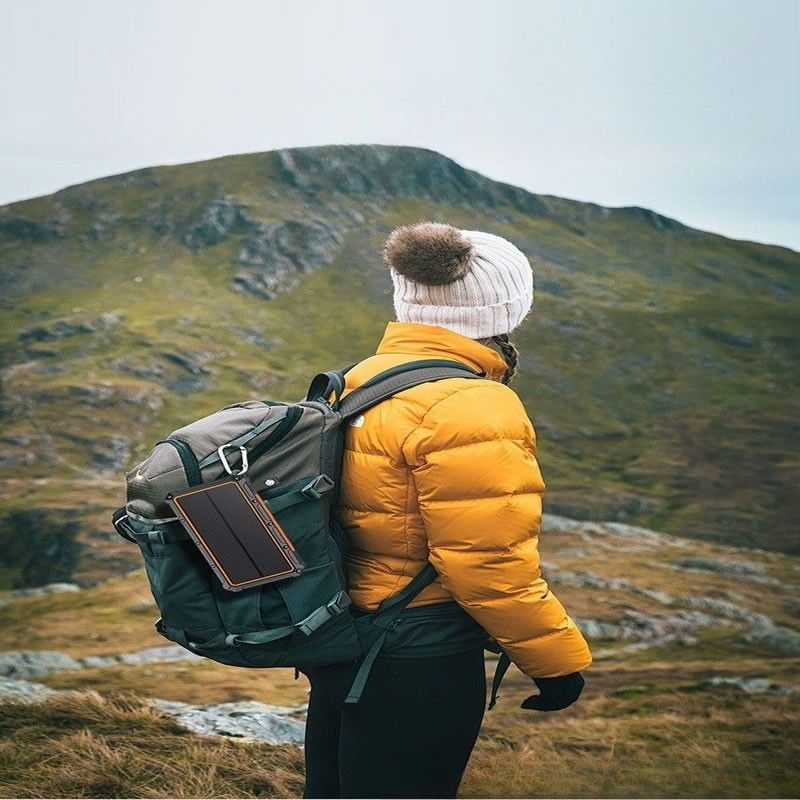
How Solar Power for Charging Phones Works
At the core is the photovoltaic effect. When sunlight hits semiconductor material in a solar cell, photons free electrons and create direct current (DC). The U.S. Energy Information Administration explains that only absorbed photons generate electricity, and that PV cells produce DC suitable for charging batteries and DC devices (EIA – Photovoltaics and electricity). The U.S. Department of Energy describes the same chain: sunlight absorbed by PV cells creates electrical charges that flow in response to the cell’s internal field (DOE – How does solar work?).
In a portable solar mobile phone charger or solar powered power bank, that process usually looks like this:
Panel harvest – Monocrystalline or polycrystalline cells produce voltage and current under light.
Regulation – Circuitry stabilizes uneven solar input so the battery and phone see safe levels.
Storage – Energy goes into lithium cells inside the pack (typical for a solar power bank battery charger).
Output – USB-A, USB-C, wireless Qi, or built-in cables feed the phone at a controlled rate.
Safety layer – Protection against overcharge, short circuit, over-current, and excess heat.
Direct solar vs stored solar
For most wholesale catalogs and retail kits, the hybrid solar powered power bank wins because buyers want both “charge now from the sun” and “charge the phone after dark.”
What real sunlight delivers
Rated panel watts assume strong, direct sun and good angle. In the field:
Clear midday sun supports the strongest harvest
Light cloud often cuts output roughly in half
Heavy overcast may leave only a trickle
Shade on part of a panel can cut output sharply
That is why capacity (mAh) and wall/USB input still matter. Solar is the independent refill path—not always the only path.
Types of Portable Options: Solar Phone Charger to High-Capacity Packs
Not every “solar charger” solves the same job. Matching type to use case prevents returns and support tickets.
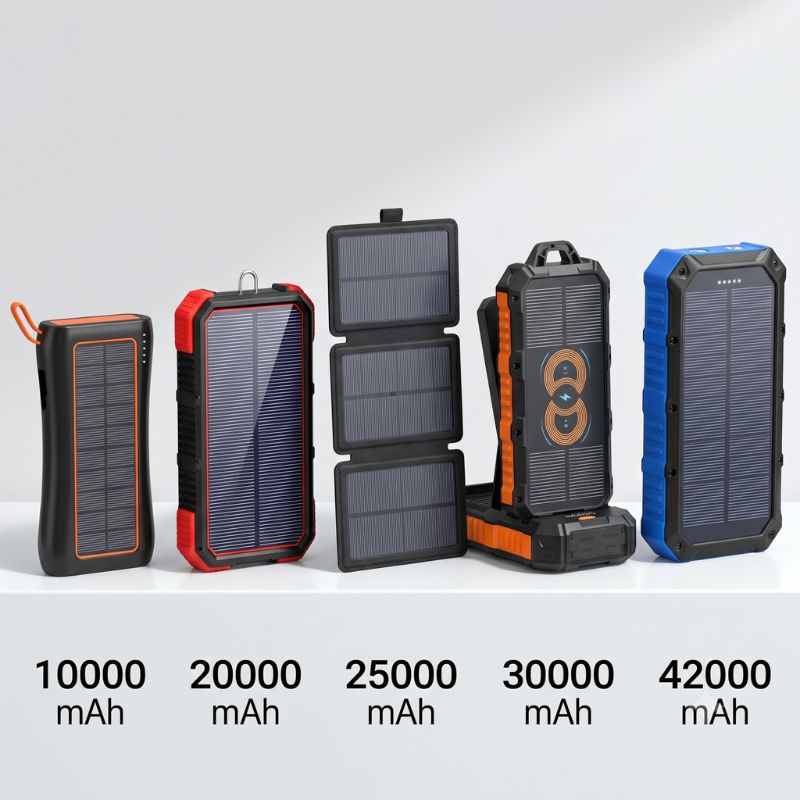
Compact solar phone charger (around 10,000 mAh)
A lighter solar phone charger suits day hikes, urban emergency kits, and gift SKUs. Example direction: a 10,000 mAh outdoor solar power bank with wireless charging and strong LED lighting. Buyers get pocketable size and wireless convenience; solar refill is slower, so position it as backup plus short top-ups.
Mid-range solar power bank (20,000 mAh class)
This range is the volume sweet spot for outdoor retail and promo programs. Units often add dual USB, waterproof shells, flashlights, and sometimes wireless coils. Explore the broader solar power bank category for assortment planning, then shortlist models such as:
Waterproof 20000 mAh solar panel power bank with fast charging
New dual-USB 20000mAh waterproof solar panels power bank with LED (HDL519X)
Fast-charging foldable outdoor 20000mAh solar charger with LED lights
Higher-capacity solar powered power bank (24,000–42,000 mAh)
Multi-day camping, group travel, and “shared gear” programs need larger stores of energy. Useful references include:
25000mAh solar charger power bank with dual USB, waterproof design
24000mAh / up to 36000mAh-class wireless solar power bank with cables (HDL-531)
24000mAh standard 36000 built-in 4 cables wireless solar pack (HDL529)
30000mAh Qi wireless solar charger power bank, IP65, USB-C (HDL528)
42000mAh solar power bank with built-in 4 cables, wireless charging, dual LED (HDL-628)
Camping-focused solar mobile phone charger kits
Some SKUs emphasize outdoor form factors—carabiners, strong LED, multi-panel faces—for camping aisles. See the camping gear solar charger power bank (HDL519) when the merchandising story is trail and campsite use.
Comparison table: matching type to buyer scenario
How to Choose a Solar Powered iPhone Charger and Android-Ready Pack
Phones differ in connectors and wireless standards, yet buying logic stays shared. A solar powered iphone charger still needs stable 5V (or supported PD profiles where claimed), clean cable quality, and enough mAh after conversion losses. Android and mixed fleets need the same basics plus the right cable set.
Capacity and real phone charges
Nameplate mAh is measured at the cell voltage, not at 5V USB output. After conversion and cable loss, usable energy is lower. A rough planning approach:
10,000 mAh class → about 1.5–2 full charges for many modern phones
20,000 mAh class → roughly 3–4 charges under good conditions
30,000 mAh+ → multi-device or multi-day coverage
Always validate with sample testing on the phones your customers actually use.
Panel size, foldable designs, and refill expectations
Larger or foldable panels harvest more energy per hour in open sun. A small panel on a slim pack may only offset standby or add a slow top-up. Train sales teams to say: “Solar extends independence; USB wall input still fills the pack fastest before departure.”
Ports, wireless, and built-in cables
Dual USB helps families and tour groups
USB-C input/output matches newer phones and reduces cable clutter
Qi wireless suits a solar powered iphone charger story and case-friendly top-ups
Built-in cables cut “forgot the cable” returns on outdoor SKUs
Protection ratings and outdoor durability
Look for stated waterproof or water-resistant ratings (for example IPX4 or IP65 on selected models), shock-resistant shells, and secure ports. Dust and rain are normal in camping channels; packaging claims should match test reports.
Safety and compliance expectations
Lithium portable packs should follow recognized battery safety practice. IEC 62133-series requirements address safe operation of portable sealed secondary lithium cells and batteries under intended use and foreseeable misuse. Many markets also expect UN38.3 transport testing and appropriate electrical safety documentation. Ask suppliers for test summaries before large orders—not after goods ship.
Checklist for product managers
Target user and trip length
Capacity band and weight limit
Cable / wireless mix
Solar panel style (fixed face vs foldable)
IP / drop claims backed by tests
Branding and packaging needs
Sample pass/fail criteria (charge time, heat, idle drain)

Performance Tips: Getting More From a Power Bank for Solar Use
Even a strong unit underperforms if placement is wrong. Share these practices with end users and retail staff.
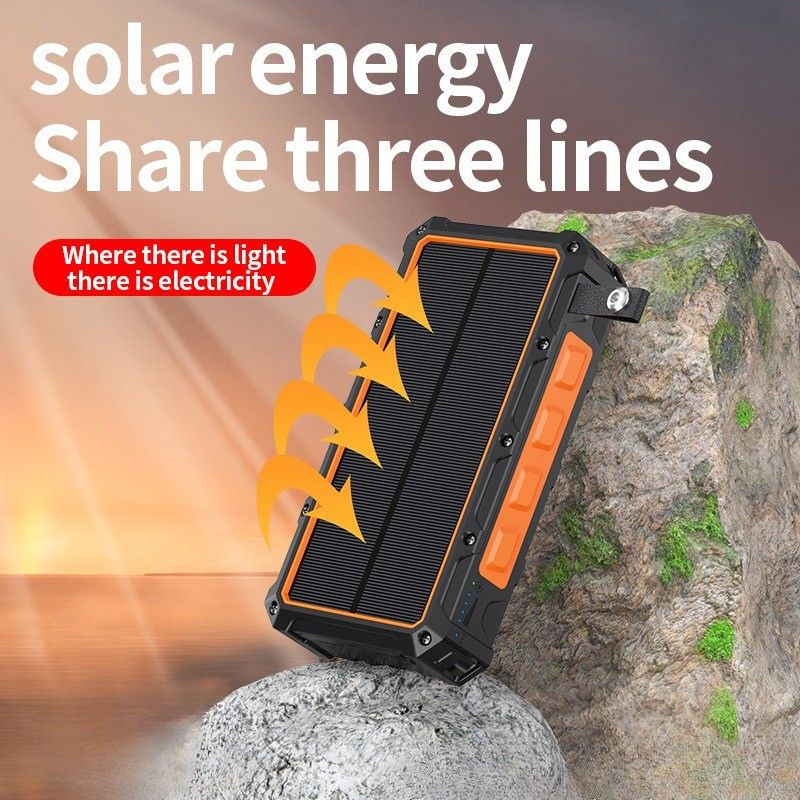
Aim the panel at the sun
Flat on the ground in morning or late afternoon wastes harvest. Tilt the panel toward the sun and adjust every hour or two when possible. Avoid partial shade from poles, trees, or backpack straps.
Prefer charging the bank, then the phone
Direct phone-from-panel charging can stutter when clouds pass. Filling the internal battery first creates a buffer. Then the phone draws steady power from the pack—cleaner for modern phone charge controllers.
Keep surfaces clean and cool
Dust and fingerprints cut light entry. Wipe the panel. Also avoid sealing a hot pack under dark fabric in full sun for long periods; heat reduces efficiency and stresses cells.
Use solar as range extension
Before a trip, fill the pack from wall USB. Use solar during the day to rebuild what you spent. That hybrid habit is how a power bank for solar scenarios stays useful across cloudy stretches.
Match expectations to weather
Light overcast still allows slow gain. Storm cover may not. Honest product pages reduce refund rates more than inflated “full phone in one hour of any daylight” claims.
Image for this section
Image title: Correct panel angle for solar power bank battery charger use
Image description: Solar power bank tilted toward midday sun on a rock while a phone charges from USB
File name: solar-power-bank-battery-charger-sun-angle.jpg
Alt text: Solar power bank battery charger angled to sunlight for faster phone charging
AI image prompt: 1:1 outdoor photo, portable solar power bank propped at angle facing sun on hiking trail rock, USB cable to phone, clear sky, realistic shadows, no text
Aspect ratio: 1:1
Common Mistakes When Specifying a Solar Cell Phone Charger
Avoid these issues early in sourcing.
Treating panel watts as constant phone watts – Conversion, angle, heat, and clouds all reduce delivery.
Ignoring cable and port quality – Weak cables cause slow charge complaints blamed on the pack.
Over-promising solar-only full charges – Especially on tiny panels paired with large phones.
Skipping sample drop and rain tests – Outdoor channels punish fragile housings.
Mixing capacity labels without explanation – Some markets print dual numbers; train teams so listings stay consistent.
Forgetting idle drain and button lock – Packs that self-discharge or pocket-activate frustrate users.
Buying on price alone – Cell grade, BMS design, and QC determine repeat orders more than a few cents per unit.
When you write RFQs, include acceptance tests: full USB charge time from empty, solar input current in defined light conditions (or at least comparative sun tests), surface temperature after 30 minutes of output, and waterproof checks aligned with the claimed rating.
Manufacturing Strength Behind Reliable Solar Power Banks
Product pages sell features. Supply continuity sells programs. Shenzhen Hedeli Technology Co., Ltd. has spent about 10 years in mobile accessories and consumer electronics, with a focus on solar power bank categories under the Hedelee line. The company employs more than 100 people, with headquarters in Shenzhen, China, plus an office and showroom in Guangzhou. A Dongguan factory with a monthly capacity of about 50,000 units supports importers, distributors, and wholesalers who need repeatable delivery—not one-off samples that never scale.
That structure matters when you plan seasonal outdoor launches, Amazon/eBay replenishment, or retail planograms. You can align:
Capacity ladder (10,000 through 42,000 mAh-class options)
Feature sets (wireless, built-in cables, foldable panels, LED lighting, waterproof shells)
Branding and packaging for channel-specific needs
Steady production rhythm for forecasted volume
Browse live assortment in the solar power bank product category, then shortlist SKUs that match your price tiers and feature matrix. Factory-direct discussion keeps specifications, test data, and carton marks under one responsible source.
If you are building a private-label outdoor line, start with one hero mid-capacity SKU (often 20,000 mAh) and one higher-capacity anchor. Validate samples against your charge-time and durability checklist, then lock packaging. That sequence reduces SKU chaos and keeps warehouse complexity under control.
Building an Assortment Plan Buyers Can Defend
A clear assortment story helps procurement justify spend and helps product managers brief agencies and marketplace teams.
Tier the offer
Align content and claims
List real ports, real IP statements, and honest solar guidance. Marketplace SEO and generative search both reward pages that answer “how long,” “does it work in clouds,” and “will it charge my phone type” without fluff.
Plan accessories and bundles
Carabiners, pouches, spare cables, and dual-pack gift boxes raise average order value. Keep electrical claims on the pack itself; treat pouches as convenience, not power.
Sample, then scale
Request samples that match mass-production intent. Compare weight, panel finish, button feel, and packaging print. After approval, freeze the golden sample. That habit protects you when reordering months later.
When you are ready to move from research to supply, speak with the factory team that builds these products daily. Shenzhen Hedeli Technology Co., Ltd. is the original manufacturer behind the Hedelee solar power bank range—so inquiries go to the source for specifications, quotes, and sample arrangements rather than through disconnected middle layers. Share your target capacity, ports, branding, and destination market requirements, and request a quote or sample set that matches your assortment plan.
Frequently Asked Questions
1. What order quantity do you support?
MOQ depends on model and customization level. Standard models often start lower than fully custom colors or packaging. Reach out for detailed specifications and current MOQ by SKU.
2. Can we customize logo and packaging?
Yes—logo print, color options, and retail packaging are common requests for brand programs. Contact us to request samples and artwork guidelines for your channel.
3. Which compliance tests can you provide?
Typical requests include battery safety documentation aligned with IEC 62133 practice, UN38.3 transport, and market-facing electrical files as applicable. Ask for the test list that matches your destination markets.
4. How long is the usual lead time?
Lead time varies with quantity, materials, and customization. Forecasted repeat orders schedule more smoothly than rush peaks. Reach out with quantity and ship-by date for a production window.
5. Do you offer samples before bulk orders?
Sample evaluation is recommended before volume commits. Contact us to request samples of shortlisted solar power bank models and confirm charge behavior on your devices.