

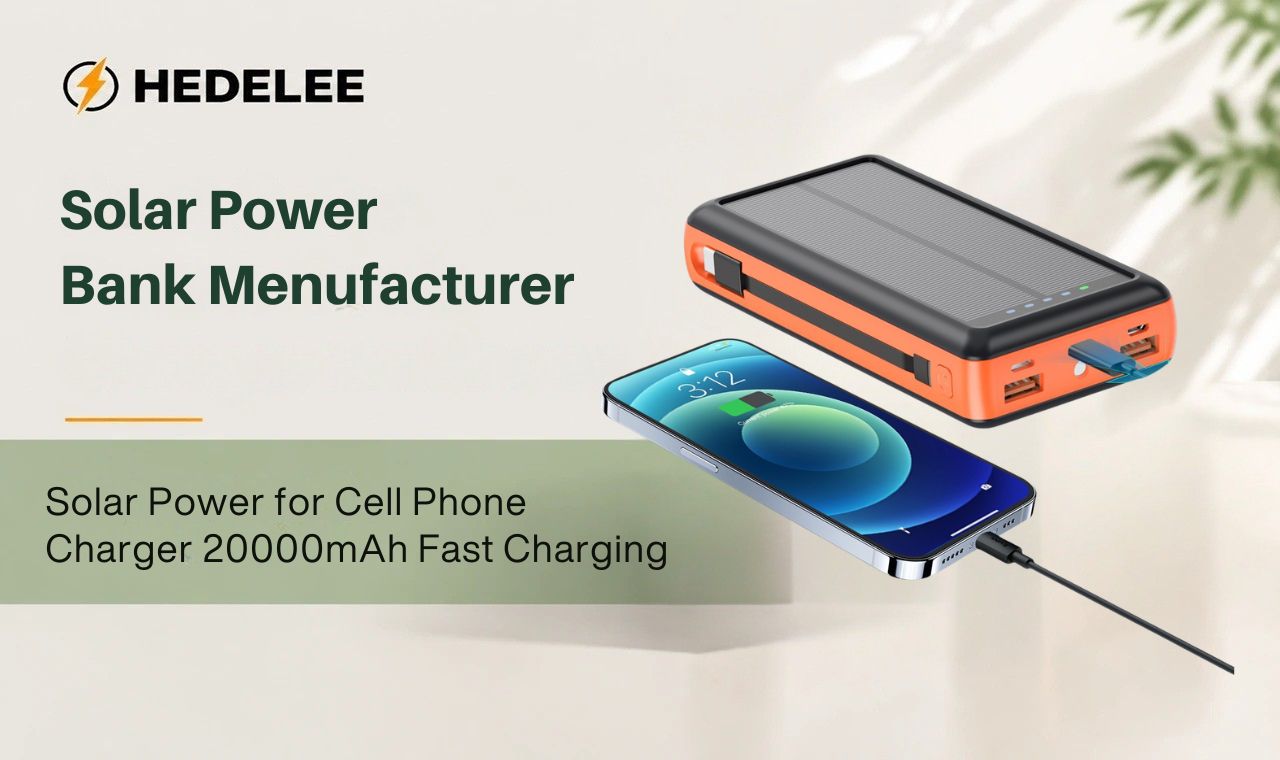
A dead phone during a camping trip, on a remote job site, or in an emergency costs more than convenience. It can mean lost revenue, delayed communication, or a safety risk with no way to call for help. Solar power for cell phone charger products address this by capturing sunlight through integrated panels and storing that energy in a built-in battery for whenever a device needs charging. A 20000mAh unit sits in a practical middle ground: large enough to recharge a modern smartphone three or four times, yet still portable enough to carry in a backpack or vehicle emergency kit.
For buyers and product teams evaluating sourcing options, understanding how these devices actually perform—and what separates a dependable unit from a disappointing one—makes all the difference. This guide covers real capacity, fast charging technology, key features, model comparisons, and what to look for in a manufacturing partner.
What Is Solar Power for Cell Phone Charger?
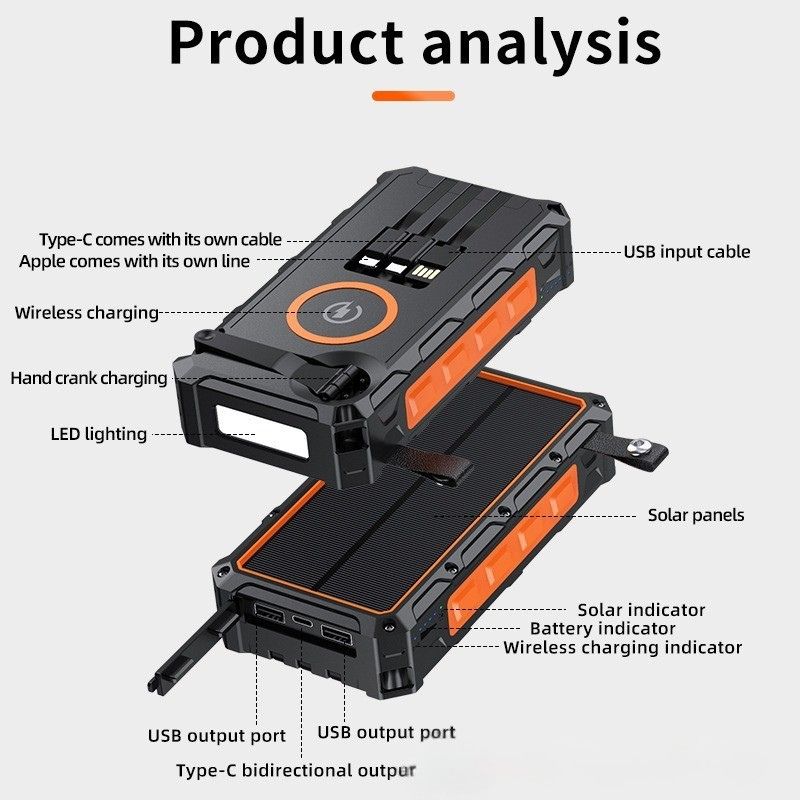
A solar power for cell phone charger system combines three components into one device: a solar panel array, a rechargeable battery pack, and a set of USB output ports. The solar panel absorbs sunlight and converts it into direct current electricity. That electricity flows into an internal lithium-ion or lithium-polymer battery, which stores the energy until you connect a phone or other device via USB.
The solar panel handles harvesting. Most portable units use monocrystalline silicon cells, which typically convert 18–24% of available sunlight into usable electricity. That percentage sounds modest, and it is—solar panels on a pocket-sized device will never match a rooftop array. But for topping up a battery during daylight hours, the panel keeps the internal cell charged without needing a wall outlet.
Real-world conditions affect this harvest significantly. The panel’s angle relative to the sun, cloud cover, ambient temperature, and even the cleanliness of the panel surface all influence how much electricity gets generated. A panel rated for 5W under ideal laboratory conditions might produce only 2–3W on an overcast afternoon. For buyers evaluating products, the rated solar input wattage is a best-case figure, not a guarantee of everyday performance.
The battery handles storage. A 20000mAh lithium-polymer cell stores energy at a nominal 3.7 volts. When you plug in a phone, the power bank’s circuitry steps that voltage up to 5V for standard USB output or negotiates a higher voltage for fast charging protocols. This voltage conversion is where some energy gets lost as heat, which is why the usable output never equals the labeled capacity.
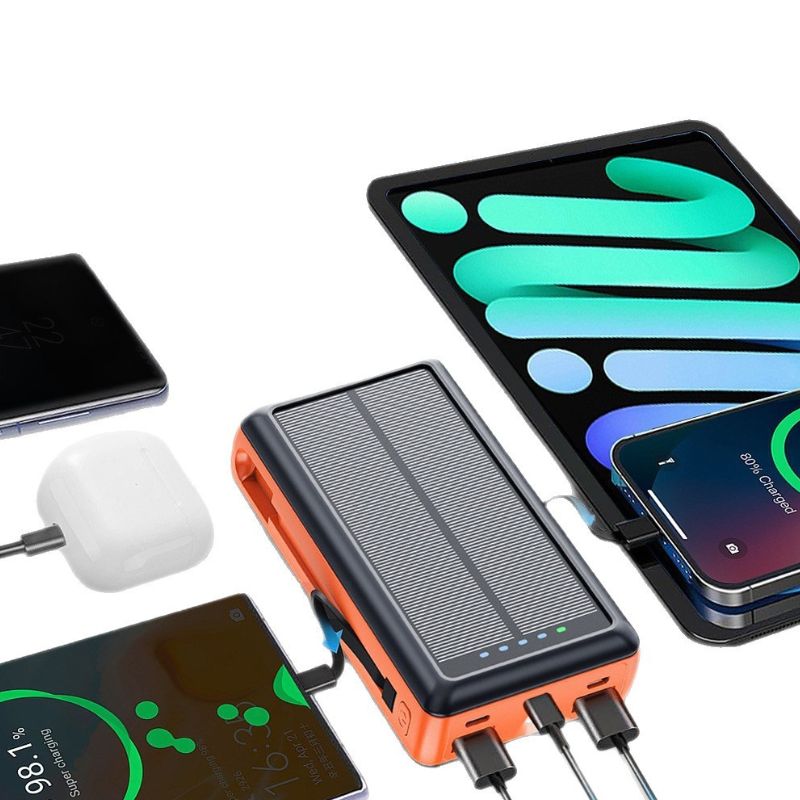
The output ports handle delivery. Dual USB-A or USB-C ports let two devices charge simultaneously, while some models add wireless charging for phones that support the Qi standard. A power bank for solar charging needs all three components working together—the panel, the battery, and the circuitry—to deliver dependable performance over months and years of use.
Why 20000mAh Matters for a Solar Phone Charger
Capacity is the number buyers look at first, and for good reason. A 20000mAh solar power bank holds roughly 74 watt-hours of stored energy (20000mAh × 3.7V ÷ 1000). That places it above the compact 10000mAh models and below the heavier 30000mAh+ units that push against airline carry-on limits.
But the labeled capacity is not the same as what reaches your phone. The internal battery stores energy at 3.7V, while USB output runs at 5V or higher. Converting between those voltages and managing heat losses means a typical 20000mAh unit delivers about 12,000–13,500mAh of usable charge at the USB port. That still translates to roughly three full charges for an iPhone 15 (3,349mAh battery) or about 2.5 charges for a Samsung Galaxy S24+ (5,000mAh battery).
For a solar phone charger, this usable capacity matters because solar input is slow. A small integrated panel in direct sunlight might add 1–2W to the battery, which means a full solar recharge of a 20000mAh pack can take 40–60 hours of sun exposure. The stored battery capacity does the heavy lifting; solar serves as a supplementary input that extends the time between wall-charged recharges.
Airline regulations also favor the 20000mAh size. Most airlines allow lithium batteries under 100 watt-hours in carry-on baggage, and a 20000mAh pack at 3.7V nominal voltage stores roughly 74Wh—comfortably below that threshold. Batteries between 100Wh and 160Wh require airline approval, and anything above 160Wh is generally prohibited on passenger flights. This makes the 20000mAh capacity a safe choice for buyers whose customers travel with their devices.
This is why 20000mAh is a practical sweet spot. It provides enough stored energy for a weekend trip or emergency, without the weight and bulk that larger packs add. For a solar powered iphone charger use case, the 20000mAh capacity also means you can share power with a travel companion and still have reserves left.
How Fast Charging Works in a Solar Power Bank
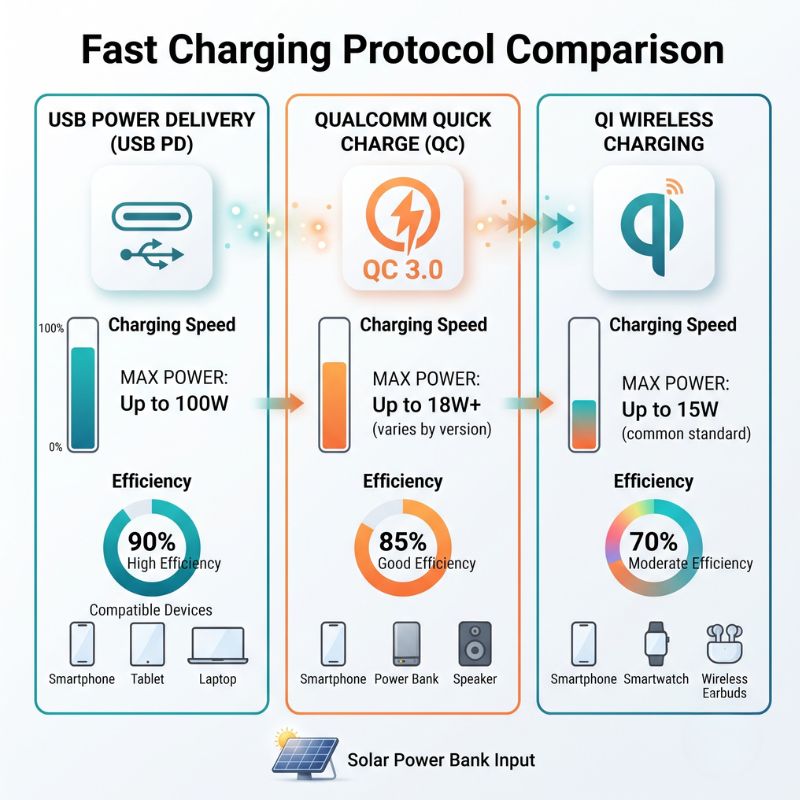
Fast charging is not a vague marketing claim—it is a set of negotiated protocols between the power bank and the connected device. The most widely adopted standard is USB Power Delivery, which allows devices to request specific voltage and current combinations dynamically. Under USB Power Delivery specifications, a power bank can output 5V, 9V, 15V, or 20V at currents up to 5A, delivering up to 100W of power.
For a solar power bank charging phones, the relevant range is typically 5V/3A (15W) or 9V/2A (18W). When a phone supports fast charging and the power bank supports the matching protocol, the two devices negotiate the fastest safe speed and deliver it until the phone’s battery reaches roughly 80%, at which point charging slows to protect the cell.
Qualcomm Quick Charge operates similarly, and newer versions (QC 4+) are compatible with USB PD. What matters for buyers is confirming which protocols a power bank supports, since a phone will only fast-charge when the power bank speaks the same language.
Wireless charging adds convenience but reduces efficiency. Qi wireless charging typically loses 25–35% of the energy during transfer, which means a 15W wireless output might deliver only 10W to the phone’s battery. For a solar power bank where every watt-hour counts, wired USB-C charging remains the faster and more efficient option.
For a solar power bank battery charger designed for outdoor use, having both wired and wireless options gives users flexibility. The 20000mAh solar power bank with wireless charger outputs and dual inputs (HDL-218) combines a Qi wireless pad with dual USB outputs and dual input ports, giving buyers a versatile charging hub in one device.
Key Features to Evaluate in a Solar Cell Phone Charger
Not all solar chargers are built the same way. When evaluating models for wholesale or distribution, several features separate dependable products from disappointing ones.
Waterproof and Dustproof Rating
An IP65 or IP67 rating means the device resists water jets or temporary submersion. Outdoor use inevitably involves rain, splashes, and dust, so a solar cell phone charger without adequate protection will fail prematurely. Look for models rated IP65 or higher.
Dual USB Outputs
Charging two devices simultaneously is a practical need for anyone traveling with a partner or carrying multiple devices. Dual USB-A ports or a combination of USB-A and USB-C gives flexibility without forcing users to wait their turn.
Built-in LED Flashlight
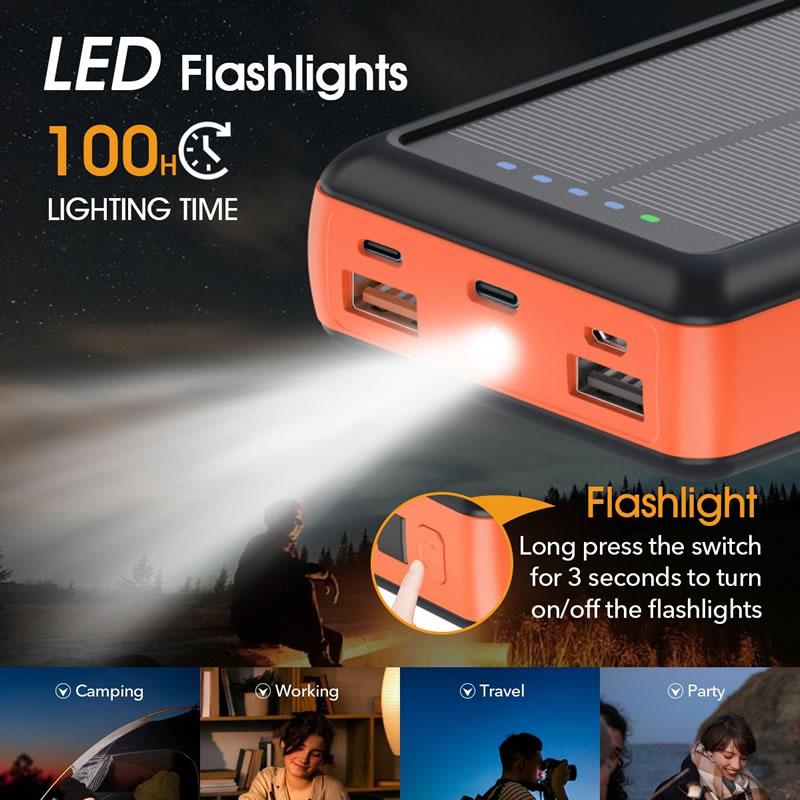
A solar power bank with an integrated LED light serves double duty as an emergency light source. For camping, power outages, or roadside situations, this feature adds value without adding much cost or weight.
Battery Chemistry and Protection
Lithium-polymer cells are lighter and more resistant to physical impact than cylindrical lithium-ion cells. A well-designed battery management system (BMS) protects against overcharging, over-discharging, short circuits, and temperature extremes. The BMS monitors individual cell voltage, balances charge across multiple cells, and cuts power if it detects a fault. For buyers sourcing at scale, asking suppliers about their BMS design and protection circuit quality is one of the most informative technical questions you can ask. Quality cells typically retain at least 80% of their capacity after 300 charge cycles, which is the standard acceptance criterion for lithium battery cycle testing.
Foldable or Integrated Panel Design
Some models use a foldable panel that opens like a book to expose more surface area to sunlight. Others have the panel integrated into the top surface of the device. Foldable designs generally capture more sunlight but add bulk; integrated designs are more compact and easier to carry in a pocket.
Multiple Input Options
A solar power bank should accept charge from both solar and a wall adapter. Dual inputs (typically Micro-USB and USB-C, or Lightning and USB-C) let users top up the battery from the fastest available source while the solar panel provides supplementary energy.
The foldable outdoor solar charger with 20000mAh capacity and LED lights exemplifies several of these features in one package: foldable panels for maximum light capture, dual USB outputs, LED lighting, and a rugged outdoor-ready build.
Comparing Four Solar Power Bank Battery Charger Models
To illustrate how these features come together, here is a comparison of four models from our solar power bank product category:
Each model targets a slightly different need. The HDL-218 works well for buyers who want wireless charging alongside wired outputs. The foldable model with LED lights maximizes solar harvesting with its expanded panel surface. The HDL-519X with dual solar panels offers a dual-panel configuration for faster solar input. And the waterproof fast charge model prioritizes compact durability for everyday carry.
Real-World Applications for a Solar Mobile Phone Charger
Understanding where and how these devices get used helps buyers match the right model to their target market.
Camping and Outdoor Recreation
A solar mobile phone charger is a natural fit for multi-day camping trips, hiking expeditions, and backpacking where wall outlets are days away. The solar panel keeps the battery topped up during daylight hours, and the stored energy powers phones, headlamps, GPS devices, and Bluetooth speakers through the night.
Emergency Preparedness
Power outages from storms, earthquakes, or grid failures can last hours or days. A charged solar power bank provides a reliable backup for keeping phones operational for emergency calls, weather alerts, and communication with family. The built-in LED flashlight on many models adds utility when grid power is down.
Remote Work Sites
Construction crews, survey teams, and agricultural workers often operate in locations without reliable power infrastructure. A solar powered power bank keeps phones and small tools charged without requiring a generator or vehicle.
Travel and Tourism
For travelers visiting areas with unreliable electricity—rural regions, developing countries, or remote islands—a solar phone charger provides independence from finding a working outlet. The waterproof construction on most models also handles the bumps and splashes of travel.
Off-Grid Events and Festivals
Multi-day music festivals, outdoor markets, and sporting events often have limited charging infrastructure. Vendors and attendees rely on portable power banks, and solar input extends the useful life of each charge cycle throughout the event.
Solar Power for Cell Phone Charger: Choosing a Trusted Supplier
Selecting the right manufacturing partner is as important as choosing the right product features. Here is what buyers should verify before committing to a supplier.
Compliance and Certifications
Any power bank containing lithium batteries must pass UN 38.3 testing before it can be legally shipped by air, sea, or land. This standard includes eight mandatory tests: altitude simulation, thermal cycling, vibration, shock, external short circuit, impact, overcharge, and forced discharge. Without UN 38.3 certification, products cannot clear customs for international shipping.
Additional certifications to request include CE (European conformity), FCC (US electromagnetic compliance), and RoHS (restriction of hazardous substances). These vary by target market but are generally required for most importers and distributors.
Manufacturing Capacity and Lead Times
A supplier’s production capacity determines whether they can meet your order volumes on schedule. Hedeli’s factory in Dongguan produces up to 50,000 units per month, which supports both moderate trial orders and larger distribution commitments. Confirm typical lead times for your order size before placing an initial purchase.
Sample Availability
Always request product samples before placing a bulk order. A physical sample lets you test charging speed, solar input rate, build quality, and waterproofing under real conditions. Reputable manufacturers provide samples promptly and stand behind their published specifications.
Customization Options
Buyers looking to build a brand often need custom packaging, logo printing, color options, or modified specifications. Ask whether the supplier offers OEM and ODM services, what the minimum order quantities are for customization, and how design changes affect lead times.
Communication and Support
A responsive supplier who answers technical questions clearly and provides documentation promptly is worth more than a slightly cheaper option that goes silent after the deposit clears. Test responsiveness during the initial inquiry phase—it usually reflects how the relationship will continue throughout production and beyond.
You can explore our full range of solar power bank products to see specifications and request detailed information for any model.
From Our Factory to Your Warehouse
Shenzhen Hedeli Technology Co., Ltd. has spent nearly a decade designing and manufacturing mobile accessories and consumer electronics. Our headquarters in Shenzhen handles sales and client coordination, while our factory in Dongguan runs a monthly production capacity of 50,000 units. We also maintain an office and showroom in Guangzhou for in-person product evaluation.
We work directly with importers, distributors, and wholesalers who need dependable solar power banks at scale. Because we are the manufacturer—not a trading company or intermediary—buyers who work with us get direct access to engineering support, competitive pricing, and consistent quality control. Every order moves through the same production line, the same testing protocols, and the same quality checks.
Every production batch undergoes aging tests, charge-discharge cycling, and solar input verification before products ship. Our quality team checks capacity consistency across units, confirms waterproof ratings on sample units from each batch, and validates that charging protocols negotiate correctly with reference devices.
If you are evaluating 20000mAh solar chargers for your next product line or distribution catalog, we welcome your inquiry. Request samples, ask about customization options, or send your specifications for a tailored quotation. Our team responds promptly with the technical details you need to make an informed purchasing decision.
Frequently Asked Questions
1. What is the minimum order quantity for solar power banks?
Minimum order quantities vary by model and customization level. Standard products without branding typically have a lower MOQ, while OEM orders with custom packaging or logo printing require a higher minimum. Reach out with your specific requirements and we will provide exact numbers.
2. Can we request custom branding and packaging?
Yes. We offer OEM and ODM services including logo printing, custom color options, and branded packaging. Contact us to request samples and discuss your design specifications—our team will confirm MOQs and lead times based on your customization needs.
3. Do the power banks come with safety certifications?
All our lithium battery products are tested to UN 38.3 standards, which is mandatory for international shipping. We also provide CE, FCC, and RoHS documentation depending on your target market. Reach out for detailed compliance documents during your inquiry.
4. What are typical lead times for bulk orders?
Standard production lead times depend on order volume and customization requirements. With a monthly capacity of 50,000 units, we can accommodate both trial orders and larger distribution quantities. We will confirm a delivery timeline when you share your order specifications.
5. Can we order samples before placing a bulk order?
Yes, we encourage buyers to request samples to test charging performance, build quality, and solar input under real conditions. Reach out for detailed specifications and we will arrange sample shipment promptly.