

A disaster radio for Japan (防災ラジオ, bosai radio) has one specification that matters more than any other: FM coverage from 76 to 95 MHz. Japan’s FM band starts at 76 MHz, far below the 87.5 MHz start used in most of the world, and many AM stations now also broadcast on FM between 90 and 95 MHz through the “Wide FM” (ワイドFM) service. A radio built for the US or European band will miss much of what Japanese listeners rely on during an earthquake or typhoon.
This guide is for Japanese importers, disaster-goods suppliers, municipalities’ procurement partners and corporate buyers stocking emergency kits. It covers band settings, power options, the functions Japanese buyers compare, and what to send us for a quote. It does not cover radios that receive municipal disaster-prevention wireless (防災行政無線) broadcasts, which need dedicated receivers.
Band Settings for Japan
| Band | What Japan needs | Why |
|---|---|---|
| FM | 76–95 MHz at minimum; many models cover 76–108 MHz | Japanese FM stations and Wide FM simulcasts of AM stations sit in this range |
| AM | About 522/531–1602 kHz in 9 kHz steps | Japan uses 9 kHz AM spacing, like Europe and most of Asia |
| Weather band (162 MHz) | Not needed | This is a North American service. Leave it off Japanese models |
| Shortwave | Optional | Useful for some buyers, not essential for disaster use |
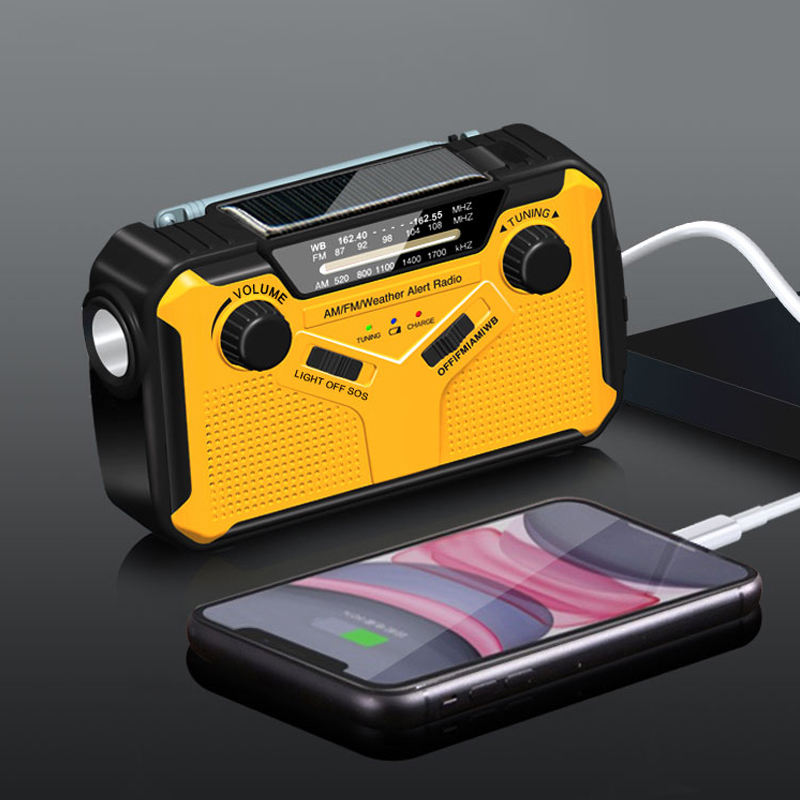
Our X-HWYX-5 emergency radio tunes FM from 63 to 108 MHz and AM from 522 to 1620 kHz, plus shortwave from 5.9 to 21.85 MHz. That covers the Japanese FM band including Wide FM. Our X-HWYX-4, by contrast, is set for North America (AM to 1710 kHz, FM from 87 MHz and the 162 MHz weather band), so it is the wrong choice for Japan. Always confirm the band settings and AM step on your sample.
Power: Several Sources, Clear Expectations
Japanese disaster-goods buyers expect more than one way to power a radio. Our emergency radios combine:
- A built-in 18650 lithium-ion cell (3.7 V, 2000 mAh in our standard models)
- USB charging as the main method
- A small solar panel for slow top-up
- A hand crank for power when there is no sun and no grid
Japanese reviews and buying guides often point out that hand cranks are for emergency use and that hand-cranking a smartphone to full charge is not realistic. We agree, and recommend product copy that says so. A 2000 mAh cell holds about 7.4 Wh, less than a typical smartphone battery, so the USB output is for an emergency top-up. If phone charging is a priority, consider our model with a 5000 mAh battery or pair the radio with a solar power bank.
Many Japanese buyers also want dry-cell backup, because AA batteries are easy to stockpile. Our current radios use a built-in rechargeable cell. If AA backup is essential for your channel, tell us and we will discuss options.
Functions Japanese Buyers Compare
- Light: flashlight and reading light, with brightness that matches your photos
- SOS siren: loud alarm for attracting rescuers
- Size and weight: for emergency go-bags (非常持ち出し袋), smaller and lighter is better
- Water resistance: state the actual rating if one is claimed
- Manual in Japanese: including storage and recharge intervals
- Storage behavior: how the battery holds charge when the radio sits in a cupboard for months
Compliance Notes
Ask your Japanese conformity partner which requirements apply to your exact model. A radio receiver with a built-in lithium cell and USB charging may involve radio-equipment rules and battery-related requirements, and portable lithium-ion batteries sold separately as power banks need the PSE mark. See our PSE guide for power banks. For shipping, we provide UN38.3 test summaries and SDS for the lithium cell.
OEM Options
- Logo printing and housing colors for volume orders
- Band configuration for Japan
- Japanese manual, packaging and warning labels
- Kit packaging for emergency sets, or retail boxes
For other markets, our solar hand crank radio wholesale guide explains band settings for North America and Europe.
What to Send Us for an Accurate Quote
- Model from our solar radio range
- Confirmation that the radio is for Japan (we set the bands accordingly)
- Quantity per color
- Branding, manual and packaging requirements
- Sales channel: retail, kit assembly, corporate or public procurement
Contact our sales team and we will reply with model options and samples.
Frequently Asked Questions
What FM range does a disaster radio need in Japan?
At least 76–95 MHz, which covers Japanese FM stations and Wide FM simulcasts of AM stations.
Does a Japanese disaster radio need the 162 MHz weather band?
No. That band is used in North America. It adds cost without benefit in Japan.
Can the hand crank charge a smartphone?
Only a little, for an emergency call or message. A full charge by hand is not realistic.
Can you make radios with our brand for Japan?
Yes. Logo printing, colors, Japanese manuals and packaging are available for volume orders.