

If you plan to stock a solar hand crank radio, the first question is not price or color. It is which market the radio is for. A radio tuned for North America needs the 162 MHz weather band and an AM range that runs to 1710 kHz. A radio for Europe, the Middle East, Africa or most of Asia does not need the weather band at all, but it should tune AM in 9 kHz steps. Get that wrong and the product works, yet it fails the customer the first time they need it.
This guide is for distributors, emergency-kit assemblers, retailers and corporate buyers who source emergency radios in volume. It covers band configuration by market, the power system, the specs that drive returns, compliance documents, and what to send a factory to get an accurate quote. It is less useful if you need a programmable SAME alert receiver for official public-warning use. That is a different product class, and we say why below.
What a Solar Hand Crank Radio Actually Is
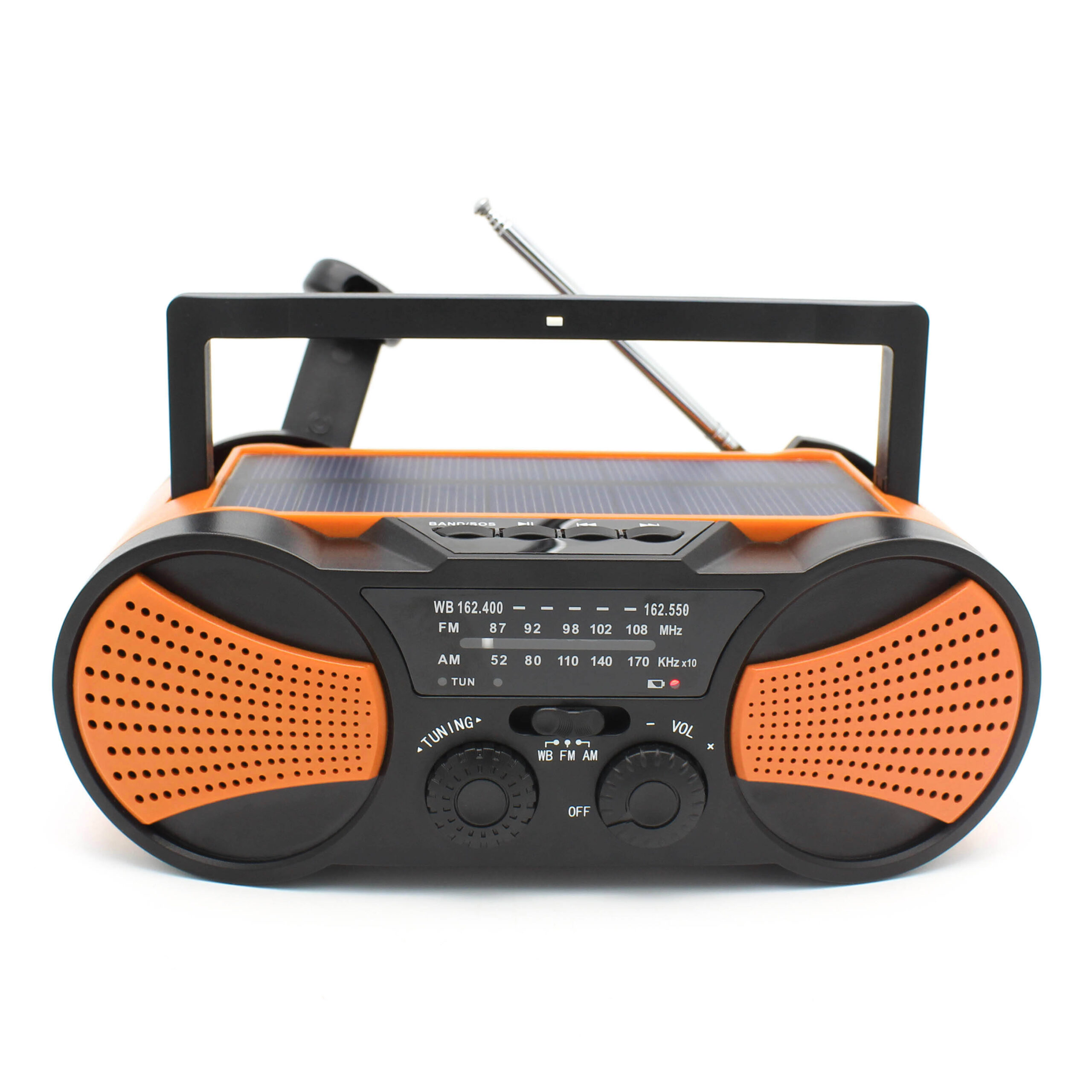
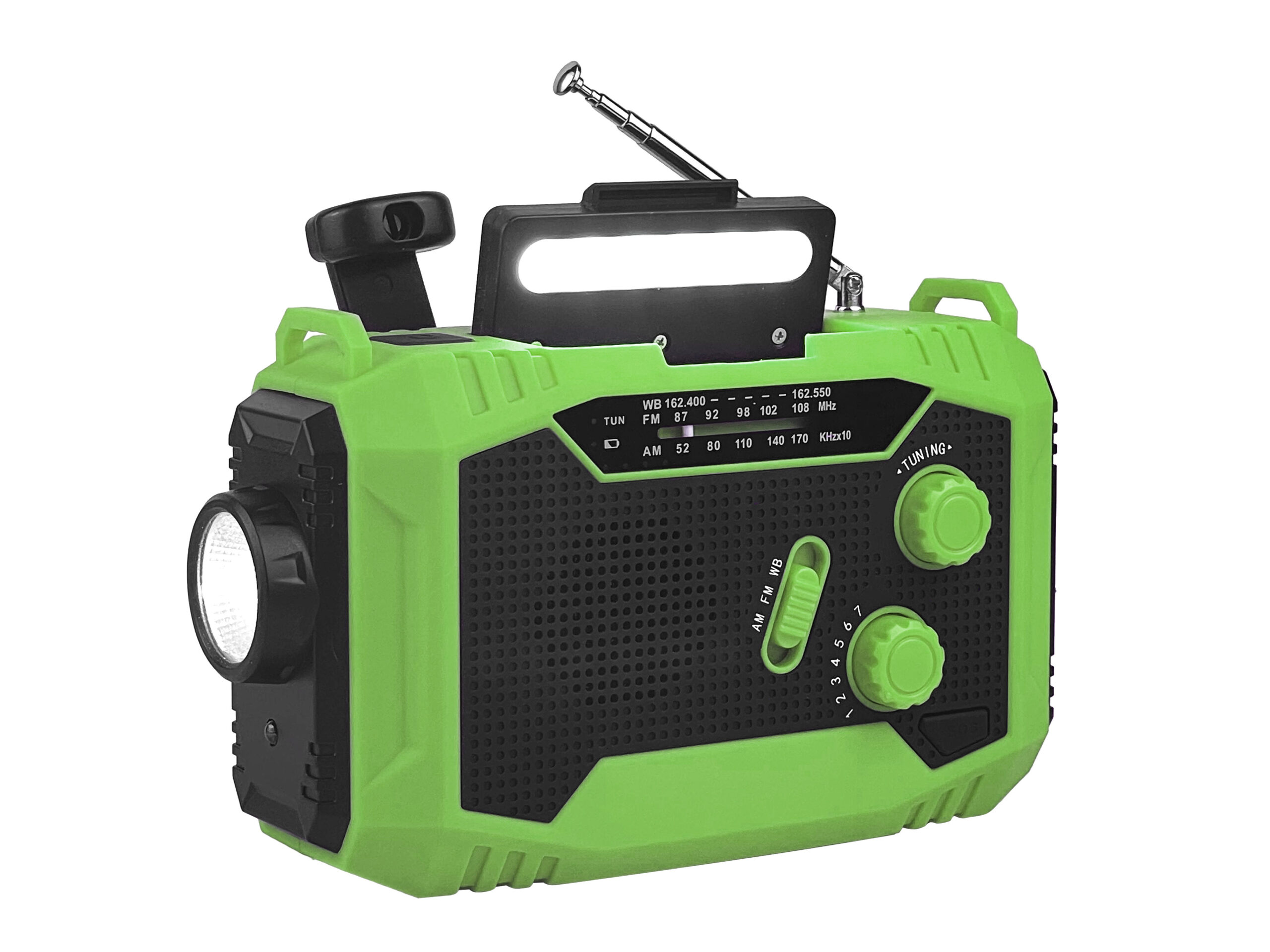
A solar hand crank radio is a battery-powered AM/FM receiver with three ways to recharge its internal battery: a USB input, a small solar panel and a hand-crank dynamo. Most models add an LED flashlight, a USB output that can top up a phone, and sometimes a reading lamp, an SOS siren or a TF-card player.
The models in our emergency radio range share one core layout. They use an 18650 lithium-ion cell rated 3.7 V / 2000 mAh, an ABS housing, a working voltage of 2.7–4.2 V and a working temperature range of −10 °C to +60 °C. The differences are in the tuner, the extra functions and the size of the built-in battery.
Step 1: Match the Radio Bands to Your Market
Band configuration is the most common sourcing mistake with emergency radios. The tuner chip can usually be set for different regions, so decide this before the order, not after the samples arrive.
The weather band (WB / NOAA)
NOAA Weather Radio in the United States broadcasts on seven VHF-FM channels from 162.400 to 162.550 MHz, in 25 kHz steps. Environment Canada and a few other governments in the region use the same frequencies. Each local transmitter uses only one of the seven channels, which is why a weather-band radio must be able to scan all seven.
Outside North America, these channels carry nothing for the end user. A weather band on a radio sold in Germany or Saudi Arabia adds cost and a button that does nothing, and it can confuse buyers who read “weather radio” on the box.
AM range and tuning step
The Americas use 10 kHz AM channel spacing, with the band running to about 1700–1710 kHz. Most of Europe, Africa, the Middle East, Asia and Oceania use 9 kHz spacing up to about 1602 kHz. A radio set to the wrong step will land between stations and sound weak or noisy, even though nothing is broken.
FM range
Most markets use 87.5–108 MHz. Japan uses a lower FM band that starts at 76 MHz, and some older receivers in Eastern Europe used a band in the 65–74 MHz range. A wide FM tuner covers both.
Two of our configurations side by side
| Item | Model X-HWYX-4 | Model X-HWYX-5 |
|---|---|---|
| AM | 520–1710 kHz | 522–1620 kHz |
| FM | 87–108 MHz | 63–108 MHz |
| Shortwave | — | 5.9–21.85 MHz |
| Weather band | 162.400–162.550 MHz | NOAA band listed on the product page |
| Max consumption | 2.5 W | 5 W |
| Battery | 18650, 3.7 V / 2000 mAh | 18650, 3.7 V / 2000 mAh |
| Extras | Display, TF-card player | Flashlight, phone charging, TF-card player |
| Best fit | US and Canada retail and emergency kits | Multi-region distributors, travelers, shortwave listeners |
How to choose: if more than half your volume ships to the US or Canada, start from the 520–1710 kHz + weather band configuration. If you sell across several regions under one SKU, a wide-range tuner with shortwave is the safer single model, and you should confirm the AM step setting on the sample.
Step 2: Understand the Power System Before You Write the Listing
Returns on emergency radios rarely come from broken units. They come from listings that oversell the crank and the solar panel. Here is how the energy actually works, so your product copy stays honest.
Do the battery math
A 3.7 V / 2000 mAh cell stores about 7.4 Wh. A typical current smartphone battery holds somewhere around 12–20 Wh. So even a full radio battery can give a phone only a partial charge, and the radio then has less energy left for itself. Position the USB output as “emergency top-up for a call or message”, not as a phone charger.
If your customers want real phone charging, step up to a radio with a larger built-in power bank. Our catalog includes a version with a 5000 mAh battery for that reason.
The hand crank is for emergencies, not daily charging
A hand crank dynamo turns muscle effort into a few watts at most, and the exact figure depends on how fast and how steadily the user turns it. Short cranking sessions are enough to run the radio or flashlight for a while. Filling the whole battery by hand takes a long time. Write runtime claims only after you have measured them on your production sample, and state the conditions.
The solar panel is a trickle source
The panel on a handheld radio is small. In direct sun it slowly tops up the battery or keeps a radio running that is left on a windowsill. It does not refill an empty battery quickly. We cover the same physics for power banks in our guide to solar chargers for emergency power.
Step 3: Know What This Radio Is and Is Not
A basic weather-band radio plays the NOAA broadcast when the user tunes to it. That is different from a SAME alert receiver. SAME receivers are programmed with a county code and switch on automatically when a warning is issued for that area. If your customer is a school, hospital or local government that needs automatic alerts, a hand crank radio is a backup, not the primary alert device.
Stating this clearly on your listing protects you. “Receives NOAA weather broadcasts” is accurate. “Wakes you up for tornado warnings” is only true for SAME alert models.
Step 4: Specs That Decide Reviews and Returns
- Battery type and replaceability. An 18650 cell is a standard size. Ask whether it is user-replaceable or sealed inside, because that decides the radio’s useful life in a kit that may sit in a cupboard for years.
- Storage behavior. Emergency kits are stored for long periods. Ask the factory what state of charge units ship in, and tell end users to recharge on a schedule.
- Crank gearbox and handle. This is the part that takes mechanical stress. Test the handle and fold-out hinge on samples, not just the electronics.
- Flashlight and reading light. Check brightness and beam on the sample against your product photos.
- Housing material and color. Our range uses ABS. High-visibility orange, red and green are standard for emergency use, and other colors can be discussed for volume orders.
- Working temperature. Our current models list −10 °C to +60 °C. If you sell into very cold climates, test cold-start behavior on samples.
Step 5: Compliance and Shipping Documents
An emergency radio is both a radio receiver and a lithium battery product, so you need two sets of paperwork.
| Need | What to ask for | Why it matters |
|---|---|---|
| US market | FCC documentation for the exact model | Radio receivers sold in the US fall under FCC rules for electronic devices |
| EU market | CE declaration and supporting test reports, RoHS | Required to place the product on the EU market |
| Battery transport | UN38.3 test summary and SDS/MSDS for the cell or pack | Carriers and forwarders ask for these before accepting lithium battery shipments |
| Labeling | Battery specification on the label, WEEE symbol for the EU | Customs and retail platforms check labels |
Our current radio listings show CE, RoHS and FCC. Always ask for the report that matches the exact model and band configuration you are ordering. A report for a different tuner version does not cover your unit. For the battery side, our OEM checklist for importers explains the documents in more detail.
Step 6: OEM and Private Label Options
Most buyers in this category sell under their own brand. Typical options are:
- Logo printing on the housing
- Housing color for volume orders
- Band configuration by market
- Manual language and safety text
- Retail box or plain kit packaging, depending on whether the radio sells alone or goes into an emergency kit
Emergency kit assemblers often need plain inner packaging and a compact footprint, while retail buyers need a box that explains the three charging methods at a glance. Tell us which one you are, because it changes the packaging cost.
What to Send Us for an Accurate Quote
To quote a solar hand crank radio quickly and accurately, please include:
- Target market or markets (this decides the band configuration)
- Model from our solar radio range, or the functions you need
- Order quantity per model and color
- Branding: logo files, housing color, manual language
- Packaging: retail box or kit packaging
- Documents you need: FCC, CE, UN38.3, SDS, or others your platform requires
- Delivery terms and destination port
Contact our sales team with these details and we will reply with a model recommendation, a quote and sample options.
Frequently Asked Questions
Does a solar hand crank radio receive NOAA weather alerts?
A radio with the weather band receives the NOAA broadcast on 162.400–162.550 MHz when the user tunes to it. Automatic alerts need a SAME-equipped receiver programmed with a county code. Check which type you are buying.
Can one radio model sell in both the US and Europe?
Yes, if the tuner covers both AM ranges and the AM step is set correctly for each market. Many distributors still choose two SKUs, one with the weather band for North America and one without it for other markets.
How long does the hand crank take to charge a phone?
Much longer than most buyers expect. The crank produces a few watts at most, and the 2000 mAh radio battery holds about 7.4 Wh, less than a typical phone battery. Treat phone charging as an emergency top-up.
Can I add my logo and change the color?
Yes. Logo printing is available on our radio range, and housing colors can be adjusted for volume orders. Send your artwork and quantity for confirmation.
Which documents do I need to ship emergency radios by sea or air?
Forwarders usually ask for a UN38.3 test summary and an SDS/MSDS for the lithium battery. The destination market will also need its own product compliance documents, such as FCC for the US or CE for the EU.