

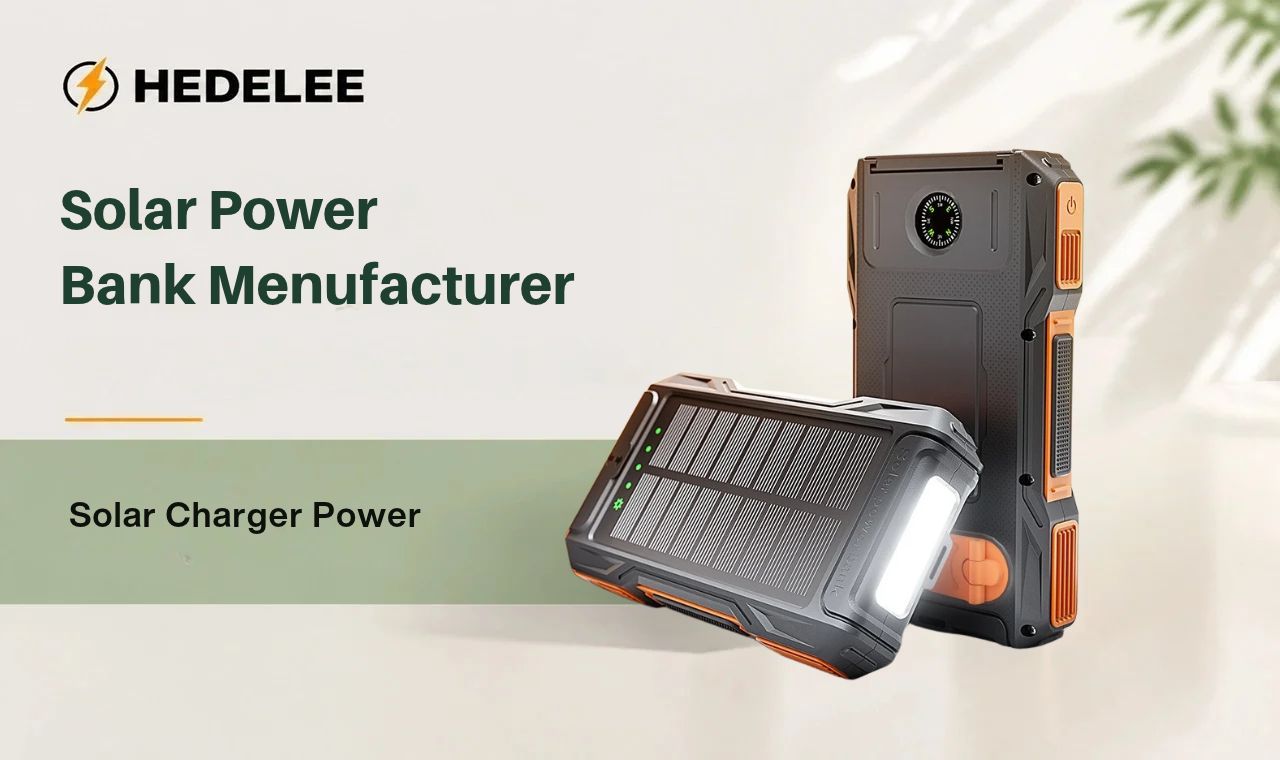
A solar charger Power bank is really two products in one housing: a rechargeable lithium battery and a small solar panel that feeds it. The panel converts sunlight into electrical current. A charge controller regulates that current so it reaches the cells safely. When you plug a phone in, the battery’s stored energy is boosted from its native 3.7 volts up to the 5 volts (or higher) your device expects.
Each of those steps costs energy. The panel loses some sunlight to heat and angle. The controller loses some current to regulation. The output conversion loses more. Understanding this chain is the first step to reading any spec sheet with clear eyes.
The panel: small area, honest limits
The panel on an integrated solar power bank typically measures a few square inches. At typical consumer-grade efficiency, a panel that size delivers roughly 1 to 2 watts in strong, direct sun. Independent testing of retail units confirms this: one reviewed 20,000 mAh unit listed a solar input around 6 watts at best, and the manufacturer itself estimated a full solar recharge at roughly 50 hours of strong sunlight. Ratings as low as 5 volts and 60–200 mA appear on budget models.athlonsports+1
That doesn’t make the panel useless. It makes it a backup and a top-up tool, not a wall-outlet replacement. Framed honestly, it’s a feature users appreciate. Framed as a primary charger, it’s a refund waiting to happen.
The battery: where the real work happens
The battery inside does the heavy lifting. Capacities in the category range from 10,000 mAh up to 42,000 mAh and beyond. A solar power bank battery charger with 20,000 mAh stores about 74 watt-hours of energy — enough for roughly four full charges of a typical smartphone, after conversion losses.
The electronics: protection and delivery
Between the panel and your phone sits a protection circuit module. Quality units monitor cell voltage, temperature, and current, cutting off charging or discharging when readings move outside safe limits. This layer separates a dependable unit from a risky one, and it’s invisible in product photos — which is why you verify it with documentation, not pictures.
Why Solar Charger Power Specs Deserve a Second Look
Here’s the uncomfortable truth about solar charger power ratings: the biggest number on the box is rarely the number that reaches a phone. Three figures decide real-world performance, and only one of them is usually printed large.
Rated capacity vs. usable capacity. The mAh figure on packaging describes charge stored at the cell’s native 3.7 V, not what comes out at 5 V. Boosting voltage costs energy. As Anker’s own support documentation explains, a 20,000 mAh bank holds about 74 Wh at the cell level, but at 82% conversion efficiency delivers roughly 60.7 Wh — equivalent to about 12,140 mAh at 5 V. Phone-side charging losses trim a further 15% or so. Across the industry, usable output typically lands at 60–80% of the headline figure.anker+1
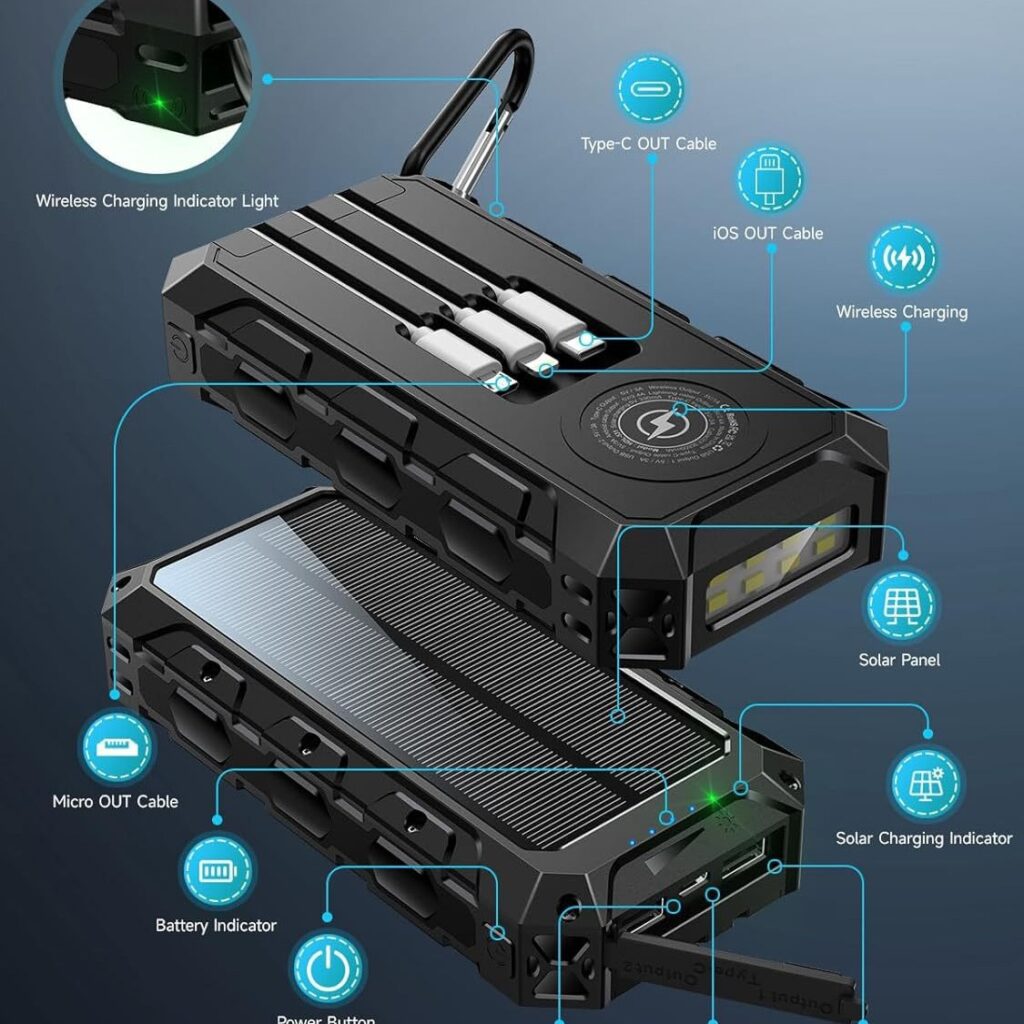
Solar input wattage. This number tells you how fast the panel refills the bank. A 1 W panel trickles. A 6 W input is a meaningful emergency backup. Foldable multi-panel designs push higher and change the use case entirely.
Output wattage and ports. Dual USB-A, USB-C, and wireless pads determine how many devices charge at once and how quickly. A solar cell phone charger that outputs 5 V / 3 A through USB-C will refill a modern phone far faster than a legacy 5 V / 1 A port.
| Spec | What it tells you | Typical range in this category |
|---|---|---|
| Rated capacity (mAh) | Energy stored at cell level | 10,000–42,000 mAh |
| Usable output (at 5 V) | What devices actually receive | ~60–80% of rated |
| Solar input (W) | Emergency/top-up recharge speed | ~1–6 W integrated; higher on foldable panels |
| Output (W / A) | Device charging speed | 5 V/2 A up to 5 V/3 A; 10–15 W wireless |
When you evaluate a supplier’s lineup, ask for all four numbers on every model. A factory that can produce them immediately — with test reports to match — is telling you something about its engineering depth.
How to Match Solar Charger Power to Real-World Use
Different customers buy mobile solar charging for different reasons, and each scenario points to a different spec mix. This is where procurement teams earn their keep: matching product tiers to channels instead of stocking one model for everyone.
Hiking and backpacking
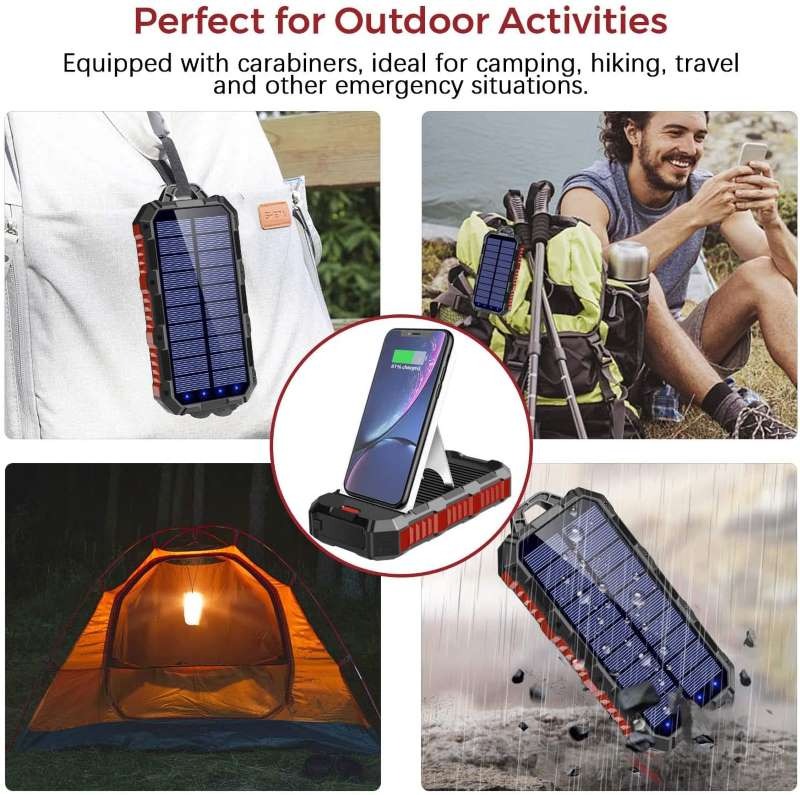
Weight matters, but so does honesty about solar input. Ultralight communities consistently point out that a 10 W panel in real conditions often delivers around half its rated output, and that a long sunny day — not cloudy-week weather — is required to refill a mid-size bank from solar alone. The reliable pattern for this segment: charge the bank from the wall before departure, treat the panel as a top-up, and size capacity to trip length. A 20,000 mAh unit covers a long weekend for one phone and a GPS. For group expeditions or van-life retail channels, foldable multi-panel units like this fast-charging 20,000 mAh foldable outdoor solar charger give meaningfully faster solar recovery.
Camping and overlanding
Campers can leave a panel angled at the sun all day — the ideal solar scenario. Priorities shift to capacity, lighting, and charging several devices at once. Dual-LED flashlight models and units with built-in cables sell well here, because campers hate hunting for cables in a dark tent. A dedicated camping-focused solar charger power bank with multi-device output fits this channel, alongside higher-capacity options like the 24,000–36,000 mAh solar power bank with built-in cables and dual LED flashlight (HDL-529).
Emergency preparedness
Emergency kit buyers care about shelf life, a flashlight, and the ability to harvest some charge with no grid at all. Solar input is the headline feature in this channel even though output per day is modest — during a blackout, 20% of a phone battery is a lifeline. Waterproof ratings (IPX4 to IP65) and a visible LED light are near-mandatory specs.
Everyday carry and travel retail
Gift shops, airport retail, and phone-accessory stores move smaller units. A 10,000 mAh outdoor solar power bank with wireless charging and strong light hits the price-and-size window for impulse buyers while still carrying the solar story.
| Use scenario | Capacity window | Priority specs | Solar role |
|---|---|---|---|
| Backpacking | 10,000–20,000 mAh | Weight, USB-C output | Top-up on the move |
| Camping / overlanding | 20,000–36,000 mAh | Multi-port, flashlight, cables | Daytime recovery |
| Emergency kits | 20,000–30,000 mAh | Waterproof, flashlight, shelf life | Off-grid lifeline |
| Travel retail | 10,000–20,000 mAh | Price point, wireless pad | Marketing feature |
Choosing the Right Solar Power Bank for Your Customers
Once you know your channel, selection becomes a process of prioritizing features. Here’s how the main decision points stack up.
Capacity tiers
-
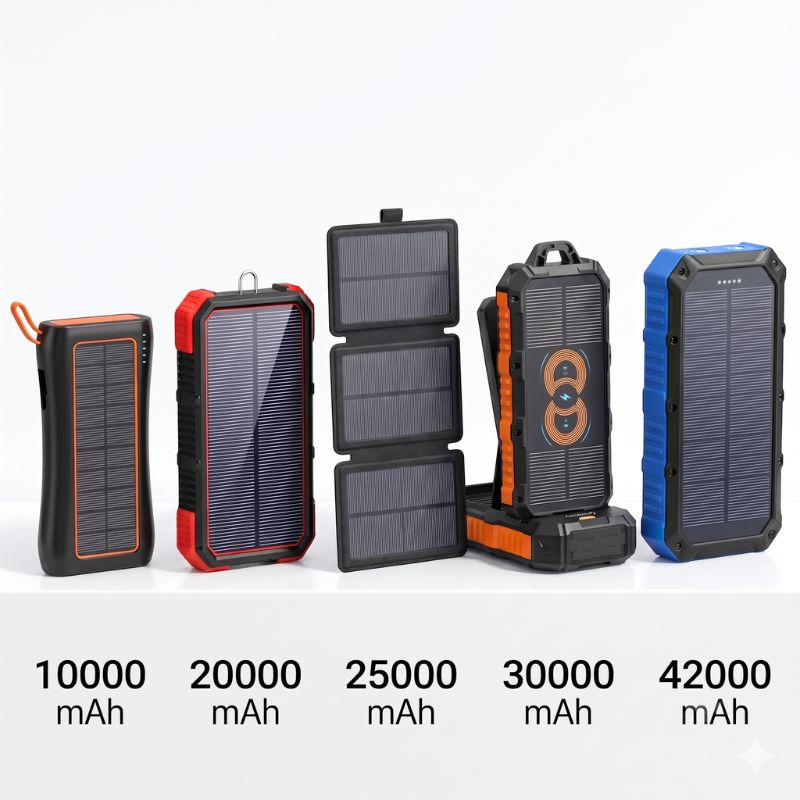
10,000 mAh class: Pocketable, price-friendly, roughly 1.5–2 real phone charges. Ideal for travel retail and promotional programs.
-
20,000 mAh class: The volume seller. Around 3–4 real phone charges, still carry-on compliant. Most of the category lives here — see the 20,000 mAh wireless solar power bank with dual inputs, waterproofing and flashlight (HDL-218) or the waterproof 20,000 mAh solar panel power bank with fast charging.
-
25,000–30,000 mAh class: Extended trips, tablets, and multi-device households. The 25,000 mAh solar charger with dual USB ports and waterproof housing and the 30,000 mAh Qi wireless solar charger power bank with USB-C input and IP65 rating (HDL-528) cover this tier.
-
36,000–42,000 mAh class: Basecamp and group use. The high-capacity 24,000/36,000 mAh wireless solar power bank with three cables (HDL-531) and the 42,000 mAh solar power bank with built-in 4 cables and dual LED flashlight (HDL-628) anchor the top end. Note: above roughly 27,000 mAh / 100 Wh, airline carry-on rules tighten — flag this for travel-focused retail programs.
Wirelessly or wired — why not both
Qi wireless pads are now an expected feature in mid-tier and above. They add perceived value at retail even though wireless transfer wastes more energy than a cable. Models with a pad plus dual wired outputs cover both preferences; the new dual-USB 20,000 mAh waterproof solar power bank with LED light (HDL519X) is a wired-first alternative where cost control leads.
Built-in cables
Units with 3–4 integrated cables remove the most common field failure — a forgotten or broken cable. Slightly thicker housings, noticeably fewer support tickets. This feature is climbing fast in buyer requests across the solar power bank category.
Durability ratings
-
IPX4: Splash resistance — light rain, tent condensation.
-
IP65: Dust-tight and resistant to water jets — genuine outdoor duty.
-
Drop-resistant housings: Rubberized corners and reinforced seams matter more than any drop-height claim.
Solar configuration
Integrated single panel for pocketability, or foldable multi-panel arrays for faster recovery. Frame the foldables as a solar solution that reduces bank size requirements per day, and the integrated models as everyday banks with an off-grid backup.
| Feature | Integrated panel | Foldable multi-panel |
|---|---|---|
| Solar input | ~1–6 W | Higher, panel-count dependent |
| Form factor | Phone-sized, pocketable | Larger, pack-mounted or camp-deployed |
| Best channel | Travel retail, everyday carry | Overlanding, expedition, emergency stock |
| Customer pitch | Backup top-up anywhere | Genuine daytime recovery |
What to Ask Before Sourcing Solar Phone Chargers at Scale
Specifications on a sample tell you about one unit. Sourcing questions tell you about the ten thousand units after it.
Compliance documentation. Lithium cells and battery packs — including power banks — must pass UN 38.3 transport testing before air or sea shipment, covering altitude simulation, thermal cycling, vibration, shock, short circuit, impact, overcharge, and forced discharge. Ask for current UN 38.3 test reports, MSDS files, and destination-market certifications (CE, FCC, RoHS as applicable) with every quotation. A solar phone charger without transport documentation is inventory you can’t legally ship.intertek+1
Cell sourcing and protection circuits. Ask which cell makers supply the factory and what the protection module monitors — overcharge, over-discharge, overcurrent, and temperature cutoffs should all be standard.
Real capacity disclosure. Request rated-capacity-at-5V figures alongside headline mAh. Factories that publish both understand why the numbers differ — and they’ll spec your private-label packaging honestly, protecting your reviews.
Solar input honesty. Ask for measured panel output under standardized light, not the theoretical cell rating. The spread between claimed and measured solar charging rates is well documented in independent reviews, and your end customers will test it themselves.
Sampling and lead times. Confirm sample turnaround, mass-production lead time, and how peak season affects scheduling. Capacity commitments matter when a pre-summer order window closes.
This is where working directly with the original manufacturer pays off. Shenzhen Hedeli Technology has spent about a decade in mobile accessories and consumer electronics — power banks, TWS earbuds, Bluetooth speakers, USB chargers and cables, car chargers, and car phone holders. More than 100 employees operate between the Shenzhen headquarters and the Guangzhou office and showroom, while the Dongguan factory runs a monthly capacity of 50,000 units supplying importers, distributors, and wholesalers on schedule. When your questions above reach the people who actually build the units, answers come back with test data attached instead of forwarded guesses.
If you’re lining up a solar program for the coming season, send over your target capacity range, feature list, and destination markets. We’ll return model recommendations, current compliance files, and a quotation from the source — no intermediaries, no spec-sheet telephone game.
Frequently Asked Questions
1. What is the minimum order quantity for solar power banks?
Typical production runs start at 500–1,000 units per model, depending on customization level. Standard catalog units like the 20,000 mAh models often allow lower trial quantities for new accounts. Share your target volume and we’ll confirm the current MOQ for each model you’re considering.
2. Can we customize branding, colors, and packaging?
Yes — logo printing, housing colors, retail box design, and manual languages are all available. Built-in cable configurations and LED options can also be specified at the order stage. Send your artwork and packaging requirements for a tailored quotation.
3. Do your units carry UN 38.3 and destination certifications?
Every lithium shipment is supported by UN 38.3 test reports and MSDS documentation, with CE, FCC, and RoHS files available per model. Request the certificate set with your sample order so your compliance team can review files before mass production.
4. How long are production lead times and sample delivery?
Samples typically ship within about a week for catalog models; customized samples take longer. Mass production generally runs 25–35 days depending on order size and season. Reach out early for peak-season programs — summer outdoor demand fills production slots quickly.
5. Why does measured solar charging differ from the spec sheet?
Panel output depends on light intensity, angle, and temperature; rated figures come from standardized lab light. Independent testing routinely shows real-world output at half or less of the panel’s rating. Ask us for measured solar input data on any model — we test to give you numbers you can print honestly.