

A solar power bank and a hot climate are a tricky combination. The product is designed to sit in the sun, but the lithium battery inside does not like heat. Most lithium-ion cells are specified for charging between about 0 °C and 45 °C, and a phone or power bank left on a car dashboard in summer can get far hotter. In the Middle East, North Africa, South Asia and northern Australia, heat is the most common cause of swelling, short battery life and complaints.
This guide is for distributors and retailers selling solar power banks in hot regions. It explains what heat does to the battery, which product features help, what to write in manuals and listings, and how to test samples. It is about consumer power banks, not large solar battery systems.
What Heat Does to a Power Bank
| Condition | Effect |
|---|---|
| Charging above about 45 °C | Faster aging and capacity loss; good protection circuits slow or stop charging |
| Storage at high temperature | Permanent capacity loss over time, worse when the battery is full |
| Discharging in heat | Usually allowed to a higher limit than charging, but accelerates degradation above about 60 °C |
| Very high temperatures (e.g. a closed car in direct sun) | Swelling, venting and in the worst case thermal runaway |
Limits vary by cell and brand, and some power bank makers recommend storage below 35 °C. Use the specification of the cell in your model, and print the operating range in the manual.
The Solar Panel Paradox
Solar charging needs direct sun, and direct sun heats the housing. A dark power bank lying in the midday sun can quickly reach temperatures where a well-designed protection circuit stops charging. So in hot regions:
- Solar charging works best in the morning and late afternoon, or with the unit partly shaded and only the panel in the light
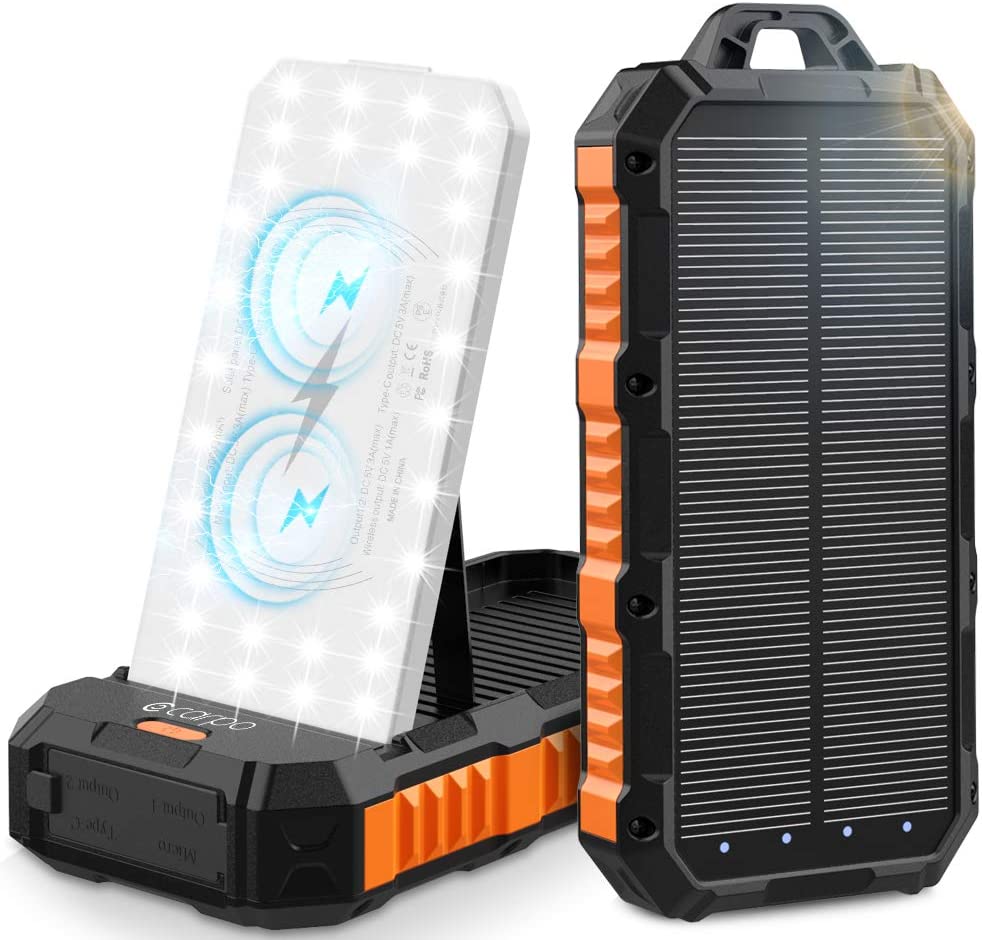
- Foldable models that keep the panel away from the battery body run cooler than single-panel units
- Lighter housing colors absorb less heat than black
- Users should never leave the unit charging on a car dashboard
This is good news for your product copy: it is honest to say the solar panel is a backup and the battery should be charged mainly by USB.
Features to Look For
- Over-temperature protection. Our HDL618 20,000 mAh solar power bank lists MCU control with over-temperature, overcharge, over-discharge, over-voltage, short-circuit and high-power protection.
- Fire-rated housing. ABS+PC with a V0 flame rating is used on several of our models.
- Quality cells. Ask which cell brand and grade are used, and whether production matches the sample.
- Dust and water resistance. Desert dust and sudden storms damage ports; sealed port covers help. Check the rating claimed.
- Housing color. We can produce lighter colors such as orange, white or green for volume orders.
What to Put in the Manual and Listing
- Charge with USB first; solar is a backup
- Do not leave the power bank in a parked car or on a dashboard
- Do not charge in direct midday sun in very hot weather; place the panel in light and keep the body shaded
- Store in a cool place, partly charged, if not used for a long time
- Stop using the unit if it swells, smells or becomes very hot
- State the charging and operating temperature range
Add Arabic, French or other local languages as needed. Clear warnings reduce returns and protect your brand.
How to Test Samples for Hot Markets
- Charge the sample in real outdoor sun at your hottest time of year and measure the housing temperature
- Check whether charging slows or stops as the unit heats up
- Leave a sample in a parked car for a few hours (without charging) and check for swelling afterward
- Compare capacity before and after a week of hot storage
Use these results to choose models and write honest copy. For Saudi documentation, see our SABER guide.
What to Send Us for an Accurate Quote
- Your market and typical summer temperatures
- Models from our solar power bank range
- Preferred housing colors
- Languages for warnings and manuals
- Quantity per model
Contact our sales team and we will recommend models for hot climates.
Frequently Asked Questions
Can a solar power bank be left in the sun all day?
Not in very hot weather. Heat damages the battery. Put the panel in the light and keep the body shaded, or charge by USB.
What temperature is safe for charging a power bank?
Most lithium-ion cells are specified for charging between about 0 °C and 45 °C. Check the specification for your model.
Why does my solar power bank stop charging in the sun?
Probably the over-temperature protection. It is a safety feature, not a fault.
Which housing color is best for hot regions?
Lighter colors absorb less heat than black. We offer several colors for volume orders.