

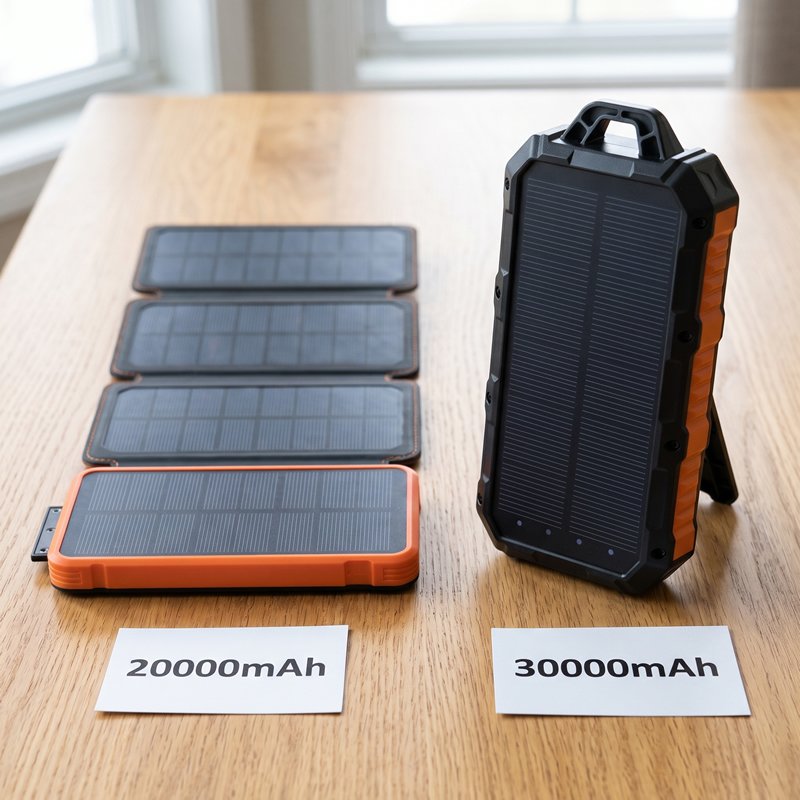
A distributor orders thousands of 30000mAh units for a travel retail chain. The stock arrives, and then the problem shows up: shoppers can’t take them on most flights without asking the airline first. One number on a spec sheet caused the whole mismatch.
Here is the short answer. A 20000mAh solar power bank stores about 74Wh, refills a typical phone 2.5 to 3 times, and flies without airline approval. A 30000mAh model stores about 111Wh and gives roughly 50% more charges. However, it weighs more, needs airline approval to fly, and a full solar power bank charge takes about 50% longer.
Below, you’ll find the capacity math, real solar charge times, weight and flight rules, and a simple way to match each size to your market.
Key Takeaways
- Capacity: 20000mAh ≈ 74Wh. 30000mAh ≈ 111Wh. Both figures use the standard 3.7V cell voltage.
- Phone charges: Expect about 2.5–4 charges from 20000mAh and about 3.7–6 from 30000mAh, depending on the phone.
- Solar charging: Built-in panels are a top-up feature. A full charge from sunlight alone takes many days for either size.
- Flights: Power banks up to 100Wh need no airline approval. Most 30000mAh models sit above that line.
- Best fit: 20000mAh suits travel, daily carry, and gifts. 30000mAh suits camping, emergency kits, and group use.
What Is the Real Difference Between 20000mAh and 30000mAh?
The simple difference is stored energy. A 30000mAh pack holds 50% more than a 20000mAh pack. But mAh alone doesn’t tell the full story, because it ignores voltage.
So the better unit is watt-hours (Wh). Airlines, regulators, and shipping rules all use Wh. Here is the formula:
Wh = mAh × 3.7V ÷ 1,000
That gives 74Wh for 20000mAh and 111Wh for 30000mAh. That 37Wh gap affects weight, charge time, and travel rules.
| Factor | 20000mAh Solar Power Bank | 30000mAh Solar Power Bank |
|---|---|---|
| Stored energy | About 74Wh | About 111Wh |
| Phone charges (4,000mAh phone) | About 3 | About 4.7 |
| Cell weight | Base | About 50% more |
| Wall charge time (15W input) | About 10 hours | About 15 hours |
| Flight status | Carry-on, no approval needed | Carry-on, airline approval needed |
| Typical buyer | Commuters, travelers, gift buyers | Campers, field crews, emergency kits |
How Capacity Affects Unit Cost and Freight
More capacity means more cells, and cells make up a large share of a power bank’s cost. So a 30000mAh unit almost always carries a higher factory price than a 20000mAh unit with the same housing and features.
The cost gap also shows up in shipping. Heavier units mean heavier cartons, and that raises freight cost per unit. In addition, lithium batteries ship as regulated goods, so every carton needs proper labels and test documents. Larger Wh ratings can add extra handling rules with some carriers.
For buyers, this means the 30000mAh line should earn a higher retail price. If your market won’t pay that higher price, the 20000mAh line usually gives a healthier margin.
For a real-world reference, our 20000mAh solar power bank with wireless charging and LED flashlight weighs about 450g. It measures 172 × 87 × 28mm, and its wall charge takes about 10 hours. A 30000mAh version needs more cells, so it gets heavier and thicker.
How Many Phone Charges Come From One Solar Power Bank Charge?
No power bank delivers its full rated capacity to a phone. Some energy turns into heat. Some is lost when the pack steps 3.7V up to 5V or higher. The cable and the phone’s own circuit also take a share.
A fair planning figure is 60–70% efficiency. We use 65% below.
The Quick Formula
- Take the pack’s Wh and multiply by 0.65.
- Find the phone’s Wh (phone mAh × 3.85V ÷ 1,000).
- Divide the first number by the second.
So a 20000mAh pack gives about 48Wh of usable energy. A 30000mAh pack gives about 72Wh.
| Phone Battery Size | Phone Energy | Charges From 20000mAh | Charges From 30000mAh |
|---|---|---|---|
| 3,000mAh | About 11.6Wh | About 4.1 | About 6.2 |
| 4,000mAh | About 15.4Wh | About 3.1 | About 4.7 |
| 5,000mAh | About 19.3Wh | About 2.5 | About 3.7 |
These are estimates, not lab results. Still, they’re far more honest than the “charges your phone 7 times” claims many listings use.
What This Means for a Solar Powered iPhone Charger
Recent iPhone models carry batteries of roughly 3,000–4,700mAh. So a 20000mAh solar powered iPhone charger gives most iPhone users three or four full charges. For a weekend trip, that is usually enough. Meanwhile, a 30000mAh pack covers a full week of light use or a small group sharing one device.
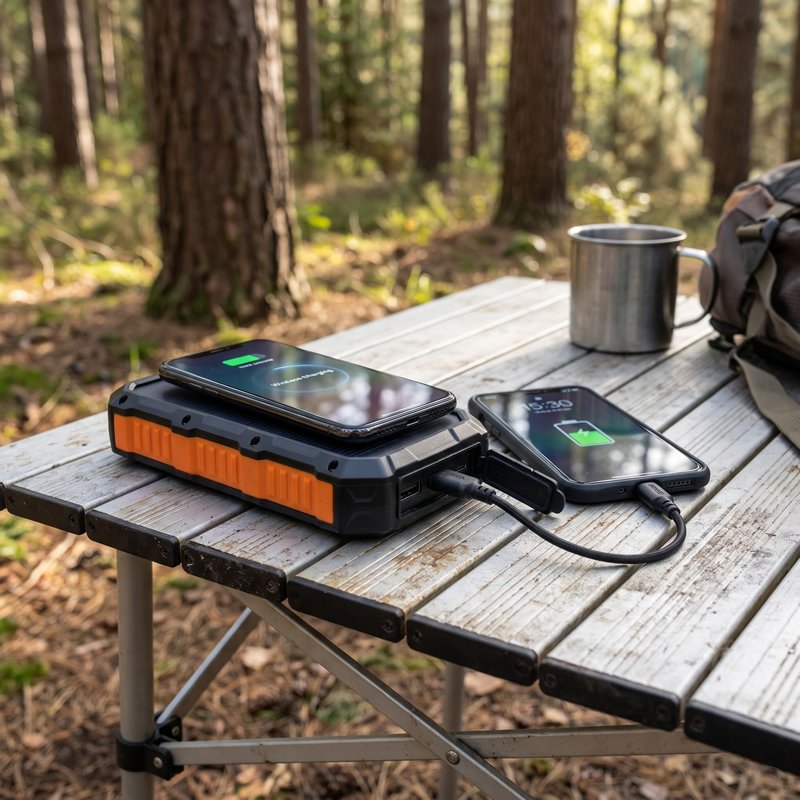
Also keep wireless charging in mind. Qi wireless output loses more energy than a cable does. Our 20000mAh wireless model outputs about 5W wirelessly. That works for overnight top-ups, but buyers should tell end users that a cable charges faster and more efficiently.
How Long Does a Solar Power Bank Charge Take?
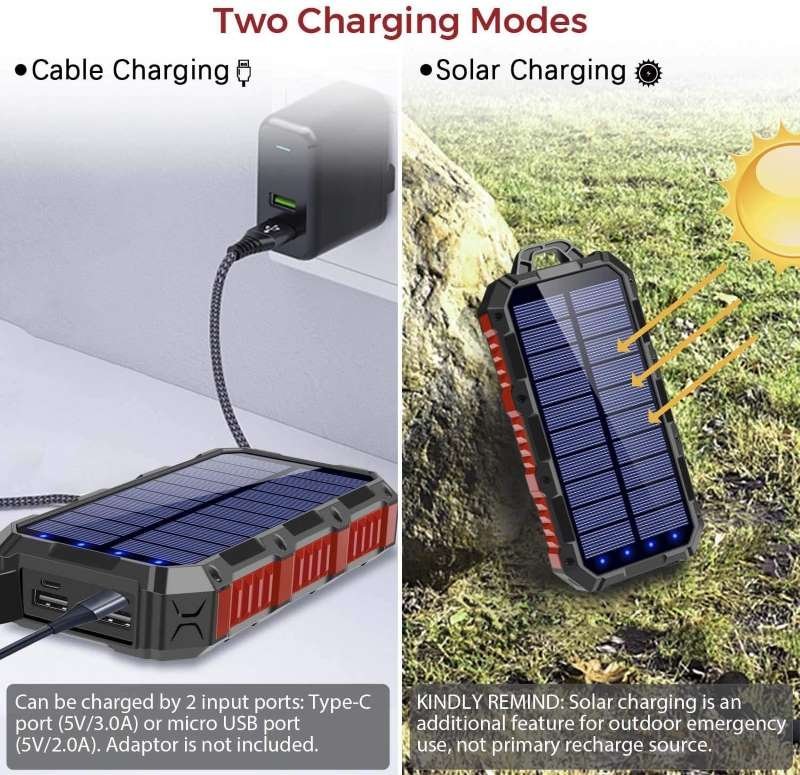
This is the question end users ask most, and it causes the most returns. The honest answer: solar charging is a backup, not the main way to fill the battery.
Our built-in panels use monocrystalline silicon rated at about 1.5W. In ideal sun, 1.5W adds about 1.5Wh per peak-sun hour. Many regions get about 4–5 peak-sun hours a day, and real conditions add more losses.
| Charging Method | 20000mAh (74Wh) | 30000mAh (111Wh) |
|---|---|---|
| Wall charger, 5V/3A Type-C (15W) | About 10 hours | About 15 hours |
| Built-in 1.5W panel, ideal sun | About 50 sun hours | About 74 sun hours |
| Built-in panel, 4–5 sun hours/day | About 10–13 days | About 15–19 days |
| Built-in panel, cloudy weather | Much slower | Much slower |
The panel math is a simple estimate based on rated panel power. Heat, panel angle, and dust all slow it down further.
Why the Panel Doesn’t Grow With the Battery
A 30000mAh pack is a bit larger, but its panel area grows only slightly. So the solar input stays about the same while the battery gets 50% bigger. As a direct effect, every full solar power bank charge takes longer on the bigger model.
This is the key trade-off many buyers miss. If your customers rely on sunlight, a bigger battery doesn’t help them refill faster. In fact, it does the opposite.
How to Set the Right Expectations
Clear packaging cuts complaints. We suggest three lines on the box or listing:
- “Charge fully from the wall before your trip.”
- “Use the solar panel to top up during the day.”
- “Solar input depends on sunlight, angle, and weather.”
Similarly, a power bank for solar top-ups works best when left in direct sun with the panel facing the sky. Behind a car window or under a tent roof, input drops sharply.
Which Size Is Easier to Carry and Fly With?
Weight and travel rules often decide the order before capacity does.
Weight and Size
Our 20000mAh wireless model weighs about 450g. A 30000mAh pack needs 50% more cell capacity, so it adds noticeable weight and thickness. For a jacket pocket or a small daypack, many users feel that extra bulk quickly.
Airline Rules
Flight rules follow Wh, not mAh. According to the FAA’s guidance on airline passengers and batteries, lithium-ion power banks are limited to 100Wh per battery for carry-on use. Larger 101–160Wh batteries are allowed only in carry-on bags, with a two-spare limit, and airlines must approve them.
Here is how that applies:
- 20000mAh (≈74Wh): Under 100Wh. Travelers can carry it on without airline approval.
- 30000mAh (≈111Wh): Above 100Wh. Travelers must ask the airline before flying.
- Both sizes: Power banks are banned from checked bags.
Rules are also getting stricter. IATA’s guidance for travelers with lithium batteries explains current carry-on limits, and several airlines added their own power bank limits in 2026. So print the Wh rating clearly on the product and the box. Airport staff check that number.
Which Solar Power Bank Size Fits Your Market?
The right capacity depends on who buys it and how they use it. Here’s a practical guide based on common buyer channels.
| Market or Use Case | Recommended Size | Why |
|---|---|---|
| Travel retail and airports | 20000mAh | Flies without airline approval |
| Corporate gifts and promotions | 20000mAh | Lighter, lower unit cost, wide appeal |
| Daily commuters | 20000mAh | Fits a bag, covers several days |
| Camping and hiking stores | Both | 20000mAh for hikers, 30000mAh for base camps |
| Emergency and disaster kits | 30000mAh | More reserve energy during outages |
| Field crews and outdoor workers | 30000mAh | Powers several devices per shift |
| Festivals and group trips | 30000mAh | One pack shared by several phones |
When 20000mAh Is the Stronger Pick
Most retail channels sell more 20000mAh units. The size hits a sweet spot of capacity, weight, and price. It also avoids flight questions, which helps travel and gift sales.
For outdoor ranges, a waterproof model adds real value. Our 20000mAh wireless unit carries an IPX7 rating, tested at 1 meter for 30 minutes. That makes it a fit for rain, river crossings, and beach trips. You can also compare our waterproof solar panel power bank with fast charging for retail shelves that want a bright, rugged look.
When 30000mAh Earns Its Place
A larger solar mobile phone charger makes sense when users stay off-grid for days. Emergency kits are a good example. During a power outage, sunlight may be the only source, so stored reserve counts more than weight.
Still, keep the solar math in mind. A bigger battery holds more, but it refills slowly from its panel. For long off-grid use, pair it with a reminder to charge fully at home first.
What Mistakes Do Buyers Make When Choosing a Solar Phone Charger?
Most capacity mistakes come from reading one number and ignoring the rest. Here are the five we see most often in sourcing talks.
1. Assuming Bigger Always Sells Better
A large number on the box looks attractive. However, many shoppers return heavy packs once they carry them for a day. For general retail, 20000mAh often sells through faster and returns less.
2. Promising Fast Solar Charging
Some listings suggest the sun can fill the battery in a day. That claim doesn’t hold up with a small built-in panel. Customers who feel misled leave poor reviews, and those reviews hurt the whole product line.
3. Forgetting the Flight Rules
Travel buyers sometimes order 30000mAh units for airport shops. Then they learn the units need airline approval. Always check the Wh rating against your sales channel first.
4. Skipping Sample Tests
Specs on paper can differ from real performance. Order samples, run a full discharge test, and check the actual output. Also test the panel in real sunlight, not under a desk lamp.
5. Ignoring the Charge Port
A pack with only Micro USB input takes much longer to refill from the wall. Since most users now carry Type-C cables, a Type-C input is the safer choice for both sizes.
In short, the right capacity is the one that fits the user’s day, the sales channel, and the travel rules. Getting those three right does more for sell-through than adding extra mAh.
What Should Buyers Check Before Ordering a Solar Powered Power Bank?
Capacity is only one line on the spec sheet. A solar power bank battery charger is still a lithium battery first, so safety and honest labeling come before features.
1. True Capacity vs. Rated Capacity
Ask for the actual tested capacity, not just the headline number. Some listings across the market print a large figure in the title and a smaller one in the specs. Request a capacity test report and check samples yourself with a USB meter.
2. Watt-Hour Label
The Wh rating should appear on the housing. Without it, end users may face trouble at airport security.
3. Certifications and Transport Tests
Ask which certificates cover the exact model. Common ones include:
- UN38.3 – required to ship lithium batteries by air, sea, and road
- MSDS – safety data sheet for freight forwarders
- CE, FCC, RoHS – market access for the EU and US
- UL or PSE – needed for some retail chains and the Japanese market
4. Waterproof Rating
IPX7 means the unit survives temporary immersion. IP65 means dust-tight and protected from water jets, but not submersion. Match the rating to the claim on your packaging.
5. Ports and Output
Check the Type-C input and output. A 5V/3A Type-C input cuts wall charge time compared with older Micro USB inputs. Also confirm how many devices can charge at once.
6. Protection Circuits and Cycle Life
Look for protection against overcharge, over-discharge, short circuit, and over-temperature. Our models include these, plus MCU monitoring, and they’re rated for about 500 charge cycles.
Browse our full solar power bank range to compare panel types, ports, and waterproof ratings across models.
How Does Custom Sourcing Work With a Factory-Direct Supplier?
Once you’ve picked a capacity, the next decision is branding. Shenzhen Hedeli Technology Co., Ltd. has worked in mobile accessories and consumer electronics for about 10 years. Our team of more than 100 people supports both OEM and ODM orders.
What You Can Customize
- Logo: Printed or engraved on the housing
- Colors: Standard options, plus custom colors for larger orders
- Packaging: Retail boxes, multilingual manuals, and Wh labels for your market
- Capacity and features: Choose panel type, wireless output, flashlight modes, and port layout
Capacity and Supply
Our factory in Dongguan produces up to 50,000 units per month. That steady output helps importers, distributors, and wholesalers plan seasonal stock, like summer camping lines or year-end gift orders. Our headquarters sits in Shenzhen, and buyers can visit our office and showroom in Guangzhou to see models in person.
For a Qi wireless option with dual inputs, look at our HDL528 solar charger with Qi wireless charging. For multi-panel designs, compare our solar power bank with extra solar panels and LED light and our foldable outdoor solar charger with LED lights.
Talk to the Factory That Builds Them
Choosing between 20000mAh and 30000mAh is easier with real samples in hand. Because we are the original manufacturer, you speak directly with the people who design, assemble, and test every unit. There’s no trading layer, so specs, test reports, and pricing come straight from the source.
Tell us your market, target price, and preferred capacity. We’ll recommend a model, share certificates for that exact unit, and prepare a quote for your volume. Send your inquiry now, and let’s build a solar power bank line your customers will trust.
Frequently Asked Questions
1. What is the minimum order quantity for solar power banks?
MOQ depends on the model and how much customization you need. Standard cartons hold 18 units for our 20000mAh wireless model, which makes trial orders easy to plan. Reach out with your target volume, and we’ll confirm MOQ and sample options for your chosen model.
2. Can you customize logo, color, and packaging for our brand?
Yes. We offer logo printing, custom colors for larger orders, and branded retail packaging with multilingual manuals. We can also print the Wh rating and safety marks your market requires. Contact us to request a custom sample.
3. Which certifications do your solar power banks come with?
Most of our models carry CE, FCC, and RoHS. Selected models also hold UN38.3, MSDS, UL, or PSE. Certificates differ by model, so ask for the documents that cover the exact unit you plan to order.
4. How long does a full solar power bank charge take?
From a 15W Type-C wall charger, a 20000mAh unit fills in about 10 hours. From its 1.5W built-in panel alone, it needs about 50 peak-sun hours, or roughly 10–13 sunny days. A 30000mAh unit takes about 50% longer either way.
5. Can travelers carry a 30000mAh power bank on flights?
Usually only with airline approval. A 30000mAh pack rates about 111Wh, which is above the 100Wh carry-on limit set for power banks without approval. A 20000mAh pack (about 74Wh) can go in carry-on bags without approval, but never in checked bags.