

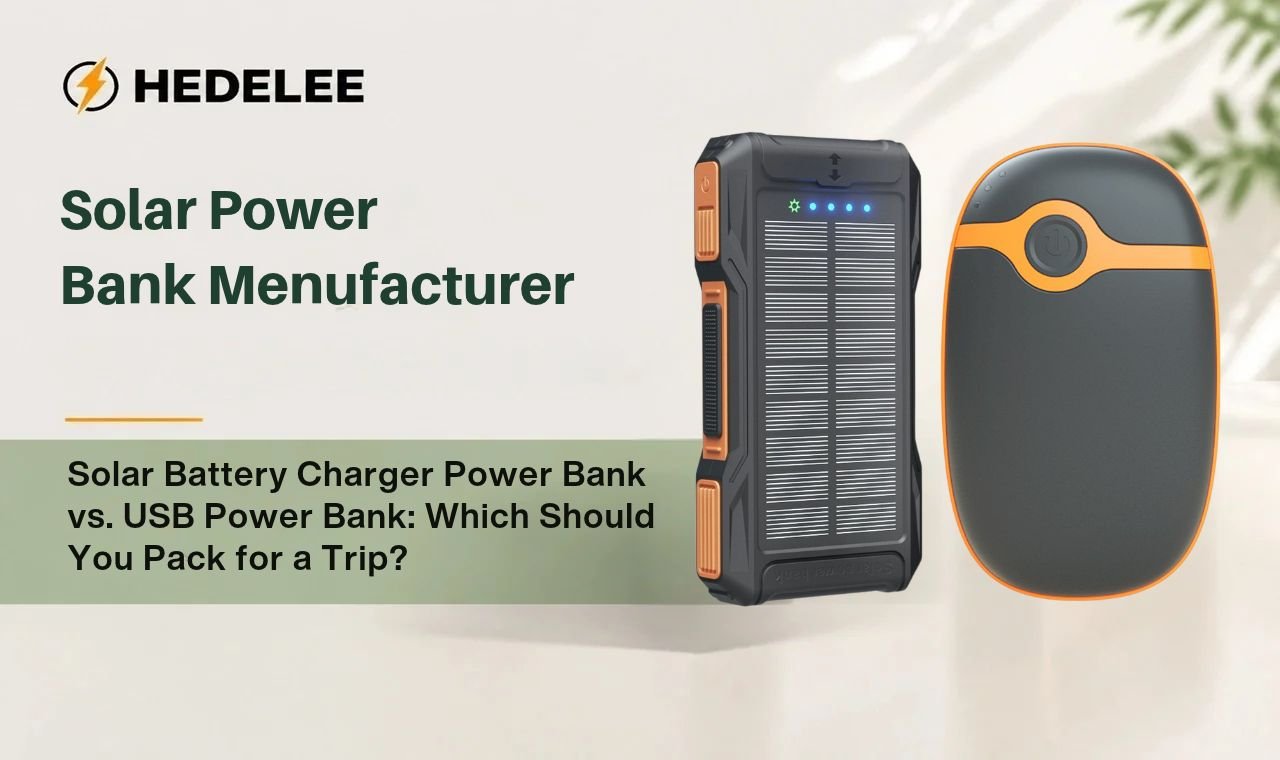
A solar battery charger power bank lets you top up your battery in sunlight when you’re camping or hiking far from an outlet. Start your trip with a full charge, since a small built-in panel can take hours to add even a little power. For a city break with regular access to outlets, a standard USB power bank is usually the simpler choice.
Imagine reaching the trailhead with your phone at 4%. What matters then is how much charge your power bank already holds. The solar panel matters later, when you have daylight and time to recharge. For wholesale buyers, that distinction helps answer two questions: which models fit your customers’ trips, and what charging performance can you promise them?
This guide compares solar and standard USB power banks by charging speed, weight, durability, airline rules, and cost. It also explains how to choose a capacity for different trips and what to ask suppliers before placing a wholesale order.
Key Takeaways
- A solar power bank is a regular USB power bank with a solar panel added. The panel is a backup input, not the main one.
- Charge from the wall before you leave. Sunlight refills the battery slowly, and a single built-in panel needs days of strong sun to fill a large pack.
- On flights, watt-hours decide what you can carry. Up to 100 Wh is allowed in carry-on bags, 101–160 Wh needs airline approval, and anything above 160 Wh is not allowed on passenger aircraft.
- Since 27 March 2026, international rules limit each passenger to two power banks and prohibit recharging them on board.
- For most trips, 10,000–20,000 mAh covers phones and small devices. Larger packs suit groups, long off-grid stays, and emergency kits.
- Before a wholesale order, ask for panel wattage, tested cell capacity, the IP rating, and battery transport documents.
What Is a Solar Battery Charger Power Bank?
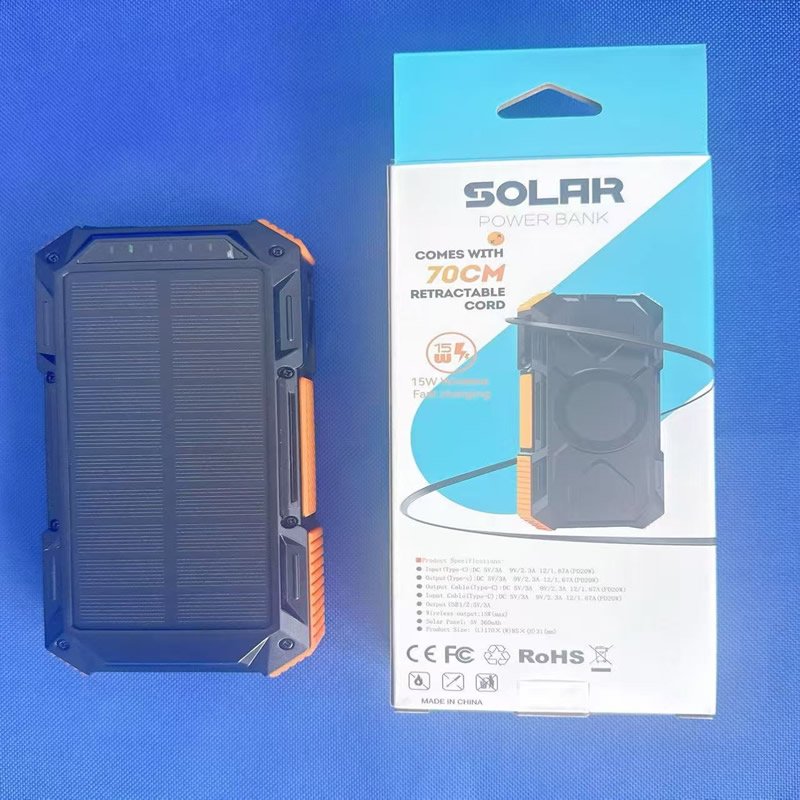
A solar battery charger power bank is a portable lithium battery pack with a built-in or fold-out solar panel. You charge it from a wall adapter over USB, like any power bank. The panel adds a second way to refill it when no outlet is around. The pack then charges phones, tablets, earbuds, cameras, and GPS units through USB ports, built-in cables, or a wireless pad.
You’ll see the same product sold under several names: solar power bank, solar powered power bank, solar phone charger, or solar power bank battery charger. All of them describe one idea. Stored energy comes first, and sunlight comes second.
That order is worth explaining to your customers. People who expect a panel the size of a phone to run their devices all week will be disappointed. People who see it as a full battery with a built-in safety net tend to be happy with the product.
How is it different from a standard USB power bank?
A standard USB power bank has one way in: a cable from a wall adapter, laptop, or car socket. A solar model keeps that input and adds the panel. Most outdoor models also add a tougher shell and a few field tools:
- Water- and dust-resistant housing, shown by an IP rating like IP65 or IPX4
- An LED flashlight or camping light, often with an SOS mode
- A loop or carabiner for hanging the pack on a backpack
- Built-in cables, so nothing gets left at home
- A wireless charging pad on some models
Inside, both types use the same kind of lithium cells and protection circuits. So at the same capacity, they deliver about the same number of phone charges.
Is a fold-out solar charger different from a single-panel one?
Yes. A single-panel unit carries one panel on its face, so it stays close to pocket size. A fold-out design opens into several panels and collects more light in the same hour. The trade-off is bulk and weight.
Our foldable 20,000 mAh outdoor solar charger with LED lights is an example of the fold-out style. It suits users who stay in one camp for several days. Single-panel units suit day hikers and commuters who want backup power without extra bulk.
How Does a Solar Battery Charger Power Bank Compare With a USB Power Bank?
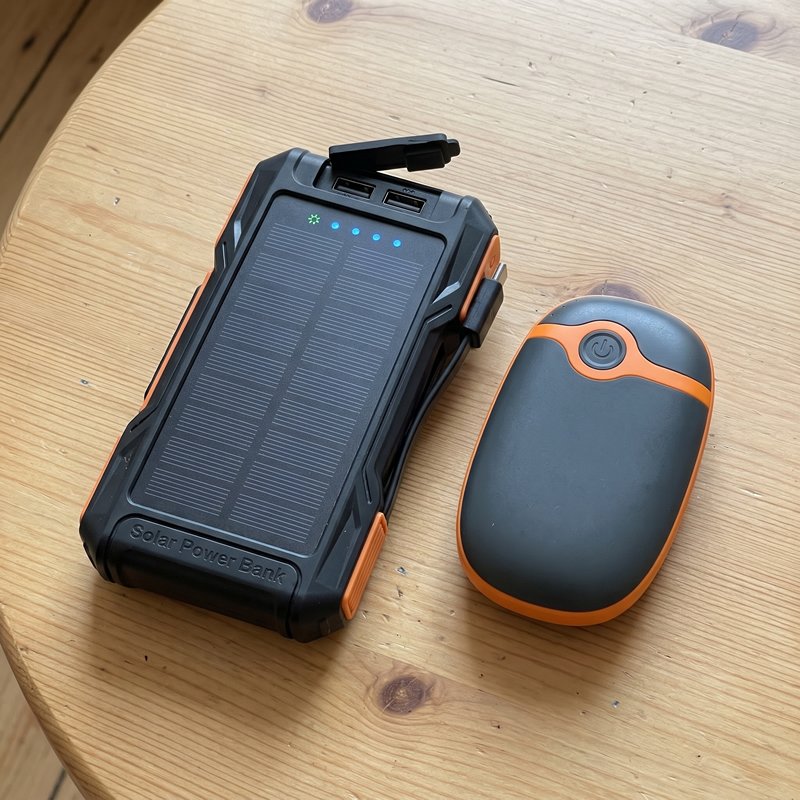
A solar powered power bank wins on independence and toughness. A USB power bank wins on weight, size, and price. Neither is better in every case, so the right pick depends on how far the user will be from an outlet.
| Factor | Solar power bank | Standard USB power bank |
|---|---|---|
| Ways to recharge | Wall or USB, plus sunlight | Wall or USB only |
| Recharge from the wall | Depends on input wattage; similar at equal capacity | Depends on input wattage |
| Recharge from the sun | Slow; days for a full refill on a single panel | Not possible |
| Weight and size | Heavier and thicker at the same capacity | Lighter and slimmer |
| Durability | Often rated for rain, dust, and drops | Mostly built for indoor and city use |
| Extras | Flashlight, SOS light, hanging loop, built-in cables | Few; the focus is a slim body |
| Unit cost | Higher, because of the panel and rugged shell | Lower |
| Suits | Camping, hiking, boating, emergencies, off-grid work | City travel, commuting, flights |
How fast does the solar panel charge the battery?
Slowly, and it pays to say so in your product copy. A quick calculation shows why.
Energy in a battery is measured in watt-hours (Wh). To get it, multiply amp-hours by voltage. A 20,000 mAh pack at 3.7 V holds about 74 Wh. Single built-in panels on pocket-size packs are commonly rated at around 1–2 W. At 1.5 W, filling 74 Wh takes roughly 49 hours of strong, direct sun, before conversion losses. That is several clear days, not one afternoon.
Now look at one day. Five hours of strong sun on a 1.5 W panel yields about 7.5 Wh before losses. That covers emergency calls, maps, and messages. It won’t refill a large pack.
Fold-out models with several panels shorten these times because they expose more panel area. Even so, the working rule stays the same: wall first, sun as a top-up. Ask your supplier for the panel wattage in writing, because the word “solar” on a box says nothing about speed.
Which one is lighter to carry?
The USB power bank, at equal capacity. A panel, a thicker shell, and sealing all add grams. Hikers who count every gram often choose a 10,000 mAh solar model. Car campers and boaters rarely mind the weight, so 20,000 mAh and above works for them.
Which one holds up better outdoors?
The solar model, in most cases. Outdoor units are built for rain, dust, and drops. Our 30,000 mAh solar charger power bank with Qi wireless charging and IP65 waterproofing (HDL528) is one example. In the IP code, the first digit covers dust and the second covers water. IP65 means dust-tight and protected against water jets. IPX4 means protected against splashing water, with no dust rating given.
One caution applies to every lithium pack: heat. A dashboard in summer sun gets far hotter than open air. Tell users to charge the pack in the open, not behind glass.
Which one costs less?
The USB power bank. The panel, sealing, and rugged shell add material and assembly cost. For buyers, the solar version can justify a higher shelf price in outdoor, hardware, and emergency-supply channels, where shoppers value the extra functions.
When Should You Pack a Solar Phone Charger Instead of a USB Power Bank?
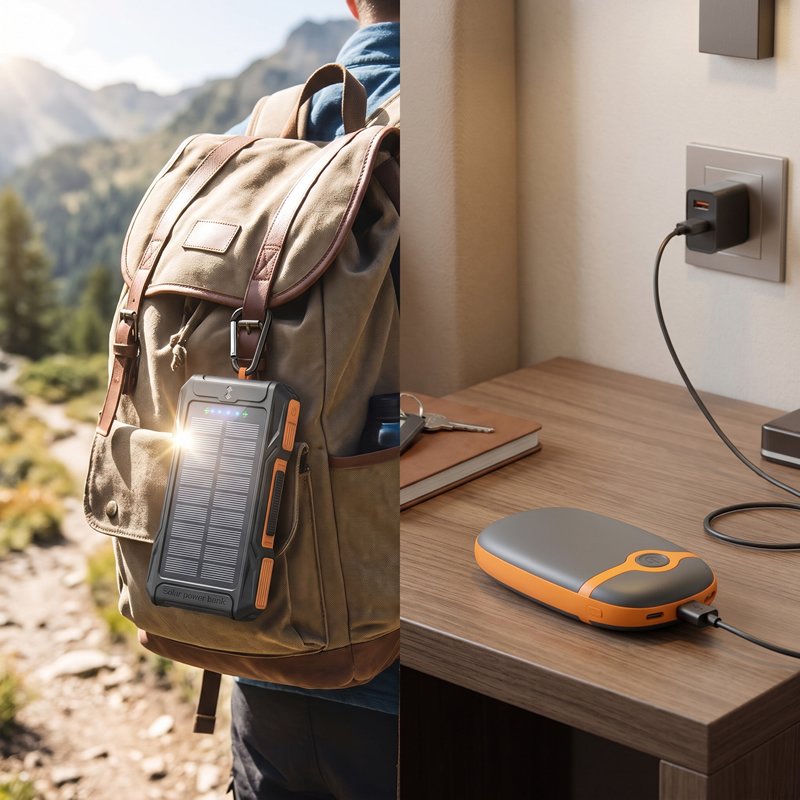
Pack a solar phone charger when you can’t count on an outlet within about two days. Pack a USB power bank when you can. The table below matches common trips to a sensible choice.
| Trip type | Days away from outlets | Sensible pick | Reason |
|---|---|---|---|
| City break or business trip | 0 | 10,000 mAh USB or compact solar model | An outlet every night; weight counts |
| Weekend camping | 1–2 | 10,000–20,000 mAh solar | The wall charge covers the trip; the panel is a safety net |
| Multi-day hike or trek | 3–7 | 20,000 mAh fold-out solar | More panel area for daily top-ups |
| Group or family road trip | Varies | 24,000–42,000 mAh solar with built-in cables | Several devices charge at once |
| Boating or fishing | 1–5 | Waterproof solar with flashlight | Spray, open sky, no sockets |
| Emergency kit | Unknown | 20,000 mAh solar with hand crank | Still works when the grid is down |
| International flight | 0 | Any pack under 100 Wh | Airline battery limits apply |
What should city travelers and frequent flyers pack?
A slim USB power bank or a compact solar model. City travelers sleep near an outlet, so capacity above 10,000 mAh mostly adds weight. A compact solar unit still makes sense for people who mix city days with day hikes or beach days. Two options from our range are the 10,000 mAh solar charger with high-speed backup battery (HDL533) and the 10,000 mAh outdoor solar power bank with wireless charging and a strong light.
What works for camping, hiking, and festivals?
A solar unit in the 20,000 mAh class. It carries several phone charges from the wall and picks up a little more each sunny day. Useful picks include:
- the 20,000 mAh waterproof solar power bank with dual USB and LED light (HDL519X)
- the portable solar charger power bank for camping gear (HDL519)
- the wireless solar battery charger with LED flashlight (HDL514)
- the 20,000 mAh solar power bank with wireless charging, dual inputs, and flashlight (HDL-218)
To get more from the panel, users can follow five simple steps:
- Charge the pack to 100% from the wall before leaving.
- In camp, lay the panel flat or tilt it toward the sun, away from shade.
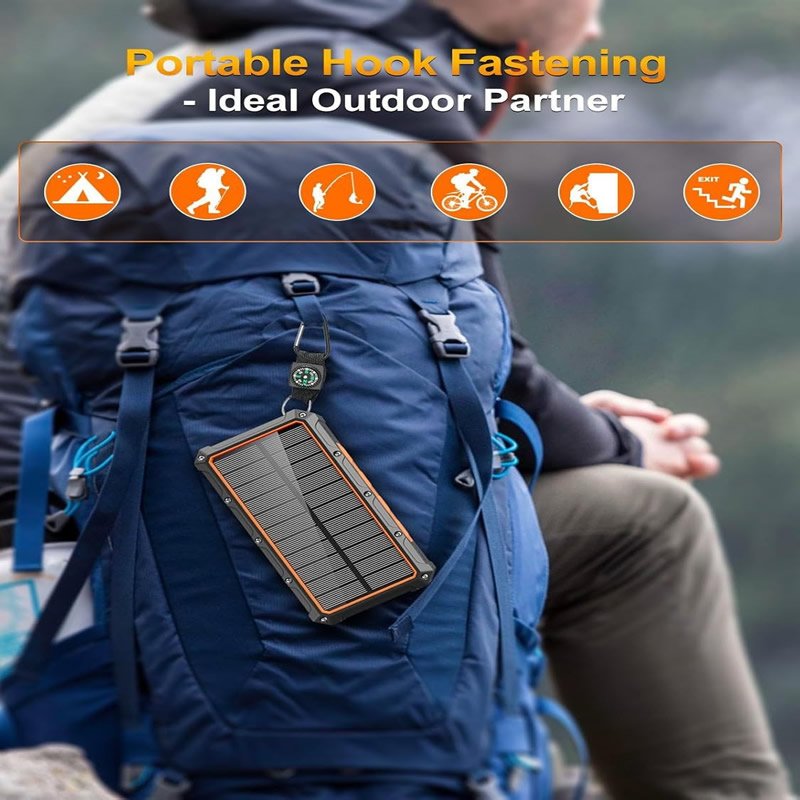
- On the move, hang the pack on the outside of the backpack.
- Keep the pack out of closed, hot spaces like a parked car.
- Charge phones from the pack in the evening, and let the panel work again the following day.
Print these steps on the box or in the manual. They cut down on “it doesn’t charge” complaints.
What should go in an emergency kit?
A solar unit with a second backup input. During storms and long power cuts, the sky may stay grey for days. A hand crank can add a little power at night or in bad weather. Our 20,000 mAh emergency solar power bank with hand crank and built-in cable was designed for this use. It suits retailers in storm-prone regions who build seasonal emergency displays.
Does a solar powered iPhone charger work with Android phones too?
Yes. A product sold as a solar powered iPhone charger is a solar cell phone charger with USB output, so it charges Android phones as well. The cable is the only real difference. iPhone 15 and later models use USB-C, and older iPhones use Lightning. Models with several built-in cables cover both groups, like our solar power bank with four built-in cables, wireless charger, and dual LED flashlight (HDL529). A solar mobile phone charger with a Qi wireless pad also works with any Qi-compatible phone, whatever the brand.
Can You Take a Solar Battery Charger Power Bank on a Plane?
Yes, in carry-on baggage only, and within watt-hour limits. The solar panel changes nothing here. Airlines look at the lithium battery inside.
Under the FAA PackSafe rules for lithium batteries, power banks count as spare batteries and must stay out of checked bags. Packs up to 100 Wh are allowed. Packs from 101 to 160 Wh need airline approval, with a limit of two per person. Anything above 160 Wh is not allowed on passenger aircraft.
International rules tightened in 2026. Under the ICAO power bank restrictions, effective 27 March 2026, each passenger may carry no more than two power banks and may not recharge them during the flight. Some airlines go further and ban any use of power banks on board. Always check the carrier’s own rules before flying.
How do you convert mAh to watt-hours?
Multiply the capacity in amp-hours by the cell voltage. Most lithium cells have a nominal voltage of 3.7 V, so the formula is: Wh = mAh ÷ 1,000 × 3.7.
The table applies that formula to common capacities in our range.
| Rated capacity | Energy at 3.7 V | Carry-on status under FAA limits | Example from our range |
|---|---|---|---|
| 10,000 mAh | 37 Wh | Allowed | HDL533 |
| 20,000 mAh | 74 Wh | Allowed | HDL-218, HDL519X |
| 25,000 mAh | 92.5 Wh | Allowed | 25,000 mAh solar charger with dual USB ports |
| 30,000 mAh | 111 Wh | Airline approval needed | HDL528 |
| 36,000 mAh | 133 Wh | Airline approval needed | HDL-531 wireless solar power bank with three cables |
| 42,000 mAh | 155 Wh | Airline approval needed; close to the cap | 42,000 mAh solar power bank with four built-in cables (HDL-628) |
| 52,800 mAh | 195 Wh | Not allowed on passenger aircraft | 52,800 mAh large-capacity solar power bank |
These figures are estimates. Airline staff check the watt-hour rating printed on the product label, so it should be clear and easy to find.
What do flight limits mean for your product range?
They split a range into packs that fly and packs that stay on the ground. Plan each sales channel around that line:
- Travel retail and airport channels: keep every model at or under 100 Wh, and print the Wh figure on the housing and the box.
- Outdoor and camping channels: 20,000–30,000 mAh suits drivers and campers who rarely fly with the pack.
- Emergency and home-backup channels: very large packs like 52,800 mAh belong here. Sell them as car, cabin, and home units, and state plainly in the listing that they can’t be taken on flights.
- Shipping: lithium batteries are regulated cargo. Ask for the UN38.3 test summary and the safety data sheet for every model before you book freight.
How to Choose a Power Bank for Solar Charging: A Buyer’s Checklist
Choose a power bank for solar charging by checking eight things: tested capacity, panel wattage, ports, ingress rating, safety circuits, documents, customization, and supply. Each one maps to a question you can put to a supplier.
- Tested capacity. Ask for the rated cell capacity and a discharge test report. Then check samples yourself with a USB load tester. Output at the port is always lower than the cell rating, because voltage conversion costs some energy.
- Panel wattage and type. Ask for the panel’s watt rating and cell type. Monocrystalline cells are a common choice for compact panels. A photo of a panel is not a specification.
- Ports and charging speed. Check for USB-C input and output, the maximum output in watts, and any fast-charge protocols your market expects.
- Ingress rating. Ask which IP rating the model carries and request the test report. IP65 and IPX4 are not the same promise, as explained earlier.
- Safety circuits. Confirm protection against overcharge, over-discharge, short circuit, and high temperature.
- Documents. Request the UN38.3 test summary and safety data sheet for shipping. Then confirm the approvals your market needs, like CE, FCC, RoHS, or PSE for Japan.
- Customization. Ask about logo printing, housing colors, cable types, and retail packaging, and what each does to the minimum order.
- Supply. Ask about monthly capacity, lead time, sample policy, and warranty terms.
Which features are worth paying for?
Pay for features your end users will use often, and skip the rest. A short guide:
| Feature | Worth it for | Skip it for |
|---|---|---|
| Fold-out panels | Multi-day camps, field crews | Commuters, frequent flyers |
| Wireless charging pad | Gift and retail sets, Qi phone users | Price-led promotions |
| Built-in cables | Families, rental and event kits | Users who carry their own cables |
| Hand crank | Emergency kits | Everyday carry |
| Flashlight with SOS mode | Camping, roadside, emergency use | Office gifts |
What should you ask a manufacturer before ordering?
Ask who builds the product. Trading companies and factories can quote the same model, but only the factory controls cells, assembly, and testing. Three questions sort this out fast:
- Where is the factory, and can we visit or join a video audit?
- What is the monthly capacity for this model?
- Who do we speak to when a batch needs a change?
Shenzhen Hedeli Technology Co., Ltd. has worked in mobile accessories and consumer electronics for about 10 years. Solar power banks are the main products in our Hedelee range.
Our headquarters are in Shenzhen, and we have an office and showroom in Guangzhou. In Dongguan, our factory can produce up to 50,000 units per month and supplies importers, distributors, and wholesalers. Across the company, we employ more than 100 people.
You can browse the full Hedelee solar power bank range to compare models side by side.
Which Should You Pack, and Which Should You Stock?
For packing, three rules cover most trips:
- Outlet every night: take a slim USB power bank or a compact 10,000 mAh solar model.
- One to seven days off-grid: take a 20,000 mAh solar battery charger power bank, charged from the wall first.
- Flying: stay under 100 Wh, keep the pack in the cabin, and bring no more than two.
For stocking, the same logic runs in reverse. Start from where your customers travel, then pick capacities and features to match. A range with one compact model, one or two 20,000 mAh outdoor models, and one large emergency unit covers most demand without overlap.
If you’re building or refreshing that range, talk to the people who make the product. Hedelee is the original manufacturer, so your questions reach the factory team directly, with no trading company in between. Send us your target market, capacity range, and expected order volume. We’ll reply with matching models, full specifications, sample options, and a quotation you can plan around.
Frequently Asked Questions
1. What is the minimum order quantity for solar power banks?
MOQ depends on the model and how much customization you need. Standard models in stock colors usually start lower than orders with custom logos or packaging. Send us your target model and quantity, and we’ll confirm the exact figure.
2. Can solar power banks be customized with our own branding?
Branding options are confirmed model by model. Common requests are logo printing, housing color, cable type, and retail packaging. Share your artwork and target quantity, and contact us to request samples before you commit.
3. What compliance documents should a solar power bank have?
At minimum, a UN38.3 test summary and a safety data sheet for transport. Your market may also require approvals like CE, FCC, RoHS, or PSE. Reach out for detailed specifications and the current documents for each model.
4. How long does a solar power bank take to charge?
From a wall adapter it takes hours, and from sunlight alone it takes days. A 74 Wh pack with a 1.5 W panel needs roughly 49 hours of strong sun. Treat the panel as a top-up and the wall as the main input.
5. Can passengers carry a solar power bank on flights?
Yes, in carry-on bags only. Packs up to 100 Wh are allowed, 101–160 Wh need airline approval, and larger packs are not allowed on passenger aircraft. Since March 2026, passengers are limited to two power banks and can’t recharge them on board.