

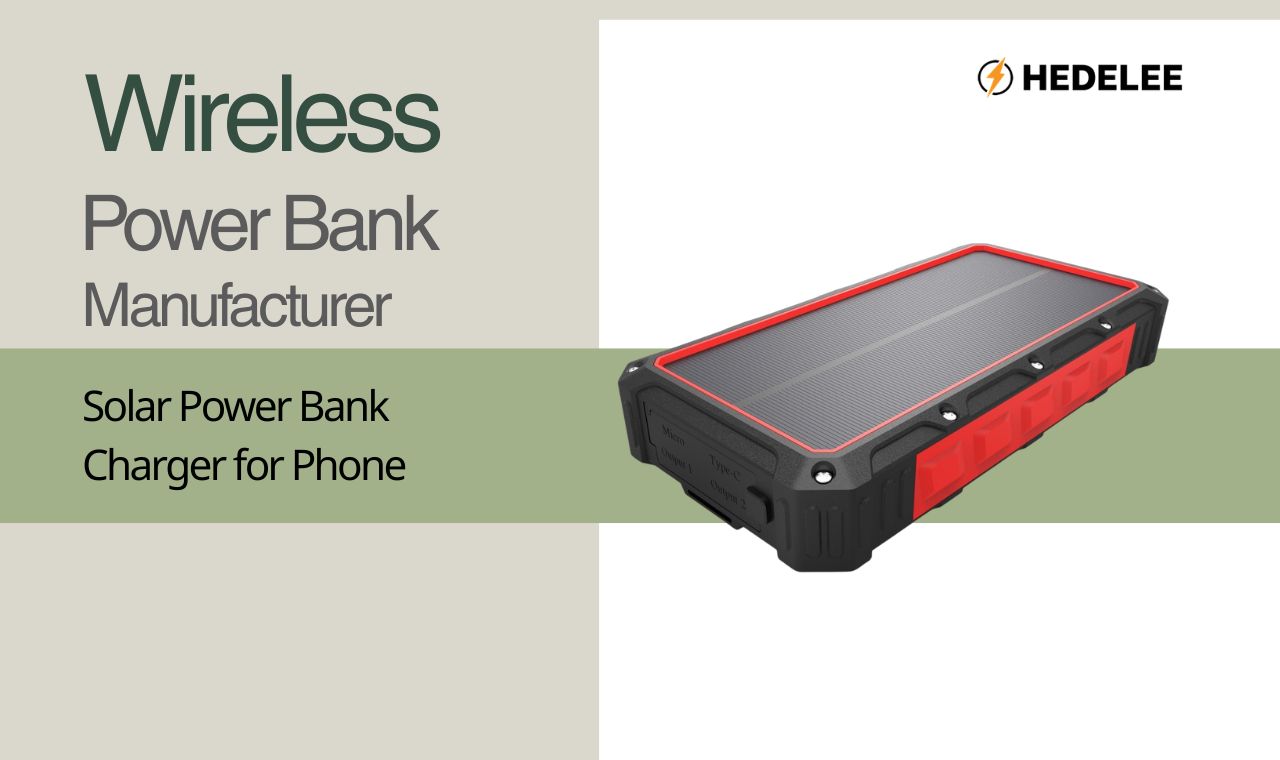
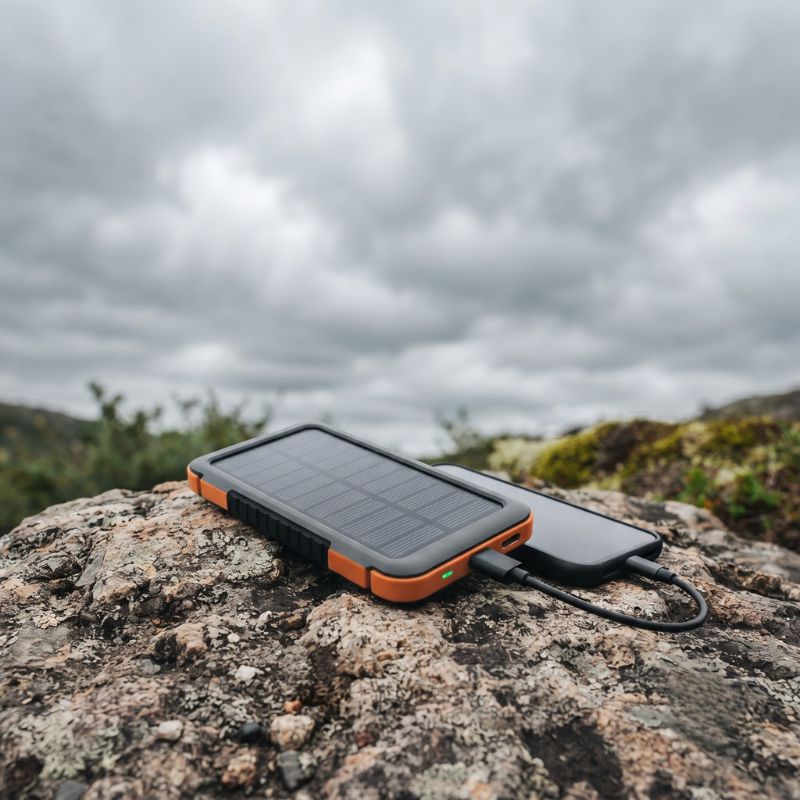
A solar power bank charger for phone can collect energy in cloudy conditions, but it will charge far more slowly than it does in strong, direct sunlight. That difference can surprise buyers who expect the small built-in panel to refill a large battery during one overcast afternoon. The panel still receives scattered light; it simply receives less usable energy.
For outdoor users, the practical answer is to begin with a full battery, treat solar input as backup energy, and choose panel area according to the charging goal. Procurement teams should also compare panel wattage, rated battery energy, input controls, charging protocols, test reports, and real performance under several light levels. This approach sets realistic expectations before a product reaches the market.
Does a solar power bank charger for phone work under clouds?
Yes, it can work under clouds. Photovoltaic cells convert light into electricity, and some sunlight still reaches a panel after clouds scatter it. The U.S. Department of Energy explains that solar radiation at the ground includes direct beam radiation and diffuse radiation. Thick cloud can remove all direct beam radiation, although diffuse light may remain available at the surface. Its solar radiation overview gives buyers a useful scientific basis for evaluating cloudy-weather claims.
However, “works” does not mean “charges at the normal rate.” A small panel may show an active charging indicator while adding energy too slowly to refill the battery in a useful period. The phone normally draws power from the stored battery, not directly from the changing solar input. Therefore, the power bank’s battery and control circuit buffer an uneven supply as clouds pass.
Three conditions are worth separating:
- Bright overcast: Diffuse daylight may provide a measurable, steady input, though it remains below clear-sky output.
- Broken cloud: Output can rise and fall quickly as the sun appears and disappears.
- Dark storm cloud or deep shade: Input may fall below the level needed for useful charging, even if an indicator remains visible.
A solar powered power bank is effective in cloudy weather when “effective” means extending available energy, supporting emergency use, or recovering a small amount of charge over time. It is less effective when the expectation is a complete, rapid refill from a compact built-in panel. Clear product communication should make this distinction easy to understand.
Why cloudy output is lower and less predictable
Clouds reduce the light reaching the solar cells and change its direction. Dense cloud blocks more radiation than thin cloud. Moving cloud also makes input unstable. A panel that briefly receives strong sunlight may produce a useful peak, then fall to a small fraction of that output seconds later.
Panel area creates another limit. Portable power banks are designed around size, weight, battery volume, and grip. Their integrated solar panels occupy only part of the case, so their rated wattage is often much lower than the wall-charging input. For example, the listed HDL618 20,000mAh wireless solar model uses a 1.5W monocrystalline panel, while its wired Type-C input and output ratings are higher. This is why USB charging should normally fill the bank before travel.
The following factors shape real solar yield:
| Factor | Better condition | Lower-output condition | Buyer check |
|---|---|---|---|
| Cloud density | Thin or broken cloud | Thick, dark overcast | Test at measured irradiance levels |
| Panel angle | Panel faces the brightest area | Panel lies vertically or faces away | Include positioning guidance |
| Panel area | Foldable multi-panel surface | Small case-mounted panel | Compare active area and rated watts |
| Shade | Full view of the sky | Trees, packs, glass, or buildings | Test outside without obstruction |
| Surface condition | Clean, dry panel | Dust, mud, water film, or scratches | Review cleaning and sealing design |
| Electronics | Stable low-light controller | Repeated start-stop cycling | Log input voltage and current |
| Temperature | Battery within operating range | Battery too hot or too cold | Verify thermal protection behavior |
Battery capacity does not increase solar collection. A larger cell stores more energy, but it also takes longer to refill with the same panel. For that reason, a 42,000mAh unit with a compact panel may offer longer stored runtime yet need much more sunlight to recover the same percentage of capacity than a smaller model.
Panel chemistry and conversion electronics also affect output. Monocrystalline cells are common in portable designs, but the complete product must be tested as a system. Cell efficiency alone does not show losses in wiring, voltage conversion, charging control, battery storage, and phone output.
How long can solar charging take on an overcast day?
There is no honest universal time estimate because cloud thickness, day length, panel angle, panel wattage, controller efficiency, and battery state all change the result. Instead, calculate an estimate from energy. Battery capacity is often shown in milliamp-hours, while solar panel output is shown in watts. Converting both to watt-hours allows a fairer comparison.
Use these basic formulas:
- Battery energy in watt-hours: capacity in amp-hours × nominal battery voltage.
- Ideal solar energy: average panel power × exposure time.
- Stored solar energy: ideal solar energy × total conversion efficiency.
- Estimated refill time: energy needed ÷ average stored solar power.
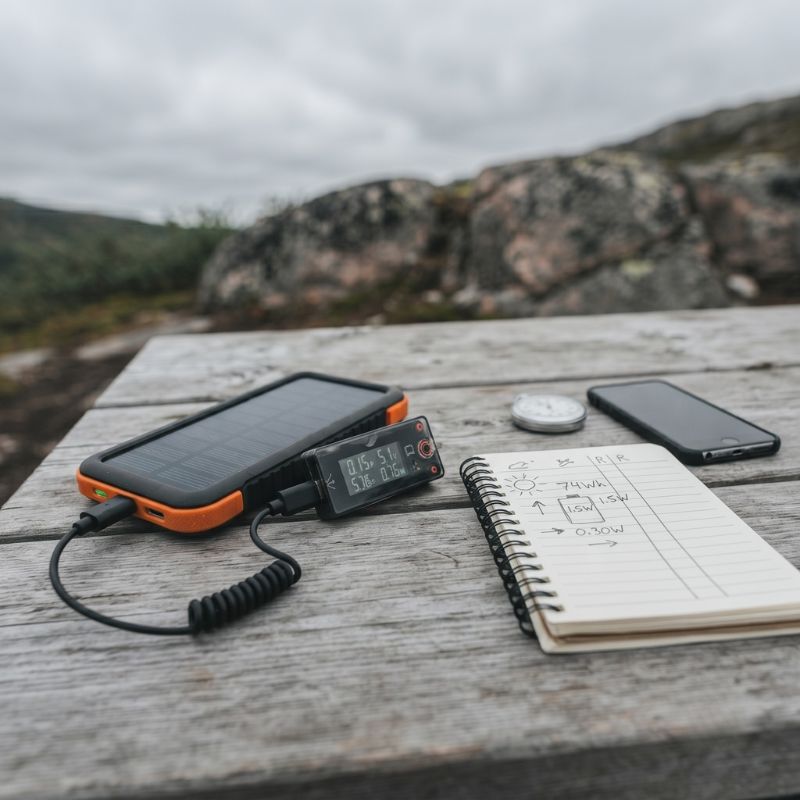
For illustration, a 20,000mAh lithium battery rated at a nominal 3.7V contains about 74Wh before conversion losses:
20Ah × 3.7V = 74Wh
Now consider a 1.5W built-in panel. Under a hypothetical clear-light test where it averages its full rated output for five hours, it would collect 7.5Wh before system losses. If cloudy conditions reduce its average output to 0.3W during the same period, it would collect only 1.5Wh before losses. These numbers are examples, not a forecast for every location or model.
| Illustrative case | Average panel power | Exposure | Energy before losses |
|---|---|---|---|
| Strong-light reference | 1.5W | 5 hours | 7.5Wh |
| Bright-cloud example | 0.75W | 5 hours | 3.75Wh |
| Dense-cloud example | 0.30W | 5 hours | 1.50Wh |
The calculation explains why a charge light can be technically correct while the battery percentage barely moves. It also shows why charging a connected phone during solar collection can hide progress: the phone may consume energy as quickly as the panel supplies it. Collect energy in the bank first, then charge the phone when possible.
Procurement teams should request performance curves or measured results at defined irradiance levels rather than accept one “hours to full” statement. Useful test records include panel voltage, panel current, battery state at the start and end, exposure duration, ambient temperature, panel temperature, light level, and whether a phone was connected.
Built-in panel or foldable panel: which works better?
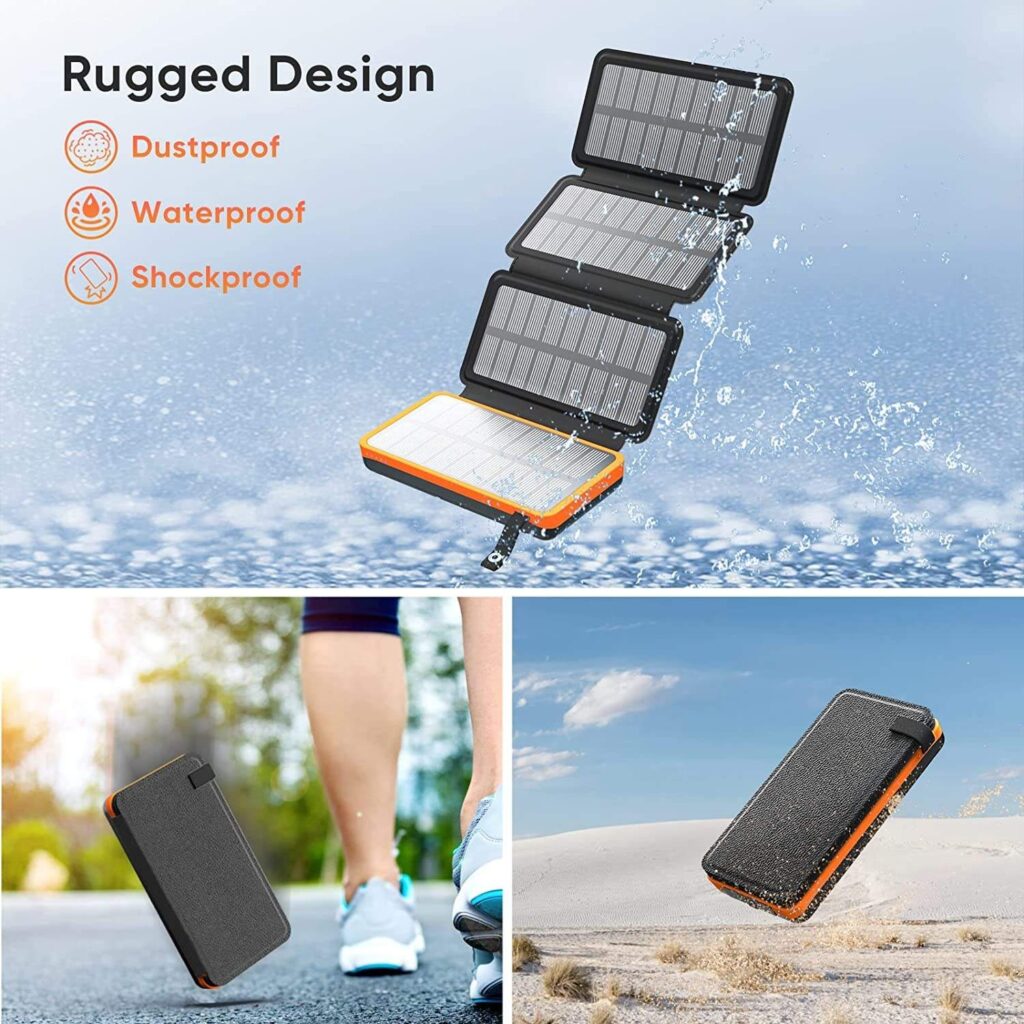
A built-in panel and a foldable panel solve different problems. The integrated type is easy to carry because the panel is always attached. It can collect small amounts of energy whenever conditions allow. A foldable design offers more collecting area, so it has a better chance of delivering useful cloudy-day input, provided its rated output and controller match the battery.
| Product type | Main strength | Cloudy-weather limit | Suitable use |
|---|---|---|---|
| Single built-in panel | Compact and always available | Small active area | Backup collection and emergencies |
| Foldable attached panels | More area without a separate device | Added size and hinge wear | Camping and longer daylight exposure |
| Separate portable panel | Wider choice of wattage and placement | Extra item, cable, and setup | Faster off-grid battery recovery |
| USB wall input plus solar backup | Predictable starting charge | Requires mains access before travel | Daily carry and planned trips |
The foldable 20,000mAh solar charger with LED lights is an example of a design that expands collecting surface compared with a single case-mounted panel. Buyers should still verify its solar input separately from its USB charging rating. “Fast charging” may refer to wired input or output, not necessarily the rate available from sunlight.
The phrase power bank for solar often describes a battery intended to receive energy from a solar source. Yet the electrical match deserves attention. A separate panel should supply a supported voltage and current through the approved input. Directly connecting an unregulated panel can cause repeated charging interruptions or protection shutdowns.
For a solar powered iPhone charger, compatibility also means more than having a suitable connector. Check the output protocol, cable type, wireless charging specification where offered, usable battery energy, and temperature control. The iPhone draws energy from the bank’s regulated USB or wireless output; it does not benefit from a larger solar panel unless that panel first adds enough energy to the bank.
Choose the built-in type when compact backup collection is the priority. Choose foldable or separate panels when solar recovery is a planned daily energy source. For wider sourcing, compare formats in the solar power bank product range and request panel-wattage data for the shortlisted models.
Start with the bank fully charged by USB. Solar then becomes an energy extension rather than the only source. This is especially useful for emergency kits, travel, hiking, fieldwork, and areas with unstable mains supply.
Follow this practical routine:
- Charge from USB before departure. Confirm that the battery indicators and all outputs work.
- Place the panel in open daylight. A bright patch of sky is usually better than deep shade, even when the sun is not visible.
- Adjust the angle during the day. Point the panel toward the brightest part of the sky and keep the full active surface exposed.
- Keep it away from heat traps. Do not leave the bank on a car dashboard, inside a sealed vehicle, or on a heat-absorbing surface.
- Collect first, discharge later. If practical, avoid charging the phone while the panel is receiving weak light.
- Clean the panel gently. Remove dust, salt, and water film with the method stated in the product instructions.
- Recheck after cloud changes. Some products may stop and restart input when light fluctuates.
- Carry a cable backup. Wireless output is convenient, but cable charging can reduce conversion loss and hold the phone more securely outdoors.
Weather resistance needs careful wording. A stated IP level relates to a defined test, not permission to leave open ports exposed in rain. Port covers must be seated, and charging cables may reduce sealing. Review each model’s manual and current test documents before making a water-resistance claim.
Temperature deserves equal attention. Apple advises charging an iPhone in ambient conditions from 0°C to 35°C and avoiding direct sun or hot enclosed spaces. Its thermally limited charging guidance notes that charging may slow or pause outside a suitable temperature range. Keeping the panel in light while placing the battery and phone in ventilated shade may require a longer cable or a product designed for separated placement.
A solar mobile phone charger should also be inspected after drops. Stop using a unit if the case swells, cracks, leaks, develops an unusual smell, or becomes abnormally hot. Solar collection is useful, but battery safety always takes priority over recovering a few more percentage points.
How buyers should compare cloudy-weather models
Begin with the intended use rather than the largest number printed on the case. A daily-carry model, an emergency-kit model, and a multi-day camping model need different balances of size, stored energy, lighting, cables, weather protection, and panel area.
Compare energy and charging data
Request these specifications for each candidate:
- nominal cell capacity in mAh and Wh
- rated or usable output capacity at a stated voltage
- integrated solar panel wattage, voltage, and current
- wired input and output ratings by port
- supported charging protocols
- wireless output rating, if included
- low-light charging behavior
- overcharge, over-discharge, short-circuit, and temperature protection
- cycle-life test method and acceptance limit
- product weight, dimensions, packing details, and included cables
A large printed capacity does not prove usable output. Compare laboratory reports, sample measurements, and the energy delivered at the USB port. Also confirm whether a capacity number is nominal cell capacity, marketed capacity, or rated output capacity.
Match product design to the use case
For compact phone backup with wireless output and a flashlight, buyers can review the HDL618 20,000mAh model or the 10,000mAh outdoor wireless model with strong lighting. A water-resistant 20,000mAh fast-charging model provides another format to compare.
For cable convenience, review the HDL531 wireless model with three cables, the HDL529 model with four built-in cables, and the HDL628 large-capacity model with four cables. Built-in leads can reduce the need for separate accessories, although bend-life and connector-fit testing should be part of sample approval.
For outdoor assortments, compare the HDL519 camping solar charger, the HDL519X dual-USB waterproof battery charger, the 25,000mAh dual-USB solar charger, and the HDL528 30,000mAh wireless IP65 model. Use current model sheets and approved samples as the source for final specifications because configurations can change.
Ask for evidence behind each claim
A buyer evaluating a solar cell phone charger should request cloudy-condition measurements, not only clear-sky laboratory values. Sample tests should record the complete setup so results can be repeated. If a supplier says a model charges under clouds, ask what irradiance, duration, panel angle, and battery state were used.
The same care applies to certification. Ask which exact model and battery configuration appear on each report. Verify the report number, issuing laboratory, applicable standard, validity, and consistency with the shipping sample. Documents for a related model do not automatically cover every housing, cell, PCB, or capacity option.
Testing, customization, and sourcing from the manufacturer
Cloudy-weather performance should be part of product approval, especially when the sales message emphasizes outdoor or emergency use. One clear-sky sample test cannot represent every market. Northern regions, tropical rainy seasons, winter travel, and shaded campsites create different exposure patterns.
Build a repeatable sample test
A useful evaluation plan can include:
- Charge every sample to the same battery level by USB.
- Discharge to a defined starting state with a controlled load.
- Record battery and ambient temperature.
- Place samples at the same angle and orientation.
- Measure irradiance or use a calibrated reference instrument.
- Log solar input over a fixed period under clear, bright-cloud, and dense-cloud conditions.
- Measure stored energy or later USB discharge with the same method.
- Repeat enough times to identify normal variation.
- Inspect the case, panel bond, ports, covers, and cables after environmental and drop tests.
This process gives product teams a defensible basis for packaging statements. It also helps customer-service teams explain why location and weather change charge time.
Plan customization around real use
Customization may include case colors, logo printing, packaging, cable combinations, lighting modes, accessories, capacity options, and manuals. Each change must be reviewed for its effect on safety, labeling, test coverage, lead time, and order quantity. A new battery cell, PCB, housing material, or port layout may require added validation.
Shenzhen Hedeli Technology Co., Ltd. has worked in mobile accessories and consumer electronics for about ten years. The company has more than 100 employees, with its headquarters in Shenzhen, an office and showroom in Guangzhou, and a factory in Dongguan. Monthly production capacity is about 50,000 units for importers, distributors, and wholesale customers.
Before a production order, request samples and confirm the approved specification sheet, artwork, packaging, test documentation, inspection method, lead time, and shipment terms. Samples can also be tested in the destination market’s cloudy season rather than only near the factory.
A solar power bank battery charger should be sold with accurate expectations: USB charging prepares the battery, the stored battery powers the phone, and solar input supports recovery when daylight is available. If your range needs compact backup units, foldable panels, built-in cables, wireless output, lighting, or custom branding, send the target specification and forecast quantity for review. Working directly with the original manufacturer gives your team access to the product source, configuration guidance, sample coordination, and a quote based on the actual order requirements.
Frequently Asked Questions
1. Do solar phone chargers work beneath heavy clouds?
Yes, but useful output may be very low. Thick cloud can remove direct sunlight, leaving only weaker diffuse light, so treat solar charging as backup energy rather than a rapid refill.
2. How should buyers test cloudy charging performance?
Test samples at defined light levels, angles, temperatures, durations, and battery states. Record solar input and later USB discharge so competing models can be compared on the same basis.
3. Can solar charger colors and packaging be customized?
Yes, many models support color, logo, packaging, cable, and accessory options. Send the required design, quantity, and destination market so feasibility, cost, and lead time can be confirmed.
4. What compliance documents can buyers request?
Buyers can request available reports for the exact model, battery, and destination market. Reach out for model-specific documents and confirm that report numbers match the approved production configuration.
5. How long are samples and production lead times?
Timing depends on model availability, customization, testing, quantity, and packaging. Contact the manufacturer with your specification and target date to receive an accurate sample and production schedule.