

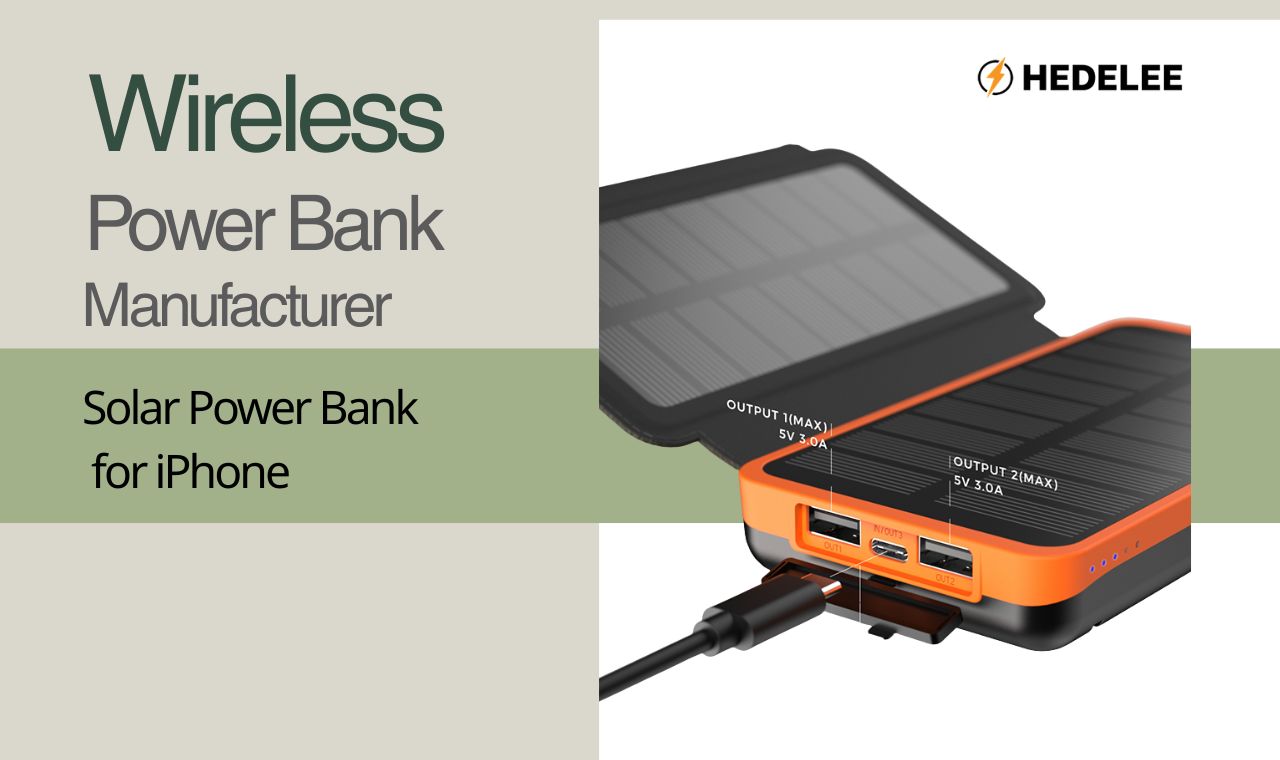
Your iPhone dies at the worst possible moment — halfway through a camping trail, during a power outage, or somewhere your wall outlet is three time zones away. A solar power bank for iPhone sounds like the perfect answer, but there’s a lot of noise online about what actually works. Before placing a bulk order or recommending one to your retail customers, it pays to understand exactly how solar charging functions, what specs matter, and how to match the right product to the right use case.
This guide breaks it all down clearly — from battery chemistry to connector types — so you can make purchasing decisions with confidence.
How Does Solar Charging Actually Work?
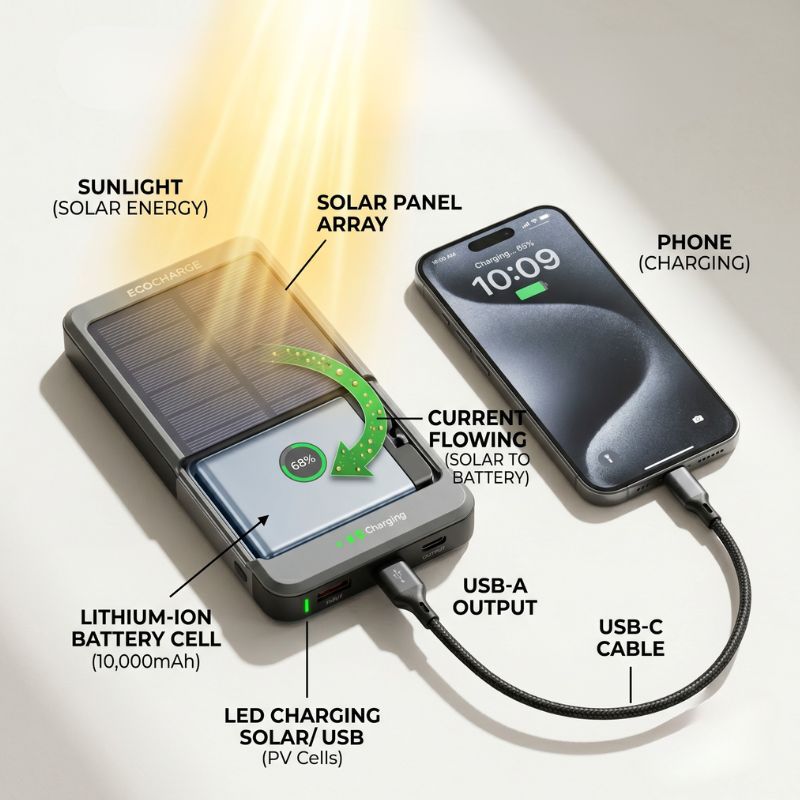
A solar power bank combines two technologies: a lithium-ion or lithium-polymer battery pack and one or more photovoltaic (PV) solar panels embedded in the casing. When sunlight hits the solar panel, it converts light energy into electrical current. That current flows into the battery, where it’s stored until you need it.
The key thing to understand is that solar panels on portable chargers are supplemental, not primary, charging sources. The solar panels built into a pocket-sized device are small — usually 1–3 watts — which means in full direct sunlight, they generate enough power to top up the battery slowly over several hours. They’re not designed to charge an iPhone directly from panel to phone in real time. Instead, you charge the battery pack in advance (via USB wall outlet), and the solar panel extends or maintains that charge when you’re off-grid.
Think of solar panels on a portable bank as a slow trickle recharge, not an instant power source. In practical terms, a 5W panel in ideal sunlight might add about 1,000–1,500 mAh per hour — enough to meaningfully extend your reserves over a day outdoors.
Does a Solar Power Bank Work with iPhone?
Yes — and it works well when you choose the right product. The connection is handled by your charging cable, not the power bank itself, so compatibility comes down to two things: the output port on the bank and the connector your iPhone uses.
Here’s the connector breakdown for current iPhone models:
Any solar power bank with a USB-A or USB-C output port will charge an iPhone without issue. For iPhone 15 and newer models, a power bank with a USB-C output port allows fast charging, which makes a noticeable difference when time matters.
Apple’s own guidance confirms that for fast charging, iPhone 12 and newer require a power adapter delivering at least 20W. If your solar power bank has a USB-C PD (Power Delivery) output rated at 20W or higher, it will fast-charge a compatible iPhone exactly as a wall adapter would.
How Much Capacity Do You Need?
This is where a lot of buyers go wrong. They focus on price per unit and overlook whether the capacity actually delivers the promised charge cycles for iPhones.
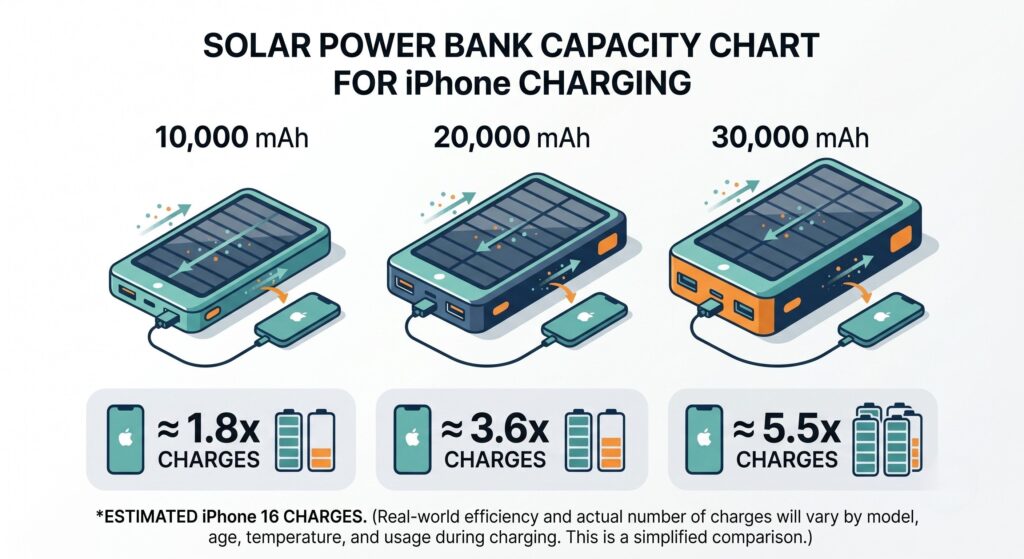
Here’s the real math. iPhone battery capacities range from roughly 2,000 mAh (iPhone SE) to over 5,000 mAh (iPhone 17 Pro Max in eSIM configuration). Due to energy conversion losses — heat, cable resistance, voltage step-down — a power bank delivers roughly 60–70% of its rated capacity to the device it’s charging. So a 10,000 mAh power bank realistically transfers about 6,000–7,000 mAh to your iPhone.
For buyers sourcing products for outdoor, emergency, or travel use, 20,000 mAh is the sweet spot. It covers most users through a full day or two without needing a wall outlet. For demanding off-grid scenarios — multi-day hikes, emergency preparedness kits, or locations with unreliable grid power — 30,000 mAh and above makes much more sense.
Hedelee’s 20,000 mAh Solar Power Bank (HDL-218) covers both the capacity and the waterproofing needed for reliable outdoor use, and our 20,000 mAh Foldable Solar Charger adds a folding panel design for faster solar recharging in the field.
What Features Actually Matter in a Solar Powered iPhone Charger?
Not all solar power banks are built the same. When you’re evaluating a solar powered iPhone charger for resale or procurement, these are the specifications that actually affect buyer satisfaction and return rates.
Output Ports and Charging Speed
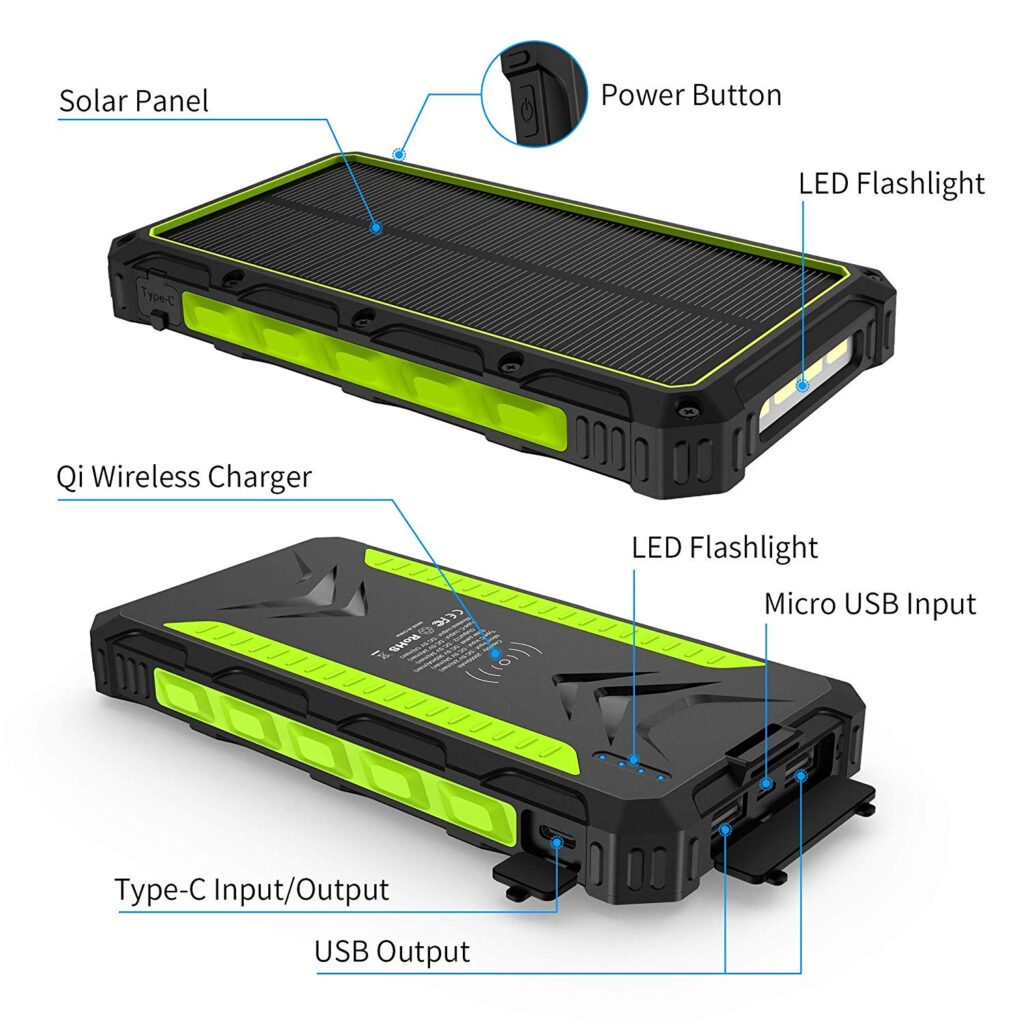
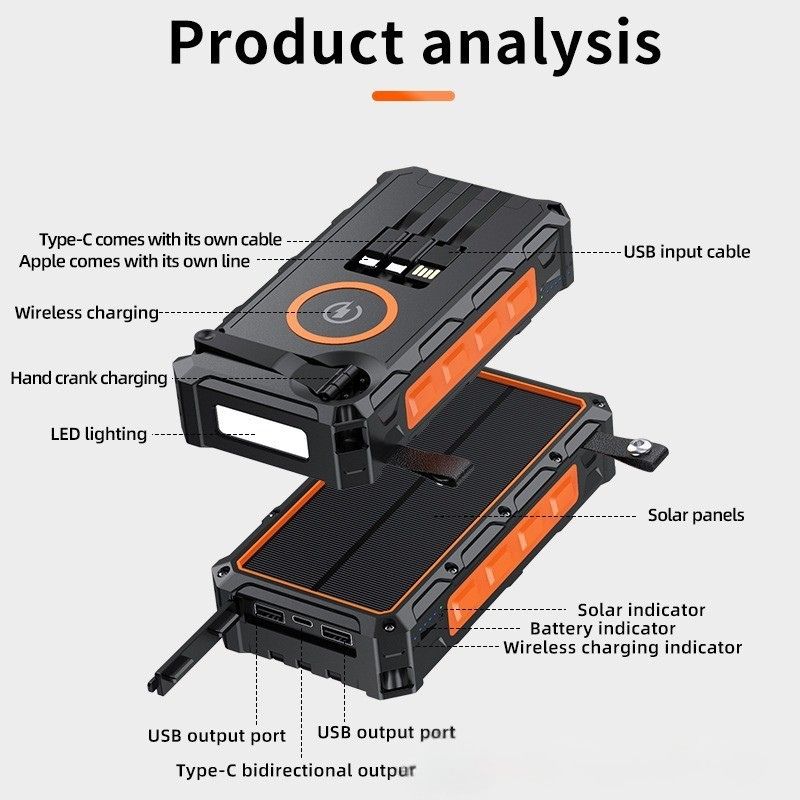
A USB-C PD port rated at 18W–20W or higher enables fast charging for iPhone 12 and newer models. USB-A outputs are still widely useful for older devices and accessories. Look for products with multiple output ports so users can charge an iPhone and another device simultaneously.
Our 25,000 mAh Solar Charger with Dual USB Ports handles simultaneous device charging with ease — a key requirement for users managing phones, earbuds, and GPS devices at the same time.
Wireless Charging Support
Qi wireless charging means no cable needed on the iPhone side. iPhone 8 and newer are all Qi-compatible, which makes wireless charging a genuine value-add rather than a gimmick. Our 30,000 mAh Qi Wireless Solar Power Bank (HDL528) delivers 5V/3A wireless output with IP65 waterproof protection, making it suitable for genuinely demanding environments.
Waterproof Rating
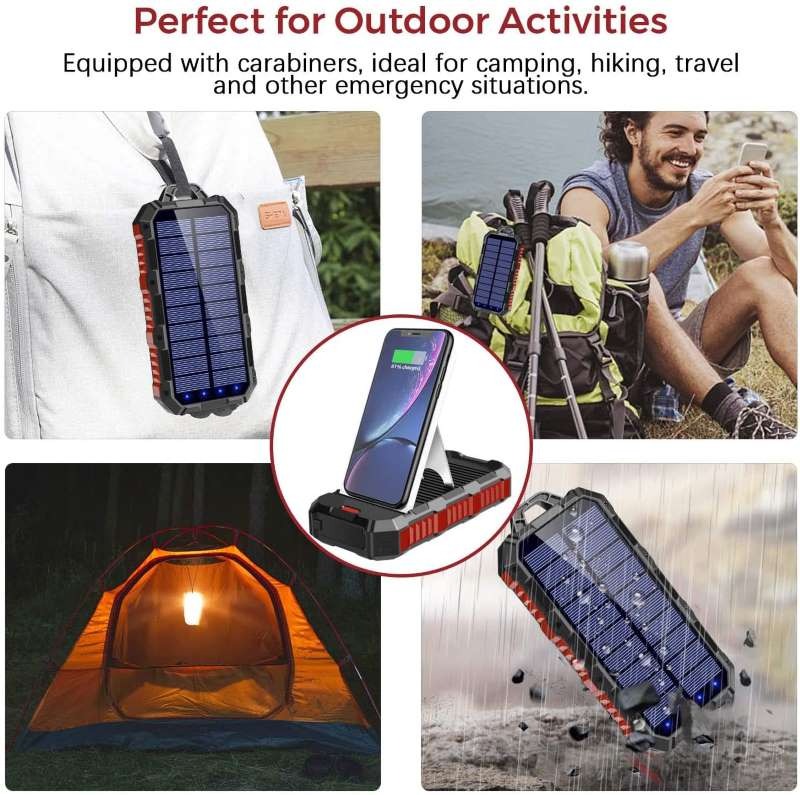
An IPX4 rating means the device can handle rain splashes from any direction. IP65 goes further, providing full dust protection and low-pressure water jet resistance. For outdoor markets — camping, hiking, boating, emergency preparedness — IP65 is the minimum worth specifying.
Solar Panel Size and Wattage
Larger, foldable solar panels recharge the battery pack faster. A single small panel on the back of a bank may add 500–1,000 mAh per day in good sunlight. A foldable multi-panel design can push that to 2,000–3,000 mAh per day. For buyers focused on off-grid markets, the Foldable 20,000 mAh Solar Power Bank offers an expanded panel surface for faster field recharging.
Built-in LED Flashlight
For emergency preparedness, survival kits, and outdoor use, a built-in LED flashlight adds immediate practical value. Our 36,000 mAh Wireless Solar Power Bank (HDL529) includes dual LED flashlights alongside four built-in cables — covering Lightning, USB-C, and Micro-USB — so no separate cable is needed.
How to Use a Solar Power Bank to Charge Your iPhone
Using a solar phone charger correctly makes a noticeable difference in how much useful power you actually get. Follow these steps for the best results:
-
Charge the bank fully via USB first. Before heading outdoors, use a wall outlet to charge the power bank to 100%. Solar panels provide supplemental power, not primary recharging in most portable designs.
-
Place the solar panel in direct sunlight. Angle the panel toward the sun at roughly 90 degrees. Even partial shade reduces output significantly — a shadow covering 10% of the panel can cut output by 50% or more.
-
Connect your iPhone using the correct cable. iPhone 15 and newer: use USB-C to USB-C. iPhone 14 and older: use USB-A or USB-C to Lightning. If your power bank has built-in cables like the HDL529 model, no separate cable is needed.
-
Use wireless charging when hands-free is a priority. Simply place your iPhone face-up on the wireless charging surface. Make sure the phone’s case doesn’t block the Qi charging area.
-
Keep the bank shaded while charging your phone. Solar panels charge the battery; the battery charges your phone. You don’t need to have the bank in the sun while your phone is plugged in — in fact, keeping both devices in the shade helps regulate temperature and protects battery health.
-
Monitor the LED indicator. Most solar power banks use an LED display or indicator lights to show remaining capacity. Check this before a long day outdoors so you know how much reserve you have.
Choosing the Right Solar Power Bank for iPhone: A Use-Case Comparison
Different buyers have different priorities. Rather than recommending a single “best” product, the most helpful approach is to match the product to the use case. Here’s how Hedelee’s solar power bank range aligns with common sourcing scenarios:
You can also browse the full Hedelee solar power bank range to compare all available models by capacity, output type, and certification.
Solar Cell Phone Charger Reliability: Common Questions Answered
Does solar charging damage an iPhone battery?
No. A quality solar power bank outputs regulated DC voltage — typically 5V — which is the same standard your wall charger delivers. The solar panel charges the power bank’s internal battery; the power bank then charges your iPhone through a regulated output circuit. The iPhone sees a stable, controlled charge regardless of the weather outside.
How long does it take to solar-charge a power bank?
This varies by panel wattage and sunlight intensity. A 1W panel in full sun might deliver 800–1,000 mAh per hour to the battery. A 3W panel can push that to 2,500–3,000 mAh per hour under ideal conditions. A 20,000 mAh bank charged entirely from a small built-in panel could take 20+ hours of direct sunlight — which is why always pre-charging via USB wall outlet before any outdoor trip is the practical approach.
Can a solar mobile phone charger work on cloudy days?
It can, but at reduced efficiency. Solar panels produce output even under overcast skies, typically at 10–25% of their full-sun capacity. Cloudy-day solar charging is best viewed as battery maintenance rather than meaningful recharging. If the forecast calls for extended cloud cover, make sure the bank is fully charged before departure.
Is solar charging waterproof-safe for iPhone?
This depends on the IP rating of the power bank, not the iPhone. Products with IPX4 or IP65 ratings can handle outdoor moisture, rain, and splash. The HDL-218 and HDL528 models from Hedelee both carry waterproof certifications, making them well-suited to wet environments. Always cover the USB port when not in use to maintain the IP rating.
Why Source from a Manufacturer Directly?
When you source a solar power bank battery charger through distributors and middlemen, you pay for each layer of margin. More importantly, you lose direct access to product specifications, customization options, and quality verification.
Shenzhen Hedeli Technology Co., Ltd. has operated in mobile accessories and consumer electronics for about 10 years. Our headquarters is in Shenzhen, with an office and showroom in Guangzhou. Our Dongguan factory runs a monthly production capacity of 50,000 units, supplying importers, distributors, and wholesalers with reliable lead times and consistent product quality across orders of any scale.
With more than 100 employees dedicated to product development and production, Hedelee maintains direct oversight of every unit that ships. That means the product you receive matches the spec sheet you approved — not a variation sourced from a third-party warehouse.
If you need a solar mobile phone charger with specific output configurations, custom packaging, or OEM branding, working directly with the manufacturer is the only way to guarantee those outcomes. For procurement teams and product managers evaluating a new solar product line, requesting samples before committing to volume is the most reliable way to verify real-world performance.
Reach out to Hedelee directly through the product catalog on solarpowerbank.cn to request specifications, sample pricing, or a custom quote. You’ll be talking to the source — not a reseller reading off a data sheet.
Frequently Asked Questions
1. What mAh capacity is needed to fully charge an iPhone?
An iPhone 16 carries a 3,561 mAh battery, and the iPhone 17 Pro Max reaches 5,088 mAh. Given energy conversion losses, a 20,000 mAh solar power bank delivers roughly 3–4 full iPhone charges in real-world conditions — making it the recommended minimum for buyers targeting outdoor or travel use. For sample specifications, contact Hedelee directly.
2. Do solar power banks support fast charging for iPhone?
Yes, provided the power bank has a USB-C PD output rated at 20W or higher. iPhone 12 and all later models support fast charging, which can bring the battery from 0 to 50% in about 30 minutes with a compatible charger. Hedelee’s 30,000 mAh HDL528 model includes a USB-C input and output with 5V/3A — reach out to confirm fast-charge output specs for your target iPhone models.
3. Can these solar chargers be ordered with custom branding?
Yes. Hedelee supports OEM and ODM services including custom packaging, logo printing, and accessory configurations. Minimum order quantities and lead times vary by product model and customization scope. Contact us with your requirements to receive a detailed proposal.
4. What certifications do Hedelee solar power banks carry?
Compliance documentation including CE, FCC, and RoHS certifications is available for relevant products. For procurement teams requiring specific regional certifications or documentation packages, please request details when placing your inquiry.
5. How are samples requested before placing a volume order?
Sample requests are handled directly through Hedelee. Reach out via the product inquiry page on solarpowerbank.cn with the product model, required capacity, and your destination market. Samples are dispatched from our Dongguan facility and include full product documentation.