

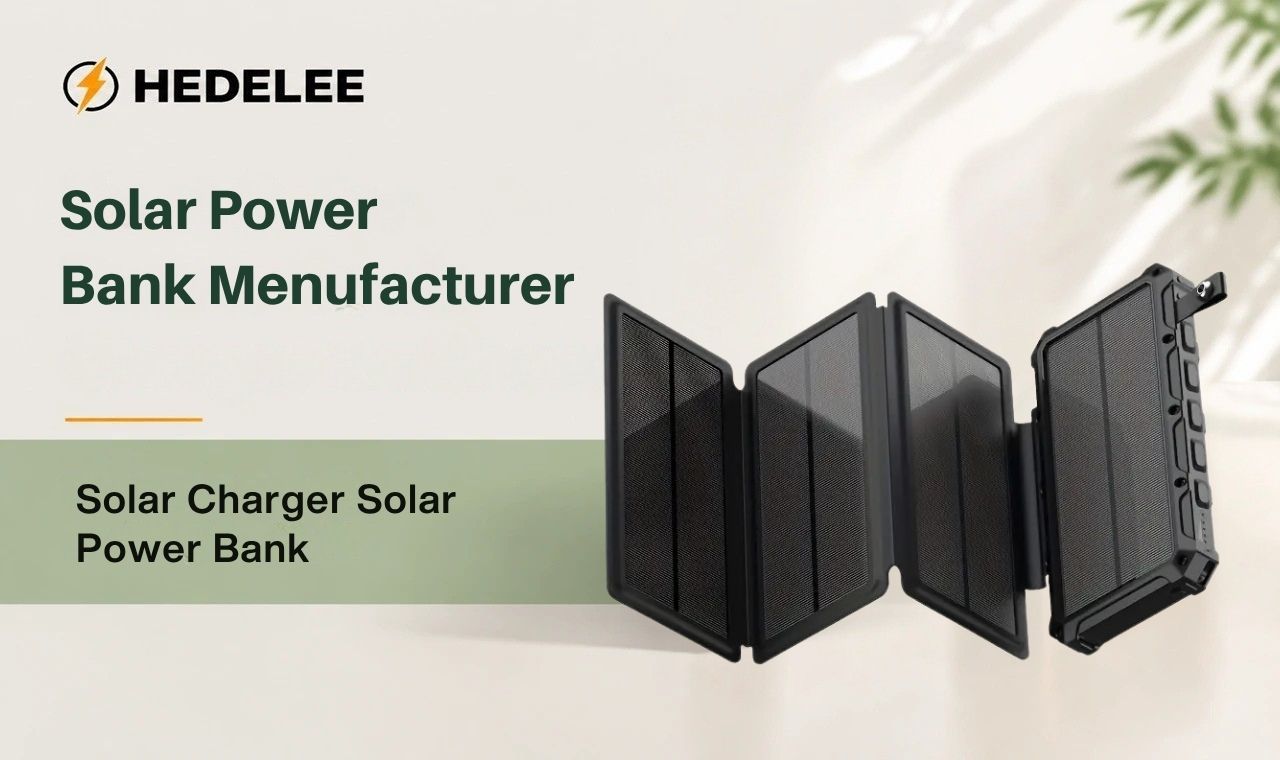
Outdoor retailers keep sending the same field note back to procurement: the carton promised solar charging, yet testers sat in sun all afternoon and the meter barely moved. The product is not always defective. A solar charger solar power bank is a lithium pack with a small solar surface, and sunlight does not behave like a wall adapter.
If you buy, specify, or private-label these units, you need hours you can defend in a catalog—not a printed “fast solar charge” line that collapses in a tent. Below you will get realistic time ranges, the math behind them, and the spec checks that keep returns and marketplace complaints down.
Sunlight charging for a pocket or mid-size pack usually falls between several hours and several days. Built-in panels on many 10,000–20,000mAh units sit in the 1–5W range, so a full refill from empty is slow. Foldable panels in the 8–28W class cut that wait. A USB wall input still wins for warehouse prep. Treat solar as a field top-up, and treat mains as the fill you use before goods leave the dock.
Shenzhen Hedeli Technology Co., Ltd. (Hedelee) has spent about 10 years on mobile accessories and consumer electronics. Our factory in Dongguan runs a monthly capacity of 50,000 units for importers, distributors, and wholesalers. Head office is in Shenzhen, with an office and showroom in Guangzhou. When charge-time claims go into a listing, we prefer numbers that match panel watts, cell capacity, and weather—not a single optimistic hour count.
How Long Does a Solar Charger Solar Power Bank Take?
Most handheld packs with a built-in panel need far more than a lunch break in the sun. Under strong, direct midday light, a small 10,000mAh unit with a modest panel may need about 8–12 hours of good exposure for a large share of capacity. Larger 20,000mAh housings with 1–3W cells often need a full day or more, and many real trips stretch that to 25–50 hours of mixed sun.
That range sounds wide because “an hour of daylight” is not “an hour of rated panel power.” Panels are rated at about 1,000 watts per square meter, the lab condition used for peak output. Open-sky noon in summer can approach that. Morning, late afternoon, haze, and thin cloud do not.
A useful planning split looks like this:
Built-in panel, 1–3W, 10,000–20,000mAh: think in days, not hours, for a true 0–100% fill.
Built-in panel, 5–7W, same capacities: a long, clear day can add a meaningful share, still rarely a full pack.
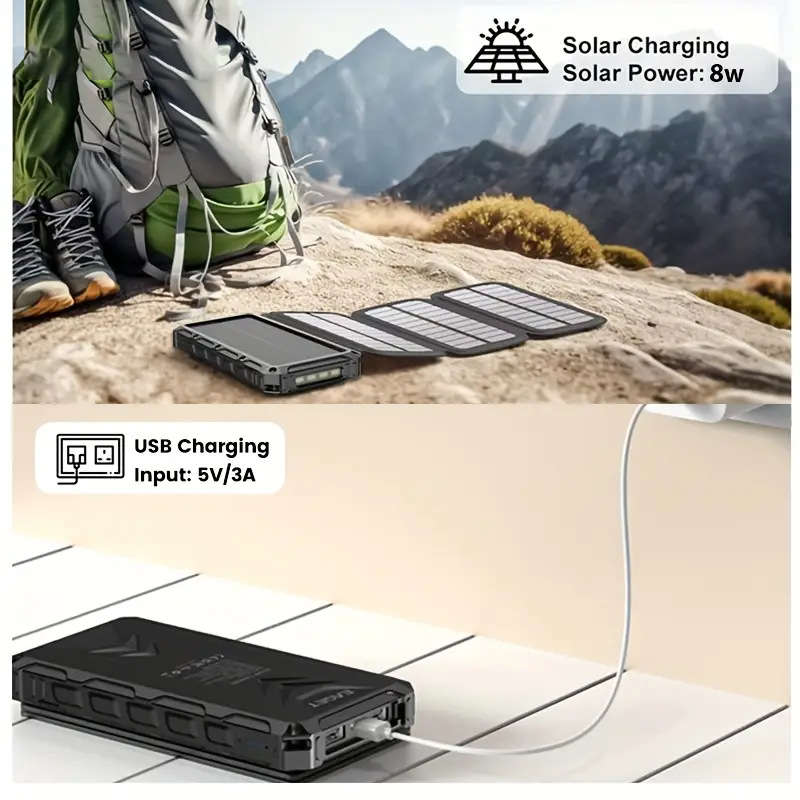
Foldable 8–28W solar charger paired with the pack: often one to three strong days, depending on capacity.
USB-C or Micro-USB wall input at 5V/2A or higher: commonly 4–8 hours for 10,000–20,000mAh class cells, model dependent.
The UK-facing consumer question “how long in sunlight?” often gets a 4–12 hour answer. That figure fits larger folding panels and some compact power stations. It does not fit a credit-card-size cell glued to a 20,000mAh brick. If your catalog mixes both product types, print two time columns. Buyers notice when a hiking SKU cannot match a 100W blanket.
For a mid-size 20,000mAh solar power bank, industry write-ups often show 8–24 hours in strong sun when the panel is larger, and 25–40 hours when the panel is a thin emergency strip. Hedeli’s own 20,000mAh class notes a typical solar add of about 200–400mAh per hour in ideal direct light. At 300mAh per hour, a full 20,000mAh refill is in the 50-hour class of peak-equivalent exposure.
That is not a reason to drop solar from the line. It is a reason to sell the feature honestly: keep phones alive on a trail, offset drain during a festival, and recover some charge when no socket exists. Full depot charging still belongs on USB.
If you need a single sentence for a spec sheet: sunlight refill time equals battery energy divided by real panel watts, then stretched by weather, angle, heat, and charge-controller loss.
What Changes Solar Charging Speed Outdoors
Charge time is a system result, not a single printed watt number. Five variables dominate what your customers will measure.
Sunlight strength and peak sun hours
Peak sun hours are not clock hours of daylight. One peak sun hour is the energy of one hour at 1,000 W/m². A site with 5 peak sun hours may have 12 hours of visible day and only a few hours near rated output.
Thin cloud still produces power, often a large fraction of peak, but heavy overcast, rain, and deep shade cut current hard. Even a small shadow across a series string can slash output. Dust, fingerprints, and backpack fabric do the same.
Panel wattage and cell area
A 2W window on a 20,000mAh body cannot match a 15W fold-out. Wattage is the first filter when you compare samples. Ask the factory for:
Rated panel watts (and whether that is STC)
Typical current into the pack at noon, 25–35°C
USB solar input vs built-in cell input, if both exist
Foldable outdoor chargers raise wattage without making the stored pack huge. That is why a foldable 20,000mAh solar charger with LED lights behaves differently in the field than a flat brick with a postcard-size cell.
Battery capacity and chemistry
Capacity is energy, usually listed in mAh at a nominal 3.7V cell voltage. 20,000mAh is about 74Wh before conversion loss. 10,000mAh is about 37Wh. Double the energy and, with the same panel, you roughly double the sun hours.
Lithium-ion polymer packs used in handheld banks accept a tapering current near full. The last 15–20% often crawls. Field testers who stop at 80% will report faster “usable” times than testers who wait for 100%.
Angle, heat, and mounting
A panel lying flat on a dark tent floor runs hot and off-angle. Heat lowers output. A slight tilt toward the sun, a light-colored surface, and a mid-day re-aim add more charge than a thicker cable.
If the pack is charging a phone at the same time, net battery gain drops. Pass-through is convenient. It is not a speed feature.
Controller, cable, and input path
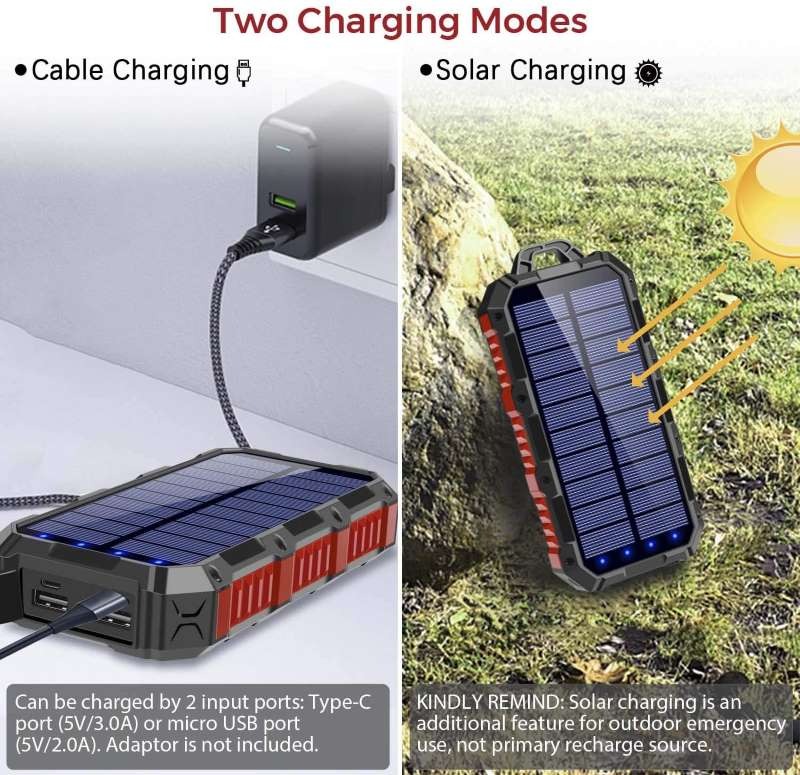
Cheap diodes, undersized traces, and 5V-only inputs waste power. A solar power bank battery charger that also accepts 5V/3A USB-C will refill in a hotel far faster than it ever will on a 2W cell. Write both paths into the sell sheet.
Charge Time by Capacity and Panel Size
Procurement teams need a table they can drop into an RFQ. Use it as a planning band, then confirm with a sample under a sun lamp or outdoor noon test.
A 5W–6W panel in strong, direct sun may add about 1,000–1,500mAh per hour. A large 25,000mAh body can still eat a full good day or more. Most molded “solar brick” panels sit closer to 0.5–3W, which is why a 5W rating already changes the story.
Worked example you can reuse in training:
Convert capacity: 20,000mAh × 3.7V ÷ 1,000 = 74Wh.
Assume a 2W panel and 50% real-world capture (angle, heat, controller): 1W average during peak-quality sun.
74Wh ÷ 1W = 74 hours of that peak-quality sun.
At 5 peak sun hours per day, you are looking at about two weeks of perfect placement. Miss noon, and the calendar grows.
Swap in a 10W foldable at 60% capture (6W): 74 ÷ 6 ≈ 12 hours of peak-quality sun. That is still not “charge while you eat,” but it is a product you can explain to a camping buyer.
Wall charging remains the depot method. USB at 10W (5V/2A) into 74Wh is on the order of 8–10 hours before losses. PD-class inputs, where the model supports them, shorten that. Do not let solar hours and USB hours share one icon on the box.
For assortment planning, pair a daily-carry 10,000mAh outdoor solar power bank with wireless charging with a larger 20,000mAh waterproof dual-input wireless model (HDL-218). Same solar story, different phone-count and charge-time expectations.
Built-In Solar vs Foldable Panels vs USB Input
Buyers often mix three hardware ideas under one SKU name. Separate them in the line sheet.
A solar powered power bank with only a built-in cell is a battery that can sip sun. A foldable panel is a charger that happens to roll up. Some Hedeli models combine both, which is what outdoor catalogs actually want: USB for the stockroom, solar for the trail.
Look at how the housing is used:
Slim brick with face cells. Easy to hang on a backpack. Output falls if the bag swings into shade. See the waterproof 20,000mAh solar panel power bank when you need a simple hang-and-hope form.
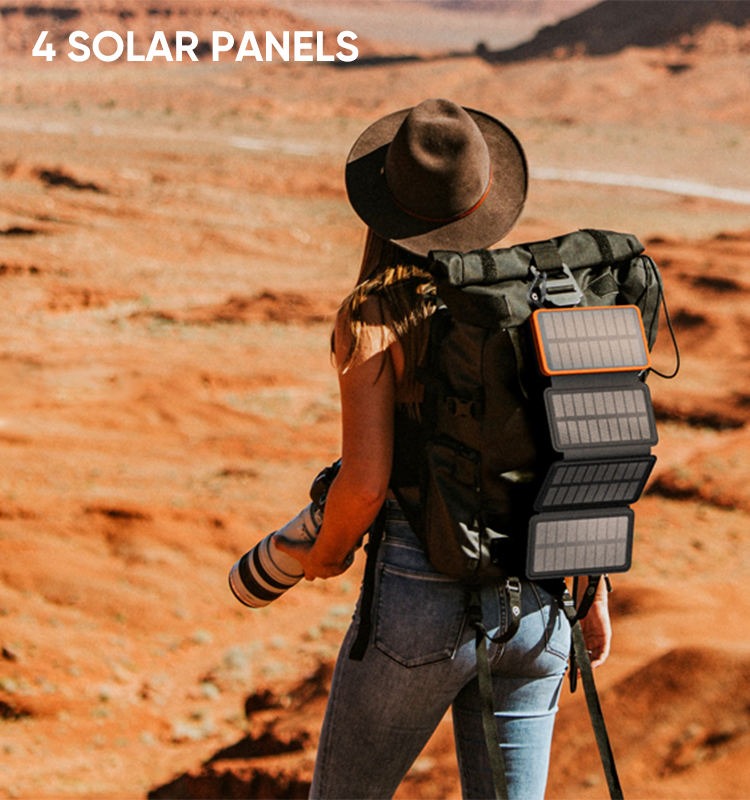
Foldable array. You stop, unfold, aim, and leave it. Higher watts, more user effort. The HDL519 camping solar charger sits in this outdoor-gear pattern.
Large mAh with extra cables. Fewer forgotten cables in a glove box. Longer solar fill if the panel area does not grow with the cell. The HDL-531 high-capacity panel bank and HDL-628 42,000mAh pack with built-in cables need honest sun-hour copy.
Wireless charging on the back of a pack is a phone convenience feature. It is not a solar-speed feature. Qi output draws from the same battery the panel is trying to fill. If a demo unit is sitting on a counter in wireless mode, solar gain will look worse than a spec-lab test.
Waterproof ratings (IPX4, IP65, and similar) protect the pack in rain. Water on the glass or ETFE still cuts light. Dry the face before you judge a sample.
How to Charge Faster in the Field
You cannot rewrite physics, but you can stop giving away half the panel’s current. Share these steps with retail staff and with the instruction card inside the box.
Pre-fill on USB before the trip. Solar then covers phone drain, not a zeroed pack.
Aim the cells straight at the sun. Recheck every 60–90 minutes. A lazy flat angle is a silent tax.
Keep the face clean and uncovered. Mesh pockets and tinted dry bags waste watts.
Avoid hard shade. A small shadow on a string of cells can collapse current.
Charge the pack, then the phone. Simultaneous drain hides solar gain.
Use the largest legal panel input the model allows. If the bank accepts an external 5V solar blanket, say so in the manual.
Start at mid-morning, not late afternoon. Peak sun hours cluster around noon.
Watch temperature. On a black car dash, the pack may throttle. A pale rock or hanging strap is kinder.
Cloudy-day planning: expect a slower crawl, not zero. Many modern panels still produce a useful fraction under bright overcast. Heavy storm cover is closer to a pause. If your target market is the UK or the Pacific Northwest, print a “clear / bright cloud / dark cloud” time band instead of one number.
For phone-focused listings, language should stay precise. A solar phone charger, a solar cell phone charger, and a solar mobile phone charger are the same job: move energy into a handset. The pack in between may hold 10,000mAh or 30,000mAh. Solar hours follow the pack and panel, not the phone brand.
If you run incoming quality checks, log:
Open-circuit panel voltage
Short-circuit or loaded current at a fixed lamp distance
USB input current from a 5V/2A adapter
Minutes to climb from 20% to 40% under the lamp
A 20% gain on a 20,000mAh class pack is already in the neighborhood of a full small-phone fill, even when 100% solar refill is still hours away. That single fact keeps outdoor copy honest and still useful.
Browse the wider solar power bank range when you want matching housings across 10,000–42,000mAh so charge-time tables stay consistent from SKU to SKU.
Solar Charger Solar Power Bank Specs Buyers Should Confirm
A purchase order should freeze the numbers that control time-in-sun, not only the color of the flashlight. Use this checklist in sampling.
Electrical and solar
Nominal capacity in mAh and energy in Wh
Cell configuration and typical conversion efficiency to 5V
Built-in panel watts, technology (poly, mono, or similar), and measured noon current
USB-A / USB-C input rating (example: 5V/3A on HDL528 30,000mAh IP65)
Output ports, wireless coil presence, and whether solar and output can run together
LED or LCD state-of-charge method (segment LEDs hide the last 10%)
Mechanical and outdoor
Waterproof / dust rating and test method
Operating temperature for charge and discharge
Hook, compass, or carabiner that actually holds the face toward the sun
Foldable flap count and closed thickness for carton design
Compliance and shipping
Lithium packs moving by air need transport testing. Ask for UN38.3 documentation, IEC 62133 (or successor) cell/pack safety files, MSDS, and the Wh value printed for airline staff. Capacity labels should match the cells inside. Inflated mAh is a charge-time problem and a customs problem.
Hedeli supports importers who need consistent lots: more than 100 people across Shenzhen, Guangzhou, and the Dongguan plant, with monthly output around 50,000 units. That scale only helps if the spec you approve on sample 01 is the spec on carton 5,000.
Copy and marketplace claims
Ban these claim patterns unless a test file exists:
“Full solar charge in 2–4 hours” on a 20,000mAh, 2W built-in panel
“Works in any weather at full speed”
“Unlimited power from sunlight” with no USB disclaimer
Allowed, if true:
“Solar top-up in daylight; full refill recommended via USB”
“Fold-out panel for faster field charging”
“IP-rated housing for rain; dry the panel for better current”
Search phrases stay messy. Retail queries still include bank power solar and mixed word order. Your title can follow the keyword plan. Your spec table should still lead with Wh, watts, and hours.
When you compare a 25,000mAh dual-USB solar charger, a HDL519X 20,000mAh dual-USB panel bank, and a HDL529 24,000mAh class pack with built-in cables, judge them on panel watts and input amps first. Flashlight lumens do not refill a battery.
Matching Hedeli Models to Outdoor Programs
Once time-in-sun is clear, map SKUs to the job rather than to the largest mAh number on the Alibaba filter.
Day hikes and festival weekends. 10,000–20,000mAh, hangable body, flashlight, USB-A plus USB-C. Solar is a bonus while the pack rides on a bag. Pre-charge every unit in the warehouse.
Multi-day camping. Foldable panels or larger face area, 20,000–30,000mAh, extra cables so users do not lose a lead in a tent. Expect users to leave the array on a picnic table from 10:00 to 16:00.
Emergency kits. Waterproof housing, simple indicators, conservative solar claims. People will store these in a dark closet for months. Include a 3–6 month USB top-up note in the insert.
Private-label outdoor lines. Color, logo, manual language, and carton icons need a charge-time pictogram that matches the panel you approved. Hedeli can align housing families so a 20,000mAh and a 30,000mAh SKU share port layout while watts stay truthful.
We are the original manufacturer of these packs, not a trading desk that swaps cells between lots without notice. If you want measured solar current on a golden sample, ask for it in the RFQ. Direct factory contact is how you get the same BOM on the second container.
For mixed carts, keep at least one wireless model and one cable-built-in model. Wireless wins unboxing photos. Built-in cables win rainy trail use. Neither replaces a clear sun-hour table.
If you already know the capacity band, start from the full solar power bank collection and short-list by panel watts, IP rating, and input amps. Then run one outdoor noon test before you freeze artwork.
Request a factory quote, a measured solar-current note, and carton markings that match the hours your customers will see. That is how a solar line stays on shelves after the first camping season.
Frequently Asked Questions
1. What order quantity applies to custom solar banks?
MOQ depends on housing, print, and cell pack, and is confirmed per SKU. Shared-mold colors often start lower than a new tool. Mixed-capacity containers are possible when housings already exist. Reach out for detailed specifications on the model you want branded.
2. Can we request samples before a bulk order?
Yes, functional samples are available for most catalog solar packs. Air-shipped samples let you measure USB fill time and outdoor solar current before artwork freeze. Contact us to request samples with the capacity and panel wattage you plan to list.
3. How long do production lead times run?
Lead time follows cell stock, housing color, and order size, and is stated on each quotation. Repeat orders on running BOMs move faster than new logo tooling. Ask the factory team for a date tied to your ship window, not a generic range.
4. Do you provide UN38.3 and IEC test reports?
Yes, lithium shipping and pack safety files can be supplied for supported models. Reports should match the exact capacity and cell version on your PO. Request the file set with your quote so logistics can book air or sea without last-minute swaps.
5. What customization options are available for branding?
Logo print, color, manual language, and carton icons are the usual set. Charge-time graphics can be rewritten to match measured panel watts so retail claims stay accurate. Share your target markets and we will map ports, IP rating, and copy to that list.