

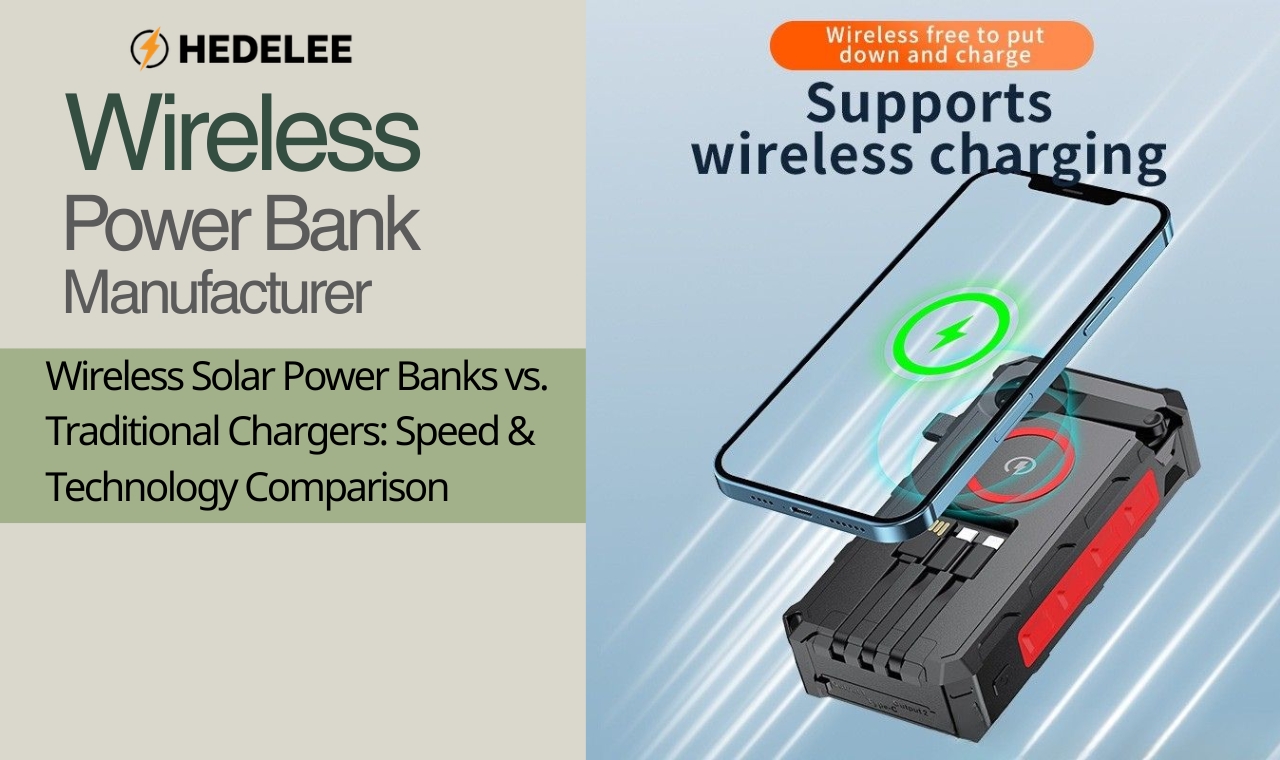
When your phone dies on a camping trip or during a power outage, a wireless solar power bank feels like magic. No cables. No wall outlet. Just sunlight and a working phone. But the real story is more interesting than convenience—it’s about how wireless technology and solar cells actually compete with traditional wired charging, and why speed matters more than most people think.
The market for portable charging has shifted dramatically in the last five years. Wireless solar power banks now represent a genuine alternative to conventional portable chargers, but not in every situation. Understanding which charging method suits your needs requires knowing how these technologies actually work—not just the marketing language about “fast charging” or “all-day power.”
This guide cuts through the noise. We’ll compare wireless solar charging to traditional methods, show you the real speed differences, and help you decide whether a wireless solar power bank makes sense for your lifestyle. If you spend time outdoors, travel unpredictably, or want backup charging without cables, the technology comparison here matters.
Quick Answer: A wireless solar power bank charges devices without physical cables using Qi wireless charging technology and built-in solar panels. While slower than wired charging (typically 5W wireless vs. 18W+ wired), they excel for outdoor use, emergencies, and cable-free convenience. Speed depends on sunlight intensity, panel quality, and device compatibility—making them ideal for camping and travel rather than rapid daily charging.
How Wireless Solar Power Banks Actually Work
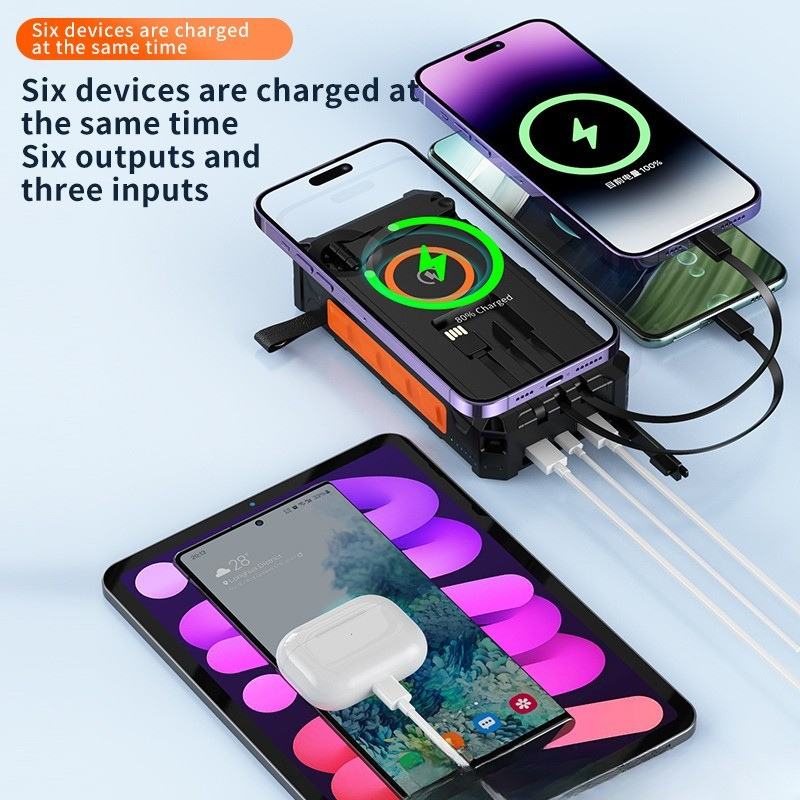
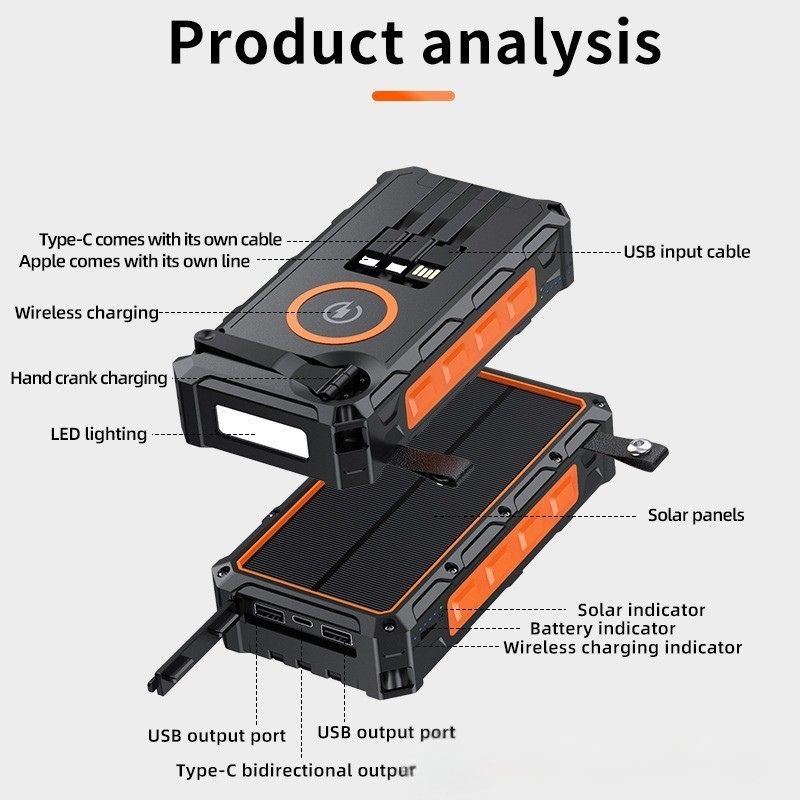
A wireless solar power bank combines three technologies: solar panels, internal battery storage, and wireless charging transmission. These work together in a specific sequence that determines real-world speed and reliability.
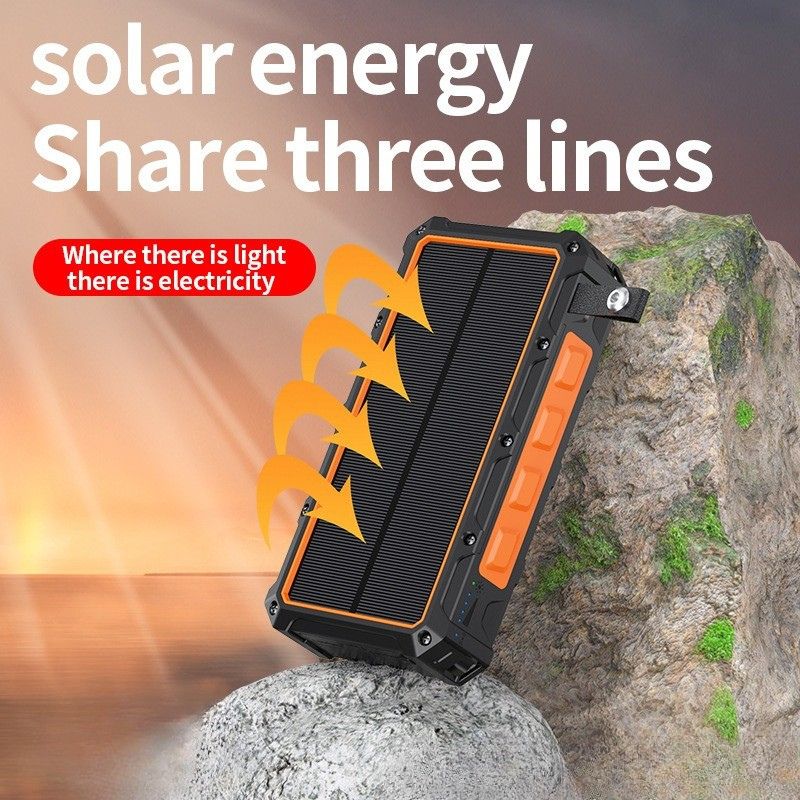
The solar panel (usually monocrystalline or polycrystalline silicon) converts sunlight into DC electricity. Monocrystalline panels are more efficient in low-light conditions but cost more. Polycrystalline panels are cheaper but need stronger sunlight. Most portable solar power banks use polycrystalline cells rated between 5W and 20W. This solar power generates direct current, which flows into an internal charging controller.
The internal lithium-ion battery stores energy from both the solar panels and traditional wired charging (USB-C or micro-USB). Capacity ranges from 5,000 mAh (small, lightweight models) to 30,000 mAh (heavier outdoor units). The controller regulates voltage and prevents overcharging—critical because solar input varies constantly with cloud cover and sun angle.
The Qi wireless charging module (the transmitter coil) sends power inductively to compatible devices. Qi is the global standard for wireless power. It operates at two main power levels: 5W (standard wireless) and 15W (Quick Charge-compatible wireless). Most phones support 5W. Premium models and newer flagship phones accept 10–15W wireless input.
Here’s the practical sequence: On a sunny day, solar panels charge the internal battery simultaneously while the device user charges via wireless. At night or indoors, the stored battery powers wireless output. If neither solar nor wireless is used, the power bank can recharge via a wired USB port—fast, predictable, and unaffected by weather.
The speed of wireless solar charging depends on three variables: solar intensity (measured in lux or watts per square meter), panel efficiency (usually 15–22% for consumer products), and device compatibility (does your phone support Qi?). A 10W solar panel in direct midday sun might generate 7–8W of usable power, but clouds, afternoon angles, or dust reduce this to 2–3W.
Wireless Charging Speed vs. Wired Charging: The Real Numbers
Speed is where wireless solar power banks reveal their limitations compared to traditional wired methods. The numbers matter because perceived “speed” influences purchasing decisions.
Wireless charging (standard Qi): 5W output = 0–20% battery in approximately 1.5–2 hours. A full 0–100% charge on most modern phones takes 3–4 hours.
Wired charging (USB Power Delivery 18W or higher): 18W–30W output = 0–80% battery in 30–60 minutes. A full charge takes 1–2 hours.
Wired charging (basic 5V/1A): 5W output = similar to wireless, 3–4 hours to full charge.
The speed gap is real but not disqualifying. A wireless solar power bank delivers roughly one-third the speed of modern fast-wired charging. However, this comparison assumes optimal conditions—direct sunlight for wireless solar. In practice, wired charging wins consistency. A USB Power Delivery charger performs the same speed whether it’s noon or dusk. A solar panel’s speed fluctuates with weather and time of day.
For emergency use or outdoor situations, wireless solar speed is acceptable. You’re not trying to charge your phone in 30 minutes during a hiking trip. You’re trying to add 20–30% battery life when you have several hours of daylight. In that context, 5W wireless charging becomes practical.
The hybrid model—solar charging the power bank, then using the bank’s wireless output—creates a slower but more flexible workflow. The power bank itself charges faster via solar (no internal Qi circuit losses), and then transmits at standard 5W. This makes sense for all-day outdoor trips.
Wireless Solar Power Banks vs. Traditional Portable Chargers: Key Advantages and Tradeoffs
Traditional portable chargers (non-solar, wired output only) still dominate the market because they deliver speed and reliability without complexity. Understanding the real tradeoffs helps you choose correctly.
Wireless Solar: Advantages
No cable required. This sounds trivial until you’re on a beach or hiking trail. Cables get lost, damaged, or left behind. Wireless charging eliminates that single point of failure.
Solar autonomy. Over weeks or months of outdoor use, solar input reduces dependence on wall outlets. A 10W solar panel in regular use can partially recharge itself in sunlight, lowering total electricity cost.
Emergency backup. In prolonged power outages, solar panels become functional when wall charging fails. This advantage applies specifically to remote or outdoor scenarios.
Aesthetic appeal. No visible cables. This matters for some users; it shouldn’t matter for purchasing decisions, but it does.
Wireless Solar: Tradeoffs
Slower charging. 5W wireless is definitively slower than 18W+ wired. If you need full battery in under two hours, wireless solar underperforms.
Weather dependence. Clouds, rain, and seasonal variation reduce solar output unpredictably. On a winter day in northern latitudes, a solar panel might generate 30–50% of summer output.
Higher cost. Wireless solar power banks cost 40–60% more than non-solar portable chargers of equivalent capacity. You pay for solar cells, wireless circuitry, and more complex manufacturing.
Heavier. Solar panels and wireless charging coils add weight. A 20,000 mAh wireless solar model weighs 500–700 grams. A non-solar wired 20,000 mAh model weighs 350–400 grams.
Limited compatibility. Only Qi-compatible phones and devices benefit from wireless charging. Older phones, some Android devices, and accessories without Qi support cannot use wireless output.
Traditional Portable Chargers: Advantages
Faster wired output. 18W–65W wired charging charges modern devices in 1–3 hours, depending on capacity.
Cheaper. Lower cost reflects simpler design and manufacturing.
Lightweight. No solar panels or wireless circuitry.
All-device compatibility. Works via USB-C, micro-USB, or Lightning cable with virtually any device.
Traditional Portable Chargers: Tradeoffs
Cable dependency. You must carry appropriate cables or accept incompatibility. Cables fail or get forgotten.
No autonomy. Requires wall charging. In sustained outdoor use without power access, non-solar chargers eventually deplete.
No emergency value in outages. If power is unavailable, you cannot recharge.
Understanding Wireless Charging Technology (Qi Standard) and Solar Panel Efficiency
The technology underneath wireless solar power banks determines their real-world performance. Knowing these details helps you evaluate products honestly.
Qi Wireless Charging Standard
Qi (pronounced “chee”) is the global standard for inductive wireless charging, maintained by the Wireless Power Consortium. It defines power levels, safety protocols, and device compatibility.
Standard Qi (5W): Power transmitted at 5W over distances up to 5mm. This is the baseline, supported by most modern smartphones. Charging speeds range from 2–4 hours for typical 3,000–4,000 mAh phone batteries.
Qi Fast Charge (10W–15W): Enhanced Qi protocol supporting higher power transfer. Supported by flagship devices from Apple (iPhone 12 and newer with 7.5W), Samsung (Galaxy S10 and newer with 10W), and others. Cuts charging time to 2–3 hours but requires compatible phones.
Qi operates at a carrier frequency of 110–205 kHz, meaning the transmitter coil in the power bank and receiver coil in your phone create an electromagnetic field. Energy transfers inductively—no direct electrical contact. This is why there’s no risk of water damage or sparking, making Qi inherently safer than physical connectors.
Coil alignment matters. If your phone isn’t centered on the wireless power bank’s transmitter coil, power transfer drops significantly or stops. This is one source of real-world frustration. Premium wireless chargers include alignment guides or larger coil areas to reduce this issue.
Solar Panel Efficiency and Real Output
Solar panel efficiency in consumer portable chargers ranges from 15–22%. This means a panel rated 10W converts only 1.5–2.2 watts of actual usable power under ideal test conditions (1,000 W/m² direct sunlight, 25°C cell temperature). Real-world output is lower because:
- Non-ideal sun angle. Unless the panel directly faces the sun, output drops. Mid-afternoon sun at 45° reduces output by ~30%.
- Dust and debris. Outdoor use collects dust, reducing efficiency by 10–20%.
- Temperature effects. Solar cells generate less current on hot days (paradoxically), losing ~0.5% efficiency per degree Celsius above 25°C.
- Cloud cover. Overcast conditions reduce output to 10–20% of sunny-day capacity.
A “10W solar power bank” under perfect lab conditions generates ~10W. In real outdoor use on a clear day, expect 5–7W actual output. On a partly cloudy day, expect 2–4W. On an overcast day, expect 1–2W or none at all.
This is not a defect—it’s physics. Marketing often obscures this reality by quoting peak rated power, not typical output.
Choosing Between Wireless Solar and Traditional Charging: When and Where Each Makes Sense
The choice depends on your actual use case, not general enthusiasm for either technology.
Choose a wireless solar power bank if:
- You spend sustained time outdoors: camping, hiking, traveling, or working in remote locations.
- You want backup charging without carrying cables.
- You prioritize convenience over charging speed.
- Your devices are Qi-compatible (modern iPhones, newer Android flagships).
- You travel unpredictably and want redundant charging options.
- Extended power outages concern you, and solar autonomy appeals to you.
Choose a traditional wired portable charger if:
- You need fast charging (under 2 hours to full battery).
- You use older devices or non-Qi-compatible phones.
- You’re primarily indoors or in urban environments with reliable power access.
- You want the lightest, cheapest option.
- You charge multiple devices with different cable types.
- Weight and size matter (traditional chargers are more compact).
Use both if you can. Many users carry a small, wired 10,000 mAh power bank for daily urban use and a larger wireless solar model for weekend trips. The cost and weight of two chargers is still lower than the opportunity cost of a dead phone during important activities.
Real-World Performance: How Wireless Solar Power Banks Handle Common Scenarios
Testing these devices in realistic conditions reveals where marketing diverges from practice.
Scenario 1: All-day outdoor trip with intermittent use
You’re hiking and checking maps, taking photos, and messaging occasionally. Your phone starts at 80% battery. You have a 20,000 mAh wireless solar power bank with a 10W solar panel.
Morning (6 AM–12 PM): Low sun angle. Solar output is ~2–3W. The power bank itself charges slowly. Your phone’s Qi receiver gains 10–15% over 2–3 hours of sporadic wireless charging. Meanwhile, the power bank is charging from solar, so the net loss is minimal.
Afternoon (12 PM–5 PM): High sun angle. Solar output peaks at 6–7W. Your phone gains 20–30% battery if left on the charger continuously. Realistically, you’ll pick it up periodically, so you’ll add 15–25% to your phone’s battery. Simultaneously, the power bank gains 3–4 hours of 6W solar input, recovering the morning’s losses.
Evening (5 PM–sunset): Solar output drops again to 2–3W. Battery is depleted more slowly due to direct wireless charging reducing phone power draw.
Outcome: Your phone remains 50–70% charged all day without a wall outlet. This works. A traditional power bank would deplete if you drew 20–30% daily from it without recharging via USB.
Scenario 2: Urban commute, daily charging
You’re traveling between home and office, with daily access to chargers at both locations. A wireless solar power bank adds zero value here. A lightweight wired 10,000 mAh charger is superior because it charges faster and costs less. The solar panel sits unused indoors.
Scenario 3: Extended travel without power access
You’re on a week-long sailing trip, beach vacation, or expedition. Power access is limited. A solar power bank with built-in cable and 20,000+ mAh capacity becomes genuinely valuable. Combined with wireless charging, it provides multiple charging pathways: solar input, wired USB input if power becomes available, and wireless output to your phone. Redundancy matters in extended remote use.
Comparing Wireless Solar Specifications: What to Look For
Product specifications for wireless solar power banks can be deceptive. Here’s how to read them critically.
| Specification | What Marketers Claim | What Actually Matters |
|---|---|---|
| Solar Wattage | “10W solar panel” | Real-world output: 50–70% of rated power under ideal sun. Expect 5–7W on a clear day. |
| Capacity (mAh) | “20,000 mAh” | Actual usable capacity is 60–70% due to circuit losses and battery chemistry. A 20,000 mAh bank delivers ~12,000–14,000 mAh to your phone. |
| Wireless Output | “15W Fast Charge” | Requires a compatible device. Most phones are limited to 5–7.5W. Check your phone’s specs. |
| Charging Speed | “Charges 50% in 1 hour” | Under what conditions? Wired? Wireless? Plugged to power? These claims usually assume wired input, not solar. |
| Durability Rating | “IP65 waterproof” | IP ratings matter. IP65 = dust-resistant, water-jet resistant. IP67 = submergible up to 1 meter. Check the spec sheet, not the marketing image. |
| Panel Type | “Premium monocrystalline” | Monocrystalline is better in low light but costs more. Polycrystalline is adequate and cheaper. Both work—choose based on budget and climate. |
Key takeaway: Compare real-world capacity to your daily usage. If you use 30% of your phone’s battery daily, a 20,000 mAh power bank covers 2–3 days of emergency charging (accounting for conversion losses). A 5,000 mAh model covers less than one day.
Building a Charging Strategy for Different Lifestyles
One charger rarely fits all situations. Smart users build a simple toolkit.
Urban daily commuters:
- Primary: Lightweight wired 10,000 mAh portable charger with USB-C output.
- Secondary: Wall charger with Power Delivery at the office.
- Strategy: Recharge the power bank daily at home or office. Ultrafast charging isn’t necessary.
Frequent travelers (flights, car trips):
- Primary: 20,000 mAh wired charger (fits carry-on, provides 2–3 full phone charges).
- Secondary: USB-C wall charger with Power Delivery for hotel rooms.
- Strategy: Use wired charging for speed. Wireless adds no value without extended outdoor time.
Outdoor enthusiasts (camping, hiking, expeditions):
- Primary: 20,000 mAh wireless solar power bank with built-in cables.
- Secondary: Lightweight wired charger backup (redundancy matters remotely).
- Tertiary: Solar panel (larger, dedicated) if trips exceed one week.
- Strategy: Use solar input during daytime, wireless output for convenience, wired charging if you reach a lodge or car.
For off-grid or emergency preparedness:
- Primary: Large-capacity solar power bank (30,000+ mAh) with multiple solar panels.
- Secondary: Hand-crank or battery-powered backup charger.
- Strategy: Prioritize redundancy and autonomy over speed.
Frequently Asked Questions
Q: Does wireless solar charging work indoors?
A: Not effectively. Indoor lighting (even bright office fluorescents) provides 200–500 lux. Outdoor direct sun provides 50,000–100,000 lux. Solar panels need direct or very bright diffuse sunlight to generate meaningful power. Indoors, a wireless solar power bank becomes a conventional battery—useful, but the solar component adds weight and cost without benefit. Use it outdoors.
Q: Can I charge two devices at once on a wireless solar power bank?
A: Depends on the model. Most wireless solar power banks have one Qi wireless coil (charge one device wirelessly) and one USB port (charge one device wired). Some premium models offer dual wireless coils or dual USB ports, but this is less common. Check the product specs. Charging two devices simultaneously splits power output, slowing both charges.
Q: How long does a wireless solar power bank take to charge from empty using only sunlight?
A: A 20,000 mAh wireless solar power bank with a 10W solar panel takes approximately 20–30 hours of direct sunlight to charge fully from 0% (assuming 6–7W real-world output and 70% conversion efficiency). In practice, this rarely happens because you’ll use the battery during daytime. Plan for partial solar recharging, not full recharges via solar alone.
Q: Are wireless solar power banks waterproof?
A: Many are water-resistant (IP65 or IP67 ratings), meaning they withstand splashing and brief submersion. True waterproof models are rare because solar panels require exposure to sunlight, creating seams and joints where water can enter. Check the IP rating on the product specification. Don’t assume “water-resistant” means “leave in a river.” Treat them as splash-resistant, not waterproof.
The Right Wireless Solar Power Bank Makes Real Difference
Speed isn’t everything in charging. Convenience, autonomy, and reliability matter differently depending on where you live and how you work.
If you’re spending a weekend camping, working outdoors regularly, or traveling unpredictably, a wireless solar power bank provides genuine value that a traditional portable charger cannot match. The absence of cables, the partial solar recharging capability, and the dual-charging options make it a practical choice for people who spend time away from power outlets.
If you’re primarily urban-based, rely on fast charging, and use older devices, a lightweight wired portable charger remains the better choice. The wireless solar approach adds cost and weight without solving your actual problem.
The technology comparison boils down to this: wireless solar power banks trade speed for autonomy and convenience. That trade is worth making in some situations and not worth it in others. Understanding your actual charging scenarios—not hypothetical future camping trips—determines whether the investment makes sense.
At Solar Power Bank, we design wireless solar chargers specifically for people who need charging solutions beyond wall outlets. Our product line includes compact 5,000 mAh wireless models for daily portability and larger 20,000+ mAh models with built-in solar panels for extended outdoor use. We also offer wireless power banks with integrated phone holders, combining charging with hands-free phone mounting for travel and outdoor work.
If your lifestyle includes outdoor time, travel, or remote work, explore our wireless power bank collection to find the model that fits your needs. Real autonomy in charging starts when you stop depending on wall outlets.