

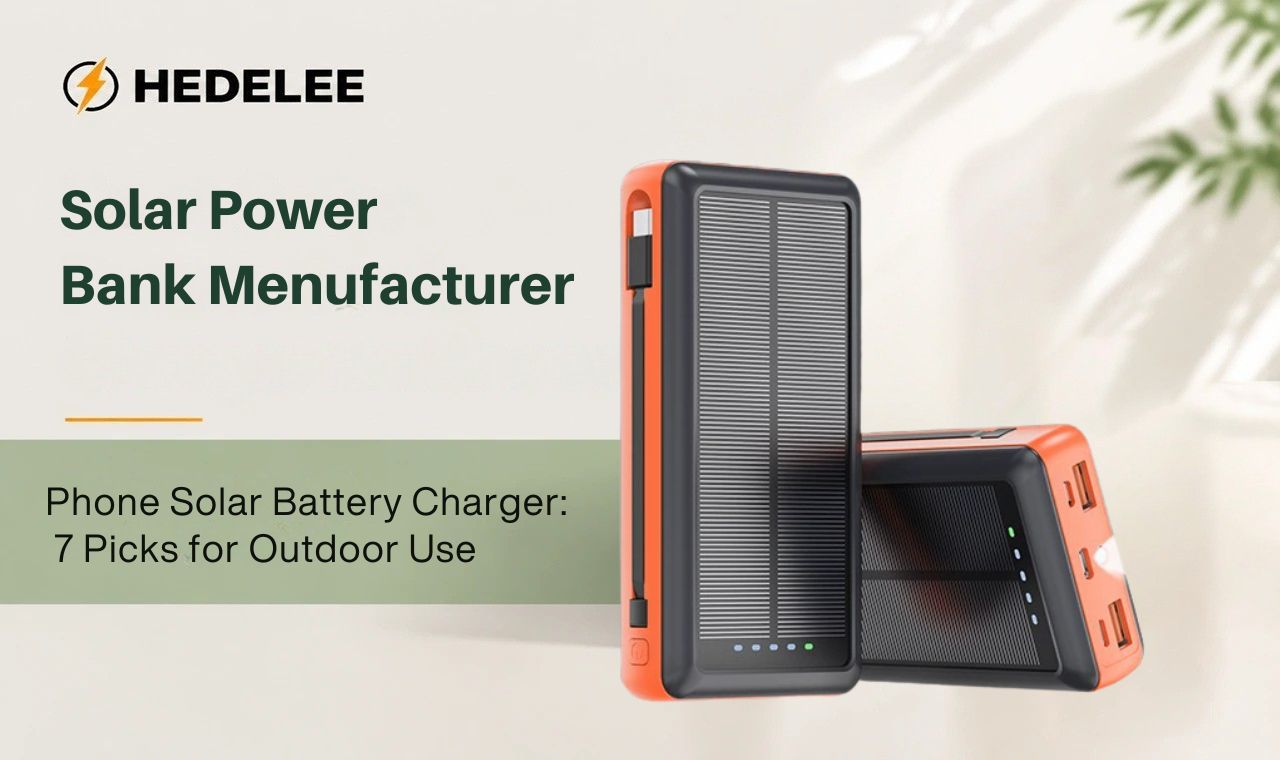
A dead phone at hour six of a hiking trail is more than an inconvenience. For the people who buy your products, it can mean a lost GPS signal, an unreachable client, or an emergency call that never connects. That frustration sits behind one of the steadier niches in mobile accessories: the phone solar battery charger.
For buyers, procurement teams, and product managers, this category offers a practical mix of steady demand, clear use cases, and healthy margins. Outdoor retailers stock them year-round. Emergency-preparedness channels order them in seasonal waves. Corporate gifting programs pick them up for field staff.
This guide covers how solar charging technology works, what separates a reliable unit from a disappointing one, and seven solar power bank options suited to outdoor use — drawn from a factory floor that builds them at scale.
What Is a Phone Solar Battery Charger and How Does It Work?
A phone solar battery charger combines two things in one housing: a rechargeable lithium battery (the power bank) and one or more photovoltaic panels (the solar charger). The panel converts sunlight into electrical current, and that current refills the internal battery. Your phone then charges from the battery through a USB port, a built-in cable, or a wireless charging pad.
The science behind the panel is well established. Photovoltaic cells absorb energy from sunlight and convert it into electrical energy through semiconducting materials, as the U.S. Department of Energy’s photovoltaic technology overview explains. Individual cells are wired together into modules, which is why a foldable charger with four panel sections harvests meaningfully more energy than a single small panel.
Why the Battery Matters as Much as the Panel
Here is the part many first-time buyers miss: the solar panel on a compact unit is a backup feature, not the primary charging method. A small integrated panel in direct sunlight might add a few percent of battery charge per hour. That is enough to keep a phone alive in an emergency, but it will not refill a 20,000mAh pack in an afternoon.
In practice, the workflow looks like this:
Charge the power bank fully from a wall outlet before the trip.
Use stored battery power to charge phones and other devices as needed.
Let the solar panel top up the battery during daylight hours to extend total runtime.
Framed this way, a solar powered power bank behaves like a standard power bank with an insurance policy attached. When the grid is unavailable for days, that policy pays off.
Common Configurations
Single-panel units: One small panel on the housing; lightest and cheapest to produce; solar input is modest.
Foldable multi-panel units: Three to five panels that unfold like a map; far stronger solar harvest; slightly bulkier.
High-capacity units: 24,000mAh and above; built for multi-day trips or charging several devices at once.
How to Choose a Phone Solar Battery Charger for Outdoor Use
Choosing a phone solar battery charger for outdoor use comes down to four variables: capacity, panel design, durability, and port selection. Each one affects how the product performs in the field — and how well it sells afterward.
1. Capacity: Match mAh to the Trip
Capacity, measured in milliamp-hours (mAh), determines how many phone charges one full battery delivers. A typical modern phone holds roughly 3,000–5,000mAh, so the math is simple:
One detail worth flagging for travel-oriented assortments: airline rules cap spare lithium batteries at 100 watt-hours in carry-on luggage. A 20,000mAh bank at 3.7V sits around 74Wh — comfortably inside the limit. Units above roughly 27,000mAh exceed it. The FAA’s PackSafe guidance on batteries and power banks lays out the thresholds clearly, and many importers use the 20,000mAh tier as their volume seller for exactly this reason.
2. Panel Design: Single vs. Foldable
A single integrated panel keeps the product slim and the unit cost low. A foldable solar panel power bank sacrifices a little pocketability for a much larger light-catching surface. For customers who genuinely plan to live off solar input for days, the foldable format is the honest recommendation. For customers who mainly want a reliable battery with emergency solar backup, the single-panel format wins on price and weight.
3. Durability: Read the IP Rating
Outdoor gear meets rain, dust, and drops. Ingress Protection (IP) ratings tell you what a unit can handle:
IPX4: Resists splashing water from any direction — fine for light rain.
IP65: Fully dust-tight and resists low-pressure water jets — suited to harsh conditions.
A waterproof solar power bank with an IP65 rating, a rubberized shell, and reinforced corners will survive conditions that kill ordinary electronics. For camping, marine, and emergency-preparedness channels, that rating often decides the purchase.
4. Ports and Extras
Dual USB outputs let two devices charge at once — a small feature that reviewers mention constantly. USB-C input shortens the unit’s own wall-recharge time. Built-in cables remove the “forgot the cord” problem entirely, and Qi wireless pads let a solar powered iPhone charger work without any cable at all. LED flashlights and SOS strobes round out the outdoor feature set.
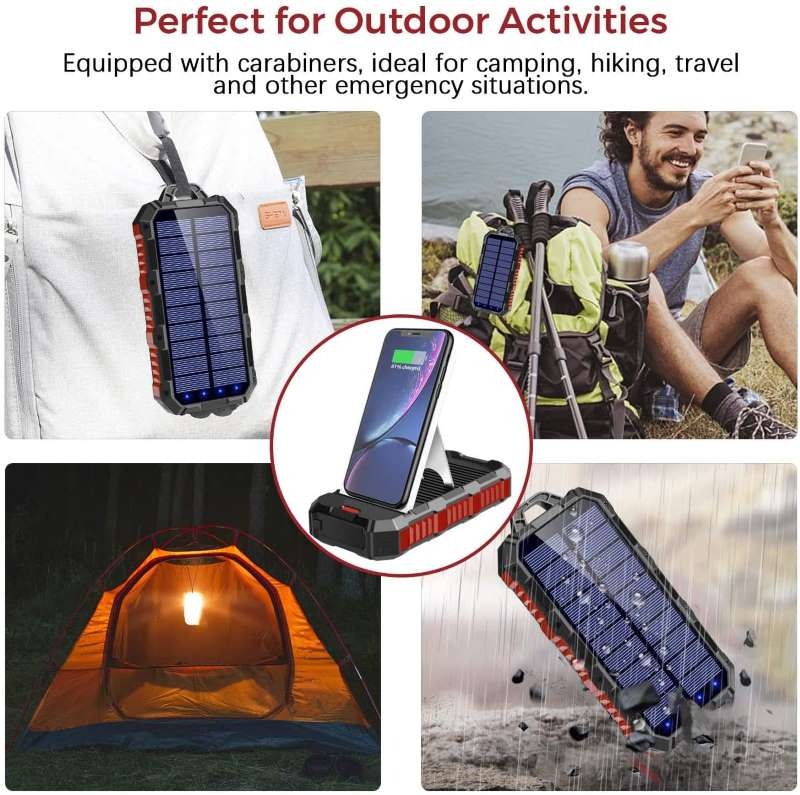
7 Phone Solar Battery Charger Options for Outdoor Use
These seven phone solar battery charger options span the formats and capacities most requested by importers, distributors, and wholesale buyers. All come from our own production lines, so specifications are consistent and customization is straightforward.
1. 20,000mAh Waterproof Wireless Solar Power Bank (HDL-218)
The dependable middle of the range. This 20,000mAh wireless solar power bank with dual inputs and a built-in flashlight pairs wireless charging with waterproof housing, making it a strong fit for general outdoor retail. The capacity keeps it airline-friendly, and the flashlight adds everyday utility.
2. Foldable 20,000mAh Solar Charger with LED Lights
For customers who intend to actually live on solar input, panel area is everything. This fast-charging foldable solar charger with LED lights unfolds into a wide array that harvests far more daylight than a single-panel design, then folds down to pack size. It suits trekking, overlanding, and any assortment aimed at serious outdoor users.
3. 20,000mAh Dual-USB Waterproof Solar Charger (HDL519X)
A value-focused workhorse. This dual-USB solar power bank with waterproof housing and LED light charges two devices at once and hits a price point that works well for promotional programs and entry-level retail shelves.
4. 25,000mAh Dual-Port Solar Charger for Smartphones
Slightly above the mainstream tier, this 25,000mAh portable solar charger with dual USB ports serves buyers whose customers camp for long weekends and carry more than one device. It functions well as a solar cell phone charger for families sharing a single pack at a campsite.
5. 30,000mAh Qi Wireless Solar Power Bank, IP65 (HDL-528)
Built for rough conditions. This 30,000mAh Qi wireless solar power bank with USB-C input and IP65 protection brings together a 5V/3A output, dust-tight sealing, and wireless charging. Marine, fishing, and emergency-preparedness channels respond well to the IP65 rating. Keep in mind the capacity exceeds standard airline carry-on limits, so position it for land-based adventures and home emergency kits.
6. 24,000mAh Solar Power Bank with 4 Built-In Cables (HDL-529)
Cable-free convenience at mid-high capacity. This 24,000mAh solar battery pack with four built-in cables and a dual LED flashlight charges nearly any phone without a separate cord, and the wireless pad handles compatible devices. As a solar mobile phone charger for group travel, it removes the usual cable negotiations around a campfire.
7. 42,000mAh High-Capacity Solar Battery Pack (HDL-628)
The heavyweight. This 42,000mAh solar power bank with built-in cables and wireless charging targets extended off-grid stays, worksite charging, and emergency-preparedness bundles where runtime outweighs portability. It anchors the top of an assortment and lifts average order value.
Quick Reference
You can browse the full range, including 10,000mAh compact units, in our solar power bank product category.
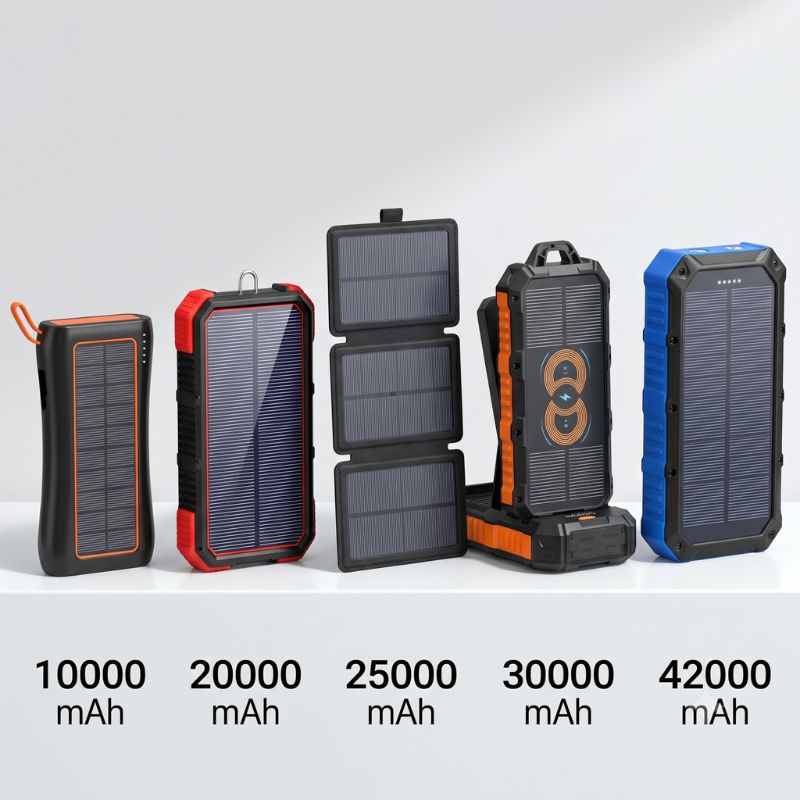
What Wholesale Buyers Should Verify Before Ordering
Retail customers judge a solar power bank by how it feels on a trail. Procurement teams need to judge it earlier — on paper, in the lab, and on the production line. A few verification points separate a smooth program from an expensive lesson.
Safety and Compliance Documentation
Lithium batteries are regulated goods in most markets. Before committing to a purchase order, request and review:
UN 38.3 test reports — required for legal air and sea transport of lithium batteries.
MSDS documentation — needed by freight forwarders and customs brokers.
CE, FCC, and RoHS certificates — market-entry requirements for the EU and US respectively.
Cell supplier information — consistent, traceable battery cells predict consistent field performance.
A factory that produces these documents quickly has run export programs before. One that hesitates has not.
Real Capacity vs. Label Capacity
Inflated capacity claims are the oldest trick in this category. A honest 20,000mAh unit delivers roughly 60–70% of its rated energy to a phone after conversion losses — that is normal physics, not a defect. What matters is that the label matches the cell inside. Ask for discharge test data on sample units, and weigh samples against the factory’s stated cell weight. Both checks are fast and revealing.
Customization and Branding Options
Most wholesale programs in this category involve some level of private labeling. Common options include:
Logo printing or laser engraving on the housing
Custom colors and surface finishes
Branded retail packaging and inserts
Built-in cable combinations matched to your market’s devices
Agree on artwork formats, color tolerances, and packaging dielines early. Revisions cost little before mass production and a great deal after.
Lead Times and Order Quantities
Solar power banks involve more components than standard packs — panels, sealed housings, flashlights — so production planning deserves attention. Typical programs run three to five weeks from confirmed order to shipment, depending on customization depth and order size. Buyers planning seasonal outdoor or holiday assortments should build in freight time on top of that.
Getting the Most from Solar Charging in the Field
A solar phone charger performs well when users understand its rhythm. Sharing these habits in packaging inserts or listing copy reduces returns and improves reviews — a detail worth passing along to your own customers.
Start full. Wall-charge the unit to 100% before departure; solar input then extends rather than creates your power budget.
Angle the panel. Lay or prop the panel perpendicular to the sun, and re-aim it every hour or two. Output drops sharply at shallow angles.
Keep it cool. Panels lose efficiency as they heat up, and lithium cells age faster when hot. Dappled shade for the battery body with the panel in full sun is the ideal arrangement.
Charge devices during daylight. Let the panel feed the battery while the battery feeds the phone; you capture energy you would otherwise miss.
Expect weather variance. Cloud cover can cut solar input by half or more. Treat sunny-day harvest as the plan and cloudy-day harvest as a bonus.
Buyers who set honest expectations in their marketing copy see it reflected in their review scores. Solar charging rewards patience; it does not reward hurry.
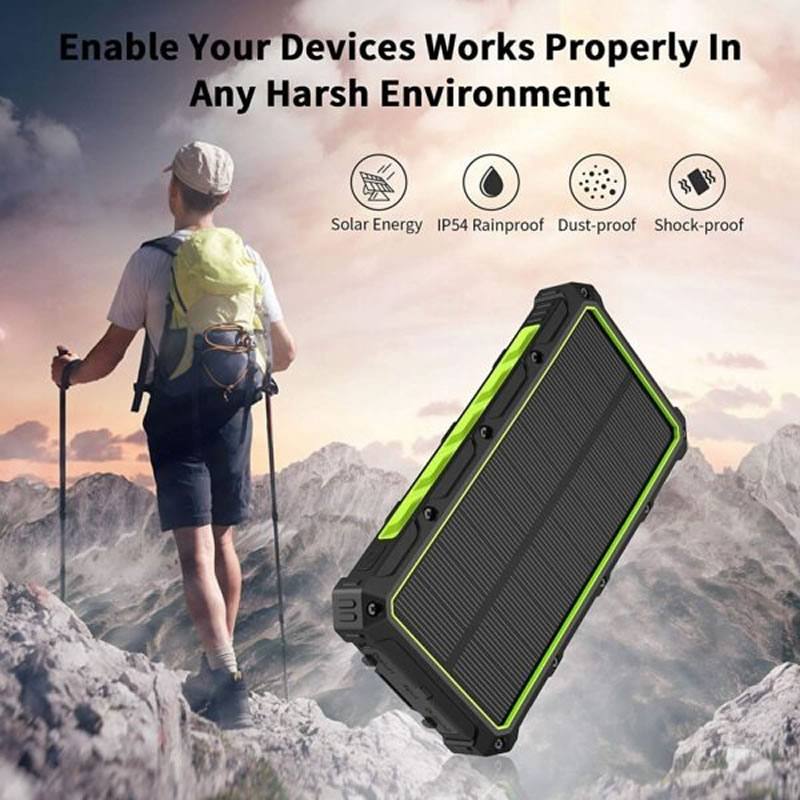
solar cell phone charger backpack
Frequently Asked Questions
1. How long does a phone solar battery charger take to recharge?
From a wall outlet, most 20,000mAh units refill in six to ten hours depending on input wattage. Solar-only recharging takes several days of direct sun on a single-panel model, which is why panels serve as extenders rather than primary power sources.
2. What is the minimum order quantity for solar power banks?
Our minimum order quantities vary by model and customization level, with lower thresholds for standard units. Reach out for detailed specifications and current MOQ terms for the models you are considering.
3. Can we customize branding and packaging on solar chargers?
Yes. We support logo printing, custom housing colors, and branded retail packaging across the range. Contact us to request samples with your artwork so you can approve finish and placement before mass production.
4. Which safety certifications do your solar power banks carry?
Our units ship with UN 38.3 transport certification and MSDS documentation, and models for Western markets carry CE, FCC, and RoHS compliance. Ask our team for the certificate set matching your destination market.
5. Can we request samples before placing a bulk order?
Sample units are available for all standard models, and we encourage testing them — capacity, panel output, and housing durability — before you commit. Contact us to arrange samples and a quotation for your target quantity.
Sourcing Direct from the Manufacturer
Shenzhen Hedeli Technology has spent about a decade building mobile accessories and consumer electronics, with solar power banks as a core category. Our factory in Dongguan runs a monthly capacity of 50,000 units, our headquarters sit in Shenzhen, and our Guangzhou office and showroom welcome visiting buyers. More than 100 employees handle everything from cell sourcing and panel assembly to packaging design.
Working with the original manufacturer changes the conversation. Pricing reflects production cost rather than a reseller’s margin. Customization happens on the line that builds the product, not through a middle layer. And when you need discharge test data, compliance documents, or a revised sample, the people answering you are the people making the units.
If any of the seven options above fits your assortment — or if you want a configuration built around your market — send us your target specifications and quantities. Our team will respond with samples, certification documents, and a factory-direct quotation.
Featured Image
Image title: Phone solar battery charger powering devices at a campsite
Image description: A solar power bank charging a smartphone on a camping table at dusk, with a tent and warm lantern light in the background — capturing the core promise of off-grid power.
File name: phone-solar-battery-charger-outdoor-camping.jpg
Alt text: Phone solar battery charger powering a smartphone beside a tent at an evening campsite
AI image prompt: Square 1:1 cinematic lifestyle photo, a rugged solar power bank charging a smartphone on a wooden camping table at dusk, canvas tent and warm lantern glow in the soft-focus background, subtle sunlight catching the solar panel’s surface, cozy outdoor atmosphere, rich warm tones, photorealistic, no text overlays.