

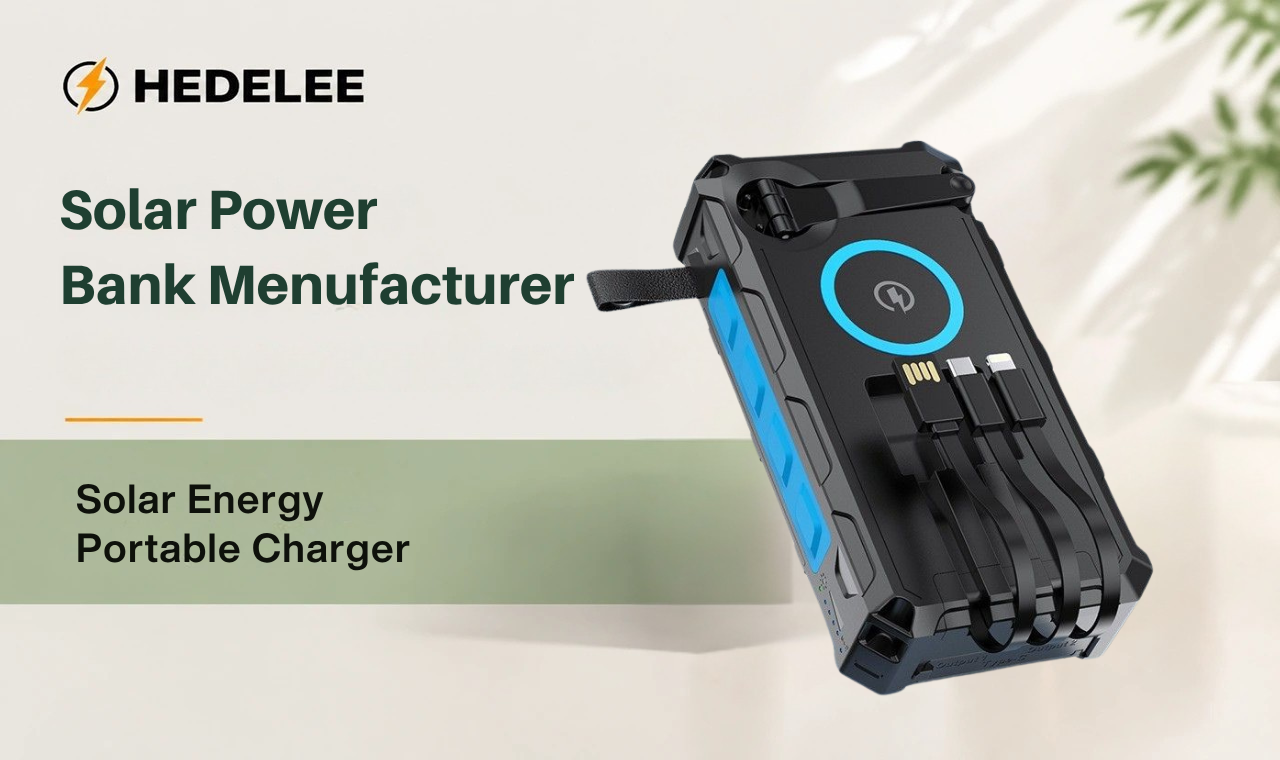
A phone at 5% battery can disrupt navigation, communication, field reporting, and emergency response. Yet a large capacity number on a product shell does not tell buyers how well a charger will work outdoors. Panel size, available sunlight, conversion losses, charging protocol, cell quality, and protection circuits all shape real performance.
A solar energy portable charger combines a rechargeable battery with one or more photovoltaic panels. It stores power from a wall charger or sunlight and then supplies controlled output to phones and other small electronics. For procurement teams, the right choice is not simply the model with the largest advertised capacity. It is the model whose battery, panel, ports, construction, and documentation fit the intended market.
What Is a Solar Energy Portable Charger?
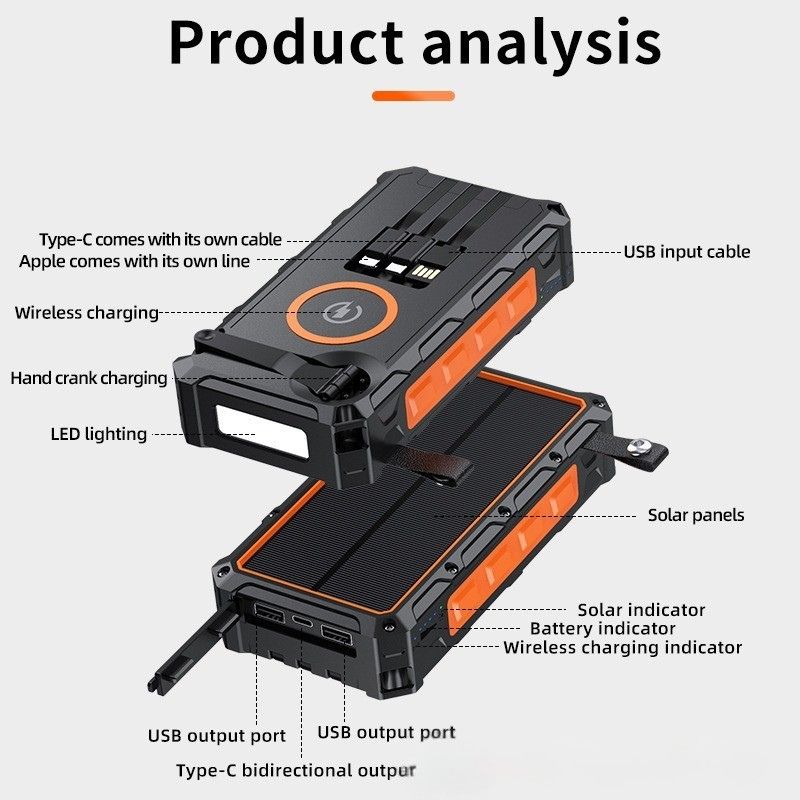
A solar energy portable charger is a battery pack with an integrated or connected solar panel. The panel converts sunlight into direct-current electricity. A charging controller conditions that electricity before it reaches the internal lithium battery. The stored energy can later leave through USB-A, USB-C, built-in cables, or a wireless charging coil.
The design solves two different needs:
- Portable storage: The battery can be filled through a wall adapter before travel.
- Solar recovery: The panel can add energy when a wall outlet is unavailable.
- Device charging: Regulated output delivers power at a voltage supported by the connected device.
- Outdoor utility: Some models include LED lighting, hanging points, covered ports, and water-resistant housings.
The terms used in product catalogs can be confusing. A solar power bank normally stores energy in an internal battery. A panel-only charger produces power when sunlight is available but may not store it. A portable power station is larger and may offer AC outlets for laptops or small appliances. A solar powered power bank is usually another name for a compact solar charger with storage.
| Product type | Energy storage | Typical output | Suitable use |
|---|---|---|---|
| Solar power bank | Built-in battery | USB and sometimes wireless | Phones, cameras, GPS units |
| Panel-only charger | Usually none | USB or DC from live sunlight | Daytime charging in open areas |
| Portable power station | Large battery | USB, DC, and often AC | Multiple devices and small appliances |
Some marketplace feeds use the inverted phrase bank power solar. Buyers will normally get clearer specifications by searching for “solar power bank” and then filtering by battery capacity, panel wattage, and output protocol.
How Does a Solar Energy Portable Charger Work?
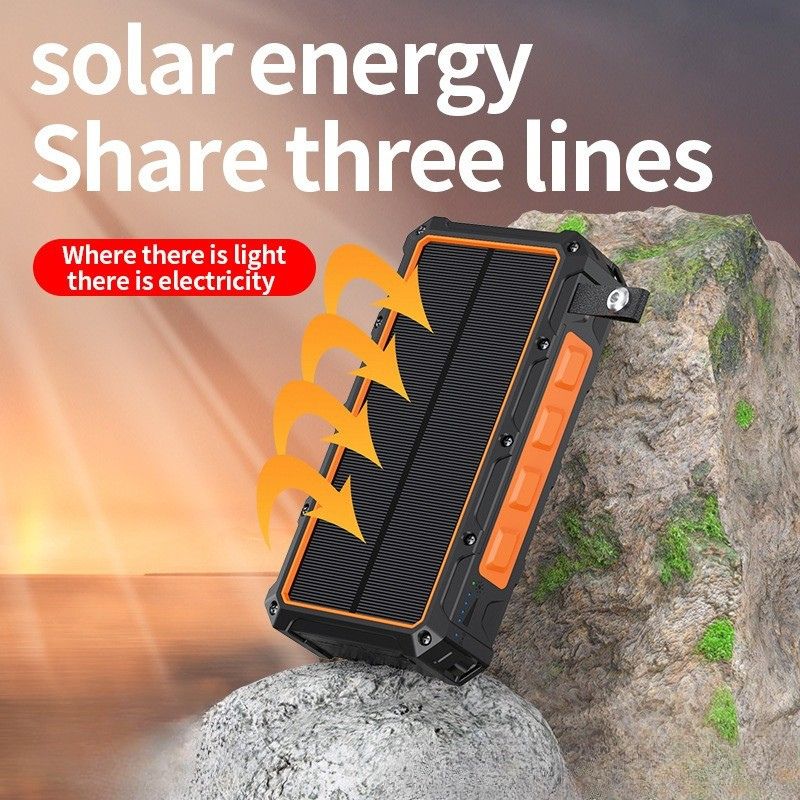
Photovoltaic cells absorb light and create an electrical current. The U.S. Department of Energy explanation of photovoltaic technology notes that a solar cell is a semiconductor device that converts sunlight into electricity. A portable charger then uses power-management electronics to regulate this variable input.
The operating flow has five stages:
- Sunlight reaches the panel.
- The panel generates direct-current electricity.
- A controller manages voltage and current.
- The internal battery stores the available energy.
- An output circuit supplies regulated power to a connected device.
Solar input changes from minute to minute. Clouds, shade, panel angle, dust, and heat can reduce production. A small built-in panel therefore works better as a supplemental charging source than as the main way to fill a large battery every day. A foldable design with several panels presents more surface area to the sun and can collect more energy under comparable conditions.
Panel ratings also need careful interpretation. The printed wattage usually represents a maximum under controlled conditions, with clean cells aimed correctly at strong light. A panel hanging vertically from a moving backpack may receive light at a poor angle or pass through repeated shade. It can still add energy, but it will not behave like the same panel placed in full sun and adjusted during the day. Buyers planning outdoor claims should test both an ideal setup and a realistic use setup.
Outdoor charging guidance also favors charging a power bank first rather than sending unstable panel output directly to an electronic device. The battery and controller act as a buffer. This arrangement protects charging continuity when a passing cloud changes panel output.
A solar power bank battery charger should still be fully charged by cable before shipment, travel, or an emergency season. Solar input can maintain or recover part of the charge, but refill time depends on panel wattage and weather. Procurement documents should never promise a fixed solar recharge time without defining test irradiance, panel angle, temperature, and starting battery level.
How to Choose a Solar Energy Portable Charger
Start with the intended job, not the capacity printed in the largest type. A commuter who wants one emergency phone charge has different needs from a camping retailer, emergency-kit distributor, or field-service team. Define the use case, then compare the following seven points.
1. Confirm usable battery capacity
Battery capacity is commonly shown in milliamp-hours (mAh), but the label is not the same as usable output. Voltage conversion, cable resistance, heat, and protection limits consume part of the stored energy. Ask the supplier for cell capacity, rated output capacity, nominal voltage, and test conditions. These details allow buyers to compare offers on the same basis.
2. Compare panel wattage and surface area
A larger panel can collect more sunlight at one time. Panel wattage is measured under defined conditions, so outdoor results will vary. Integrated single-panel models favor portability. Foldable multi-panel models favor faster solar collection but add size, weight, and hinges.
3. Match output to target devices
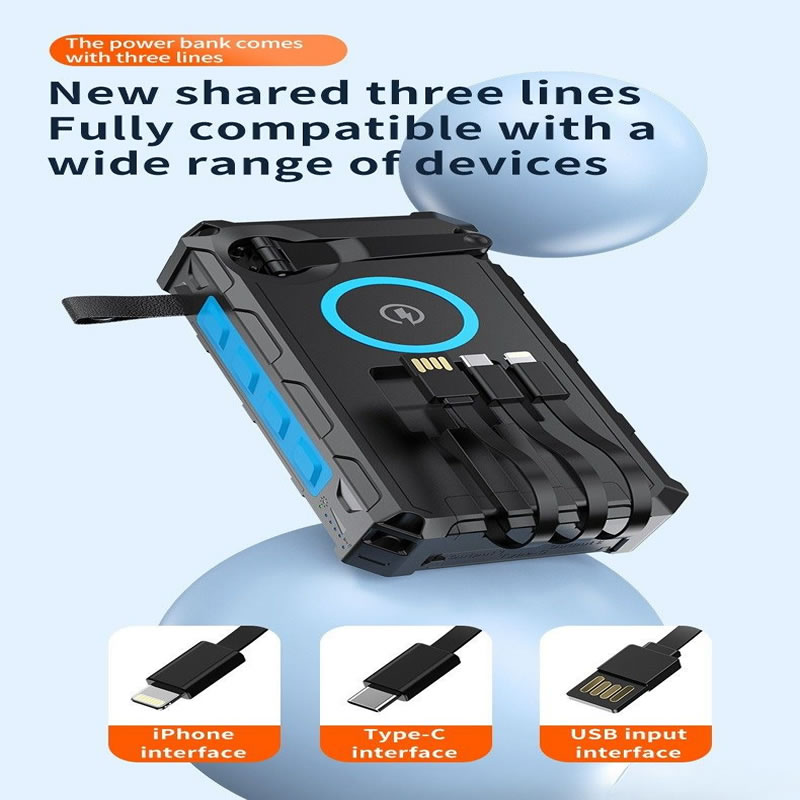
Check voltage, current, maximum wattage, charging protocols, and whether ports can operate together. USB-C input and output can reduce cable complexity. Built-in Lightning, Micro-USB, and USB-C cables may help retail customers who want an all-in-one unit. Wireless charging adds convenience, though wired charging usually wastes less energy.
4. Review input choices
Solar should not be the only input. A practical product also accepts cable charging through USB-C or Micro-USB. Confirm the maximum input, whether USB-C works in both directions, and whether the package includes an appropriate cable.
Input speed affects the customer experience after solar use. A large battery paired with a low cable-input rate can require an overnight refill. Ask for a charging curve that shows input wattage, total refill time, and temperature from a defined starting level. If the product supports pass-through charging, confirm how the circuit divides power and whether the supplier permits the feature in normal use.
5. Inspect outdoor construction
Review port covers, enclosure joints, drop resistance, panel protection, hanging hardware, and operating temperature. If a listing uses an IP rating, request the supporting test report and confirm that the production sample matches the tested construction. “Waterproof” and “water-resistant” should not be treated as equal claims.
6. Check safety architecture
The protection board should address overcharge, over-discharge, short circuit, overcurrent, and temperature. Buyers should also request the documents required for the destination market and transport route. Certification names on a sales sheet are not a substitute for reports tied to the exact model and battery cell.
7. Evaluate production support
Ask about sample timing, approved components, color matching, logo method, packaging files, inspection standards, production capacity, and change control. A dependable factory should document what will be produced and how production units will be checked against the approved sample.
Create a one-page sourcing specification before requesting prices. Include target capacity, cell type, panel construction, input and output ratings, connector mix, charging protocols, enclosure material, water-resistance claim, dimensions, weight, lighting functions, colors, logo process, package contents, carton limits, compliance documents, warranty expectation, and destination. Suppliers can then quote the same requirement, which makes price and feature comparisons more useful.
How Much Capacity and Output Do Buyers Need?
Capacity planning begins with the device battery. Multiply the device capacity by the number of required recharges, then add a reasonable allowance for conversion losses. A 5,000mAh phone that needs two full refills requires more than a 10,000mAh power bank rating because energy transfer is not perfectly efficient.
Use watt-hours when comparing products with different battery voltages:
Watt-hours = volts × amp-hours
For example, a 20,000mAh cell pack at a nominal 3.7V contains about 74Wh before conversion losses. Buyers should use confirmed cell data rather than calculating from a decorative shell label.
| Use scenario | Practical capacity range | Output features to review | Other useful features |
|---|---|---|---|
| Daily emergency backup | 10,000mAh class | One USB-C output, wired or wireless | Compact body, clear indicator |
| Weekend camping | 16,000–25,000mAh class | Two outputs, 2A–3A support | LED lamp, hanging point, port covers |
| Field team or family travel | 20,000–30,000mAh class | Multiple simultaneous outputs | Built-in cables, larger battery display |
| Extended off-grid use | Higher-capacity or multi-panel model | USB-C plus multiple device outputs | Foldable panels or separate solar panel |
For retail travel kits, a solar phone charger may prioritize low weight and one dependable wired port. Camping customers may prefer a solar cell phone charger with a larger housing, brighter LED light, and covered connectors. Meanwhile, field teams can benefit from a solar mobile phone charger equipped with multiple cables, allowing users with different devices to share one unit.
Output claims need context. “5V/3A” may describe a port maximum rather than the power available from every port at once. Ask for single-port and combined-output figures. If wireless charging is included, confirm coil alignment, supported wattage, foreign-object detection, and case-thickness limits.
Estimate charges with a realistic allowance
An exact number of phone recharges cannot be predicted from mAh alone. The phone and power bank operate at different internal voltages, and both devices consume energy during conversion. Cable quality, screen use, network activity, ambient temperature, and battery age also change the outcome. For product planning, compare watt-hours and use measured discharge energy from a sample. Then state a conservative recharge range tied to a named phone battery rather than promising a universal number.
Capacity also affects freight, shelf weight, and traveler eligibility. A larger unit may look more valuable on a listing, yet it can increase shipping cost and feel heavy during daily use. The better commercial choice is the lowest capacity that satisfies the defined charging goal with an adequate reserve.
Which Solar Power Bank Design Fits Each Market?
Product selection becomes easier when features are tied to a clear customer profile. Shenzhen Hedeli Technology Co., Ltd. offers a solar power bank product range covering compact wireless units, integrated-cable models, single-panel products, and foldable-panel designs.
For compact retail and gift programs, the 10,000mAh outdoor wireless model combines wireless output, USB-C input/output, lighting modes, and a smaller body. The HDL618 20,000mAh-class wireless charger adds dual inputs, a flashlight, and 5V/3A listed output for programs that favor more stored energy.
For outdoor assortments, buyers can compare the HDL519 camping solar charger with the HDL519X multi-panel model. The standard HDL519 favors a compact single-panel format. The HDL519X listing uses three 1.5W panels, giving buyers a larger collection area for daylight charging.
Where connector convenience drives the purchase, the HDL531 wireless model with three cables and the HDL529 model with four built-in cables reduce dependence on loose accessories. The HDL628 four-cable model extends this format with a larger-capacity positioning and several lighting modes.
For conventional dual-port programs, review the 25,000mAh-class dual-USB solar charger and the 20,000mAh-class fast-charging model. Buyers seeking wireless output and a specified ingress-protection position can evaluate the HDL528 USB-C and Qi model. For greater panel area in a self-contained unit, the foldable outdoor solar charger is designed around a multi-panel format.
These groupings are a starting point. Before ordering, confirm the approved capacity, input and output limits, panel specification, materials, dimensions, weight, color, packaging, and compliance documents for the selected version.
Assortment design often works better with two or three distinct roles than with many nearly identical capacities. A compact model can cover commuting and promotional programs. A mid-size unit with lighting and covered ports can serve camping and emergency channels. A built-in-cable or foldable-panel model can occupy the higher feature tier. Clear separation helps sales teams explain why each unit exists and reduces internal competition between similar stock items.
Packaging should make the same distinctions. Show rated electrical data, included connectors, solar limitations, charging instructions, and care guidance in readable language. Avoid presenting emergency lighting, water resistance, or solar recharge speed beyond what the approved sample and test records support.
How Should Procurement Teams Verify Quality?
A product sample is useful only when the evaluation method is defined. Create a written checklist before samples arrive, record the test equipment, and apply the same method to every supplier.
Battery and charging tests
- Measure full-charge energy input and discharge energy output.
- Test USB ports separately and together at their agreed loads.
- Record voltage stability, temperature rise, and automatic shutoff behavior.
- Check wireless charging alignment and surface temperature.
- Compare the battery indicator with measured remaining capacity.
- Run solar input tests under defined light conditions.
Mechanical and outdoor checks
- Inspect panel bonding, housing gaps, screws, port covers, and cable strain relief.
- Operate buttons and connectors repeatedly.
- Check hanging points with the agreed load.
- Confirm dimensions, net weight, color, surface finish, and printed markings.
- If water resistance is required, use the method tied to the claimed rating.
Document checks
Request a model-specific specification sheet, battery MSDS, UN38.3 test information, transport paperwork, and market documents required by the destination. Match the model number, cell, enclosure, and electrical ratings across the sample, report, packaging, and purchase order. Expired reports, unrelated model numbers, or changed cells require follow-up.
Approve a sealed reference sample after testing. The purchase order should state that component or construction changes need written approval. Pre-shipment inspection can then compare production goods with the approved unit.
Add aging and packaging checks
One successful discharge does not show how the product behaves after repeated use. For larger programs, agree on cycle testing or accelerated aging for cells, cables, buttons, and port covers. Record capacity retention and any change in charging temperature. The test plan can also include low-battery recovery, idle current, indicator accuracy, and storage after several weeks.
Packaging must protect the panel surface, connectors, and housing during transport. Run a packed-product drop test using the agreed carton configuration, then inspect both function and appearance. Check barcode position, manuals, warnings, accessories, inner trays, master-carton quantity, gross weight, and shipping marks. A signed packing sample prevents late changes that can affect freight or retail presentation.
Inspection sampling should be agreed before production. Define which checks apply to every unit, which are sampled, and what happens when a defect is found. Keeping this process in the order documents makes acceptance decisions consistent for the supplier and buyer.
How Can Users Charge and Carry It Safely?
Begin each trip with the battery charged by cable. Place the panel in direct sunlight with its face aimed toward the sun, keep it free from dust, and move it when shadows cross the surface. Do not leave the unit on a car dashboard or another area where heat can build. Keep ports covered when they are not in use, and let wet surfaces dry before connecting cables.
Do not place the power bank under bedding or inside a sealed bag while it is charging. Stop using a unit that becomes swollen, damaged, unusually hot, or releases odor or smoke. Use the supplied cable or a cable that meets the agreed current rating.
Air transport requires added attention. The U.S. Federal Aviation Administration guidance for lithium batteries states that spare lithium-ion batteries and power banks belong in carry-on baggage, not checked baggage. Units up to 100Wh are generally within the standard passenger limit; 101–160Wh batteries require airline approval, and larger units are not allowed on passenger aircraft. Airlines and countries may apply tighter rules, so travelers should check their carrier before departure.
Product labels should show watt-hours where transport rules require them. They should also identify input, output, model, and manufacturer information in a readable form. For distributor training, include a short care card explaining that the solar panel supports outdoor recovery but does not promise rapid charging in shade or weak sunlight.
Storage conditions affect battery life as well. Keep units away from prolonged heat, direct flame, corrosive materials, and heavy objects that may damage the panel or housing. For long storage, follow the cell supplier’s recommended charge level and inspection schedule. Recharge stored inventory when the agreed maintenance interval is reached, and isolate any carton containing a swollen, leaking, or damaged unit.
Retailers and field managers should retain the model list, batch code, shipment date, and test documents. This record supports warranty review and helps a factory trace a reported issue to the relevant production run. User instructions should provide a clear method for reporting abnormal heat, physical damage, charging failure, or reduced capacity.
Why Work Directly With the Original Manufacturer?
Direct factory access gives buyers clearer control over specifications, samples, packaging, inspection, and production scheduling. It also shortens the path between a technical question and the team responsible for the product.
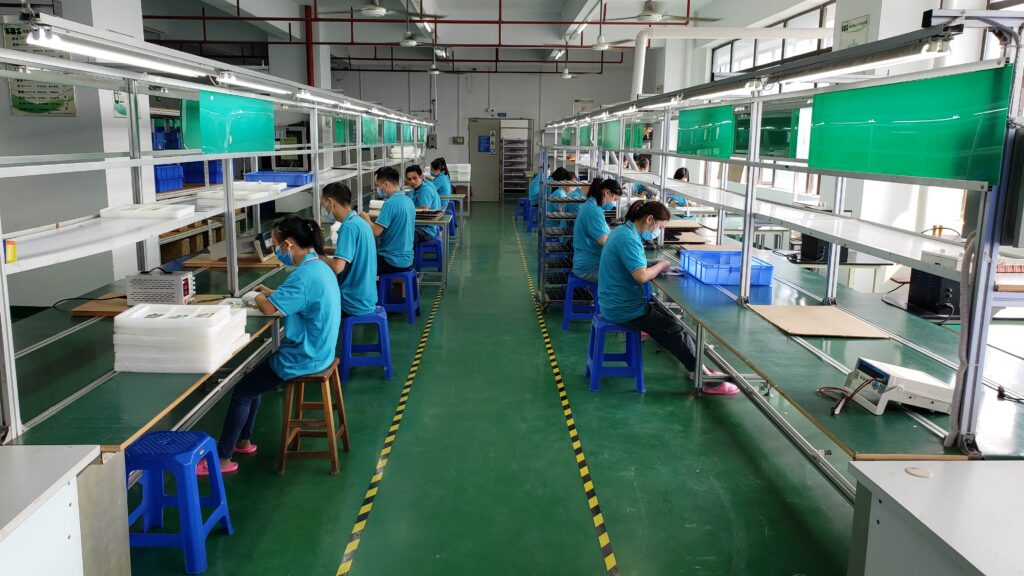
Shenzhen Hedeli Technology Co., Ltd. has worked in mobile accessories and consumer electronics for about 10 years. The company has more than 100 employees, with headquarters in Shenzhen, an office and showroom in Guangzhou, and a factory in Dongguan. Monthly production capacity reaches 50,000 units across power banks and related electronics.
Customization can cover color, logo application, capacity marking, accessories, instruction manuals, and retail packaging, subject to model, quantity, and compliance needs. Buyers can request samples to compare formats before confirming a production specification.
An effective request for quotation should include the forecast order quantity, annual volume, destination, target delivery window, trade term, artwork status, desired sample count, and inspection plan. Importers, distributors, and wholesalers should also state any channel-specific labeling or carton rules. Complete information allows the factory to identify tooling, component, testing, and packing costs before the price is confirmed.
After sample approval, keep the model specification, bill of materials controls, artwork version, packaging standard, and inspection checklist linked to the order. This record protects consistency when the same product is reordered months later or when a new color is introduced.
If your product plan calls for a compact solar phone charger, a foldable-panel unit, or a built-in-cable power bank, send the target market, expected quantity, required ports, capacity, packaging, and compliance list. Our factory team can review the requirements, recommend a suitable base model, and prepare a direct quotation. Working with the original manufacturer means your inquiry reaches the source responsible for sampling and production.
Frequently Asked Questions
1. How long does solar charging usually take?
Solar charging time varies with panel wattage, battery size, sunlight, angle, and temperature. Small built-in panels are normally intended for supplemental recovery; request model-specific test conditions for planning.
2. Can buyers customize colors, logos, and packaging?
Yes, many models support custom colors, logo methods, manuals, accessories, and retail packaging. Send the artwork, quantity, destination market, and packing requirements for a feasibility review.
3. What compliance documents can buyers request?
Buyers can request available model-specific electrical, battery, transport, and destination-market documents. Reach out with the target country and sales channel so the factory can confirm the applicable files.
4. Do you provide samples before production orders?
Yes, sample availability depends on the selected model and customization level. Contact us to request samples and confirm sample preparation time, courier options, and testing details.
5. How are order quantity and lead time confirmed?
Order quantity and lead time depend on the model, components, packaging, customization, and production schedule. Share the full requirement for an accurate quotation and delivery estimate.