

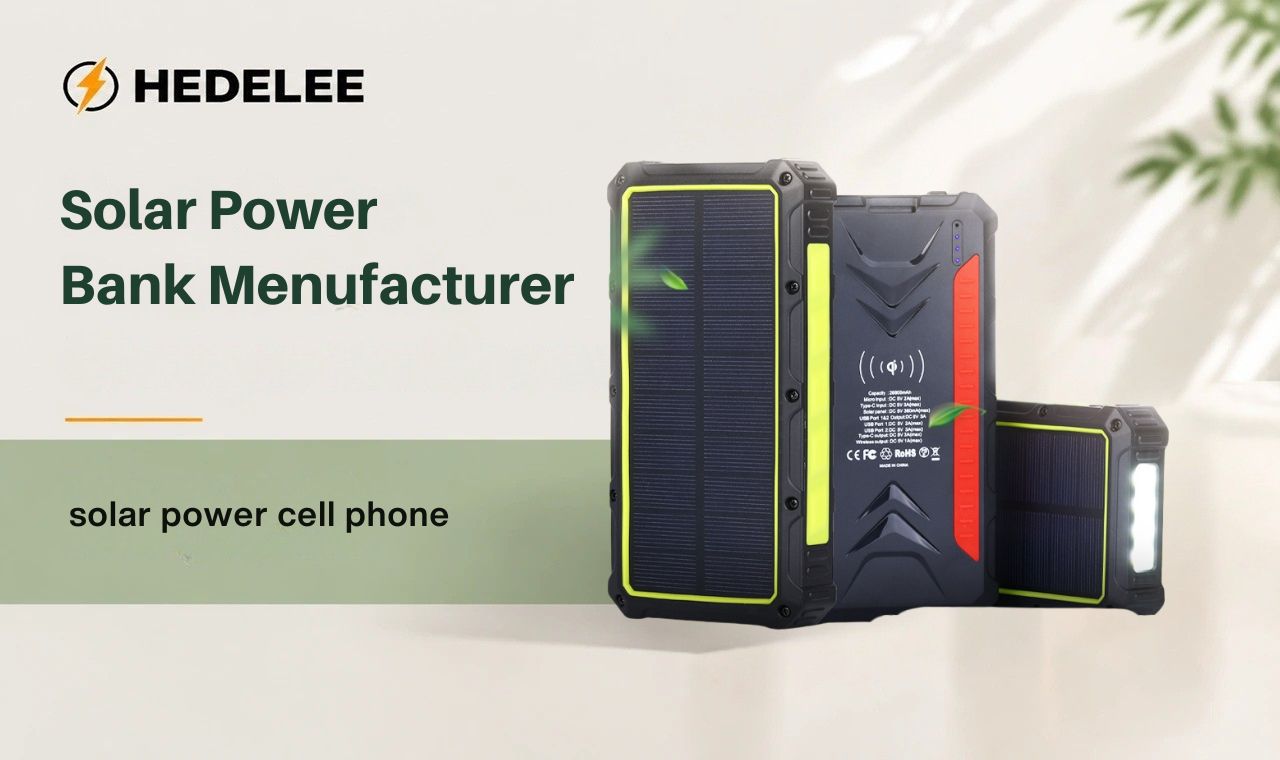
Here’s a complaint many importers know by heart: “The solar panel doesn’t charge my phone.” In most cases, nothing is broken. The customer simply expected wall-socket speed from a panel the size of a playing card.
That gap sits behind almost every return of a solar power cell phone charger. Solar charging does work. But it works slowly, and the speed depends on sun, heat, and panel size. So buyers who know the real numbers can set honest claims, pick better specs, and cut refund rates.
Below, you’ll find realistic output ranges, simple charge-time math, and weather limits. You’ll also get a checklist for cells, panels, waterproof ratings, and shipping documents. Finally, we’ll match solar power bank designs to the sales channels where they perform well.
How Does a Solar Power Cell Phone Charger Work?
Every solar charger starts with photovoltaic (PV) cells. These are thin layers of silicon that make electricity when light hits them. The U.S. Department of Energy gives a clear overview of how solar energy technology works, from a single cell to a full system.
The cells produce a small direct current. Then that current flows into a charge controller, which steadies the voltage and protects the battery. After that, the energy goes one of two ways. It either flows straight into the phone, or it’s stored in a built-in battery for later.
That single design choice splits the market into two product types.
Panel-Only Chargers vs. Solar Power Banks
A panel-only solar phone charger has no battery inside. It powers the phone only while light hits the panel. So when a cloud drifts over, charging slows, stops, or restarts. Some phones also show a warning when the input keeps dropping.
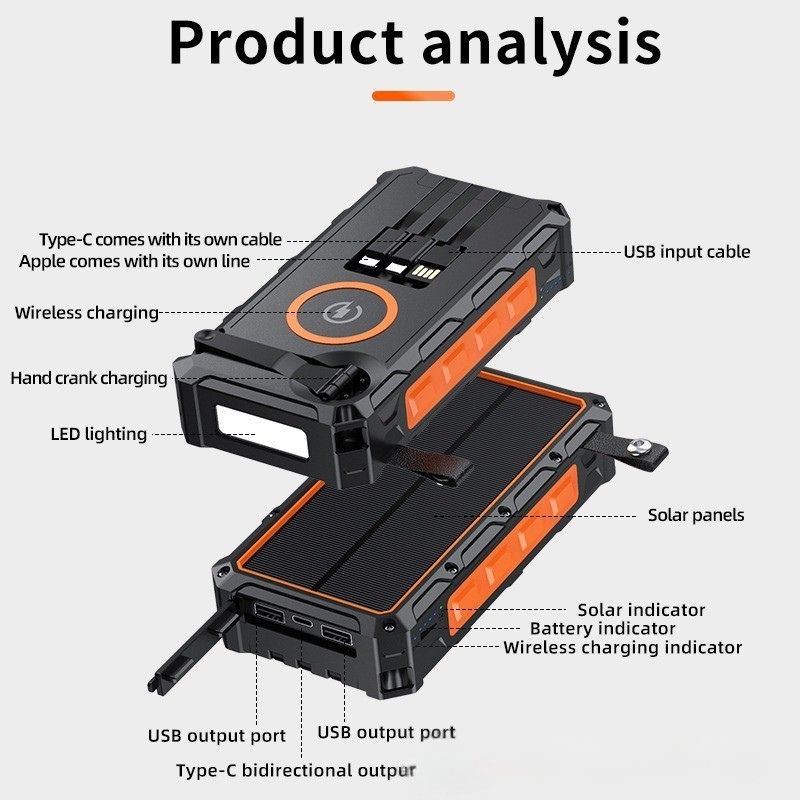
A solar power bank works differently. It’s a battery pack with one or more panels built into the case. The panel tops up the battery over time. Then the battery charges the phone at a steady rate, day or night. Because of that buffer, the phone never feels the sun’s ups and downs.
Think of a solar power bank battery charger as two products in one shell. One part is a normal power bank. The other is a small backup generator. Most of the daily value comes from the battery, while the panel acts as a safety net.
| Feature | Panel-Only Solar Charger | Solar Power Bank |
|---|---|---|
| Built-in battery | No | Yes (often 10,000–42,000mAh) |
| Charges a phone at night | No | Yes |
| Output to the phone | Rises and falls with sunlight | Steady, set by the battery circuit |
| Typical solar wattage | 15–28W folding panels | 1–7W built-in or fold-out panels |
| Main strength | Fast solar input on clear days | Stored power at any time |
| Suits | Long trips with strong sun | Daily carry, travel, emergency kits |
For most retail and gift channels, the solar power bank is the stronger seller. It works like any power bank, and the solar feature adds backup value on top.
Real Charging Speeds: What the Numbers Say
Panel wattage on a label comes from lab testing. Those tests use bright, cool, direct light at the perfect angle. Real days are hotter, hazier, and messier. In field use, panels often deliver around 30–60% of their rated output.
So let’s run the math on a common design.
A built-in panel on a 20,000mAh power bank is usually about the size of a phone. In strong sun, it may produce 1–1.5 watts. Over five good sun hours, that adds up to about 5–7 watt-hours (Wh).
Now compare that with the battery. A 20,000mAh pack stores about 74Wh (20,000mAh × 3.7V ÷ 1,000). So a single built-in panel needs around two weeks of clear days to fill it from empty.
What about the phone itself? Most current smartphones hold roughly 15–19Wh. Therefore, one sunny day on a small panel adds about a quarter to a third of a phone charge. That’s helpful in an outage or on a trail. But it’s not a wall-plug replacement, and marketing should never suggest it is.
Realistic Solar Output by Panel Type
| Panel Setup | Rated Output | Real Output in Full Sun | Energy per Sunny Day (≈5 hrs) | Phone Charges per Day* |
|---|---|---|---|---|
| Single built-in panel | 1.5–2.5W | 0.8–1.5W | 4–7Wh | 0.2–0.35 |
| Fold-out multi-panel (4–5 panels) | 5–7.5W | 2.5–4W | 12–20Wh | 0.6–1 |
| Separate folding panel | 21–28W | 10–16W | 50–80Wh | 2.5–4 |
*Estimates based on a 17Wh phone battery and about 85% transfer efficiency. Weather, angle, and heat will shift real results.
Notice the jump between rows. Solar power bank charging time depends far more on panel area than on battery size. So a fold-out design with four or five panels collects roughly three times the energy of a single built-in panel.
Why Real Output Falls Below the Label
Several everyday factors pull output down:
- Sun angle. A panel lying flat late in the afternoon catches far less light than one tilted toward the sun.
- Heat. Silicon cells lose about 0.3–0.5% of their output for every degree above 25°C. At a panel temperature of 60°C, that’s a 10–18% loss.
- Partial shade. Cells are wired in a chain. So shading one small corner can drag down the whole panel.
- Dirty or hazy surfaces. Dust and fingerprints block light. Cheap PET coatings can also go cloudy after one hot summer.
- Conversion losses. Some energy is lost as heat in the controller, the battery, and the cable.
How Long Does a Solar Phone Charger Take to Fill a Power Bank?
The table below shows rough recharge times from empty. Wall charging is included for comparison.
| Capacity | Stored Energy | Single Built-In Panel (≈5Wh stored per day) | Fold-Out Multi-Panel (≈15Wh stored per day) | Wall Charging at 10W Input |
|---|---|---|---|---|
| 10,000mAh | 37Wh | About 7 sunny days | About 2–3 sunny days | About 4.5 hours |
| 20,000mAh | 74Wh | About 15 sunny days | About 5 sunny days | About 9 hours |
| 30,000mAh | 111Wh | About 22 sunny days | About 7–8 sunny days | About 13 hours |
| 42,000mAh | 155Wh | About 31 sunny days | About 10 sunny days | About 18 hours |
The pattern is hard to miss. The wall fills the battery, while solar keeps it from running dry. Products sold with that message set fair expectations from day one. Plus, USB-C input with fast charging support can cut wall times well below these figures.
Do Solar Phone Chargers Work on Cloudy Days or Indoors?
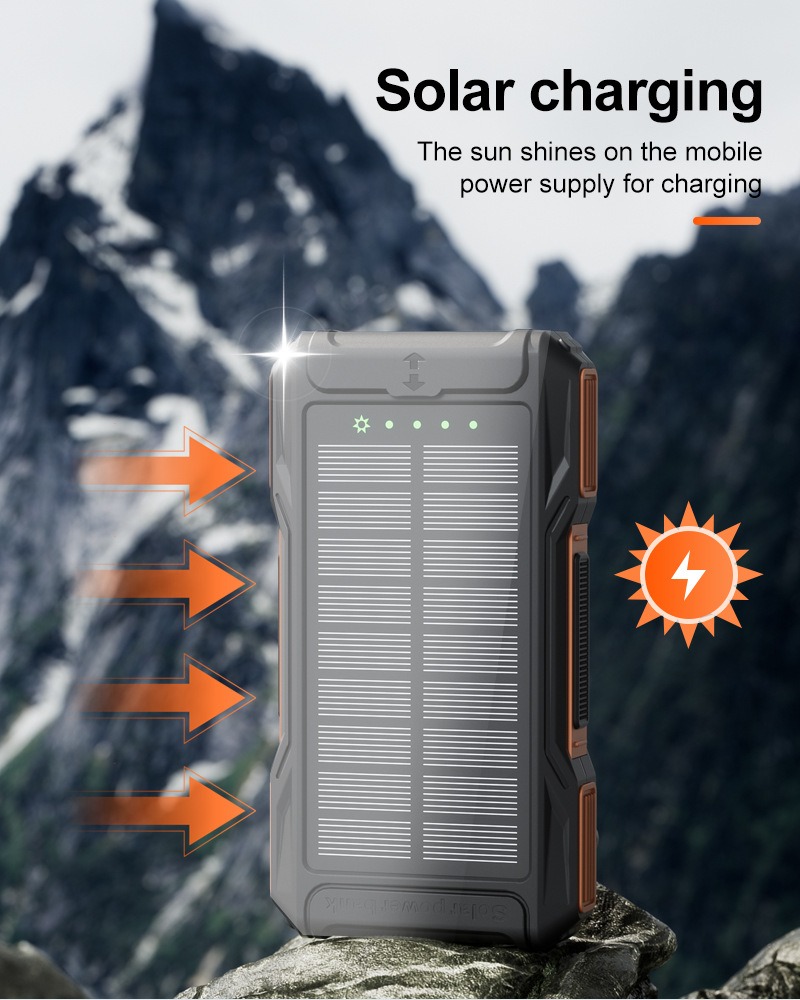
Yes, but only a little. Under thin cloud, a panel may deliver around 10–25% of its peak output. Heavy overcast often pushes output close to zero for practical use.
Indoor use is weaker still. Window glass, low sun angles, and shade all cut the light that reaches the cells. Meanwhile, office lights and desk lamps give off far too little energy for a phone.
There’s also a hidden threshold. Most charge circuits need a minimum voltage before they accept power. If weak light can’t reach that level, the charging indicator may not light at all. Customers then assume the unit is faulty, even though it’s working as designed.
A few plain notes in the user manual prevent most of these complaints:
- Use solar charging outdoors, in direct sun.
- Expect very little on gray days, so charge from the wall before storms or trips.
- Don’t leave the pack on a car dashboard. The heat damages the battery more than the light helps.
Where a Solar Power Cell Phone Charger Makes Sense
A solar power cell phone charger performs well where outlets are scarce and time is flexible. It struggles where users want a fast top-up between meetings. So the useful question for buyers isn’t “Does solar work?” Instead, ask “Does solar fit how my customers live?”
| Use Scenario | Fit | What to Specify |
|---|---|---|
| Multi-day camping and hiking | Strong | 20,000–30,000mAh, fold-out panels, IPX4 or higher |
| Home emergency kits (storms, outages) | Strong | High capacity, flashlight, low self-discharge |
| Field work (farming, surveying, building sites) | Good | IP65 shell, built-in cables, drop resistance |
| Boating and fishing | Good | Higher water rating, bright shell color |
| Festivals and outdoor events | Moderate | Compact 10,000mAh, wireless pad |
| Daily city commute | Weak | Solar adds little; a standard power bank fits better |
| Office or indoor use | Poor | Solar feature goes unused |
Promotional and corporate gift programs form another channel. A solar powered power bank carries a clear eco message and offers a wide print area for logos. In that setting, the panel works as both a feature and a talking point.
There’s also a cost side to weigh. Solar models usually weigh a little more than standard packs of the same capacity. Their panels also add a surface that can scratch in a bag. So in channels where solar adds little, a standard power bank may give you a healthier margin.
Naming also varies by market. Some shoppers search for a solar cell phone charger. Others type “bank power solar” or “solar mobile charger.” The words change, but the question stays the same: will this keep my phone alive without an outlet? Your listing should answer that with real numbers.
What to Check Before Ordering Solar Power Banks in Bulk
Spec sheets can look alike across suppliers. However, the details below separate a product that sells through from one that comes back.
Battery Cells and Honest Capacity
- Ask for the cell type and grade. Lithium-polymer and 18650 lithium-ion cells are both common. Grade A cells hold their capacity longer over hundreds of cycles.
- Know what the label means. Capacity is rated at the cell’s 3.7V. Phones charge at 5V through a converter, which loses some energy. So a 20,000mAh bank usually delivers about 12,000–14,000mAh at 5V. That’s normal, not a defect.
- Test unusual claims. If a pocket-sized unit promises 50,000mAh at a very low price, run a discharge test before you order.
Panel Type, Size, and Coating
- Monocrystalline cells convert more light per square centimeter than polycrystalline cells. On small panels, that extra efficiency shows.
- Surface coating affects lifespan. ETFE layers resist heat and UV better than basic PET films.
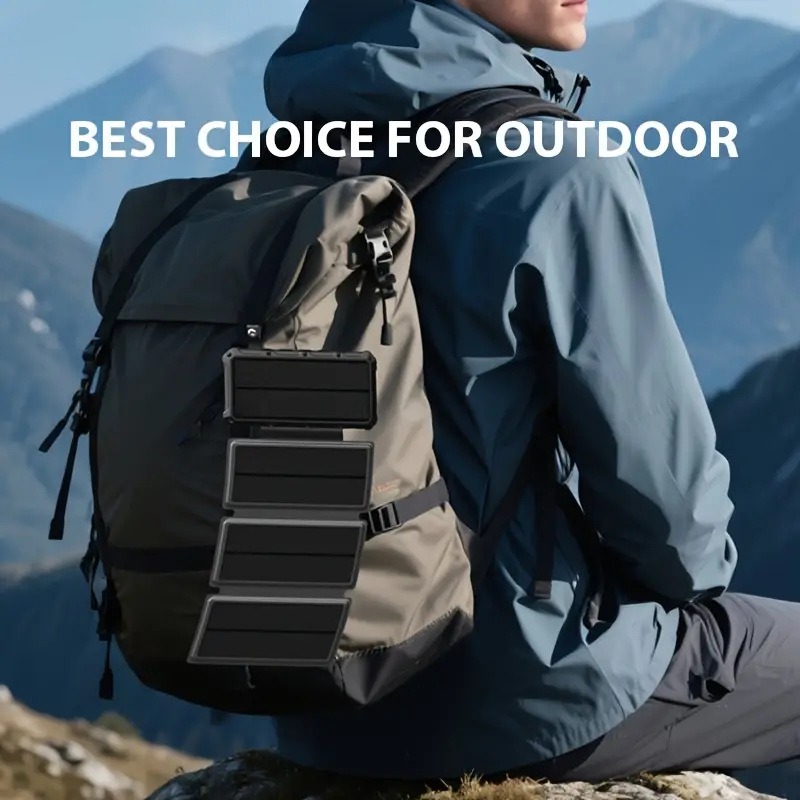
- Panel count sets solar speed. As shown above, a foldable solar power bank with several panels collects about three times more energy than a single-panel unit.
Ports, Fast Charging, and Wireless Output
- USB-C input with Power Delivery (PD) cuts wall charging time sharply.
- Qi wireless pads add convenience. Still, they lose more energy as heat than a cable does.
- Built-in cables (USB-C, Lightning, Micro-USB) reduce “I forgot my cable” moments. They also help in homes with several kinds of devices.
Waterproof Rating
IP codes come from the international standard IEC 60529. The first digit rates dust protection, and the second rates water protection.
| IP Code | Dust Protection | Water Protection | Practical Meaning |
|---|---|---|---|
| IPX4 | Not rated | Splashing from any direction | Rain and splashes |
| IP65 | Dust-tight | Low-pressure water jets | Heavy rain, dusty sites |
| IP67 | Dust-tight | Temporary immersion (1 m, 30 min) | Accidental drops in water |
Product titles often say “waterproof” when the real rating is splash-resistant. So before you list any waterproof solar power bank, match the claim to the test report.
Heat Protection
Solar banks sit in the sun by design. That’s hard on lithium cells, which age faster when hot. So look for temperature sensors that pause charging once the pack gets too warm. Light-colored shells also absorb less heat than black ones.
Certifications, Shipping Documents, and Air Travel
- Market marks: CE, FCC, and RoHS are common. Some markets also require UKCA, PSE, or KC.
- Shipping files: Lithium batteries need a UN38.3 test report and an MSDS for transport.
- Flight limits: Power banks over 100Wh need airline approval. The U.S. TSA allows up to two spare lithium batteries between 101 and 160Wh with that approval.
A 42,000mAh pack holds about 155Wh. So market it for camping, vehicles, and home backup rather than air travel. For travel-focused lines, packs at 26,800mAh or below stay under the 100Wh mark.
How to Test Solar Samples Before You Order
Lab reports help, but a simple field test shows how a sample behaves in real use. A procurement team can run this check in one sunny afternoon.
- Drain the sample to empty. Use the bank until every indicator light goes out. Then let it rest for an hour.
- Place it in full sun near noon. Tilt the panel toward the sun and note the air temperature.
- Charge by solar for four hours. Don’t move the unit or change its angle during the test.
- Measure what went in. Discharge the bank through a USB power meter into a phone or a USB load. Then record the watt-hours delivered.
- Compare with the ranges above. A single built-in panel should return about 2.5–5Wh after four good hours. A fold-out multi-panel design should return about 8–13Wh.
- Check the heat. Touch the shell right after the test. If it’s too hot to hold, ask how the unit protects its cells.
- Run a full wall-charge test. Charge the bank fully from the wall, then discharge it at 5V. A 20,000mAh unit should deliver about 12,000–14,000mAh.
Results far below these ranges point to weak cells, poor panel wiring, or an inflated label. Also, test two or three samples per model, because one unit can be an outlier.
How to Get More From a Solar Mobile Phone Charger
Even a well-built solar mobile phone charger needs good habits. These seven tips work well as a packaging insert or a short card in the box.
- Charge from the wall first. Start every trip with a full battery. Solar should top up, not start from zero.
- Face the panel at the sun. Tilt it until its shadow falls straight behind it. Then adjust it every hour or two.
- Keep it cool. Lay it on a light surface, not on hot sand or a dark dashboard.
- Keep the surface clean. Wipe off dust, sunscreen, and fingerprints before charging.
- Charge the bank by day and the phone by night. That avoids stop-start charging on the phone.
- Cut phone demand. Low-power mode and airplane mode stretch every watt-hour.
- Store it half-charged. For long storage, keep the pack near 50% and top it up every three months.
Printing these tips costs almost nothing. Yet it heads off the most common “it doesn’t work” complaint before it reaches your support team.
Matching Solar Power Bank Models to Your Market
A clear range usually covers three tiers: a compact model, a mid-size all-rounder, and a rugged high-capacity unit. The table below maps our current solar models to the channels where they tend to fit. You can also browse the full solar power bank range to compare photos and specs.
| Model | Capacity | Key Features | Good Fit For |
|---|---|---|---|
| 10,000mAh outdoor solar power bank with wireless charging | 10,000mAh | Wireless pad, fast charging, bright light | Gifts, festivals, entry-level retail |
| 20,000mAh solar power bank with wireless charger and flashlight (HDL-218) | 20,000mAh | Wireless output, dual inputs, waterproof shell, flashlight | General retail, travel stores |
| Waterproof 20,000mAh solar panel power bank with fast charging | 20,000mAh | Waterproof body, fast charging | Outdoor retail, online stores |
| Dual USB 20,000mAh waterproof solar power bank with LED light (HDL519X) | 20,000mAh | Dual USB, waterproof, LED light | Hardware stores, value lines |
| Foldable 20,000mAh outdoor solar charger with LED lights | 20,000mAh | Fold-out solar panels, fast charging, LED lights | Camping, hiking, emergency kits |
| Camping solar charger power bank for outdoor devices (HDL519) | See listing | Portable, outdoor-focused design | Camping and outdoor gear shops |
| 25,000mAh solar charger with dual USB ports | 25,000mAh | Dual USB, waterproof | Field workers, long trips |
| 30,000mAh Qi wireless solar charger with IP65 rating (HDL528) | 30,000mAh | Qi wireless, USB-C input, 5V/3A output, IP65 | Rugged outdoor, marine |
| Wireless solar power bank with three built-in cables (HDL-531) | 24,000mAh standard; larger versions listed | Wireless output, three cables, outdoor build | Travel, family use |
| Solar power bank with 4 built-in cables and dual LED flashlight (HDL529) | 24,000mAh standard; larger versions listed | 4 cables, wireless, dual LED, IPX4 | Multi-device users, emergency kits |
| 42,000mAh solar power bank with 4 built-in cables (HDL-628) | 42,000mAh | 4 cables, wireless, dual LED flashlight | Home backup, vehicles, base camps (not flights) |
For a first order, many buyers start with one model from each tier. Then they reorder based on sell-through. Custom logos, colors, and packaging can be discussed for each model on the list.
Writing Honest Solar Claims for Listings and Packaging
The fastest way to cut returns is to change the words on the box. Solar claims draw the most complaints, so they deserve the most care.
| Risky Claim | Honest Alternative |
|---|---|
| “Charges your phone fully by sunlight” | “Solar backup charging for outdoor use and emergencies” |
| “Never plug in again” | “Charge by USB, then top up with sunlight” |
| “Fast solar charging” | “Fast USB-C charging plus slow solar top-up” |
| “Fully waterproof” (on an IPX4 unit) | “IPX4 splash-resistant” |
| “50,000mAh” with no test data | Rated capacity backed by a test report |
Also, add one line about solar input to the spec sheet. For example: “Solar input: about 1W in direct sun.” That sentence sets expectations before the sale, not after it. Plus, clear claims lower the risk of complaints under consumer protection rules in markets like the EU and the US.
Why Source Directly From a Solar Power Bank Manufacturer
Shenzhen Hedeli Technology Co., Ltd. has worked in mobile accessories and consumer electronics for about ten years. Our mission is simple: give the world well-made, innovative products. Our range covers power banks, TWS earbuds, Bluetooth speakers, USB chargers, USB cables, car chargers, and car phone holders. Solar power banks sit at the heart of our outdoor line.
Here’s how we’re set up:
- Headquarters in Shenzhen, with more than 100 employees.
- Office and showroom in Guangzhou, where buyers can handle samples in person.
- Factory in Dongguan, with a monthly capacity of 50,000 units for on-time supply to importers, distributors, and wholesalers.
Working with the source changes how a project runs. First, there’s no middle layer adding cost or delay. Second, spec changes go straight to the team that builds the product. Third, you can request custom logos, colors, packaging, and user manuals, including clear solar charging guidance that sets fair expectations. Finally, test reports come from the factory that made the goods.
Solar products sell well when the promise matches the performance. So if you’re planning a solar line, tell us your target market, preferred capacities, and expected volumes. Because you’ll be speaking with the original manufacturer, you get factory pricing and realistic lead times. You also get honest answers about what each solar cell phone charger can do. Request a quote or a sample set, and we’ll recommend the models that fit your channel.
Frequently Asked Questions
1. How long does solar take to recharge a power bank?
It takes days, not hours, and panel size sets the pace. A single built-in panel adds roughly a quarter to a third of a phone charge per sunny day. Fold-out multi-panel designs collect about three times more. For full recharges, USB or wall charging stays the main method.
2. What is the minimum order quantity for solar power banks?
MOQ depends on the model and how much customization you need. Standard models with logo printing usually need smaller runs than fully custom designs. Share your target quantity, and we’ll confirm the MOQ for each model.
3. Can you customize logos, colors, and packaging?
Yes. As the original manufacturer, we offer logo printing, custom shell colors, branded packaging, and tailored user manuals. Send your artwork or brand guide, and we’ll prepare a proposal with samples.
4. Which certifications should a solar phone charger have?
Most markets expect CE, FCC, and RoHS, and lithium shipments need a UN38.3 report and an MSDS. Some countries add marks like UKCA, PSE, or KC. Reach out for the current test reports on the exact model you plan to order.
5. Can we test samples before placing a bulk order?
Yes, and we recommend it. Samples let you check real capacity, solar input, and build quality in your own conditions. Contact us to request samples, and we’ll share lead times for both samples and bulk production.