

Solar power for cell phones sounds simple, yet it causes more product returns than almost any other accessory. A customer takes a solar charger camping and leaves it on his tent all afternoon. At night, he plugs in his phone and gets about 20% battery. The next week, he leaves a one-star review that says “doesn’t work.
What Does Solar Power for Cell Phones Actually Mean?
Solar power for cell phones means using light to create electricity that ends up in a phone battery. In practice, that happens in one of two ways.
First, a solar panel can send power straight to the phone. Second, and far more common, a panel charges a built-in battery, and that battery charges the phone later. The second type is what most people call a solar power bank.
The difference sounds small. However, it shapes the whole user experience. Direct charging only works while the sun is out and steady. A battery, by contrast, stores energy during the day so the phone can charge at night, in a tent, or during a blackout.
The Main Types of Solar Phone Chargers
Here’s a simple breakdown of what’s on the market:
| Device type | How it works | Typical use | Main strength | Main limit |
|---|---|---|---|---|
| Solar power bank (single built-in panel) | Small panel on the case tops up an internal battery | Everyday carry, travel, emergency kits | Compact, works like a normal power bank | Slow solar top-up |
| Foldable solar powered power bank | Several fold-out panels plus a battery | Camping, hiking, fieldwork | More panel area, faster solar input | Bulkier and heavier |
| Standalone folding solar panel | Large panel, no battery, USB output | Off-grid trips, base camps | Highest solar output | No storage; needs steady sun |
| Solar phone case | Thin panel built into a phone case | Niche gadget use | Always attached | Very low output |
For most retail and wholesale programs, the first two types make up the bulk of demand. They’re easy to explain and they still work as a regular power bank when the sun isn’t out.
Some shoppers search for odd phrases like “bank power solar” or “solar power bank battery charger.” In nearly every case, they want the same thing: a battery pack with a panel on top that keeps a phone alive away from the wall socket.
How a Solar Power Bank Charges a Phone, Step by Step
The process inside a solar power bank is simple once you break it down. Every model follows roughly the same path:
- Light hits the solar cells. The panel is made of photovoltaic (PV) cells. When sunlight hits them, they produce a small direct current.
- A charge controller manages the input. This chip keeps the voltage steady and protects the battery from overcharging.
- Lithium cells store the energy. Most units use lithium-ion or lithium-polymer cells. This is where the “power bank” part lives.
- A booster raises the voltage. Battery cells sit at about 3.7V, but phones charge at 5V or higher. So a small converter steps the voltage up.
- Power flows to the phone. Energy leaves through a USB-A port, a USB-C port, a built-in cable, or a wireless charging pad.
Each step loses a little energy. That’s normal for every power bank, solar or not. Because of those losses, a 20,000mAh bank won’t deliver 20,000mAh to a phone. We’ll put real numbers on that shortly.
Monocrystalline vs. Polycrystalline Panels
The panel type affects how much power a solar phone charger can collect. Here’s how the two common options compare:
| Panel type | Look | Efficiency | Low-light behavior | Cost |
|---|---|---|---|---|
| Monocrystalline | Uniform dark black cells | Higher | Better in cloudy or angled light | Higher |
| Polycrystalline | Blue, speckled cells | Lower | Weaker in poor light | Lower |
For portable products, monocrystalline panels are the usual choice. The surface area on a power bank is small, so every bit of efficiency helps. If you’re comparing quotes, ask each supplier which panel type they use. It’s a quick way to spot why one sample charges faster than another.
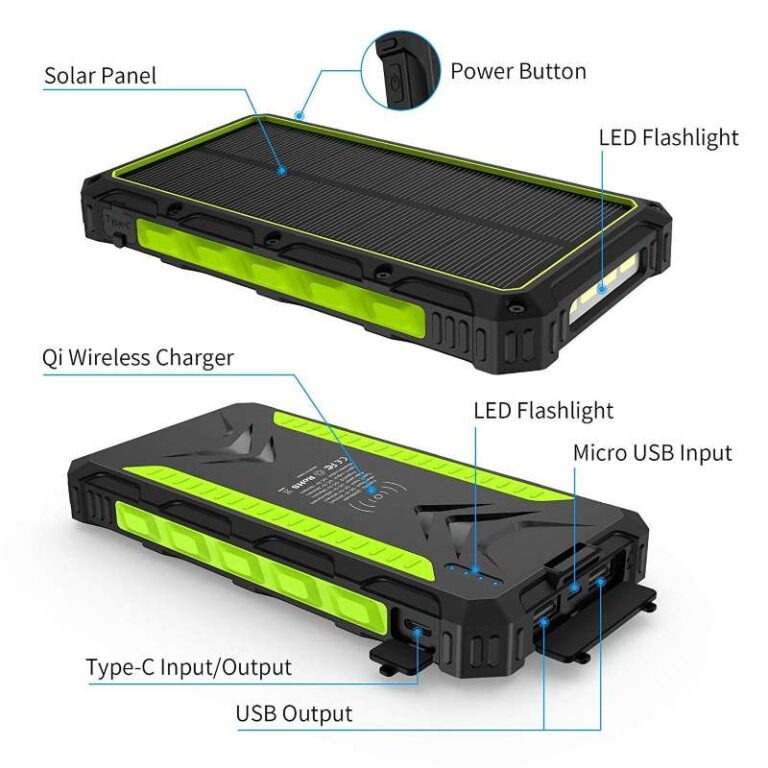
solar power bank how it works diagram
How Long Does Solar Charging Take? Realistic Numbers
This is the question behind most complaints. So let’s answer it with honest math.
First, how many phone charges does each capacity give? Most phones today carry a battery of around 4,000–5,000mAh. After voltage conversion and heat losses, a power bank usually delivers about 60–70% of its rated capacity to the phone.
| Rated capacity | Energy (Wh, at 3.7V) | Phone charges (approx., 4,500mAh phone) | Airline carry-on note |
|---|---|---|---|
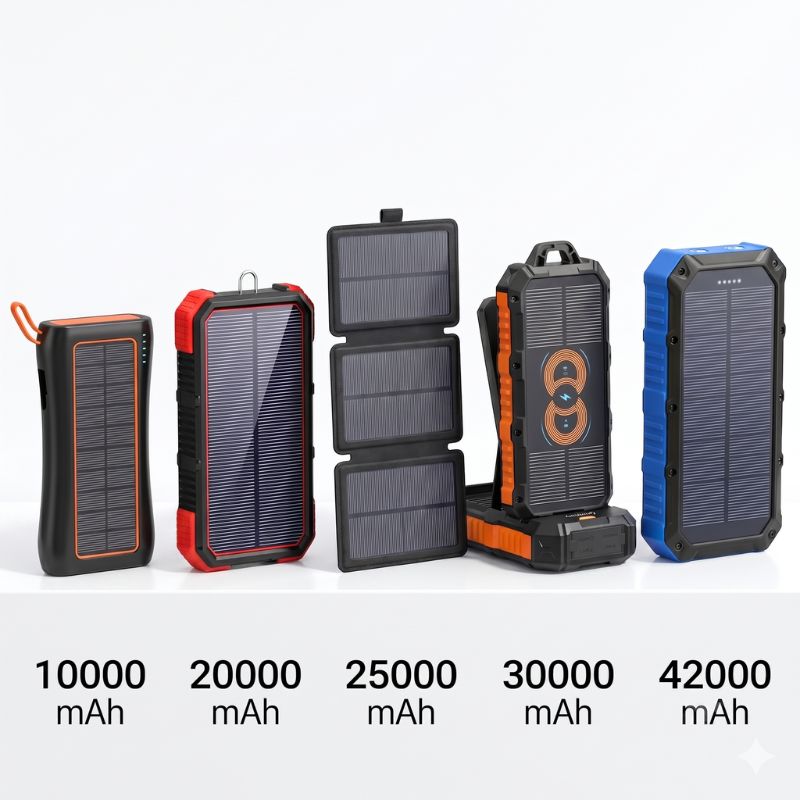
| 10,000mAh | 37Wh | About 1–1.5 | Under 100Wh |
| 20,000mAh | 74Wh | About 2.5–3 | Under 100Wh |
| 25,000mAh | 92.5Wh | About 3–3.5 | Under 100Wh |
| 30,000mAh | 111Wh | About 4 | 100–160Wh range; airline approval usually needed |
| 42,000mAh | 155Wh | About 5.5–6 | 100–160Wh range; airline approval usually needed |
Figures are estimates. Real results depend on phone model, cable, temperature, and cell quality.
How Much Can the Sun Add Per Day?
Now for the solar side. A single panel on a pocket-sized power bank is small. In strong sun, it produces roughly 1–2 watts. A phone wall adapter, by comparison, often runs at 10–20 watts or more.
Here’s what that means across a sunny day with about five hours of good light:
| Solar setup | Typical rated panel output | Energy added per sunny day (est.) | What users can expect |
|---|---|---|---|
| Single built-in panel | About 1.5–2W | About 4–8Wh | Roughly a quarter to half of one phone charge |
| Foldable 3–5 panel power bank | About 4–6W | About 12–20Wh | Roughly half to one phone charge |
| Standalone folding panel (20W+) | 20–28W | About 50–80Wh | Several phone charges, or most of a 20,000mAh bank |
So, can solar alone refill a 20,000mAh bank with one small panel? Yes, but it takes many days of good sun. That’s why the right message for end users is simple: charge it fully from the wall first, then let the sun top it up. Used that way, a solar powered power bank stretches battery life on long trips instead of replacing the wall socket.
For wall charging, a 20,000mAh unit usually takes about 6–10 hours with a standard 5V/2A adapter. Models with fast-charge USB-C input can cut that time a lot.
What Slows Solar Charging Down
Several everyday factors reduce panel output:
- Clouds and shade. Heavy cloud can cut output to a small fraction of full sun.
- Panel angle. A panel lying flat at noon does fine. In the morning or late afternoon, it needs tilting toward the sun.
- Window glass. Charging behind a car or house window loses a good share of the light.
- Heat. Solar cells actually work less well when they get very hot. Lithium cells also dislike high heat.
- Dust and dirt. A dusty panel collects less light. A quick wipe helps.
If your product page or manual covers these points, customer satisfaction usually goes up. People forgive slow charging when they know why it happens.
Where Solar Power for Cell Phones Makes the Most Sense
Solar charging isn’t for every customer. But in the right settings, it solves a real problem. These are the use cases that drive steady demand:
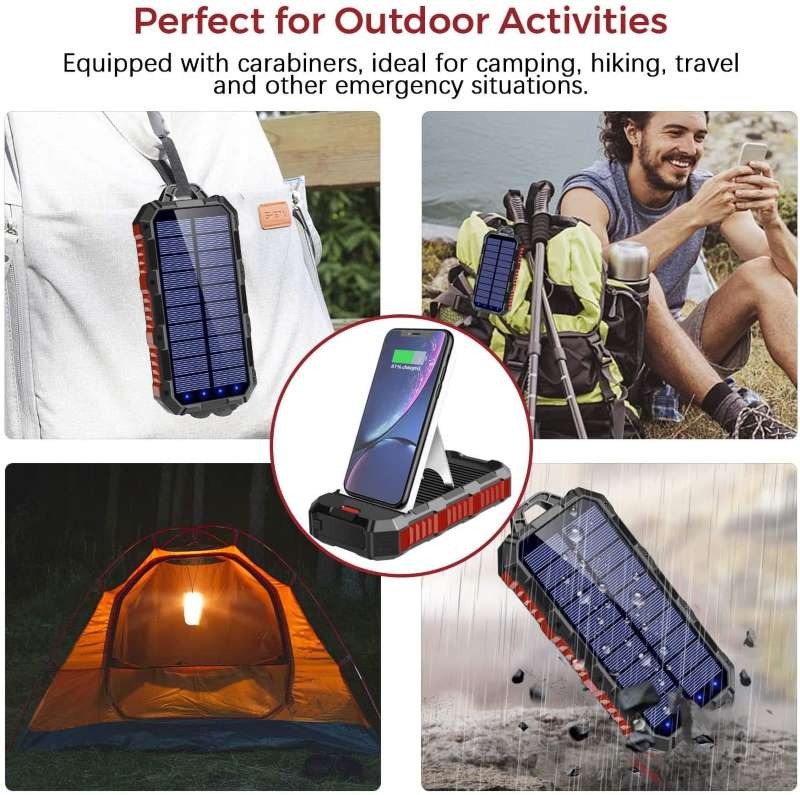
- Camping, hiking, and fishing. Multi-day trips with no outlets are the classic case. Foldable models with flashlights sell well here.
- Emergency and disaster kits. After storms, floods, or earthquakes, the grid can be down for days. A solar phone charger lets people keep calling, texting, and checking alerts.
- Regions with unstable power. In areas with frequent outages or load shedding, solar backup is a daily tool, not a gadget.
- Outdoor work and fieldwork. Survey teams, farm workers, and construction crews often spend full days away from power.
- Festivals and travel. Long days outdoors drain phones fast. A compact solar power bank doubles as a normal travel battery.
- Corporate and promotional gifts. Solar models carry a clear “green” message and print well with a logo.
Why Buyers Keep Adding Solar Lines
There’s also a business angle. Solar power banks often sit at a higher price point than basic power banks. They also fit seasonal pushes, like summer outdoor season or hurricane season prep. So a well-chosen solar line can lift average order value without adding many new SKUs.
Solar Power Bank vs. Regular Power Bank: Which Should You Stock?
Many buyers ask whether they should carry solar models at all, or just stick with standard power banks. The honest answer depends on who your customers are. Here’s a quick comparison:
| Factor | Regular power bank | Solar power bank |
|---|---|---|
| Main charging source | Wall adapter or laptop | Wall adapter, plus sunlight as backup |
| Typical body | Slim plastic or aluminum | Rugged shell, often rubber-sealed |
| Extra features | Fast charging, slim design | Flashlight, water resistance, hanging loops |
| Best customer fit | Commuters, office users, students | Campers, travelers, emergency planners, field crews |
| Price position | Lower to mid | Mid to upper |
| Seasonal demand | Steady all year | Peaks in summer and storm seasons |
In short, regular power banks win on size and price. Solar models win when users spend long stretches away from outlets. Many retailers carry both. They place regular units near phones and laptops, and solar units in outdoor, travel, and emergency sections.
If you’re testing the category for the first time, start small. One mid-size solar power bank and one foldable model are usually enough to measure interest.
Key Features of a Solar Cell Phone Charger Worth Paying For
Not every feature adds value. Some add cost but rarely get used. Here’s how to judge the main specs of a solar cell phone charger.
Battery Capacity
Capacity drives size, weight, price, and shipping rules. As a rough guide:
- 10,000mAh: Light and pocketable. Good for day trips and gifts.
- 20,000–25,000mAh: The sweet spot for most outdoor buyers. Enough for a long weekend.
- 30,000mAh and up: For groups, longer trips, or multiple devices. Heavier, and often over the 100Wh airline line.
Ports and Fast Charging
Look for at least one USB-C port. It’s now the standard on most new phones. Dual USB outputs help users charge two devices at once. A USB-C input also makes wall charging faster and cuts the need for extra cables.
Wireless Charging
Qi wireless charging lets users set the phone on top and go. It’s convenient, though slightly slower and less efficient than a cable. For outdoor users, it also means one less port exposed to dust and water.
Built-In Cables
Models with built-in cables (often Lightning, USB-C, and Micro-USB) solve the “forgot my cable” problem. They’re popular in travel and rental markets.
Waterproof and Dustproof Ratings
Outdoor products face rain, sand, and splashes. Ingress protection (IP) ratings tell you how much protection a unit has:
| Rating | Dust protection | Water protection | Good fit for |
|---|---|---|---|
| IPX4 | Not rated | Splashes from any direction | Light rain, everyday outdoor use |
| IP65 | Dust-tight | Low-pressure water jets | Hiking, camping, worksites |
| IP67 | Dust-tight | Short immersion (up to 1m) | Water sports, very wet conditions |
Be careful with marketing that just says “waterproof.” Ask for the exact IP rating and the test report behind it.
Flashlight and LED Lights
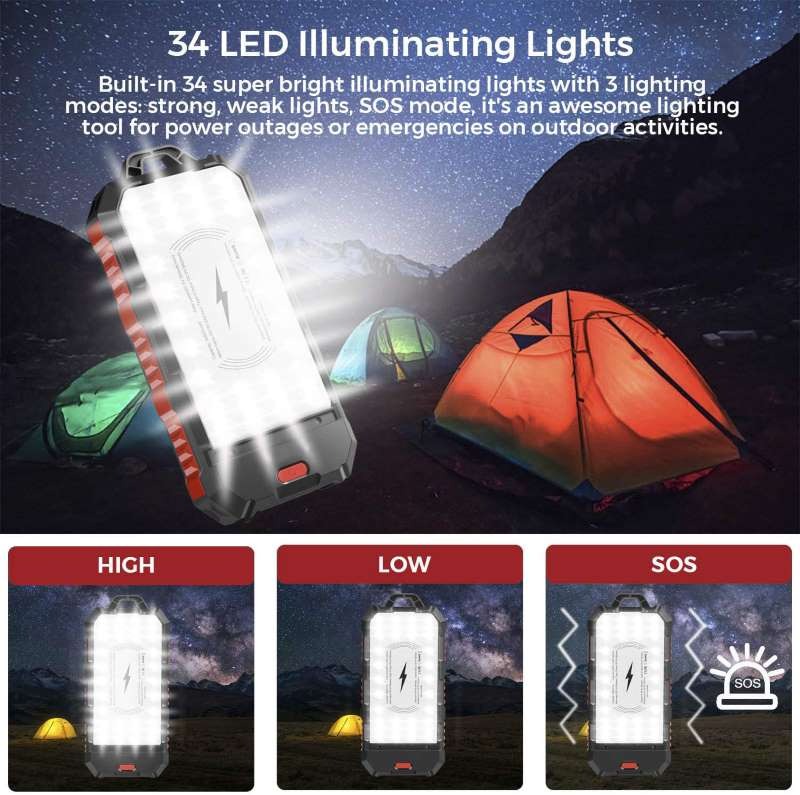
A built-in LED flashlight sounds like an add-on. In practice, it’s one of the most-used features for campers and emergency kits. Dual LEDs or a strong single light add real value at low cost.
Weight, Shell, and Small Details
Spec sheets often skip the things users notice first. So check these during sampling:
- Weight. A 20,000mAh solar unit often weighs around 400–500g. Hikers care about every gram, so list the weight clearly.
- Shell material. Rubberized ABS or silicone edges help the unit survive drops on rocks and pavement.
- Port covers. A tight rubber flap protects the ports from sand and rain. Loose covers are a common reason for early failure.
- Hanging loop or carabiner. It lets users clip the panel to a backpack so it charges while they walk.
- Battery indicator. Clear LED dots or a small digital display tell users how much power is left.
None of these details cost much. However, together they shape whether a product feels cheap or well made in the customer’s hand.
Matching Models to Your Market: A Product Overview
Different customers need different solar power banks. So rather than pushing one model, we group our range by buyer type. You can browse the full solar power bank collection here.
| Buyer focus | Suggested model | Why it fits |
|---|---|---|
| Light travel and gifts | 10000mAh outdoor solar power bank with wireless charging and strong light | Compact, wireless pad, fast charging, bright light |
| Everyday outdoor retail | 20000mAh solar power bank with wireless charging, dual inputs, and flashlight (HDL-218) | Balanced capacity, waterproof body, flashlight |
| Faster solar top-up | Foldable 20000mAh outdoor solar charger with LED lights | Fold-out panels collect more sunlight |
| Budget-friendly waterproof line | Waterproof 20000mAh solar panel power bank | Simple, water-resistant, fast charging |
| Dual-device users | 20000mAh dual USB waterproof solar power bank with LED light (HDL-519X) | Two outputs, LED light, rugged design |
| Camping gear stores | Solar charger power bank for camping gear (HDL-519) | Built for outdoor shelves and kits |
| Longer trips | 25000mAh solar charger with dual USB ports | Extra capacity, still under 100Wh |
| Worksites and wet conditions | 30000mAh solar power bank with Qi wireless, USB-C input, and IP65 rating (HDL-528) | IP65 protection, 5V/3A output, wireless |
| “No cable needed” users | Solar power bank with four built-in cables and dual LED flashlight (HDL-529) | Built-in cables, wireless, IPX4 |
| Group camping and multi-device | High-capacity wireless solar power bank with three cables (HDL-531) | Large capacity options, built-in cables |
| Maximum capacity | 42000mAh solar power bank with four built-in cables and wireless charging (HDL-628) | Most capacity in the range, dual LED flashlight |
A practical tip: start with two or three models that cover different price points. Then expand once you see which one your customers reorder.
7 Checks Before You Order Solar Power Banks in Bulk
Sourcing solar power banks looks easy from a catalog. The problems usually show up after the container lands. These seven checks help you avoid the most common ones.
1. Real Battery Capacity and Cell Grade
Ask what cells are inside and request a capacity test on samples. Some low-cost suppliers label a 10,000mAh pack as 20,000mAh. A simple discharge test will reveal it. Grade A cells also last for more charge cycles, which means fewer returns.
2. Honest Solar Panel Specs
Ask for the panel’s rated wattage and cell type. If a supplier claims a tiny built-in panel can fully charge a 20,000mAh battery in a few hours, treat that as a red flag. Honest specs protect your brand from bad reviews.
3. Certifications for Your Target Market
Most markets require proof of safety and compliance. Common documents for lithium power banks include:
- CE (Europe)
- FCC (United States)
- RoHS (restricted hazardous substances)
- UN38.3 (lithium battery transport test)
- MSDS / SDS (safety data sheet for shipping)
Confirm which ones your importer, retailer, or online marketplace needs before production starts. Adding them later costs time.
4. Shipping Classification
Power banks count as dangerous goods for transport. They usually ship under UN 3480 as lithium-ion batteries. Air freight has strict packing, labeling, and charge-level rules. The IATA lithium battery shipping guidance is the main reference forwarders use. Sea freight is common for bulk orders and often costs less.
5. Airline Rules for Your End Users
Your customers will carry these products on planes. Power banks must travel in carry-on bags, not checked luggage. Units up to 100Wh are generally allowed. Units from 100Wh to 160Wh usually need airline approval. In 2026, ICAO also introduced new power bank rules for air passengers, so it’s wise to print the Wh rating clearly on every unit.
6. Customization and Packaging
Ask early about logo printing, custom colors, retail boxes, and multi-language manuals. These options affect lead time and MOQ. A clear manual that explains solar charging times also cuts support tickets.
7. Factory Capacity and Quality Control
Find out if you’re dealing with a trading company or the actual factory. Then ask about monthly output, incoming cell inspection, aging tests, and final checks. A factory with steady capacity can handle reorders during peak season without long delays.
How to Get More From a Solar Mobile Phone Charger: User Tips
Many returns come from simple misuse. Sharing these tips in your manual, product page, or packaging insert helps end users get good results from any solar mobile phone charger.
- Charge from the wall before the trip. Start with a full battery. Treat solar as a top-up, not the main source.
- Face the panel at the sun. Tilt it to meet the light directly. Adjust it every hour or two if you can.
- Charge during peak hours. Light is strongest from about 10am to 3pm.
- Keep the phone in the shade. Let the panel sit in the sun, but keep the phone and cable cool.
- Avoid charging behind glass. Car and house windows block part of the light.
- Don’t leave it on a hot dashboard. High heat shortens lithium battery life.
- Keep the panel clean. Wipe off dust, sand, and fingerprints with a soft cloth.
- Use it every few months. If stored long-term, recharge it to about half every few months to protect the cells.
These tips also give your sales team easy talking points. When a customer asks “Does it work?”, the honest answer is “Yes, and here’s how to use it well.”
Working Directly With a Solar Power Bank Manufacturer
Everything above comes back to one point. Solar power banks succeed when the specs are honest, the cells are good, and the paperwork is in order. That’s much easier when you work with the factory that builds them.
Shenzhen Hedeli Technology Co., Ltd. has spent about 10 years in mobile accessories and consumer electronics. Our team of more than 100 people works from our headquarters in Shenzhen, with an office and showroom in Guangzhou. Our factory in Dongguan produces around 50,000 units a month. That capacity lets us supply importers, distributors, and wholesalers on time, including during busy seasons.
Beyond solar power banks, we also make standard power banks, TWS earbuds, Bluetooth speakers, USB chargers, USB cables, car chargers, and car phone holders. So you can build a full accessories line with one production partner.
Because we’re the original manufacturer, you deal directly with the people who choose the cells, test the panels, and pack your orders. There’s no middleman adding cost or slowing down answers. Tell us your target market, capacity range, and branding needs, and we’ll recommend models, share test reports, and send a detailed quote. Send your inquiry now, and let’s build a solar line your customers will trust.
Frequently Asked Questions
1. What is the minimum order quantity for solar power banks?
MOQ depends on the model and how much customization you need. Standard models usually start lower than fully custom designs. Share your target quantity and we’ll confirm the options for each model.
2. Can you add our logo and custom packaging?
Yes. We offer logo printing, custom colors, retail boxes, and branded manuals. Send your artwork and packaging ideas, and we’ll advise on lead time and cost.
3. Which certifications do your solar power banks have?
Common documents include CE, FCC, RoHS, UN38.3, and MSDS, depending on the model. Tell us your target market, and we’ll confirm which reports apply. Reach out for detailed specifications.
4. How long does a solar phone charger take to charge?
From the wall, a 20,000mAh unit takes about 6–10 hours with a standard adapter. From sunlight alone, a single built-in panel adds a fraction of a phone charge per day. Foldable panels charge noticeably faster.
5. Can we get samples before placing a bulk order?
Yes, we can arrange samples so you can test capacity, solar input, and build quality. Contact us to request samples and a quote.