

A camper leaves a solar energy power bank on a tent roof all afternoon. By evening, the battery gauge has barely moved. Then the one-star review arrives: “The solar panel doesn’t work.”
In most cases, the panel works fine. The expectation was wrong.
For buyers, product managers, and wholesale teams, that gap between promise and physics drives returns and support tickets. So below, we explain how much energy a built-in panel really adds. We also show how to read capacity in watt-hours and how to choose specs that fit real outdoor use. Along the way, you’ll find sizing tables, a five-point spec check, and model examples from our own factory line.
What Is a Solar Energy Power Bank, and What Does the Panel Actually Do?
A solar energy power bank is a portable lithium battery pack with a small solar panel built into its case. It stores energy from a wall charger, a laptop port, or sunlight. Then it releases that energy to phones, earbuds, headlamps, and other USB devices.
The main point is simple. The battery does the heavy lifting. The panel is a backup input, not the main one.
A panel on a phone-sized pack has a small surface. So it collects a small amount of power, often around one to two watts in good sun. That is enough to slow the drain or add a modest top-up. However, it is not enough to refill a large pack in one day.
Shoppers describe this product in many ways. Some search for a solar phone charger or a solar cell phone charger. Others type the reversed phrase “bank power solar.” They all mean the same basic device. Still, the words on the box shape what customers expect, so the wording deserves care.
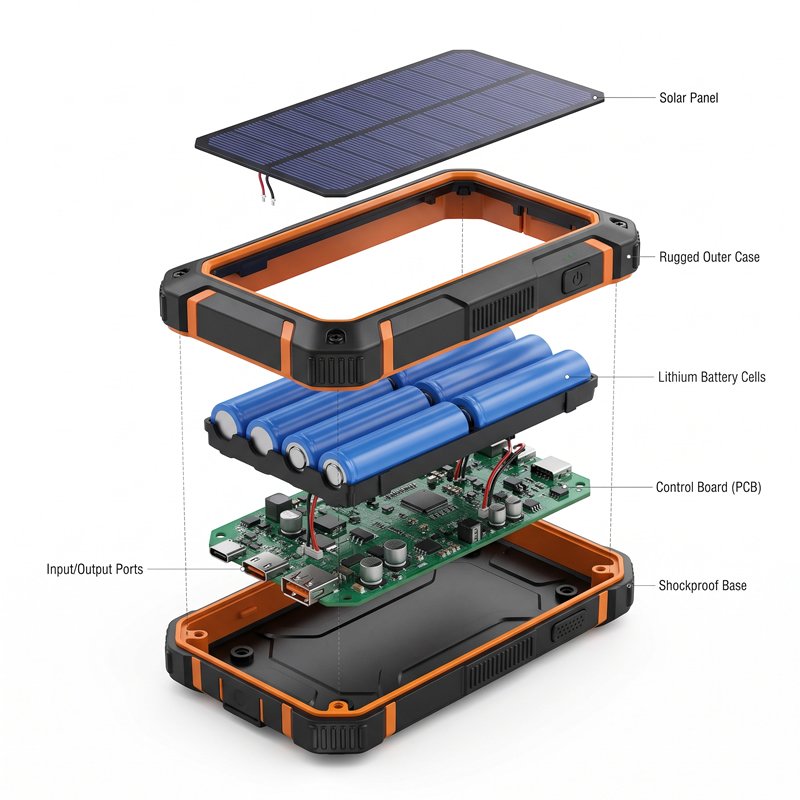
Here is how the main parts work together:
- Battery cells store the energy. Most packs use lithium-ion or lithium-polymer cells.
- Charge controller manages input from USB or the panel. It also protects the cells.
- Solar panel converts light into a small DC current.
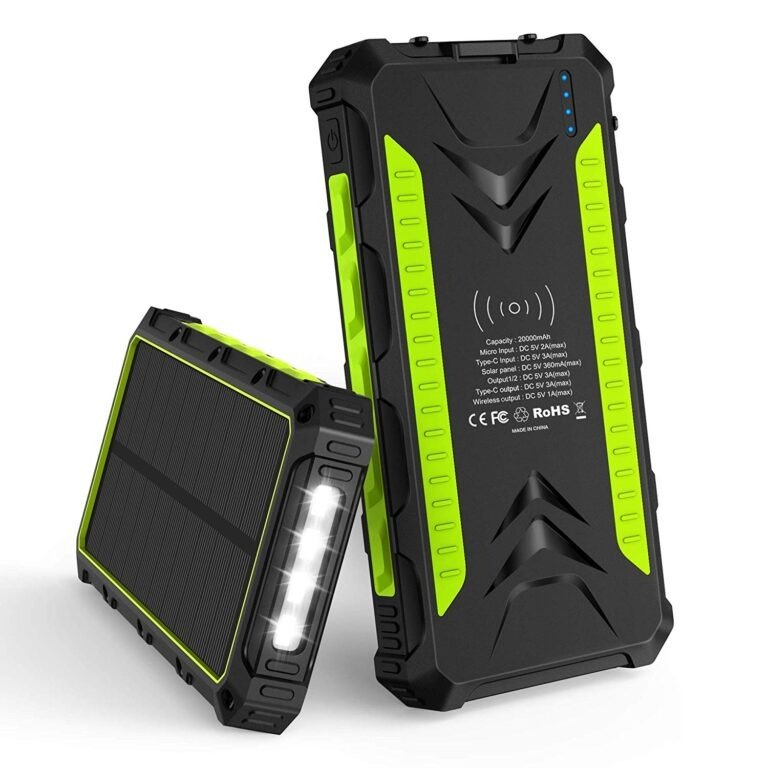
- Output ports deliver power through USB-A, USB-C, built-in cables, or a wireless pad.
- Outdoor extras include LED flashlights, rubber port covers, and hanging hooks.
When your listing explains this split clearly, customers judge the product fairly. Because of that, fewer of them blame the panel for a slow charge.
Start With Energy: How to Read mAh and Watt-Hours
Most listings lead with milliamp-hours (mAh). That number helps, but it can mislead. A more honest measure is watt-hours (Wh), because it shows the real energy stored.
The conversion is easy. First, divide mAh by 1,000 to get amp-hours. Then multiply by the cell’s nominal voltage, which is usually 3.7V.
Formula: Wh = (mAh ÷ 1,000) × 3.7
So a 20,000mAh pack stores about 74Wh. Not all of that reaches the phone, though. Voltage conversion and heat take a share. A common working estimate is that 60% to 70% of rated energy arrives at the device.
| Rated capacity | Stored energy (approx.) | Usable at device (approx. 65%) | Typical phone charges* |
|---|---|---|---|
| 10,000mAh | 37Wh | 24Wh | 1.5–2 |
| 20,000mAh | 74Wh | 48Wh | 3–4 |
| 25,000mAh | 92.5Wh | 60Wh | 4–5 |
| 30,000mAh | 111Wh | 72Wh | 5–6 |
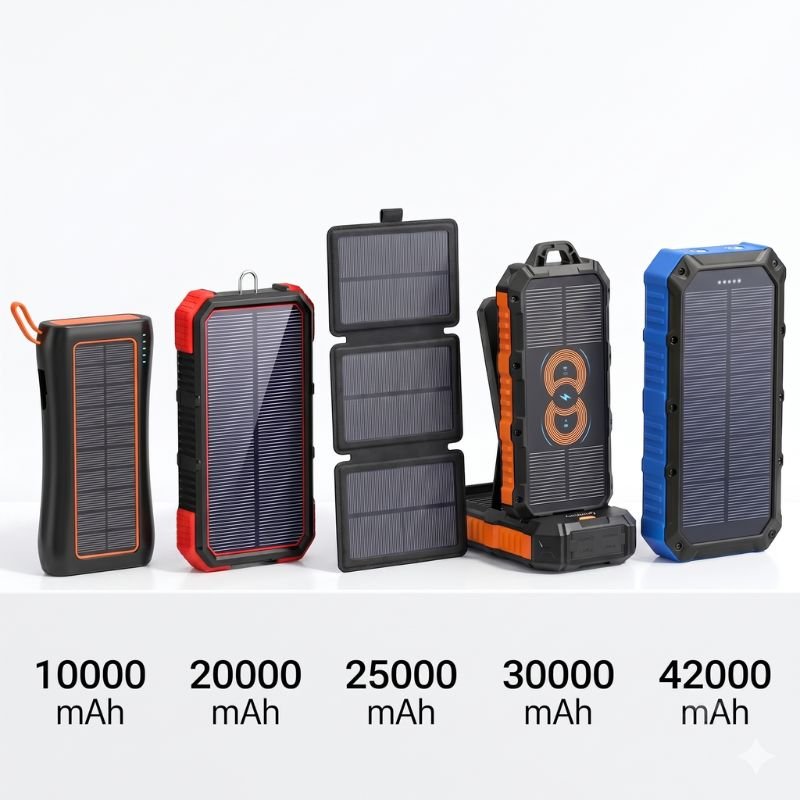
| 42,000mAh | 155Wh | 101Wh | 7–8 |
*Based on a phone battery of about 12–15Wh. Results vary by device and cable.
Watt-hours also affect travel and shipping. Under common airline rules, packs up to 100Wh can go in carry-on bags. Packs between 100Wh and 160Wh usually need airline approval. Spare power banks are generally not allowed in checked luggage. So a 30,000mAh or 42,000mAh model needs a clear Wh label on the case and the box.
For importers, this has a practical side too. Clear Wh marking speeds up customs checks and reduces questions from freight forwarders.
Why Rated Panel Watts Are Not Field Watts
Every solar panel rating comes from a lab. The industry calls these Standard Test Conditions. They assume 1,000 watts of sunlight per square meter and a cell temperature of 25°C. You can read how test labs define these standard reporting conditions at the U.S. National Renewable Energy Laboratory.
Outdoors, those conditions are rare. Several everyday factors pull output down:
- Sun angle. A pack lying flat at 9 a.m. catches far less light than one tilted toward noon sun.
- Clouds and haze. Even thin cloud cover cuts input sharply.
- Shade. A branch shadow across part of the panel can drop output to near zero.
- Heat. Solar cells lose efficiency as they warm up, and a dark case gets hot fast.
- Dirt and scratches. Dust, sunscreen, and fingerprints block light.
- Storage habits. A pack inside a backpack collects nothing at all.
Now let’s run the numbers. Say a built-in panel averages 1W for five good sun-hours. That gives 5Wh of input. After charging losses, perhaps 4Wh reaches the cells. On a 74Wh pack, that is only about 5% of a full charge.
At that rate, a full refill would take at least 74 effective sun-hours. In practice, losses push that figure even higher.
Here is what four hours outdoors can look like. These figures are illustrative, with 80% storage efficiency assumed.
| Four-hour scenario | Average panel input | Energy in | Energy stored | Share of a 74Wh pack |
|---|---|---|---|---|
| Good angle, clear sky | 2W | 8Wh | 6.4Wh | about 9% |
| Light cloud | 1W | 4Wh | 3.2Wh | about 4% |
| Partial shade | 0.5W | 2Wh | 1.6Wh | about 2% |
| Panel covered or in a bag | 0W | 0Wh | 0Wh | 0% |
The lesson for product teams is clear. Sell the panel as a reserve feature, not as a primary charger. Then the reviews tend to follow reality instead of fighting it.
When Does a Solar Power Bank Battery Charger Earn Its Place?
None of this means the panel is useless. In the right setting, a solar power bank battery charger adds real value. The trick is matching the product to the use.
Here are the settings where a built-in panel works well:
- Emergency kits. During a power cut, a few extra watt-hours can keep a phone alive for calls and texts.
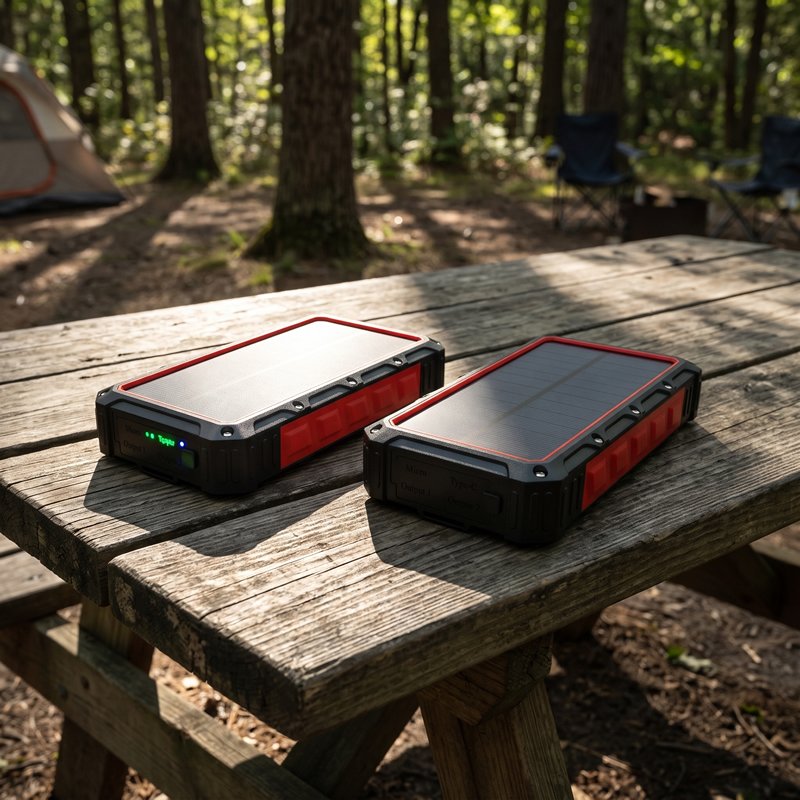
- Day hikes and fishing trips. Users charge at home, then the panel slows the drain during the day.
- Festivals and outdoor events. The pack sits in the sun between uses, adding small top-ups.
- Job sites and field work. Workers clip the pack to a bag, and the flashlight helps after dark.
- Regions with unstable power. A slow solar trickle is still better than no input at all.
Now the settings where it falls short:
- Multi-day trips with heavy use. Daily demand outpaces what a small panel can collect.
- Cold climates. Short days and low sun reduce input, and cold slows battery charging.
- Users who expect a full recharge from sunlight alone. This group generates most complaints.
For retail and e-commerce buyers, this list helps with copy. Write “emergency solar backup” rather than “unlimited solar power.” The first phrase sets a fair promise. Fair promises keep return rates low.
Here are a few common listing claims, with safer wording that still sells:
| Risky claim | Why it causes returns | Safer wording |
|---|---|---|
| “Charges fully from the sun” | A small panel needs days of sun for a full refill | “Solar backup for emergency top-ups” |
| “Unlimited outdoor power” | Daily use outpaces panel input | “Extra reserve power outdoors” |
| “Waterproof” with no rating | Users drop it in water and it fails | “IP65 water and dust resistant” |
| “40,000mAh” with no Wh figure | Users expect more charges than they get | “40,000mAh / 148Wh, about 6–7 phone charges” |
Each row swaps a vague promise for a number or a fair limit. In our experience, customers accept limits when they see them up front. What they reject is surprise.
Built-In Panel vs. Fold-Out Panel vs. Wall Charging
Customers can add energy to a pack in three main ways. Each one suits a different situation. The table below compares them side by side.
| Charging method | Typical real input | Time to add about 20Wh | Best for | Main limit |
|---|---|---|---|---|
| Wall charger (USB-C, 18W or more) | 15–20W | about 1.5–2 hours | Daily charging before a trip | Needs a power outlet |
| Built-in solar panel | 1–2W | about 12–25 sun-hours | Emergency reserve, light top-ups | Very slow, weather dependent |
| Fold-out solar panels | 5–15W | about 2–5 sun-hours | Camping and multi-day trips | costs more |
As the table shows, wall charging stays the main input for almost every user. That is why fast USB-C input deserves as much attention as the panel itself.
Fold-out designs sit in the middle. Extra panels unfold like a book and multiply the surface area. For example, our foldable 20,000mAh outdoor solar power bank with LED lights uses this approach. Our HDL-531 multi-panel solar charger with wireless output also adds panel area for users who spend whole days outside.
If your customers pair a pack with a separate fold-out panel, check compatibility first. The bank must accept the panel’s voltage and current on its input port. A 5V USB panel works with most packs. A 12V or 18V panel, however, may need a pack built for higher input. Mismatched pairs charge slowly or not at all, and buyers often blame the battery. So list the supported input range clearly on the product page and in the manual.
Still, more panels add weight and cost. So the choice depends on the end user. A city commuter needs a slim pack. A trekker may accept extra grams for faster solar input.
How to Size a Solar Energy Power Bank for Real Trips
Sizing starts with demand, not with the biggest number on a spec sheet. A short energy budget gives you a defensible answer. It also gives your sales team a clear story for each model.
Follow these five steps:
- List the devices. Include phones, earbuds, headlamps, and small cameras.
- Estimate daily Wh per device. A typical phone uses about 10–15Wh per full charge.
- Multiply by trip length. A two-day trip doubles the daily figure.
- Add a reserve. A 20% to 30% buffer covers cold weather and heavy use.
- Convert to rated capacity. Divide the total by about 0.65 to cover conversion losses.
Here is a worked example. A hiker uses a phone at 12Wh per day and a headlamp at 3Wh per day. That makes 15Wh daily. Over two days, the need is 30Wh. With a 25% reserve, it rises to 37.5Wh. After dividing by 0.65, the hiker needs about 58Wh of rated capacity.
A 10,000mAh pack stores only 37Wh, so it falls short. A 20,000mAh pack at 74Wh covers the trip with room to spare.
| User profile | Daily need | Days without an outlet | Suggested capacity |
|---|---|---|---|
| Commuter or emergency kit | 10–15Wh | 1 | 10,000mAh |
| Weekend hiker | 15Wh | 2 | 20,000mAh |
| Camper with phone and camera | 25Wh | 2–3 | 25,000–30,000mAh |
| Group or long trip | 40Wh or more | 3+ | 42,000mAh, plus fold-out panels |
Remember one more point. Solar input can stretch a trip, but it should not be part of the base math. Treat any solar gain as a bonus. That keeps the advice honest and the customer satisfied.
Climate also changes the answer. In cold weather, lithium cells deliver less of their stored energy. Phones also drain faster in the cold. So for winter or high-altitude markets, move one size up from the table. In hot, sunny markets, the panel collects more. Even so, heat stress on the battery rises, so the same sizing rules still apply.
A Five-Point Spec Check Before You Place an Order
Spec sheets in this category vary a lot. Some list honest numbers. Others print the cell total and hope nobody asks. Use these five checks to compare suppliers on equal terms.
1. Wh rating and panel rating are both printed
Ask for the Wh figure next to the mAh figure. Also ask for the panel’s rated watts and the test conditions behind it. If a supplier cannot give both, treat the listing with caution.
2. USB-C input is fast enough for daily use
Because wall charging does most of the work, input speed shapes the user experience. A large pack with slow 5V/2A input can take a full night to refill. Look for USB-C input at 5V/3A or higher, and dual inputs where possible.
3. Solar charging shows a clear indicator
Users need to see that the panel is working. A small LED that lights up under sunlight cuts support questions. Without it, customers assume the panel is dead.
4. Water resistance comes from a real IP rating
“Waterproof” on a box is not a spec. Instead, look for an IP code tested to IEC 60529. Here is a quick guide:
| IP rating | What it means in plain terms | Good fit for |
|---|---|---|
| IPX4 | Resists splashes from any direction | Light rain, sweaty pockets |
| IP65 | Dust-tight and resists low-pressure water jets | Hiking, job sites, beaches |
| IP67 | Dust-tight and survives brief immersion | Boating, kayaking, heavy rain |
Also check the port covers. A rubber flap that does not seal well undoes the rating in daily use.
5. Heat and battery safety are documented
Charging in direct sun warms the battery. Lithium cells usually charge safely only within a set range, often about 0°C to 45°C. So ask how the charge controller handles heat, and add a warning not to leave the pack in a hot car.
For shipping, every lithium pack must pass the UN 38.3 transport tests. Ask for the test summary for each model. Transport Canada’s research on substandard lithium-ion batteries under UN 38.3 testing shows why this document deserves a close look. Depending on your market, you may also need CE, FCC, RoHS, or similar reports.
How to Test a Solar Phone Charger Before You List It
Spec sheets give you a starting point. Your own field test gives you the truth. A simple test also produces real numbers for your product page, which buyers and customers both trust.
You don’t need a lab. A USB power meter, a notebook, and a few sunny days are enough. Here is a method our engineers suggest to distributors:
- Drain the pack to a known level. Run it down to about 20%, so the reading is easy to compare.
- Place it in open sun. Tilt the panel toward the sun instead of laying it flat.
- Log the conditions. Note the time, weather, panel angle, and air temperature.
- Check the level every hour. Record the battery gauge or the meter reading.
- Repeat in different weather. Test once in clear sun, once in light cloud, and once in partial shade.
- Compare with wall charging. Time a full USB-C charge for a baseline.
After three or four sessions, you’ll have a realistic range for daily solar gain. Use that range in your listing, your training notes, and your support replies.
This kind of test also helps you compare suppliers. Two packs with the same printed panel rating can perform very differently. Panel quality, cell quality, and the charge controller all play a part. So a side-by-side test before your first bulk order is time well spent.
One caution applies to every test. Do not leave a pack in strong sun for hours once it feels hot to the touch. Move it into light shade, let it cool, and then continue. Heat shortens battery life even when nothing looks wrong.
Matching Our Solar Powered Power Bank Range to Your Market
Once you know the use case and the spec checks, model selection gets easier. Our solar powered power bank line covers compact emergency units up to high-capacity camping packs. You can browse the full solar power bank product category or start with the models below.
| Model | Capacity (approx. Wh) | Notable features | Typical market fit |
|---|---|---|---|
| 10,000mAh outdoor solar power bank with wireless charging | 37Wh | Wireless pad, fast charging, strong light | Gift sets, emergency kits |
| HDL-218 20,000mAh solar power bank with wireless charger | 74Wh | Dual inputs, waterproof body, flashlight | Outdoor retail |
| HDL519X 20,000mAh waterproof solar battery charger | 74Wh | Dual USB, LED light | Camping and hardware stores |
| HDL519 solar charger for camping gear | — | Outdoor-ready body | Camping gear distributors |
| Waterproof 20,000mAh fast-charging solar power bank | 74Wh | Fast charging, waterproof design | E-commerce bestseller lines |
| 25,000mAh solar charger with dual USB ports | 92.5Wh | Dual USB, waterproof, stays under 100Wh | Travel and outdoor shops |
| HDL528 30,000mAh Qi wireless solar power bank, IP65 | 111Wh | Qi wireless, USB-C input, 5V/3A output, IP65 | Hiking and job-site markets |
| HDL529 solar battery pack with four built-in cables, IPX4 | 89Wh (24,000mAh standard) | Four cables, wireless pad, dual LED flashlight | Convenience and gift retail |
| HDL-628 42,000mAh solar power bank with four cables | 155Wh | Four cables, wireless pad, dual LED flashlight | Group camping, off-grid users |
A few patterns stand out. Built-in cables suit buyers who sell to travelers, because users never forget a cord. Wireless pads appeal to younger phone owners. Meanwhile, models under 100Wh are easier to market as flight-friendly.
If your customers mainly want a solar mobile phone charger for emergencies, a 10,000mAh or 20,000mAh model usually fits. For campers and field workers, the 30,000mAh and 42,000mAh packs make more sense, ideally paired with fold-out panels.
Why Sourcing Directly From the Manufacturer Pays Off
Everything above comes back to one idea. Honest specs build trust, and trust keeps reorders coming. That is easier when you work with the people who build the product.
Shenzhen Hedeli Technology Co., Ltd. has worked in mobile accessories and consumer electronics for about 10 years. Our team of more than 100 people covers design, production, and quality control. We run our headquarters in Shenzhen, and we keep an office and showroom in Guangzhou. Our Dongguan factory produces up to 50,000 units per month. So importers, distributors, and wholesalers receive stock on schedule.
Beyond solar models, our range also includes power banks, TWS earbuds, Bluetooth speakers, USB chargers, cables, car chargers, and car phone holders. That breadth helps when you want to build a full accessory line from one source.
Working with us directly gives you:
- Clear spec labeling. We print Wh, input, and output ratings that match test results.
- Custom options. Logo printing, color changes, and retail packaging fit your brand.
- Shipping documents. Test summaries and safety files come from the source, not a middleman.
- Faster answers. Our engineers reply to technical questions without a trading layer in between.
As the original manufacturer, we give you direct access to the factory, the engineers, and the test data. Tell us your target market, preferred capacity, and expected order quantity. We’ll recommend suitable models, share detailed specifications, and prepare a quote with sample options. Send your inquiry, and let’s build a solar line your customers will trust.
Frequently Asked Questions
1. What is the minimum order quantity for solar power banks?
MOQ depends on the model and how much you customize it. Standard models usually start lower than fully custom builds. Contact us with your target models to get exact MOQ figures.
2. Can you print our logo and design custom packaging?
Yes. We offer logo printing, color options, and custom retail packaging. Share your artwork and market details, and we’ll confirm options for each model.
3. Which test reports come with your solar energy power bank models?
Every lithium pack needs a UN 38.3 test summary for transport. Depending on your market, CE, FCC, or RoHS reports may also apply. Reach out for the documents available for each model.
4. How long does production take after samples are approved?
Lead time depends on order size and customization level. Our Dongguan factory produces up to 50,000 units per month, which supports steady delivery. Ask us for a schedule based on your quantity.
5. Can we test samples before placing a bulk order?
Yes. We supply samples so you can check capacity, solar input, and build quality yourself. Contact us to request samples of the models you’re considering.