

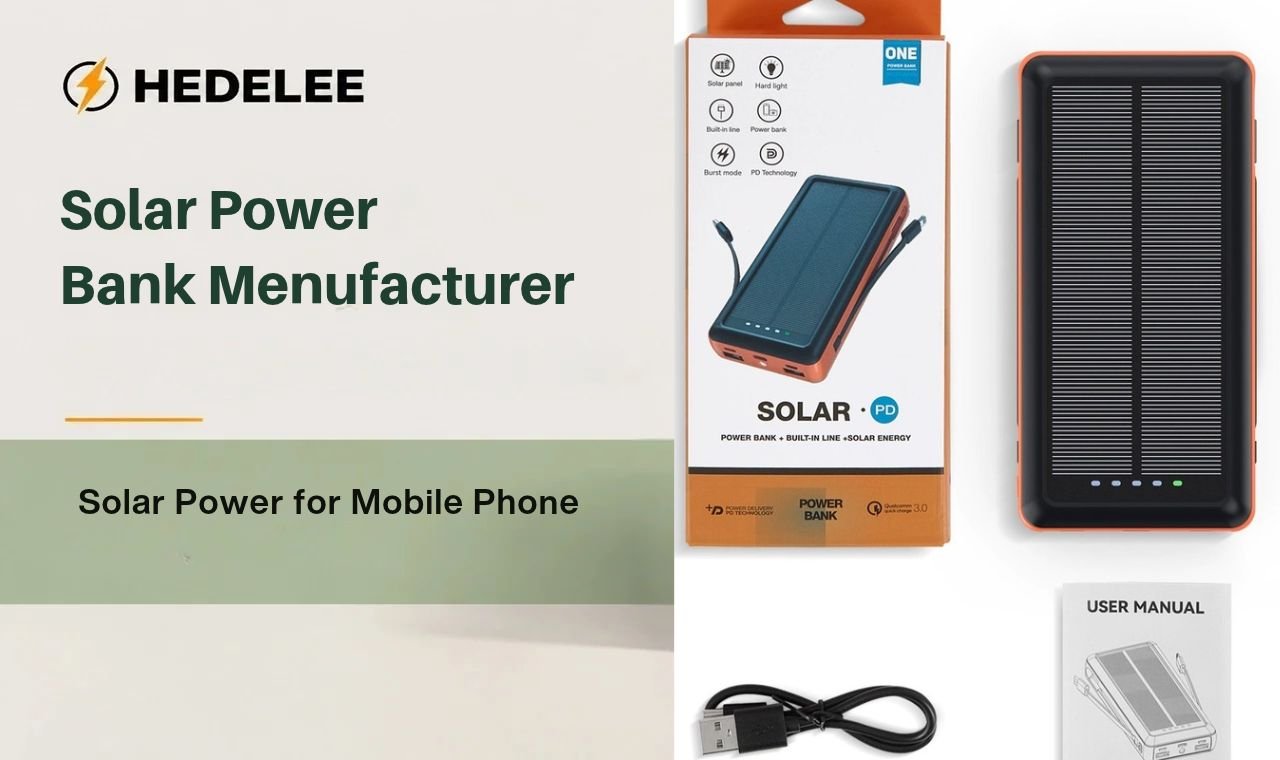
A customer leaves a new solar power bank on a sunny windowsill for the weekend. By Monday the battery level has barely moved, and a return request is waiting in your inbox. The unit isn’t faulty. Nobody told the customer what a palm-size panel can and can’t do.
That gap between expectation and physics sits behind many complaints in this category, and you can close it before the goods ship. Used the right way, solar power for mobile phone charging is dependable. It keeps phones alive at a campsite, on a fishing boat, at a remote job site, or through a power cut.
Selling it well takes four things: a clear picture of how the technology works, charging numbers you can stand behind, usage instructions your customers will follow, and a short list of checks for models and suppliers. All four are below.
What Is Solar Power for Mobile Phone Charging?
Solar power for mobile phone charging means collecting sunlight with a small photovoltaic panel and storing it in a battery. The stored energy then reaches the phone through a USB port or a wireless pad. Most products built for the job are solar power banks: a lithium polymer battery pack with a panel set into the case.
The battery is the part end users forget. A solar power bank is a power bank first. It also charges from a wall adapter through its USB-C or Micro USB input, and that is the fastest way to fill it.
How does a solar power bank work?
Four parts do the work:
- Solar panel. Monocrystalline silicon cells turn light into direct current. On pocket-size models the panel is rated at about 1 to 1.5 W.
- Charge controller. A protection circuit steadies the panel’s changing output and guards the battery against overcharge, over-discharge, short circuits, and overheating.
- Battery. Lithium polymer cells store the energy. Our spec sheets rate them for about 500 full charge cycles.
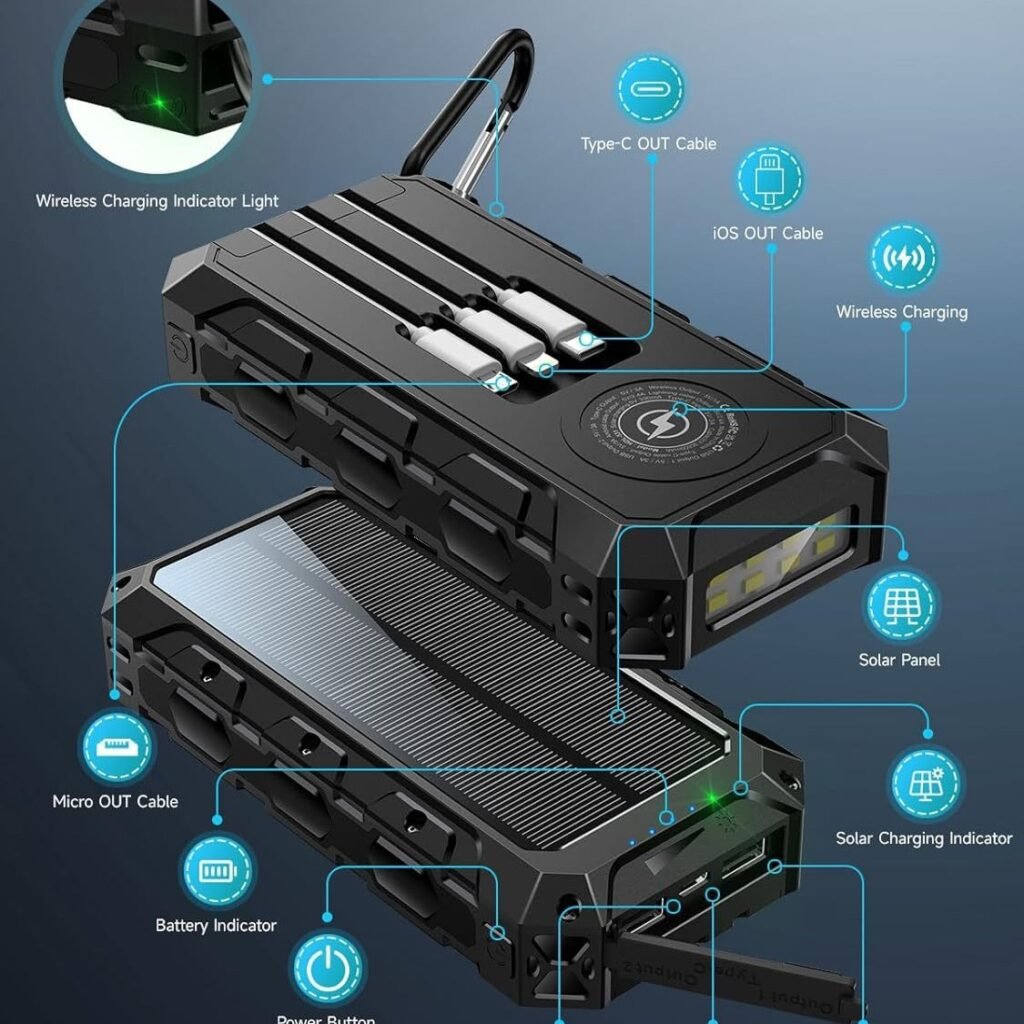
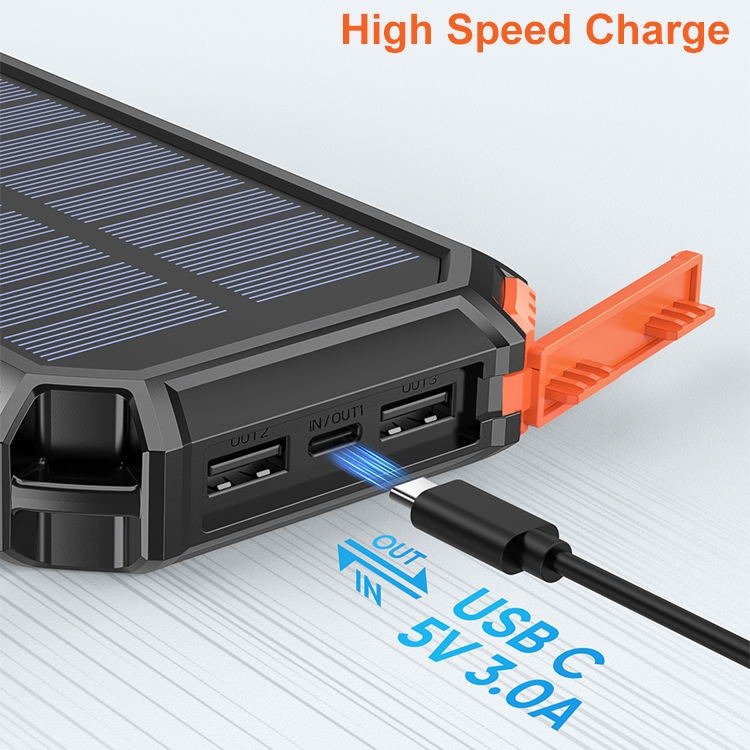
- Outputs. USB-A and USB-C ports deliver 5 V at up to 3 A. Some designs add built-in cables or a 5 W Qi wireless pad.
One product, many names
Shoppers and buyers describe these products in different ways, and the search terms overlap. The table shows what each term usually means.
| Search term | What it usually describes |
|---|---|
| Solar phone charger, solar cell phone charger, solar mobile phone charger | Any device that charges a phone from sunlight. It may be a bare panel or a panel with a battery. |
| Solar power bank, solar powered power bank, “bank power solar” | A battery pack with one or more built-in panels. It charges from the sun or from USB. |
| Solar power bank battery charger | The same battery pack, named for its two jobs: it recharges itself, then charges other devices. |
| Foldable solar power bank | A pack with three or four fold-out panels for more solar input. |
For listings and packaging, use the term your market searches for, then state the product type in plain words. You can compare the formats side by side in our solar power bank range.
How Much Power Does a Solar Phone Charger Deliver?
Less than most shoppers expect. A single built-in panel is a top-up source, and a wall socket is still the fastest way to fill the battery.
The numbers are easy to check. A 20,000 mAh pack stores about 74 Wh of energy (20 Ah × 3.7 V). A 1.5 W panel in full, direct sun produces at most 1.5 Wh each hour. Filling that pack from empty would take about 50 hours of full sun, which is ten or more clear days.
For the phone itself, one hour of strong sun on a 1.5 W panel adds roughly 5% to a typical battery once conversion losses are counted. That covers an emergency call or a map check. It is not a full recharge.
Solar power bank charging time: sun versus wall socket
| Charging source | Input power | Time to fill a 20,000 mAh pack | Where it fits |
|---|---|---|---|
| Single built-in panel (about 1.5 W) | Up to 1.5 W in direct sun | About 50 sun hours, or 10+ clear days | Emergency top-up |
| Three or four fold-out panels (about 1.5 W each) | Up to 4.5 to 6 W in direct sun | About 12 to 17 sun hours, or 3 to 4 clear days | Trips of several days away from a socket |
| USB wall adapter (5 V, 2 to 3 A) | 10 to 15 W | About 10 hours on our spec sheets | Main charge before leaving |
A “sun hour” is one hour of full-strength sunlight, about 1,000 W per square meter. Many regions get four to six on a clear summer day. Winter, haze, and cloud bring fewer.
What should you tell customers?
Put the expectation in writing on the listing, the box, and the manual: charge by USB before you leave, and use the sun to top up. Our own spec sheet for the HDL519 camping solar charger says the same. It describes solar as a backup input and advises a full charge before travel.
Plain numbers do more for your return rate than any feature claim. Customers who understand solar power for mobile phone charging as a top-up rarely send the product back for behaving like one.
How to Use a Solar Power Bank Step by Step
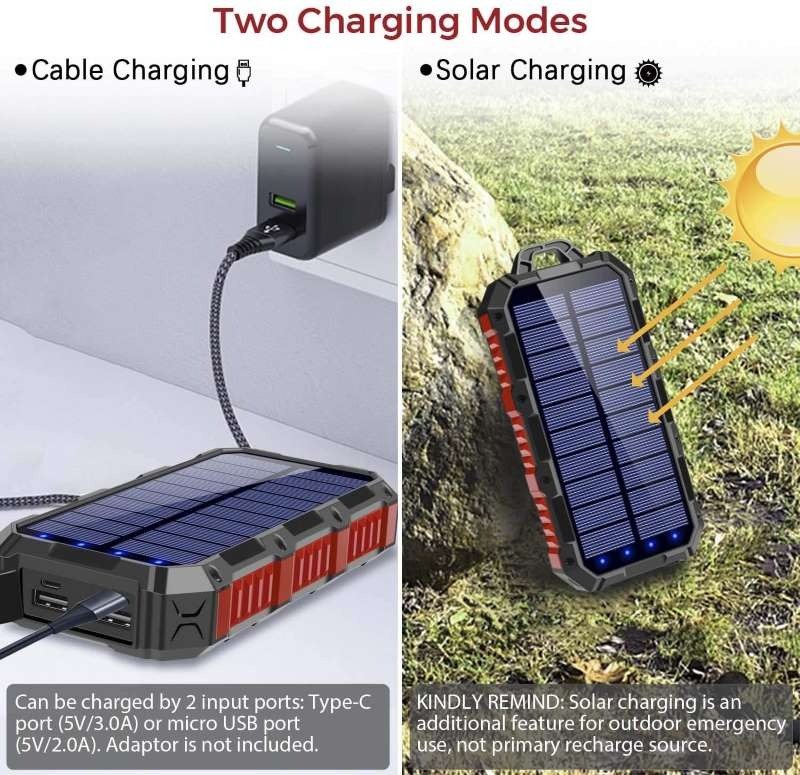
Charge it by USB first, top it up in direct sun, and run the phone from the stored energy. These six steps suit almost every model, and they fit on one card inside the box.
- Charge it fully by USB before first use. Plug the USB-C or Micro USB input into a 5 V/2 A or faster wall adapter. Our spec sheets list about 10 hours for a full charge.
- Learn the indicator lights. Battery LEDs show how full the pack is. A solar indicator lights up when the panel is getting enough sun. Patterns differ by model, so print the legend in your manual.
- Put the panel in direct sun. Set the unit outdoors with the panel facing the sun and nothing shading the cells. Open every panel on foldable models.
- Keep the battery cool. Our spec sheets list an operating range of 0 to 45°C (32 to 113°F). Lift the unit off hot rock, sand, or metal so air can move under it. Never leave it on a car dashboard.
- Connect the phone. Use a USB port or a built-in cable. If charging doesn’t start, press the power button once. On wireless models, center the phone on the pad and take off thick or metal cases.
- Store it ready for the next trip. Keep the pack in a cool, dry place and top it up by USB every three months. Lithium cells lose a little charge each month, even with nothing plugged in.
Can you charge a phone straight from the panel?
Yes, but the charge is slow and uneven. Light changes from minute to minute, and many phones pause charging when the input dips. The steadier method is to let the panel fill the battery during the day, then charge the phone from the battery in the evening.
Can you use it in the rain?
Check the IP code before you promise anything on a listing, because water ratings differ by model. Even on rated units, keep the port covers closed in wet weather and dry the unit before you plug anything in. Wet USB contacts can short or corrode.
7 Tips to Get More Solar Power for Mobile Phone Charging
Panel angle, shade, and heat decide how much energy a small panel collects, and all three are in the user’s hands. These seven habits get more from the same hours of sun.
- Face the panel square to the sun. Light that hits at a right angle delivers the most power. Lay the unit flat at midday and prop it up in the morning and late afternoon.
- Move it as the sun moves. The sun shifts about 15 degrees every hour. A quick turn every hour or two keeps the panel on target.
- Keep every cell out of shadow. Cells are wired in a chain, so a strap or a leaf across one strip can pull down the output of the whole panel.
- Charge outdoors, not behind glass. Windows and windshields block part of the light and trap heat. A dashboard is the worst place for a lithium battery.
- Wipe the panel clean. Dust, sunscreen, and salt spray scatter light. A soft, damp cloth is all it needs.
- Bank the energy first. Let the sun fill the battery, then charge the phone from the battery. The phone gets a steady current and finishes sooner.
- Clip it where it sees the sky. Hang the unit from a backpack or tent with its carabiner, panel facing out. Expect less on the move than at rest, because the angle keeps changing.
Midday sun on a clear day gives the strongest input. Haze, thin cloud, and low winter sun can cut it by half or more, which is why the advice to charge by USB before a trip never changes.
When is a foldable model worth it?
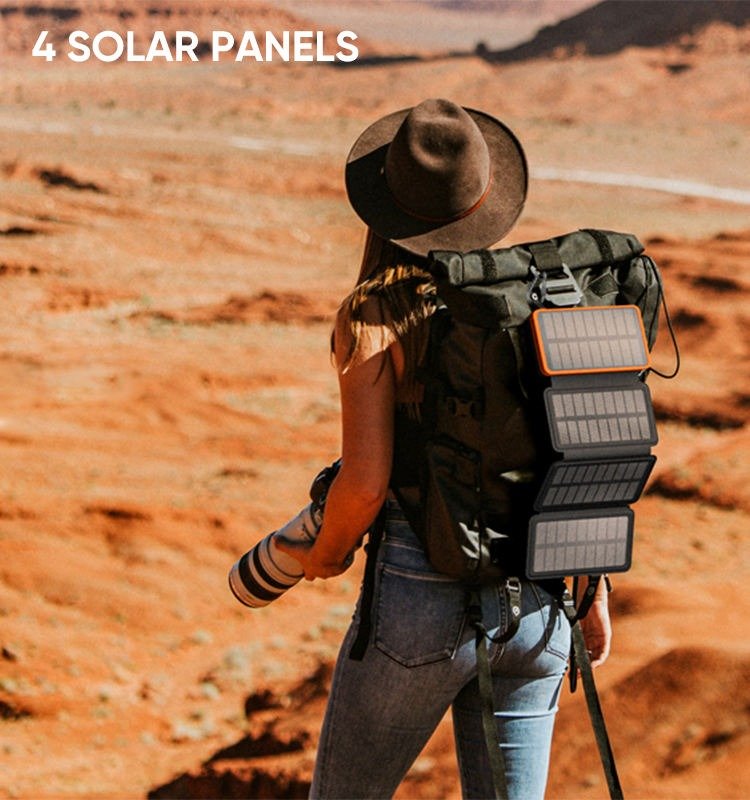
For customers who spend several days away from a socket, panel area is the real upgrade. A fold-out design with three or four panels collects roughly three to four times the energy of a single-panel unit in the same hours. Our foldable 20,000 mAh solar charger and the HDL519x three-panel solar power bank are built for that kind of trip.
Troubleshooting a Solar Powered Power Bank: 8 Common Problems
Most units reported as faulty are working as designed. The fix is usually light, a cable, a button press, or temperature.
| Problem | Likely cause | Fix |
|---|---|---|
| 1. Solar indicator stays off in daylight | Light is weak, indirect, or blocked by glass or shade | Move outdoors into direct sun, face the panel to it, and wipe the surface |
| 2. Battery level barely rises after a day in the sun | Normal for a single 1.5 W panel | Charge by USB and treat the sun as a top-up |
| 3. Pack won’t charge from the wall | Weak adapter or worn cable | Use a 5 V/2 A or faster adapter and a cable that works on another device |
| 4. Phone doesn’t start charging | Output is off, the pack is empty, or the cable is damaged | Press the power button, check the battery LEDs, then try another cable and port |
| 5. Charging stops after a few minutes | Loose plug, or a small device that draws too little current to keep the output on | Reseat the cable and press the power button to restart the output |
| 6. Wireless pad doesn’t respond | Phone is off-center, the case is thick or metal, or the phone lacks Qi charging | Center the phone, remove the case, and confirm Qi support |
| 7. Unit is hot and has stopped charging | Over-temperature protection has cut in | Move it to shade, let it cool, and keep it between 0 and 45°C |
| 8. Pack is flat after months in a drawer | Self-discharge during storage | Recharge by USB and top up every three months |
When is it a real fault?
Stop using the unit and replace it if the case is swollen or cracked, if it smells of chemicals, or if it heats up while idle. Those signs point to battery damage, and no usage tip fixes that.
How does this help your after-sales team?
A two-minute check of light, cable, button, and temperature settles many tickets without a replacement unit. Add the table to your manual and your support scripts, and fewer products come back.
How to Choose a Solar Mobile Phone Charger: 5 Checks
Match capacity, panel layout, outputs, and water protection to the place your customers will use the product. Five checks cover most range decisions.
1. Capacity and weight
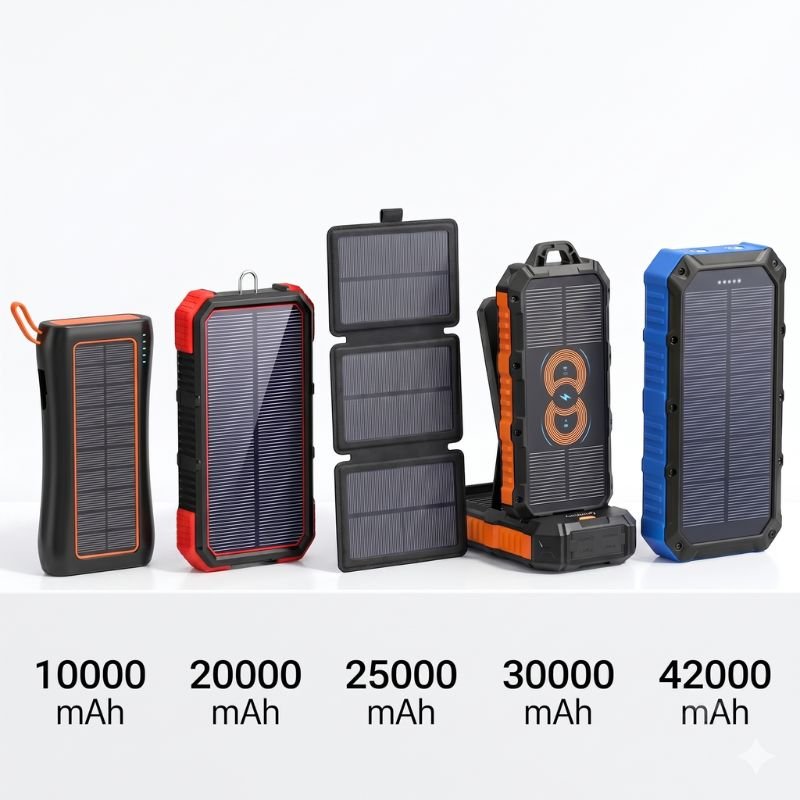
A 20,000 mAh pack gives a current phone about three to four full charges after conversion losses. Around 10,000 mAh suits day trips and gift sets. Packs of 20,000 to 25,000 mAh suit weekends away. At 30,000 mAh and above, the product belongs in vehicles, base camps, and emergency kits, where weight counts for less. Weight climbs with capacity: our compact 10,000 mAh unit weighs 248 g, and the 42,000 mAh HDL-628 weighs 740 g.
2. Air travel limits
Airlines count watt-hours, not milliamp-hours. The conversion is Wh = mAh × 3.7 ÷ 1,000. Under the FAA rules for lithium batteries in carry-on bags, power banks up to 100 Wh fly in carry-on bags, and packs of 101 to 160 Wh need airline approval. That puts the line at about 27,000 mAh, and some airlines set tighter limits. By that math, our 30,000 and 42,000 mAh models sit in the approval band. If your customers fly, keep your main travel model under 100 Wh.
3. Panel layout
A single built-in panel keeps the product slim and the price low, and it works as a top-up. A foldable solar power bank with three or four panels collects three to four times the energy, at the cost of extra thickness and weight. Choose by how long your customers stay away from a socket.
4. Outputs and cables
Look for USB-C in and out, with at least one 5 V/3 A port for current phones. Built-in cables end the “forgot my cable” complaint. A 5 W Qi pad adds convenience, though it charges more slowly than a cable.
5. Water and dust protection
Read the IP code defined by the IEC, not the word “waterproof.” IP65 means dust-tight and protected against water jets. IPX4 covers splashes from any direction and makes no dust claim. An IP code records the test a product passed, not every condition it will meet outdoors. If you list a waterproof solar power bank, put the code in the title and keep the test report on file.
Which Hedelee models fit which need?
The table lists eleven current models by capacity, with the features that separate each one from the rest.
| Model | Listed capacity | What sets it apart |
|---|---|---|
| Compact 10,000 mAh wireless solar power bank | 10,000 mAh | 88 mm square body, 5 W wireless pad, three-mode LED light |
| HDL618 wireless solar power bank | 20,000 mAh | 5 W wireless pad, USB-C and Micro USB inputs, torch with SOS mode |
| HDL519 slim camping solar charger | 20,000 mAh | 22 mm body, 5 W wireless pad, carabiner |
| HDL519x three-panel solar power bank | 20,000 mAh | Three fold-out 1.5 W panels, dual USB outputs |
| Foldable fast-charging solar charger | 20,000 mAh | Fold-out panels, USB-C plus two USB ports at 5 V/3 A |
| Waterproof fast-charging solar power bank | 20,000 mAh | Quick-charge support, LED display, V0 flame-rated ABS and PC shell |
| HDL-531 solar power bank with three cables | 24,000 mAh | Built-in Lightning, USB-C, and Micro USB cables, 5 W wireless pad |
| HDL529 solar power bank with four cables | 24,000 mAh | Four built-in cables, dual LED flashlights, IPX4 listing |
| 25,000 mAh four-panel solar charger | 25,000 mAh | Four solar panels, dual USB ports, 9-LED flashlight with SOS |
| HDL528 IP65 wireless solar power bank | 30,000 mAh | IP65 listing, Qi wireless pad, USB-C and Micro USB inputs |
| HDL-628 solar power bank with four cables | 42,000 mAh | Four built-in cables, wireless pad, torch with SOS mode |
Capacities are the figures shown on each product listing. Confirm rated capacity in Wh, port ratings, and certificates for your exact configuration when you request a quote.
Which Compliance Tests Should Buyers Ask For?
Ask for three things before you confirm an order: the battery transport test, the safety data sheet, and the approvals for your destination market. Carriers, customs officers, and marketplaces can each stop a lithium battery product that arrives without them.
| Document | What it shows | Who asks for it |
|---|---|---|
| UN38.3 test report | The battery passed eight transport tests, from altitude and vibration to short circuit and overcharge | Airlines, shipping lines, and freight forwarders |
| MSDS (safety data sheet) | Battery chemistry, hazards, and handling rules | Forwarders at booking, warehouses, and marketplaces |
| CE, FCC, and RoHS | EU conformity, US radio-interference limits, and limits on hazardous substances | Customs, retailers, and online marketplaces |
| PSE | Electrical safety approval for Japan | Japanese importers and retailers |
| UL 2056 | A US safety standard written for power banks | US retailers and marketplaces |
| IP test report | The tested water and dust rating behind a “waterproof” claim | Anyone printing an IP code on a box |
Certificates shown on our product listings vary by model. They include CE, FCC, RoHS, UN38.3, and MSDS, with PSE and UL shown on selected models.
How do you check a certificate?
Three checks take five minutes and catch most problems:
- The model number on the report matches the model on your order.
- The battery capacity on the report matches the capacity you are buying.
- The report names the test lab and carries a report number you can verify.
Approvals belong to one model and one market. Name both when you ask. Request the documents before you pay a deposit, not after the goods are packed.
What about the solar panel itself?
The lithium battery drives most of the paperwork, but the panel deserves one question of its own: how is its output tested? We check panel power on a dedicated tester during production. Ask any supplier for the rated panel wattage and the test method, then compare both with the listing.
Image for this section
- Image title: Reviewing Battery Compliance Documents
- Image description: A buyer checks test reports against a solar power bank sample and its retail box.
- File name:
solar-power-bank-battery-charger-compliance-reports.jpg - Alt text: Buyer reviewing transport and safety test reports beside a solar power bank battery charger sample and its retail box
- Image size: 1:1
- AI image prompt: Office desk photo. A procurement manager’s hands hold a pen over printed test reports and a checklist on a clipboard. Beside the papers sit a solar power bank sample, its plain retail box, and an open laptop. Neutral daylight from a window, shallow depth of field, documents show blurred charts and lines with no readable text or logos, square composition –ar 1:1
Which Compliance Tests Should Buyers Ask For?
Ask for three things before you confirm an order: the battery transport test, the safety data sheet, and the approvals for your destination market. Carriers, customs officers, and marketplaces can each stop a lithium battery product that arrives without them.
| Document | What it shows | Who asks for it |
|---|---|---|
| UN38.3 test report | The battery passed eight transport tests, from altitude and vibration to short circuit and overcharge | Airlines, shipping lines, and freight forwarders |
| MSDS (safety data sheet) | Battery chemistry, hazards, and handling rules | Forwarders at booking, warehouses, and marketplaces |
| CE, FCC, and RoHS | EU conformity, US radio-interference limits, and limits on hazardous substances | Customs, retailers, and online marketplaces |
| PSE | Electrical safety approval for Japan | Japanese importers and retailers |
| UL 2056 | A US safety standard written for power banks | US retailers and marketplaces |
| IP test report | The tested water and dust rating behind a “waterproof” claim | Anyone printing an IP code on a box |
Certificates shown on our product listings vary by model. They include CE, FCC, RoHS, UN38.3, and MSDS, with PSE and UL shown on selected models.
How do you check a certificate?
Three checks take five minutes and catch most problems:
- The model number on the report matches the model on your order.
- The battery capacity on the report matches the capacity you are buying.
- The report names the test lab and carries a report number you can verify.
Approvals belong to one model and one market. Name both when you ask. Request the documents before you pay a deposit, not after the goods are packed.
What about the solar panel itself?
The lithium battery drives most of the paperwork, but the panel deserves one question of its own: how is its output tested? We check panel power on a dedicated tester during production. Ask any supplier for the rated panel wattage and the test method, then compare both with the listing.
Why Source Direct From a Solar Power Bank Manufacturer?
Buying from the factory that builds the product gets you direct answers on specifications, test reports, and customization, with no trading layer in between.
Shenzhen Hedeli Technology Co., Ltd., the company behind the Hedelee brand, has worked in mobile accessories and consumer electronics for about 10 years. More than 100 people work across our Shenzhen headquarters, our Guangzhou office and showroom, and our Dongguan factory. That factory has a monthly capacity of 50,000 units and supplies importers, distributors, and wholesalers on schedule.
Here is what that means for an order:
- Tested production. Each unit moves through battery welding, assembly, function testing, cycle aging, and solar panel power testing before packing.
- Customization. Our OEM and ODM service covers logo printing, custom colors on larger orders, and capacity labeling on the shell.
- A wider accessory line. The same company supplies power banks, TWS earbuds, Bluetooth speakers, USB chargers and cables, car chargers, and car phone holders.
- A showroom you can visit. Our Guangzhou showroom lets you handle the products before you order.
If solar power for mobile phone charging has a place in your range, send us your target capacity, order quantity, and destination market. You will be dealing with the original manufacturer, which means direct access to the source: your questions reach the team that builds and tests the product, with no one in the middle. Request a quote or samples from the Hedelee sales team, or write to sales@solarpowerbank.cn, and we will reply with specifications, test documents, and pricing for your order size.
Frequently Asked Questions
1. What is the minimum order quantity for solar power banks?
The minimum depends on the model and the level of customization. Standard models in stock colors need a smaller commitment than orders with custom colors or printed logos. Send us the model and your target quantity, and we’ll confirm the figure with your quote.
2. Can you customize a solar phone charger with our logo?
Yes. Our OEM and ODM service covers logo printing, custom colors on larger orders, and capacity labeling on the shell. Reach out for detailed specifications and artwork guidelines for the model you have in mind.
3. Do your solar power banks come with compliance test reports?
Yes, and the set varies by model. Our listings show CE, FCC, RoHS, UN38.3, and MSDS, with PSE and UL on selected models. Tell us your destination market, and we’ll send the documents for that exact model before you order.
4. How long does production take for a bulk order?
Lead time depends on order size, customization, and component stock. Our Dongguan factory has a monthly capacity of 50,000 units, and custom colors or logos add time for materials and approval. Share your delivery date, and we’ll confirm a schedule with the quote.
5. Can we request samples before placing a wholesale order?
Yes, and we recommend it. A sample lets you check charging speed, build, and indicator lights against your own requirements. Contact us to request samples, and tell us which models and markets you have in mind.