

A customer buys a solar power bank for a camping trip. Then they leave it in the sun all afternoon and expect a full phone charge. It doesn’t happen. So the product gets a one-star review, and the retailer gets a return.
That story repeats in many markets. The problem is rarely a faulty unit. Instead, it’s a mismatch between what the buyer ordered and what the end user expected.
A solarpower charger is a useful product. But choosing the right one takes more than reading a capacity number on a box. This guide covers five practical tips for picking the right model. You’ll learn how solar input really works, which capacity fits which customer, and what to check before you place a bulk order.
We’ve built solar power banks at our Dongguan factory for years. So the advice below comes from production lines, buyer questions, and plenty of sample feedback.
What Is a Solarpower Charger and How Does It Work?
A solarpower charger is a portable battery pack with a built-in solar panel. It stores energy in lithium cells. Then it releases that energy to phones, tablets, earbuds, and other USB devices.
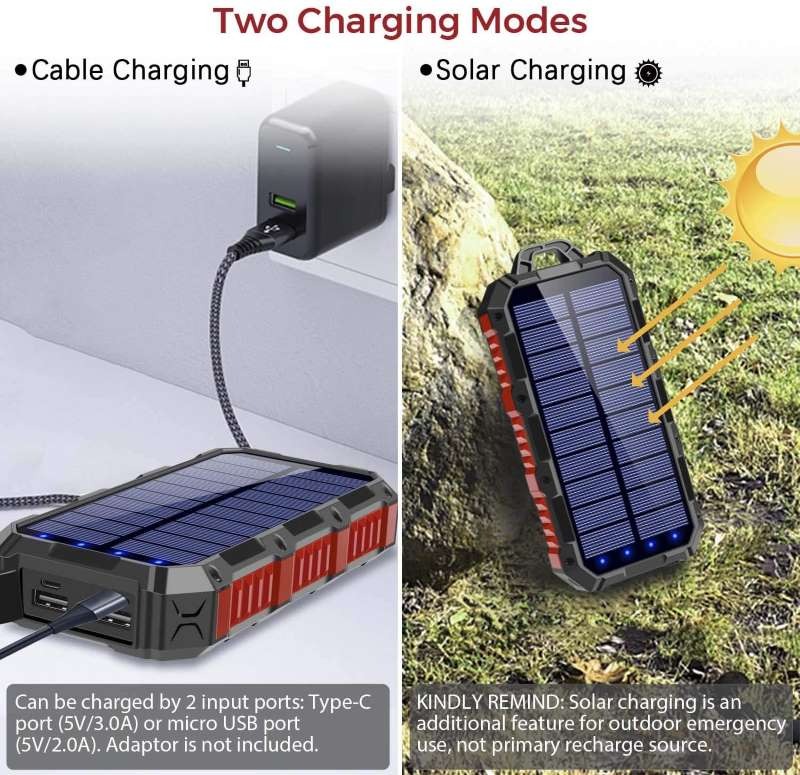
Most units charge in two ways. First, they take power from a wall adapter or computer through USB-C or Micro-USB. Second, the solar panel adds energy when the unit sits in daylight.
People call these products by many names. You’ll see “solar power bank,” “solar powered power bank,” “solar phone charger,” and “solar cell phone charger” on retail listings. Some import catalogs even list them as “bank power solar” units. However, they all describe the same basic idea: a battery you can top up with sunlight.
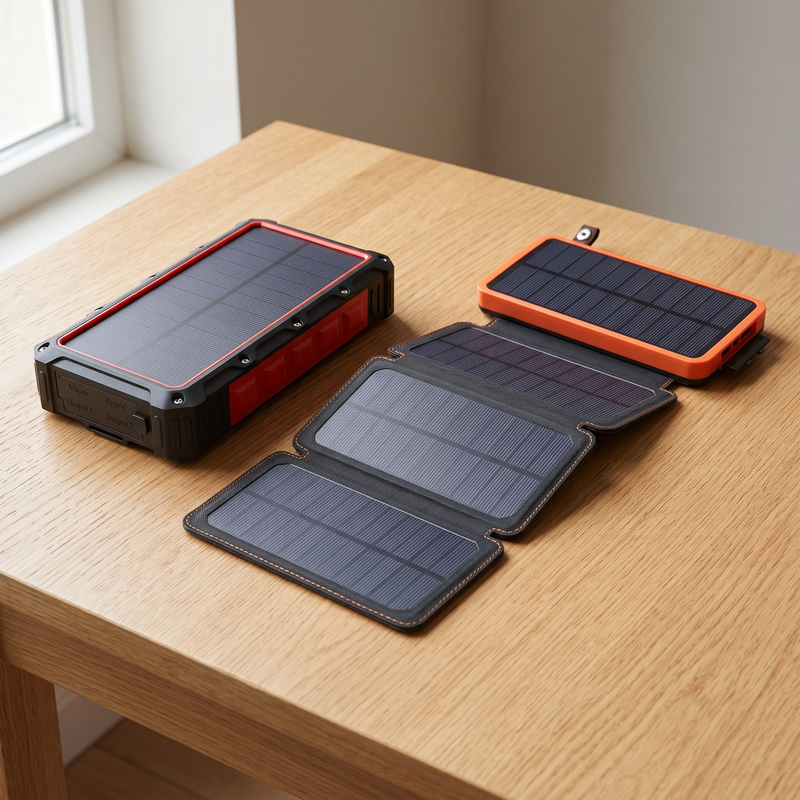
Built-in Panel vs. Foldable Panel Designs
There are two main formats. Each one suits a different customer.
| Feature | Built-in Single Panel | Foldable Multi-Panel |
|---|---|---|
| Typical solar output | Around 1–2 watts | Higher, depends on panel count |
| Size and weight | Compact, pocket-friendly | Larger when open, still portable |
| Solar charging speed | Slow, a trickle charge | Noticeably faster in strong sun |
| Main use | Emergency backup, daily carry | Camping, hiking, longer trips |
| Retail price point | Lower | Mid-range |
A built-in panel is small. Because of that, it collects only a little energy each hour. A foldable design opens up several panels, so it catches more light.
Neither format is “better.” Instead, the right choice depends on who will use the product and where.
Why Buyers Keep Adding Solar Power Banks to Their Range
Solar power banks sell steadily for a simple reason. People want a phone that stays alive when they’re away from a wall socket.
Here are the main groups that drive demand:
- Outdoor users. Campers, hikers, anglers, and festival-goers want a backup that works off-grid.
- Emergency planners. Households in storm or flood zones keep a charged pack ready for power cuts.
- Travelers. Road-trippers and backpackers want one device that covers several days.
- Workers in the field. Survey teams, farm staff, and delivery riders spend long hours outdoors.
- Promotional buyers. Companies order branded units as gifts because they’re useful and visible.
During an outage, a phone is more than a phone. It’s a flashlight, a map, a news source, and a way to call for help. Also, GPS on most phones works without mobile data. So a charged battery keeps people located even when networks are down.
That emergency angle is a strong selling point. But it’s also why honest product claims count. A customer who relies on a solar mobile phone charger in a crisis needs to know what it can and can’t do.
Tip 1: Match Battery Capacity to the End User
Capacity is the first number buyers look at. It’s measured in milliamp-hours (mAh). A bigger number means more stored energy, but also more weight.
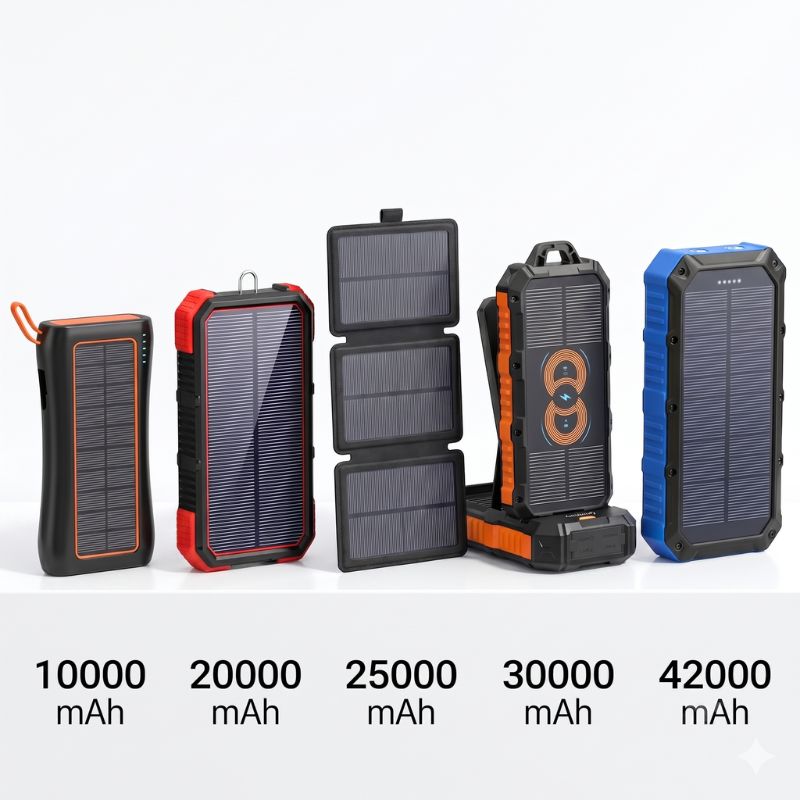
Many buyers order the largest capacity they can find. That isn’t always wise. A 42,000mAh pack is heavy for a day hike. Meanwhile, a 10,000mAh unit may disappoint a family on a week-long camping trip.
How Many Phone Charges Can Users Expect?
Not all stored energy reaches the phone. Some is lost as heat and during voltage conversion. In practice, a power bank delivers roughly 60–70% of its rated capacity to a device.
A typical smartphone battery holds around 4,000–5,000mAh. So the rough numbers look like this:
| Rated Capacity | Approx. Energy (Wh) | Est. Full Phone Charges | Typical Buyer | Carry-on Flight Status* |
|---|---|---|---|---|
| 10,000mAh | 37Wh | 1.5–2 | Daily carry, commuters | Allowed |
| 20,000mAh | 74Wh | 3–4 | Weekend trips, campers | Allowed |
| 25,000mAh | 92.5Wh | 3.5–4.5 | Group trips, field work | Allowed |
| 30,000mAh | 111Wh | 4.5–5.5 | Multi-day outdoor use | Airline approval needed |
| 42,000mAh | 155Wh | 6–7 | Base camps, families | Airline approval needed |
*Energy is based on a 3.7V cell (Wh = mAh × 3.7 ÷ 1000). Flight rules vary by airline.
Why Watt-Hours Count for Travelers
Air travel limits are set in watt-hours, not mAh. The FAA’s PackSafe guidance on lithium batteries explains that spare lithium batteries must travel in carry-on bags. Batteries above 100Wh generally need airline approval, and those above 160Wh are not allowed.
So if your customers fly often, a 20,000mAh or 25,000mAh model is the safer pick. Also, make sure the Wh rating is printed on the casing. Airport staff look for it.
Check Rated vs. Marketed Capacity
Some listings show two numbers, such as “24000mAh standard / 36000mAh.” Always ask the supplier for the rated capacity on the cell label. That’s the figure your compliance documents and flight labels should use. It also protects you from customer complaints later.
Tip 2: Set Honest Expectations for Solar Input
This is where most returns start. So it deserves careful attention.
A built-in panel on a phone-sized power bank usually produces around 1–2 watts in strong, direct sun. That’s a trickle. Filling a 20,000mAh battery from solar alone can take dozens of hours of bright sunlight. In cloudy weather, it takes much longer.
That doesn’t make the solar panel useless. It means the panel is a backup, not the main charging method.
How a Solarpower Charger Should Be Used
Here’s the realistic workflow to share with end users:
- Fully charge at home first. Use a wall adapter through USB-C before the trip.
- Use solar to top up. During the day, leave the unit facing the sun to slow the drain.
- Keep the battery in shade when possible. Heat shortens lithium battery life. So angle the panel toward the sun but avoid hot car dashboards.
- Recharge from the wall whenever possible. Any outlet at a café, campsite, or car port helps.
Why the Power Bank Sits in the Middle
Every device needs a minimum current before it starts charging. Phones and tablets need a fairly steady, higher current. A solar panel’s output rises and falls with clouds and sun angle.
A power bank solves that problem. It accepts small, uneven amounts of solar energy. Then it delivers a steady current to the phone. That’s why a solar power bank works better than plugging a phone straight into a bare panel.
Fixed Panels vs. Foldable Panels
If your customers need faster solar charging, look at foldable models. Our foldable 20000mAh outdoor solar power bank with LED lights opens several panels to catch more light. It’s a good fit for campers who spend full days outside.
Product Copy Tip for Retailers
Write listings that describe the solar panel as “emergency top-up” or “backup charging.” Avoid claims like “charges fully from sunlight in hours.” Clear wording reduces returns and builds trust.
Tip 3: Check Output Ports, Wireless Charging, and Built-in Cables
End users carry more than one device. So the number and type of outputs shape how useful a solar powered power bank feels in daily life.
Key Features to Compare
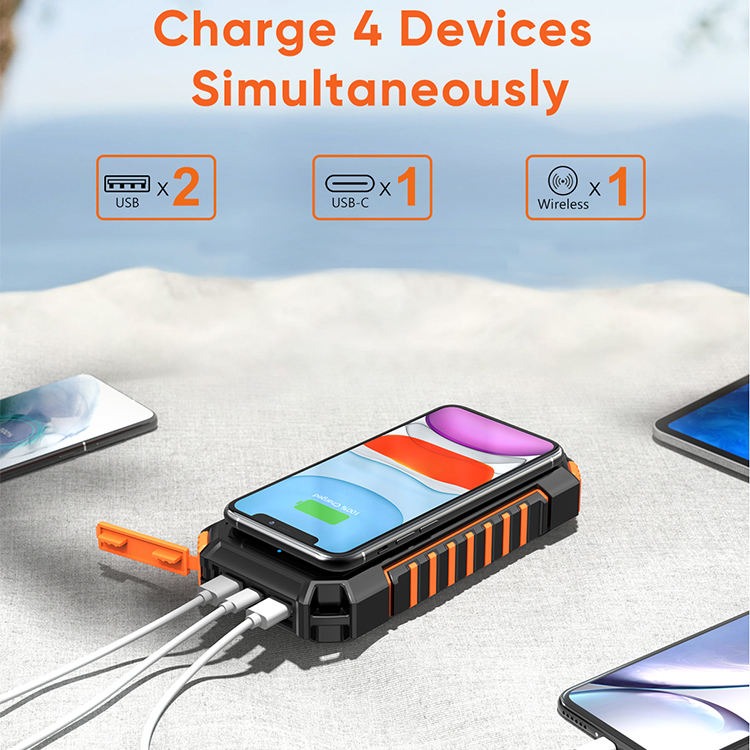
- USB-C input and output. Faster recharging from the wall and support for newer phones.
- Dual USB-A outputs. Useful for older cables and charging two devices at once.
- Qi wireless charging. Lets users drop a phone on top without a cable.
- Built-in cables. No more forgotten cords. Many models include Lightning, USB-C, and Micro-USB leads.
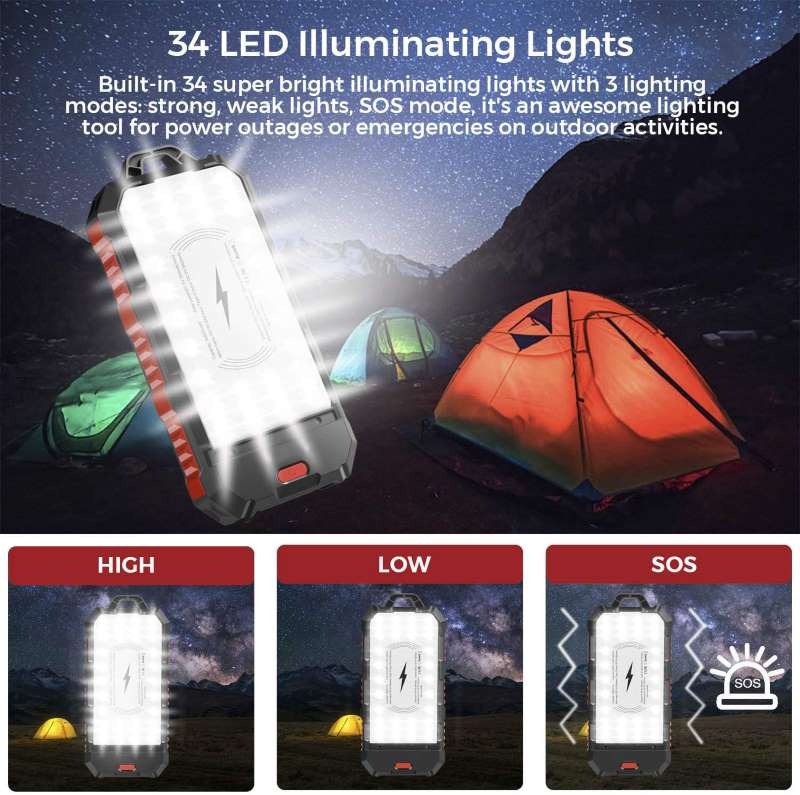
- LED flashlight. A strong selling point for camping and emergency kits.
- Battery level display. Digital or LED indicators help users plan their usage.
Feature Fit by Market
| Feature | Outdoor/Camping Market | Emergency Kit Market | Travel/Gift Market |
|---|---|---|---|
| High capacity (20,000mAh+) | Strongly preferred | Preferred | Optional |
| LED flashlight | Strongly preferred | Strongly preferred | Optional |
| Wireless charging | Nice to have | Optional | Strongly preferred |
| Built-in cables | Preferred | Preferred | Strongly preferred |
| Waterproof rating | Strongly preferred | Preferred | Optional |
Models With Multi-Device Features
If convenience is your selling point, built-in cables help a lot. The 24000mAh solar power bank with 4 built-in cables and wireless charging (HDL529) covers most phones without extra cords. It also has dual LED lights.
For buyers who want wireless charging in a mid-size unit, the 20000mAh solar wireless power bank with dual inputs (HDL-218) is a popular choice. Dual inputs give users a backup if one cable type is missing.
A Note on Fast Charging
Check the output rating, not just the port type. A 5V/3A output charges faster than 5V/1A. Also, confirm whether the unit supports fast-charging protocols your target phones use. Ask the factory for a spec sheet that lists every port’s voltage and current.
Tip 4: Look Closely at Waterproofing and Build Strength
Outdoor products face rain, dust, sand, and drops. So build strength affects return rates as much as battery quality.
Understanding IP Ratings
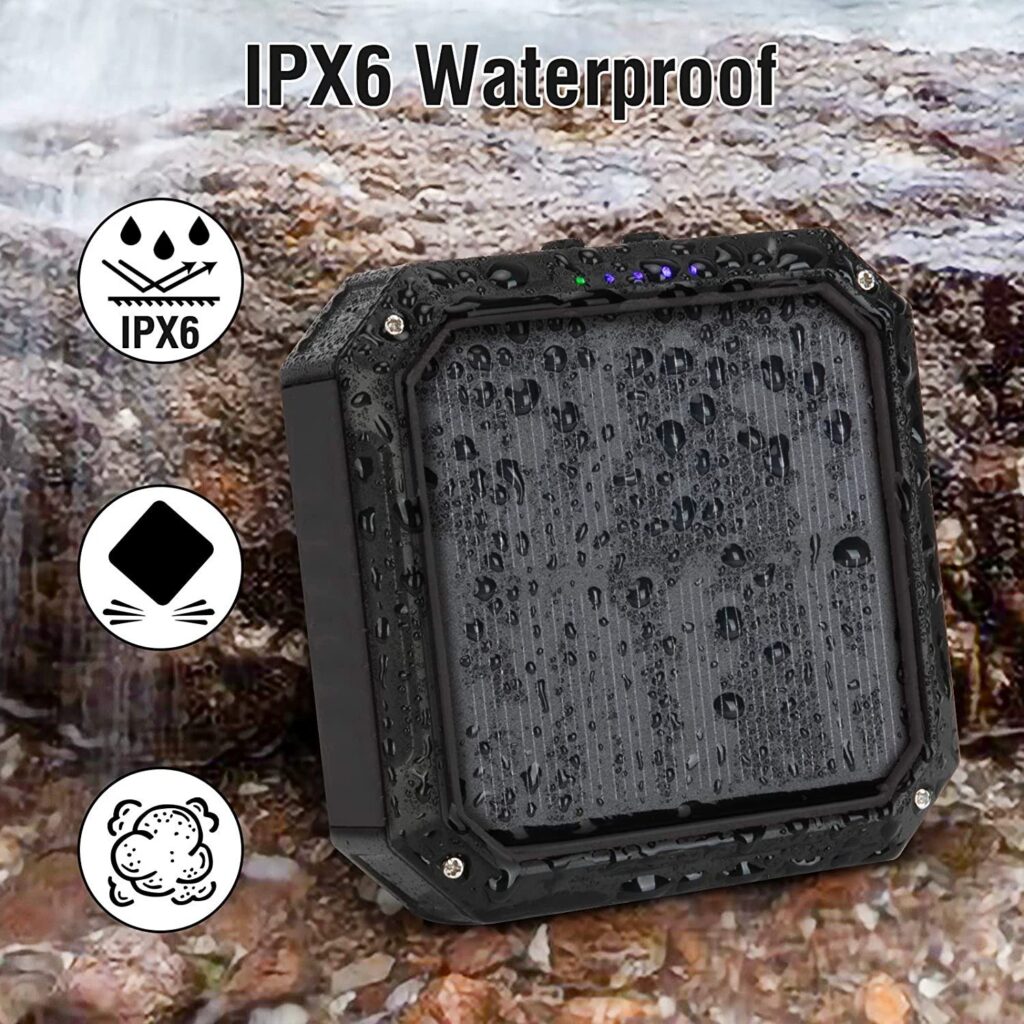
The IP code shows how well a casing resists dust and water. The first digit covers solids. The second covers liquids. You can read the full system on the IEC page explaining IP ratings.
| Rating | Dust Protection | Water Protection | Suitable For |
|---|---|---|---|
| IPX4 | Not tested | Splashes from any direction | Light rain, daily outdoor use |
| IP65 | Dust-tight | Low-pressure water jets | Heavy rain, dusty trails |
| IP67 | Dust-tight | Short immersion up to 1m | Water sports, boating |
Keep in mind that most solar power banks have rubber port covers. The rating only applies when those covers are closed. So include that note in your user manual.
Build Details to Inspect on Samples
- Casing material. Look for impact-resistant ABS or PC with rubberized edges.
- Port covers. They should seal tightly and stay attached.
- Panel surface. A scratch-resistant coating helps the panel last.
- Carabiner hook. Check that it’s firmly molded, not glued.
- Weight balance. Larger units should feel solid, not hollow.
For harsh conditions, the 30000mAh Qi wireless solar charger with IP65 rating (HDL528) offers dust-tight protection plus 5V/3A output. Meanwhile, the waterproof 20000mAh solar panel power bank with fast charging suits buyers who want a lighter outdoor option.
Tip 5: Verify Safety, Certifications, and Factory Capability Before Ordering a Solarpower Charger
Lithium batteries carry real risk if built poorly. So safety checks aren’t optional, especially at volume.
Safety Features to Request
A well-built solarpower charger should include protection circuits for:
- Overcharge
- Over-discharge
- Short circuit
- Overcurrent
- Overheating
Ask for a description of the protection board. Also ask which cell grade the factory uses. A-grade cells hold capacity longer and run cooler.
Documents Importers Usually Need
Requirements differ by country. However, these documents come up most often:
- UN38.3 test report for shipping lithium batteries by air or sea
- MSDS (Material Safety Data Sheet) for logistics
- CE for the European market
- FCC for the United States
- RoHS for restricted substances
- IEC 62133 or local battery safety reports
Ask the supplier which reports are available for each specific model. A document for one product doesn’t cover another.
Questions to Ask a Solar Power Bank Factory
- Do you produce in-house, or do you outsource assembly?
- What is your monthly capacity for this model?
- How do you test cells before assembly?
- Do you run aging tests on finished units?
- Can you supply pre-shipment inspection reports?
- How do you handle defective units after delivery?
Direct answers to these questions tell you a lot. A trading company may need days to reply. A real factory can usually answer on the spot.
Why Factory Scale Counts
At Shenzhen Hedeli Technology Co., Ltd., our Dongguan factory produces around 50,000 units per month. That capacity helps importers and distributors restock on schedule, even during peak seasons. Also, with more than 100 staff and about 10 years in mobile accessories, we handle production, testing, and packing under one roof.
Solarpower Charger Models Worth Shortlisting
Once you know your market, it’s easier to narrow down models. Here’s a quick map of our current range by use case. You can also browse the full solar power bank collection for more options.
| Model | Capacity | Standout Features | Fits Best For |
|---|---|---|---|
| 10000mAh outdoor solar wireless power bank | 10,000mAh | Wireless charging, strong light | Daily carry, gifts |
| 20000mAh dual USB waterproof solar power bank (HDL519X) | 20,000mAh | Dual USB, LED light, waterproof | Entry-level outdoor |
| Camping solar charger power bank (HDL519) | 20,000mAh | Rugged camping design | Outdoor retail |
| 25000mAh dual USB waterproof solar charger | 25,000mAh | Dual USB, waterproof | Group trips |
| 24000mAh wireless solar power bank with three cables (HDL-531) | 24,000mAh | Wireless, three cables | Multi-device users |
| 42000mAh solar battery pack with 4 built-in cables (HDL-628) | 42,000mAh | Wireless, 4 cables, dual LED | Families, base camps |
A few practical notes:
- For mixed retail shelves, pair a 10,000mAh model with a 20,000mAh model. That covers both impulse buyers and outdoor shoppers.
- For emergency kits, choose a model with a strong LED light and a clear battery display.
- For travel retailers, stay at or under 25,000mAh to keep units within the 100Wh carry-on limit.
- For heavy-use markets, the 42,000mAh unit makes sense. Just label it clearly for flight restrictions.
Customization Options
Most of these models can carry your branding. Common options include:
- Logo printing or laser engraving
- Custom casing colors
- Branded retail boxes and manuals
- Region-specific cable sets
Customization depends on the model and order size. So share your target market and quantity early. That way, the factory can suggest the right base model.
Working Directly With a Solarpower Charger Manufacturer
Picking the right model is half the job. The other half is choosing a partner who can deliver it the same way every time.
When you work with the factory that builds the product, several things get easier. Specifications come from the engineers, not a sales middleman. Sample changes happen faster. And quality issues trace back to a real production line, not a guessing game.
Here’s how a typical project runs with us:
- Share your market and use case. Outdoor, emergency, travel, or promotional.
- Receive model suggestions and spec sheets. We match capacity, ports, and IP rating to your needs.
- Test samples. Check solar input, output speed, build, and packaging in your own conditions.
- Confirm customization. Logo, colors, packaging, and documents.
- Mass production and inspection. Units go through testing before packing.
- Shipping with documents. UN38.3, MSDS, and other reports ship with the order where available.
Shenzhen Hedeli Technology has spent about 10 years in mobile accessories and consumer electronics. Our headquarters is in Shenzhen, and our Guangzhou office and showroom let partners see products in person. Production runs at our Dongguan factory. Besides solar power banks, we also make TWS earbuds, Bluetooth speakers, USB chargers, cables, car chargers, and car phone holders. So you can source a complete accessory line from one manufacturer.
If you’re planning a new solar range or replacing an underperforming supplier, send us your target specs and quantities. You’ll talk directly with the source, get honest advice on what each solar phone charger can deliver, and receive a clear quotation. Request your samples and pricing now, and let’s build a range your customers will keep using.
Frequently Asked Questions
1. What is the minimum order quantity for solar power banks?
MOQ depends on the model and how much customization you need. Standard models with simple logo printing usually start lower than fully custom designs. Share your target quantity, and we’ll confirm the exact MOQ for each model.
2. Can I customize the logo and packaging?
Yes. We offer logo printing, laser engraving, custom casing colors, and branded retail boxes. Contact us with your artwork and target market for a customization quote.
3. How long does a solar charger take to charge from sunlight?
A built-in panel gives a slow top-up, often dozens of hours for a full charge. That’s why we recommend charging from the wall first and using solar as backup. Foldable panel models charge faster in strong sun.
4. Do your solar power banks include safety test reports?
Many models have reports like UN38.3 and MSDS available for shipping. Requirements vary by market and model. Reach out for the documents tied to the specific units you’re considering.
5. Can I order samples before placing a bulk order?
Yes, samples are available for testing. We suggest testing solar input, output speed, and waterproofing in your own conditions. Contact us to request samples and lead times.