

A buyer once told us about a container of solar chargers that looked perfect on paper. The samples passed, the packaging was sharp, and the price worked. Three months after launch, the returns started: panels that barely charged, batteries that faded after fifty cycles, and housings that cracked on the first drop. Choosing a solar charging portable charger is easy when you only read spec sheets. Choosing one that survives real customers takes a closer look.
Whether your team calls it a solar phone charger, a solar power bank, or a solar charging portable charger, the product promise stays the same: stored power anywhere the sun shines. Getting that promise right starts with knowing what to check. The sections below walk through battery capacity, panel performance, durability, ports, safety testing, and supplier evaluation, so you can source with confidence and fewer surprises.
What Is a Solar Charging Portable Charger, and How Does It Work?
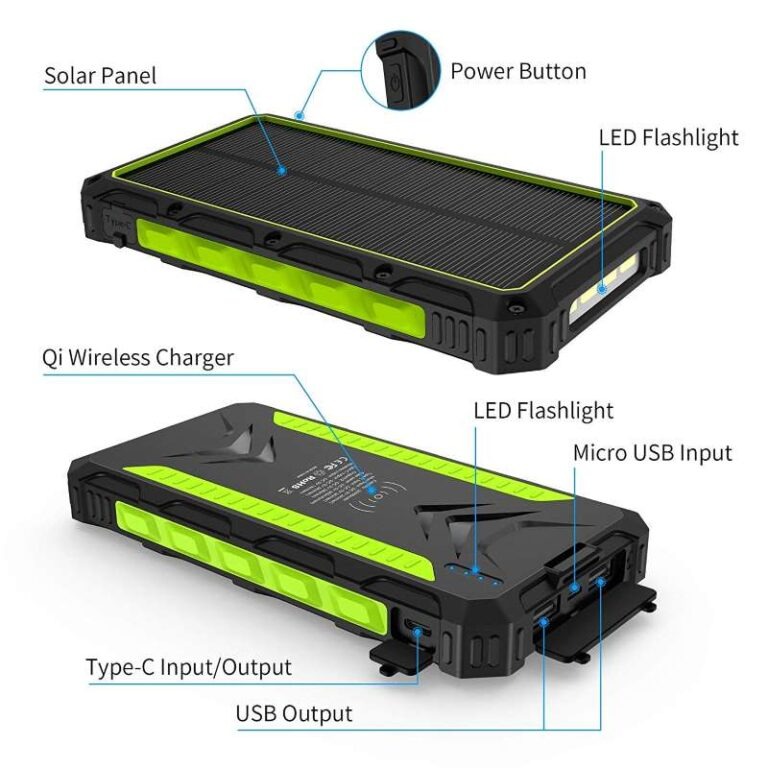
A solar charging portable charger is a power bank with a built-in solar panel. Open the housing and you will find four working parts, plus the shell that protects them:
-
Battery cell: a lithium polymer or lithium-ion pack that stores the energy
-
Solar panel: monocrystalline or polycrystalline cells that turn light into current
-
Control circuit: the board that regulates input and output and guards the battery
-
Output ports: USB-A, USB-C, or a wireless pad that delivers power to devices
-
Housing: a plastic or rubberized shell, usually with LED charge indicators
The working principle is simple. When sunlight hits the panel, photovoltaic cells absorb energy from the light and release electrons, which creates a flow of direct current. The U.S. Department of Energy explains this photovoltaic process clearly in its overview of how solar works. The internal circuit then conditions that current so it can safely refill the battery pack.
One point deserves honesty up front. The panel on a compact power bank is a top-up feature, not a replacement for wall charging. A small integrated panel collects limited energy per hour, so the main refill method remains a wall outlet before the trip. The panel then keeps the battery recovering through the day, which extends usable capacity outdoors. For camping, emergency kits, fieldwork, and travel retail, that combination is exactly what end users value.
It also helps to know where this product sits in the wider portable solar family. Buyers generally choose between three formats: a plain power bank, a folding solar panel with no storage, and the combined solar power bank. The combo unit trades some panel speed for convenience, since one device handles both jobs. Customers planning weeks off-grid often pair a large bank with a separate folding panel, while mainstream retail buyers strongly prefer the all-in-one format.
You will see many names for the same product family across marketplaces. Shoppers type “solar cell phone charger” or “solar mobile phone charger” when they think about the device being charged. Others search “bank power solar” when they think about the battery first. Procurement teams often write “solar power bank battery charger” in sourcing documents. Whatever the phrasing, the evaluation criteria stay the same, and they start with the battery.
Battery Capacity: The First Spec to Check
Capacity, measured in milliamp hours (mAh) or watt hours (Wh), tells you how much energy the unit stores. It is the first number on every listing, and the first number worth questioning.
A modern phone battery sits around 4,000 to 5,000 mAh. Rated capacity is not delivered capacity, though. Voltage conversion and heat losses mean a solar powered power bank typically delivers about 60 to 70 percent of its rated figure to your devices. A 20,000 mAh unit, for example, delivers roughly 12,000 to 13,000 mAh at the phone, which works out to about three full charges.
Wh makes cross-market comparisons easier, because it accounts for voltage as well as charge. Multiply mAh by the cell voltage and divide by 1,000 to convert. Airlines also think in Wh: packs under 100 Wh travel in cabin baggage without special approval, which covers every model in this category and reassures travel-retail buyers.
Capacity tiers map cleanly onto sales channels. Convenience and gift channels move the 10,000 mAh tier at accessible price points. Outdoor and travel specialty stores anchor their assortment at 20,000 mAh. Emergency-preparedness and professional channels take the largest packs, where weight matters less than runtime.
Cell quality decides how long that capacity lasts. Grade-A cells hold their rated figure for hundreds of cycles, while ungraded cells can drop noticeably within months. Ask any supplier two questions: which cells go into the pack, and what cycle-life data supports them. A well-made lithium pack should deliver 500 or more full charge cycles before capacity falls below 80 percent.
For range planning, a balanced catalog usually covers two or three capacity tiers. A model like the 20,000 mAh solar power bank with wireless charging and flashlight anchors the mid-range, while a 42,000 mAh solar power bank with built-in cables serves the extended-outage and group-travel segment. One practical tip for sample evaluation: run a full discharge test with a USB load meter before approving any figure printed on the box.
How Fast Does a Solar Charging Portable Charger Recharge?
Charging speed has two sides: how fast the bank refills itself, and how fast it refills your devices. Buyers who confuse the two write the most disappointed reviews, so clear expectations here protect your return rate.
Start with solar input. An integrated single panel on a pocket-size unit typically produces around 1 to 2 watts in strong, direct sun. A 20,000 mAh battery holds about 74 watt hours of energy. Divide one by the other and you get roughly 40 to 50 hours of ideal sunlight for a full solar refill, which translates to many days of real outdoor conditions. The honest message for end users: the panel recovers charge during the day and keeps the bank useful across a long trip, while the wall outlet does the heavy lifting before departure.
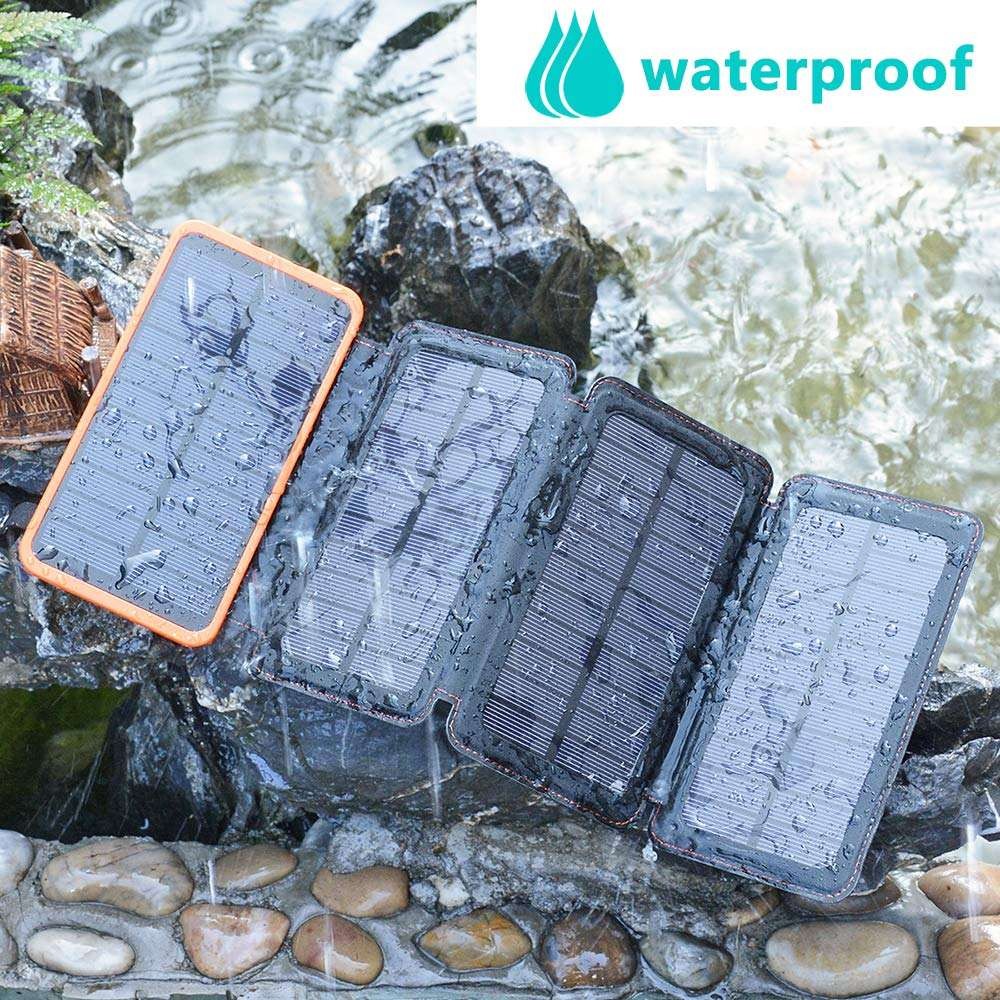
Foldable multi-panel designs improve the solar side meaningfully. Unfolded panels multiply surface area and can keep a large bank recovering steadily through a full day outdoors, which suits expedition and emergency-preparedness buyers.
Wall input is where speed actually lives. Models with dual inputs and a USB-C port rated at 5V/3A refill a 20,000 mAh pack overnight, in roughly six to eight hours.
The output side deserves equal attention. Standard ports deliver 5V/2.1A, which refills a typical phone in two to three hours. Faster models push 5V/3A or support quick-charge protocols for compatible phones, cutting that time noticeably. Two cautions apply. Fast-charge protocols only work when the phone supports the same standard, and low-grade bundled cables can bottleneck an otherwise fast port, so check what ships in the box.
Conditions play a role as well. Panel output drops sharply in shade, cloud cover, and winter sun, while lithium batteries accept charge slowly in cold weather. End users in northern climates should hear that solar recovery works year-round but peaks in summer.
If your catalog targets hikers and overlanders, a foldable 20,000 mAh solar charger with LED lights covers the panel-performance story well. For buyers who want faster wired input and output on a larger pack, the 30,000 mAh solar charger with USB-C input and 5V/3A output is a strong reference point.
Durability and Waterproofing for Outdoor Use
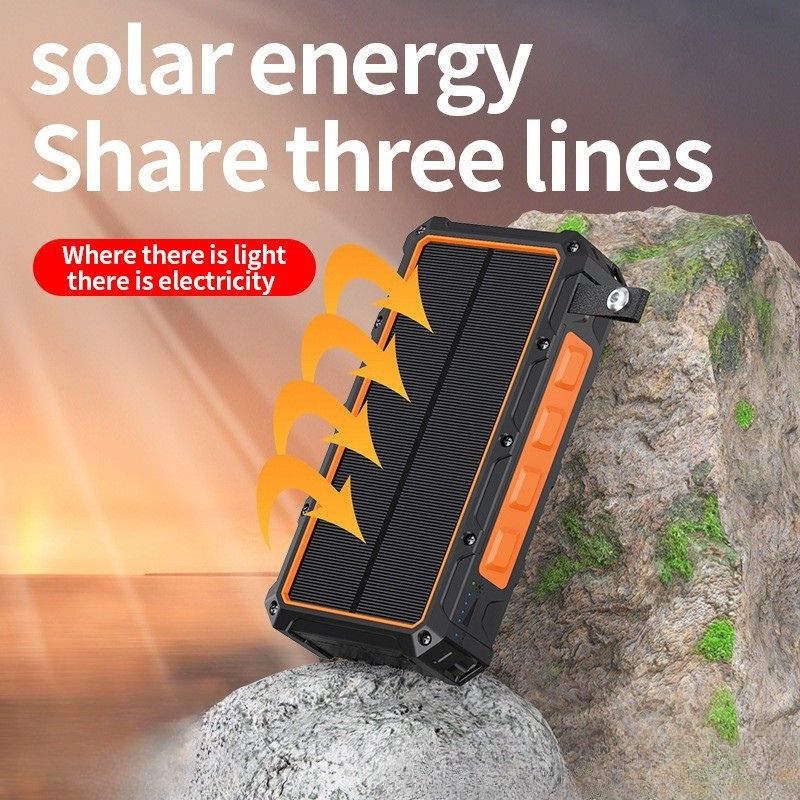
Outdoor products live hard lives. They ride in backpack side pockets, sit on wet ground, and get dropped on rock. Durability specs decide whether a solar phone charger survives its first season, and they deserve the same scrutiny as capacity.
The clearest durability language is the IP code. The International Electrotechnical Commission defines ingress protection ratings in IEC 60529, and its IP ratings guide explains what each digit means. The first digit rates dust protection, the second rates water protection. Two ratings appear most often in this product family:
Beyond the rating, look at physical construction. Rubberized corner bumpers absorb drops. Sealed port covers keep moisture off the USB sockets. Reinforced housings survive the one-meter falls that happen constantly in real use. Ask for drop-test results per model rather than a general claim on a catalog page.
Temperature behavior rounds out the durability picture. Lithium cells lose usable capacity in freezing conditions and age faster when stored hot, so advise end users to avoid leaving units on car dashboards in summer. For long-term storage, a half charge keeps cells healthy far better than a full or empty one.
Useful extras add retail value without changing the core product. Dual LED flashlights and SOS strobe modes matter to emergency-kit buyers. Carabiner loops let hikers hang the unit from a pack so the panel works while walking. Models like the waterproof 20,000 mAh dual-USB solar power bank and the 25,000 mAh waterproof solar charger with dual USB ports show how these features bundle together, while the camping-focused solar charger power bank positions the category squarely for outdoor retail.
Warranty terms offer one final durability signal. A factory willing to commit to a twelve-month warranty on outdoor electronics is telling you something about its drop tests and cell sourcing.
Ports, Cables, and Wireless Charging
Output options shape the daily experience more than any other feature, and they drive plenty of one-star reviews when done poorly. Three questions cover most of the evaluation.
First, which ports does the unit offer? USB-A remains the universal workhorse, while USB-C handles newer phones and faster input. A unit with both covers the widest device range, and dual or triple outputs let families and groups charge together.
Second, does it include wireless charging? A Qi pad on top of the bank lets a phone charge by simply resting on the surface. It removes cable wear and adds a convenience story that photographs well in listings. The 10,000 mAh outdoor solar power bank with wireless charging pairs that pad with a strong lantern-style light, a combination that suits everyday-carry assortments and gift channels.
Third, what about built-in cables? Integrated Lightning, USB-C, and Micro USB leads solve the forgotten-cable complaint permanently. The trade-off is a slightly thicker body and a cable that, if damaged, needs service rather than replacement. For many retail channels the convenience wins. Two examples from our own line: the 24,000 mAh solar power bank with four built-in cables and dual LED flashlight and the high-capacity three-cable solar power bank in 24,000 or 36,000 mAh. A waterproof 20,000 mAh solar panel power bank with fast charging rounds out the wired options for buyers who prefer standard ports only.
One more detail worth asking about: pass-through charging. Units that support it can charge a phone while the bank itself refills, which end users appreciate on short overnight stops.
Safety Protections and Compliance for Volume Orders
Safety failures in lithium batteries make headlines and destroy brands, so protection circuitry and paperwork deserve a full section in any sourcing checklist.
Every unit you consider should include a protection board covering overcharge, over-discharge, short circuit, and temperature. These four protections stop the failure modes that damage devices or, in the worst case, cause fires. Any factory should confirm them without hesitation.
For shipping and market access, the documents matter as much as the hardware:
-
UN 38.3: the transport test series required for lithium batteries moving by air or sea
-
MSDS: the material safety data sheet freight forwarders request with every shipment
-
IEC 62133: the cell and battery safety standard recognized across most markets
-
CE, FCC, and RoHS: market-access and environmental compliance for Europe and North America
The paperwork has practical teeth. Freight forwarders routinely refuse lithium battery shipments that arrive without UN 38.3 and MSDS documents, which can strand cargo and burn weeks. Insurance claims after any incident also depend on this documentation, so file it carefully when it arrives.
Two habits separate careful buyers from the rest. First, request test reports tied to the exact model number you are ordering, not a generic certificate pulled from another product. Second, on large orders, budget for an independent third-party test on pre-shipment samples. The cost is small next to a recalled container, and factories with nothing to hide welcome the scrutiny.
Choosing a Supplier You Can Audit
Specs describe a product; the supplier decides whether ten thousand units match the sample. A short set of questions reveals most of what you need to know:
-
Is the company a factory or a trading intermediary, and can you visit or video-tour the production line?
-
What is the monthly capacity, and how does lead time change between sample runs and peak season?
-
Which quality control steps run on every batch: cell grading, aging tests, charge and discharge checks, drop tests?
-
What customization is available, from logo printing and color matching to packaging and cable configuration?
-
How are samples handled, and what warranty terms apply to volume orders?
Communication deserves a place on that list too. A supplier with English-speaking sales engineers who answer technical questions within a working day saves your team long email chains and translation guesswork, especially when custom tooling or packaging is involved.
Our own background may help as a reference point. Shenzhen Hedeli Technology Co., Ltd. has spent around a decade in mobile accessories and consumer electronics, with more than 100 employees across three locations. Headquarters sit in Shenzhen, an office and showroom welcome visitors in Guangzhou, and the Dongguan factory runs a monthly capacity of 50,000 units supplying importers, distributors, and wholesalers. The showroom is worth a visit if you travel to the region: handling ten models side by side teaches you more than fifty product photos. Alongside solar models, the catalog covers power banks, TWS earbuds, Bluetooth speakers, USB chargers, USB cables, car chargers, and car phone holders, which lets partners consolidate categories with one production partner. You can browse the full solar power bank category to see how the range is organized.
Capacity figures deserve a moment of attention. A factory producing 50,000 units a month can absorb a growing account without pushing lead times out, and it signals that line workers, QC staff, and component purchasing already run at scale. When volumes rise, that infrastructure keeps delivery dates honest.
From Shortlist to Purchase Order
Everything above condenses into a working checklist your team can apply to any candidate model:
-
Capacity verified by a discharge test, not just the label
-
Solar input expectations set honestly: daytime recovery, not primary charging
-
IP rating and drop performance confirmed per model
-
Ports, wireless, and cable options matched to your channel’s customers
-
Protection circuitry plus UN 38.3, IEC 62133, CE, FCC, and RoHS documentation in hand
-
Factory capacity, QC steps, and customization terms confirmed in writing
If you are building or refreshing a solar charger range, we would be glad to help you spec it. Shenzhen Hedeli Technology designs and manufactures every model in this category at our own Dongguan facility, so an inquiry reaches the original source rather than a reseller. Send your target capacity, feature list, quantities, and destination market, and our team will reply with model recommendations, samples, and a detailed quotation. Working directly with the factory keeps communication short, pricing clear, and quality accountable from the first sample to the final carton.
Frequently Asked Questions
1. Can a solar power bank fully charge from sunlight alone?
Yes, but slowly, so treat solar as a recovery feature rather than the main refill method. An integrated panel needs many days of good sun to fill a large battery from empty. Charge from a wall outlet before trips and let the panel extend runtime outdoors.
2. What minimum order quantities do you support for wholesale orders?
Minimums vary by model and by customization level, with trial orders available for new partners. Standard models carry lower minimums than custom-branded runs. Reach out with your target models and volumes for exact figures.
3. Can we add our logo and custom retail packaging?
Yes, logo printing, color matching, and custom packaging are standard options across the range. Our team prepares digital mockups before production begins. Contact us to request samples and artwork guidelines.
4. How long do samples and mass production usually take?
Samples ship within days for standard models, while bulk production typically runs a few weeks depending on quantity and customization. Peak seasons can extend schedules, so early confirmation helps. Ask our team for a current production calendar.
5. Which compliance documents come with your solar power banks?
Each model ships with its own documentation set, including UN 38.3, MSDS, and market-access certificates such as CE, FCC, and RoHS where applicable. Reports are tied to specific model numbers. Reach out for detailed specifications on the models you are evaluating.