

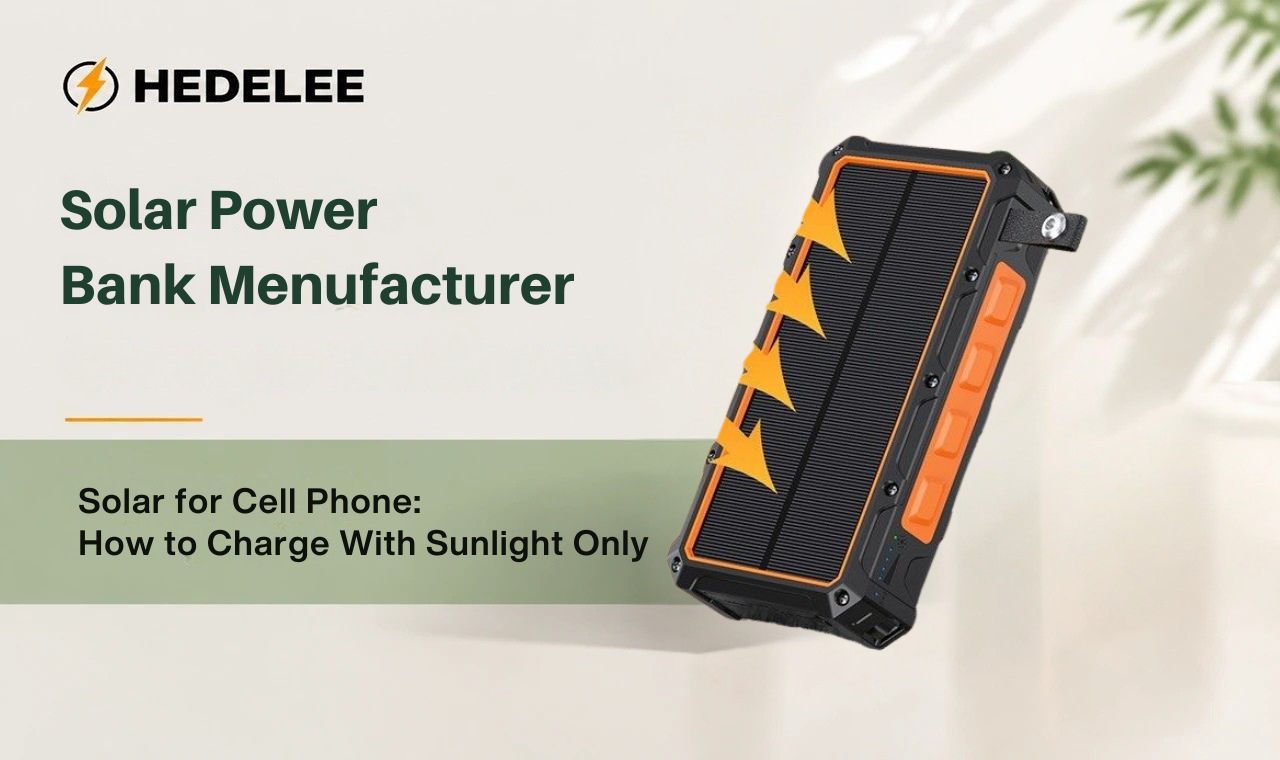
A customer buys a solar charger and leaves it in the sun all afternoon. The phone gains only a few percent. Then the return request lands on your desk.
Buyers and product managers hear this story often. It usually starts with the wrong product for the job, or with a promise the box can’t keep.
Solar for cell phone charging works well when panel size, battery capacity, and user habits line up. A panel collects energy, a battery stores it, and the phone draws from that battery.
Below, you’ll find how each charger type works and how long charging takes. You’ll also see which specs to check, which shipping rules apply, and which models suit each sales channel.
What Does Solar for Cell Phone Charging Mean?
Solar for cell phone charging means using sunlight as the power source for a phone. A photovoltaic panel converts light to electricity. That electricity then flows to the phone or, more often, to a battery first.
Most products use the battery-first design, and the reason is simple. Sunlight changes every minute, but a phone wants steady power. So the battery works as a buffer between the two.
How does a solar power bank work?
A solar power bank has four working parts:
- Solar panel. It collects light and produces a small current.
- Charge controller. It manages that current and protects the cells.
- Lithium battery. It stores the energy for later use.
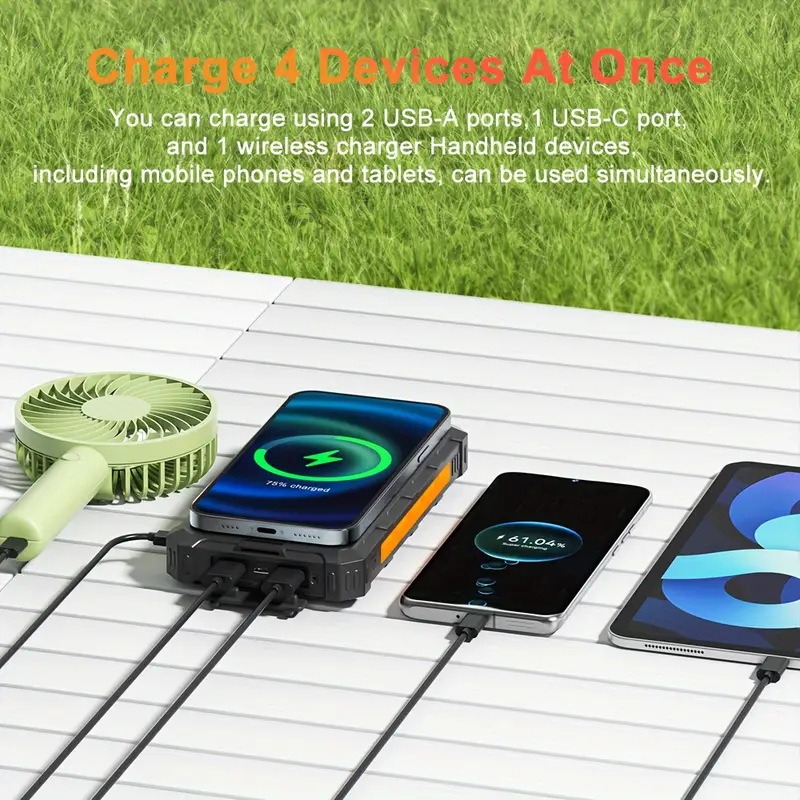
- Output ports. USB-A, USB-C, or a wireless pad send power to the phone.
The unit also accepts wall power through a USB input. So users can fill it at home, then let the sun top it up outdoors.
What can solar charging do, and what can’t it do?
Clear limits help you sell the product with confidence. Here is a fair picture:
- It can keep a phone alive for days away from an outlet.
- It can add free power whenever the sun is out.
- It can serve as backup during storms and power cuts.
- It can’t match the speed of a wall charger.
- It can’t work well indoors, in shade, or behind glass.
Because of these limits, the stored battery does most of the work. The panel then extends it.
Why does one product have so many names?
Buyers search for this product under several names. Wholesale catalogs usually say solar power bank or solar powered power bank. Some search data even shows reversed phrases like “bank power solar.”
Retail listings lean on the phone instead. There you’ll see solar phone charger, solar cell phone charger, and solar mobile phone charger. “Cell phone” is common in North America. “Mobile phone” is more common in the UK, India, and Australia.
Longer marketplace titles often read “solar power bank battery charger.” All of these terms describe one idea: a panel, a battery, and a phone output in a single device. So match your listing title to the wording your market uses.

Which Solar Phone Charger Type Fits Your Market?
Three product types cover almost every need. Each one trades carry size against solar input in a different way.
1. Compact solar power bank with a built-in panel
This is the pocket-size format most people picture. A single panel sits on the face of the bank. Because the panel is small, solar acts as a top-up and an emergency source. Wall charging still does the main work.
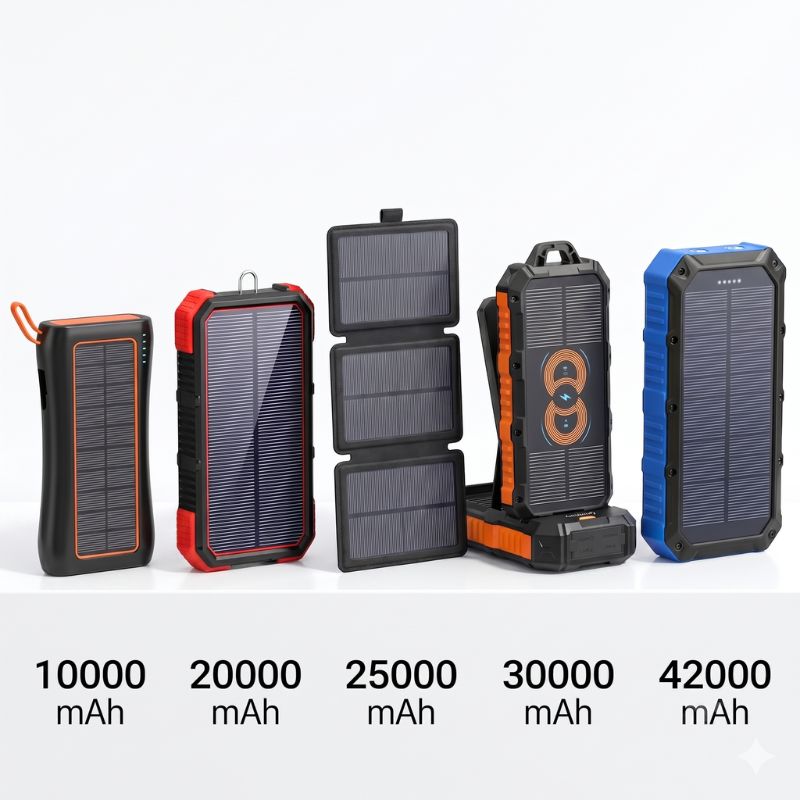
The format suits travel, daily carry, and gift programs. Our 10000mAh outdoor solar power bank with wireless charging is a typical example. For more stored energy, the 20000mAh dual-USB waterproof solar power bank (HDL519X) follows the same single-panel idea.
2. Foldable multi-panel solar power bank
Here, extra panels fold out from the battery body. More panel area collects several times more light. So the sun can replace a useful share of daily phone use.
Campers and hikers like this format because it still stores power for the night. See the foldable 20000mAh solar charger with LED lights for reference.
3. Standalone folding solar panel
This type has no battery at all. It sends power straight to a USB port while the sun shines. Panels are larger, often 10 to 30 watts, so charging is faster.
But it stops working at dusk and slows under cloud. For that reason, many users pair a folding panel with a regular power bank.
How do the three types compare?
| Feature | Built-in panel bank | Foldable panel bank | Standalone panel |
|---|---|---|---|
| Stores energy | Yes | Yes | No |
| Typical panel power | About 1–2 W | About 5–8 W | 10–30 W |
| Works at night | Yes | Yes | No |
| Carry size | Small pouch | Backpack | |
| Role of solar | Top-up, emergency | Partial daily refill | Direct charging |
| Good fit | Travel, gifts, emergency kits | Camping, hiking, field work | Base camps, vehicles |
Panel power figures are common market ranges. Always confirm the exact wattage on each model’s spec sheet.
Which type should you stock? The built-in type fits the widest range of channels, because it is compact and familiar. The foldable type suits outdoor users who expect the sun to do real work. Carrying both lets each customer choose.
How Long Does Solar Charging Take? The Real Math
Short answer: a pocket solar power bank needs many sunny days to refill itself from the sun alone. A foldable model needs about three to four days. A wall outlet does the same job in hours.
Three numbers explain why: battery energy, panel power, and sun hours.
Step 1: Convert capacity to watt-hours
Capacity labels use mAh, but energy is easier to compare in watt-hours (Wh). The formula is short:
Wh = mAh × 3.7 ÷ 1000
So a 20000mAh bank holds about 74 Wh. A phone with a 5000mAh battery holds roughly 19 Wh.
Step 2: Estimate real panel output
A panel rarely delivers its rated power outdoors. Heat, angle, haze, and conversion all take a share. For planning, assume about 70% of the rated watts.
Step 3: Count sun hours
Many regions get four to six strong sun hours on a clear summer day. Winter and cloudy weather bring fewer. The table below assumes five hours a day.
| Panel type | Rated power | Sun hours to refill 20000mAh (74 Wh) | Days at 5 sun hours |
|---|---|---|---|
| Built-in single panel | 1.5 W | About 70 | About 14 |
| Foldable multi-panel | 6 W | About 18 | About 3.5 |
| Standalone folding panel | 20 W | About 5–6 | About 1 |
These are estimates for clear weather. Real results shift with season, latitude, and how well the panel faces the sun. A bank’s input limit can also cap what a large panel delivers.
What does that mean for the phone?
Look at daily gains instead of full refills. A 1.5 W panel collects about 5 Wh on a sunny day. That equals roughly a quarter of one phone charge. A 6 W foldable panel collects about 21 Wh, which is close to one full phone charge.
So a built-in panel stretches the stored energy a little each day. A foldable panel can cover one person’s daily phone use in good weather.
How many phone charges does the battery give?
Not every stored milliamp-hour reaches the phone. Voltage conversion and heat use some energy. As a planning figure, expect 65% to 75% of the labeled capacity.
For example, a 20000mAh bank delivers about 13000 to 15000mAh. That means 2.6 to 3 charges for a 5000mAh phone.
What happens on cloudy days?
Clouds cut panel output sharply. On a heavy overcast day, a small panel may collect very little. Thin cloud is kinder, but output still drops.
So plan around stored energy, not daily sunshine. A full 20000mAh bank covers a long weekend for one phone without any sun. The panel then adds a safety margin.
This math helps your product copy too. A box that says “solar top-up for emergencies” sets fair expectations. A box that implies fast solar refills invites returns.
How to Use Solar for Cell Phone Charging: 5 Steps
Good habits can raise what a small panel collects by a wide margin. These five steps work for any solar phone charger. They also make useful copy for a manual or an insert card.
Step 1: Fill the bank from a wall outlet first
Start every trip at 100%. Then the sun only has to replace what you use each day. This single habit removes most complaints about slow solar charging.
Step 2: Give the panel direct sun
Face the panel toward the sun and tilt it, instead of laying it flat. Re-aim it every two hours if you can. Also avoid windows, because glass cuts the light a panel receives.
Step 3: Keep the battery cool
Lithium cells dislike heat. So never leave the unit on a car dashboard. On hot days, shade the battery body where the design allows it. A cooler battery also lasts more charge cycles.
Step 4: Charge the bank by day and the phone from the bank
Clouds interrupt direct solar charging again and again. Stored power is steady, so the phone charges at a stable rate. Many users charge the phone at night and leave the bank in the sun by day.
Step 5: Top up every day
Small daily gains add up over a week. Check the indicator lights each evening. On long trips, switch the phone to low power mode as well.
Common mistakes that cut solar output
- Hanging the unit inside a backpack pocket, where the panel gets little light.
- Charging behind a car windshield, where heat builds up fast.
- Expecting a full solar refill in one afternoon.
- Letting a shadow fall across part of the panel.
- Storing the bank empty for months, which shortens battery life.
Print these points on the box or manual. Clear guidance costs almost nothing, and it lowers return rates.
What Specs Should Buyers Check on a Solar Power Bank?
A spec sheet tells you how the product will perform in a customer’s hands. Seven items deserve a close look.
Capacity and watt-hours
Capacity sets how many phone charges a user gets. It also sets the watt-hour rating, which decides air travel status. The table below uses 3.7 V cells and a 5000mAh phone.
| Capacity | Energy | Approx. phone charges | Air travel status (carry-on) |
|---|---|---|---|
| 10000mAh | 37 Wh | 1.3–1.5 | Under 100 Wh |
| 20000mAh | 74 Wh | 2.6–3 | Under 100 Wh |
| 24000mAh | 89 Wh | 3.1–3.6 | Under 100 Wh |
| 25000mAh | 93 Wh | 3.3–3.8 | Under 100 Wh |
| 30000mAh | 111 Wh | 3.9–4.5 | 101–160 Wh: airline approval needed |
| 36000mAh | 133 Wh | 4.7–5.4 | 101–160 Wh: airline approval needed |
| 42000mAh | 155 Wh | 5.5–6.3 | 101–160 Wh: airline approval needed |
Solar panel size and cell type
Ask for the panel’s rated watts, not only its dimensions. Monocrystalline cells usually convert more light than polycrystalline cells of the same size. Also check whether the model has one panel or several folding panels.
Outputs and charging speed
Count the ports and note the output rating. A 5V/3A output charges most phones at a good pace. A USB-C input also lets users refill the bank faster from the wall.
Wireless charging
A Qi wireless pad adds convenience, because users can charge without a cable. It suits gift and retail buyers well. Wired charging stays more efficient, so list both options clearly.
Built-in cables
Some models carry three or four cables in the body. Users can’t forget them, which reduces “it didn’t work” complaints. Still, confirm which connector types fit your market.
Water and dust rating
Outdoor products need a clear IP rating. IP65 means dust-tight and protected against water jets. IPX4 means protected against splashes from any direction. Neither rating covers full immersion.
Lighting and shell design
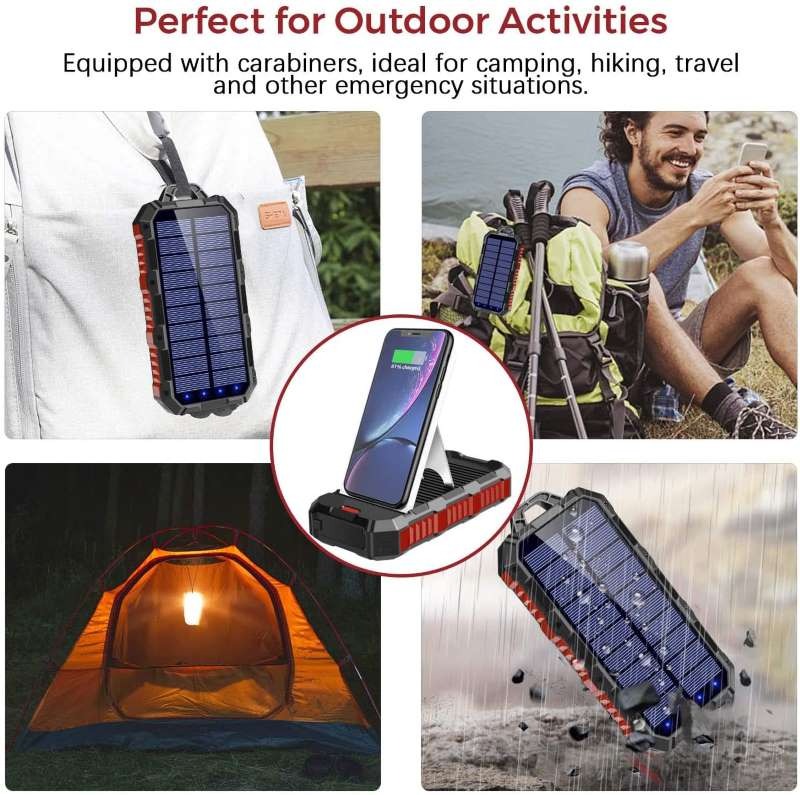
An LED flashlight adds emergency value for campers and households. Look for a shock-resistant shell, port covers, and a hanging loop too. These small details shape reviews more than buyers expect.
Which model fits which need?
The table below maps our current range to common buyer needs. You can also browse the full solar power bank collection.
| Buyer need | Model | Key features |
|---|---|---|
| Entry price, daily carry | 10000mAh outdoor solar power bank | Wireless charging, fast charging, strong light |
| Everyday outdoor retail | 20000mAh wireless solar power bank (HDL-218) | Wireless output, dual inputs, waterproof, flashlight |
| Simple wired format | 20000mAh waterproof solar power bank (HDL519X) | Dual USB, waterproof, LED light |
| Faster 20000mAh charging | 20000mAh fast-charging waterproof solar power bank | Fast charging, waterproof shell |
| Stronger solar input | Foldable 20000mAh solar charger | Fold-out panels, fast charging, LED lights |
| Camping gear ranges | Camping solar charger power bank (HDL519) | Portable outdoor design for electronic devices |
| Longer trips under 100 Wh | 25000mAh solar charger with dual USB | Dual USB ports, waterproof |
| Cable-free convenience | 24000mAh solar power bank with 4 built-in cables (HDL529) | Wireless pad, dual LED flashlight, IPX4, 36000mAh version |
| Flexible capacity tiers | 24000/30000/36000mAh wireless solar power bank (HDL-531) | Three cables, wireless charging |
| Rugged high capacity | 30000mAh IP65 solar power bank (HDL528) | Qi wireless, USB Type-C input, 5V/3A output |
| Group and multi-day use | 42000mAh solar power bank (HDL-628) | 4 built-in cables, wireless pad, dual LED flashlight |

Which Compliance and Shipping Rules Apply?
Every solar powered power bank contains lithium cells. So transport and safety rules apply before the first carton ships.
UN38.3 transport testing
Lithium batteries must pass the UN38.3 test series before transport by air, sea, or road. The eight tests simulate altitude, temperature swings, vibration, shock, and short circuit, among others. The rules sit in the UN Manual of Tests and Criteria.
Ask your supplier for the UN38.3 test summary for each model. Your freight forwarder will ask you for it.
Air travel limits for end users
Airlines sort power banks by watt-hours. Under the FAA PackSafe rules for lithium batteries, the limits are:
- Up to 100 Wh: allowed in carry-on bags.
- 101 to 160 Wh: airline approval required, with a limit of two spare batteries.
- Over 160 Wh: not allowed for passengers.
Power banks must travel in carry-on bags, never in checked luggage. Some airlines now apply stricter limits and ban in-flight use. So print the Wh rating clearly on the product and the box.
This affects range planning. If your customers fly often, keep a model of 25000mAh or less in the lineup. Larger models suit road trips, camping, and home emergency kits.
Market approvals and documents
Each market asks for its own paperwork. Before ordering, request:
- The UN38.3 test summary and a current safety data sheet (SDS).
- Market approvals for your region, like CE, UKCA, FCC, or PSE.
- RoHS or similar material compliance reports.
- Rating labels with capacity, Wh, input, and output.
- Test results that support the stated IP rating.
A supplier who sends these files quickly usually runs a disciplined factory. Treat slow or vague answers as a warning sign.
Labels and packaging
Clear labels prevent trouble at customs and at airport security. The product should show capacity in mAh and Wh, plus input and output ratings. Shipping cartons also need the correct lithium battery marks. Your forwarder can confirm the marks for each route.
Where Does a Solar Powered Power Bank Sell Well?
Demand comes from people who spend time away from outlets, or who can’t rely on the grid. Five channels stand out.
| Sales channel | What users want | Suggested spec |
|---|---|---|
| Outdoor and camping retail | Multi-day power, weather protection | 20000–30000mAh, IP65, flashlight, foldable panels |
| Emergency preparedness | Ready backup, a light source | 20000mAh or more, LED light, built-in cables |
| Promotional gifts | Compact size, logo area | 10000mAh, wireless charging |
| Regions with unstable power | Daily backup for several devices | 20000–42000mAh, multiple outputs |
| Field crews and fleets | Rugged shell, steady output | 30000mAh, 5V/3A, IP65 |
Outdoor and camping retail
Hikers and campers accept slower solar input because no outlet exists on the trail. They value weather protection, a flashlight, and a hanging loop. Foldable models do well here.
Emergency preparedness
Storm seasons and power cuts drive steady demand. A solar phone charger with a light and built-in cables fits a home emergency kit. Buyers in this channel often choose mid capacity at a friendly price.
Promotional gifts
A compact unit with a logo makes a useful gift. Wireless charging adds a modern touch. Also keep capacity under 100 Wh, so recipients can fly with it.
Regions with unstable power
Where outages are frequent, a solar mobile phone charger becomes a daily tool. Families want higher capacity and several outputs. For this reason, 30000mAh and 42000mAh models suit these markets.
Field crews and fleets
Construction, farming, and survey teams work far from outlets. They need rugged shells and steady output for long shifts. A 30000mAh IP65 unit fits this group well.
How to Source Solar Phone Chargers Direct From the Factory
Buying from the original manufacturer shortens the path between your question and the answer. You speak with the people who design, build, and test the product.
Shenzhen Hedeli Technology Co., Ltd. has worked in mobile accessories and consumer electronics for about 10 years. Our team of more than 100 people runs a head office in Shenzhen. We also keep an office and a showroom in Guangzhou. Our Dongguan factory has a monthly capacity of 50,000 units, and it supplies importers, distributors, and wholesalers on time.
Our range goes beyond solar. It also covers power banks, TWS earbuds, Bluetooth speakers, USB chargers, USB cables, car chargers, and car phone holders. So you can combine several categories with one supplier.
A simple sourcing path
- Share your market and channel. Tell us the country, the sales channel, and the target price.
- Shortlist two or three models. Use the tables above to match capacity and features.
- Test samples. Check charging output, solar input, and build yourself.
- Confirm branding. Agree on logo, color, packaging, and manual text.
- Review documents. Collect the test reports and labels your market needs.
- Plan the schedule. Fix quantities and ship dates around your sales season.
Questions worth asking any supplier
| Question | Why it helps |
|---|---|
| Is the capacity rated or actual? | Confirms the label matches the cells |
| What is the panel’s wattage? | Sets a fair solar claim |
| Which test reports exist for this model? | Speeds up customs and listing approval |
| What is the monthly output? | Shows whether peak-season orders fit |
| Can I test a sample first? | Verifies performance before you commit |
Talk to the factory behind the product
A strong solar range starts with fair specs and a supplier who answers clearly. As the original manufacturer, we give you direct access to the source. No trading layer sits between your team and our engineers.
Send us your target capacity, quantity, and market. We’ll reply with matching models, a quote, and sample options. You can start from the solar power bank range, or write to our sales team with your project brief.
Frequently Asked Questions
1. What is the minimum order quantity for solar power banks?
The minimum order quantity depends on the model and the level of customization. Standard units with neutral packaging usually need smaller quantities than custom colors or packaging. Send us your target model and volume for an exact figure.
2. Can you customize the logo, color, and packaging?
Yes, logo printing, shell color, and packaging can be customized on most models. Options vary by model and order size. Reach out for detailed specifications and artwork guidelines.
3. What compliance tests should a solar phone charger pass?
Every lithium power bank needs a UN38.3 test summary for transport. Your market may also require approvals like CE, FCC, or UKCA, plus RoHS reports. Ask us for the documents available for each model.
4. How long is the lead time for bulk orders?
Lead time depends on quantity, customization, and the season. Our Dongguan factory has a monthly capacity of 50,000 units. Share your deadline early, and we’ll confirm a realistic schedule.
5. Do you provide samples before a bulk order?
Yes, samples are available so your team can test performance first. Check solar input, output speed, and build before you commit. Contact us to request samples of the models you shortlisted.