

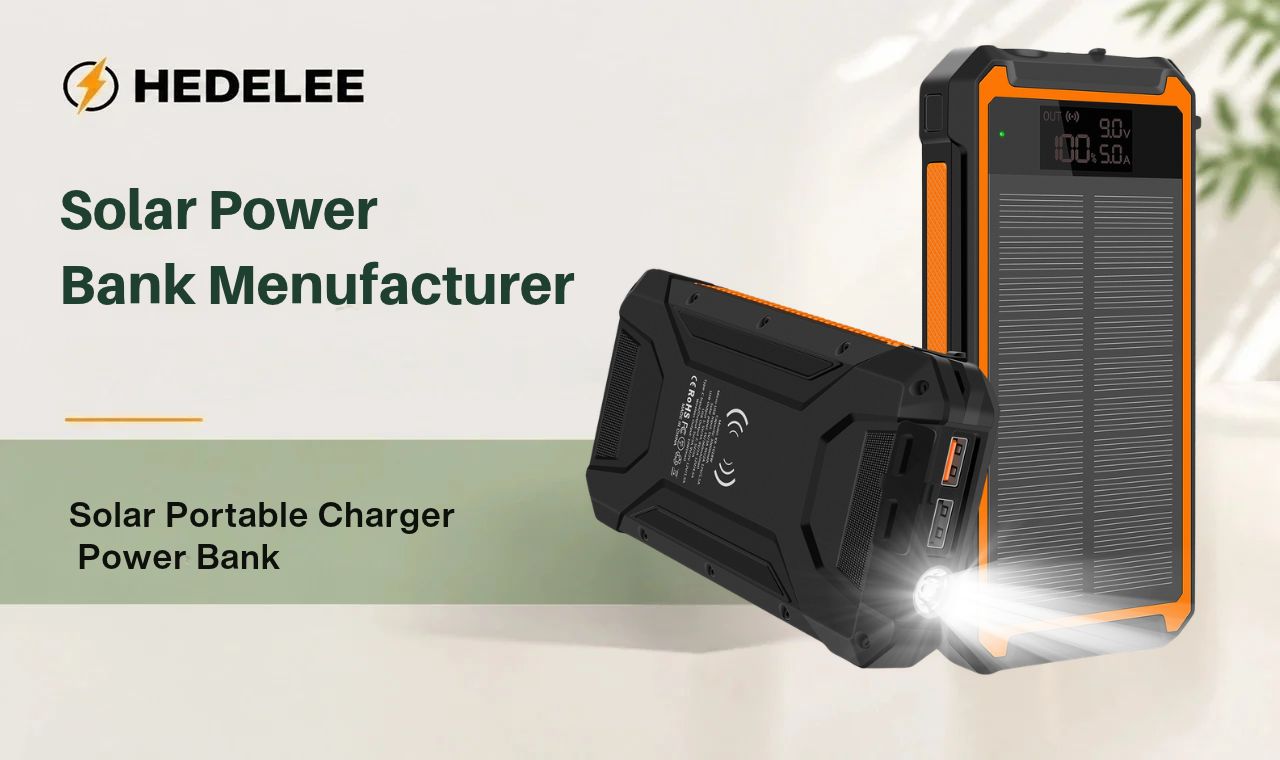
A container of solar power banks can look flawless at the factory gate and still generate returns by the following spring. The units charge phones fine on day one. The trouble starts when end customers expect the sun to refill a 20,000mAh battery in an afternoon, or when a summer of heat quietly ages the cell inside.
Choosing a solar portable charger power bank for your catalog takes more than comparing mAh ratings and unit prices. It takes an honest understanding of what a small solar panel can and cannot do, which specs separate a dependable product from a refund request, and how battery care affects the reviews your customers leave.
Here is a practical walk-through: how these devices work, what to check before placing volume orders, which capacity fits which sales channel, and how to keep the batteries healthy from warehouse to campsite.
What Is a Solar Portable Charger Power Bank?
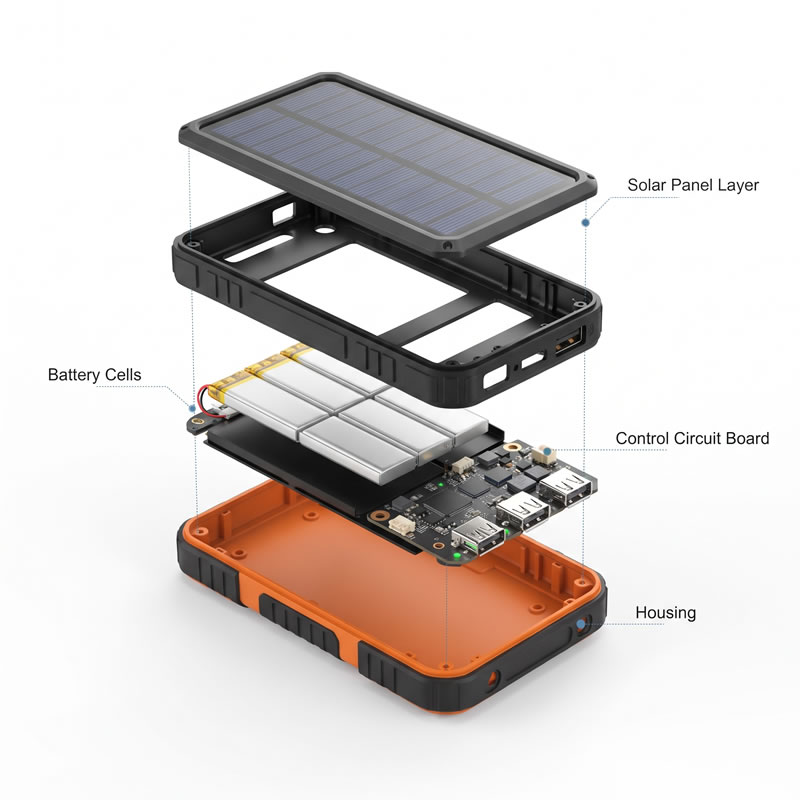
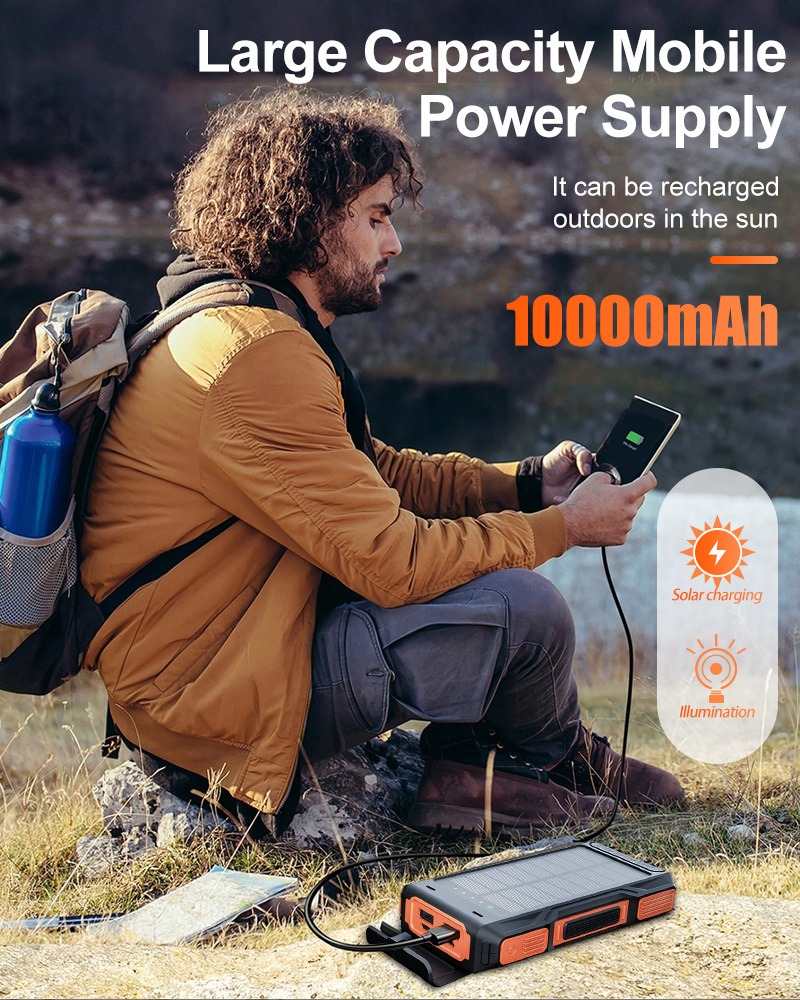
A solar portable charger power bank is a rechargeable lithium battery with a small photovoltaic panel built into its housing. The panel converts sunlight into electricity and feeds it into the internal cell, so the device can store energy outdoors and release it later — at night, in a tent, or on a long bus ride.
Two things inside the product deserve separate attention. The panel is tough and lasts for decades with almost no visible wear. The battery is the sensitive part. How solar cells turn light into current is well documented in the U.S. Department of Energy’s overview of photovoltaic technology, and panels themselves are rarely the failure point in this product category. The cell’s health is what decides whether a customer rates the product five stars or sends it back.
A solar powered power bank also differs from a plain solar charger. A plain charger has no battery at all — it passes sunlight straight to your phone, which only works while the sun is shining and can expose a phone to unregulated voltage. The power bank version buffers that energy in its own cell, which makes it far more useful as a retail product: customers charge it from a wall outlet before a trip, then treat the panel as a running top-up outdoors.
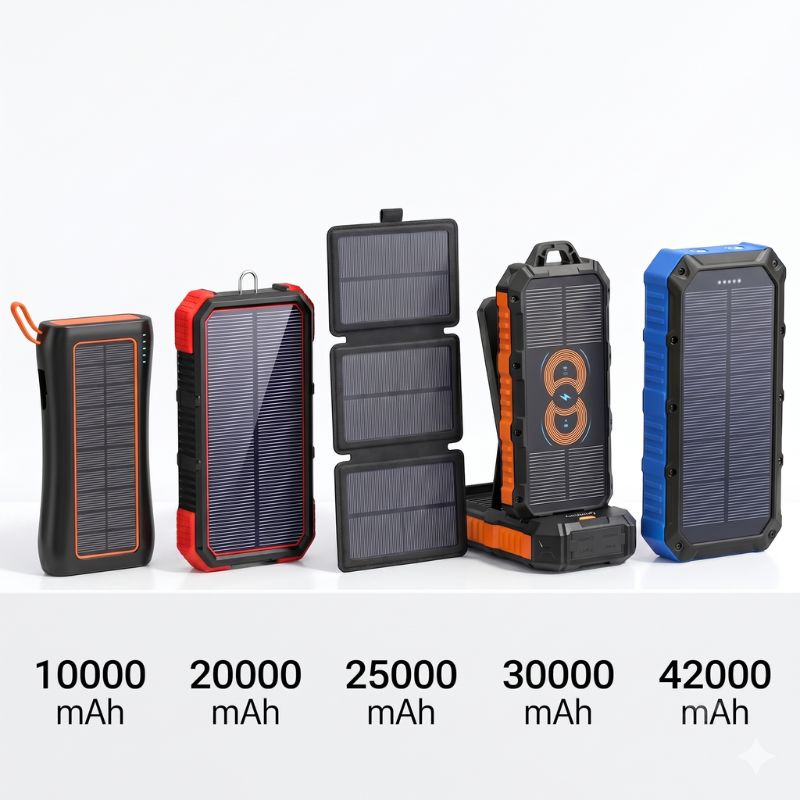
Most models in this category share a common build: a monocrystalline silicon panel around 1 to 1.5 watts, a lithium polymer cell between 10,000 and 42,000mAh, USB and Type-C ports, and extras like LED flashlights, wireless charging pads, carabiners, and water-resistant housings. The combination is what makes the product a camping and emergency-preparedness staple rather than a desk accessory.
How Does Solar Charging Work in Real Outdoor Conditions?
This is where honest product education pays for itself. Portable solar panels run at roughly 7 to 18 percent efficiency depending on the cell type, and the small panel on a pocket-size bank is no exception. A 1.5-watt panel in strong midday sun delivers around 300mA at 5 volts. Set that against a 20,000mAh battery and the math is plain: filling the whole cell from sunlight alone would take days of good weather, not hours.
That is not a flaw in the product. It is the physics of fitting a panel onto something that slips into a backpack. The right way to present a solar power bank to end customers — and the framing that protects your reviews — is this: the wall outlet does the heavy lifting, and the sun stretches runtime in the field.
Real charging speed outdoors depends on several variables buyers should understand:
-
Panel angle. Output drops fast when the panel lies flat instead of facing the sun directly.
-
Cloud cover. Overcast skies can cut panel output by half or more.
-
Temperature. Extreme heat reduces panel efficiency and stresses the battery at the same time.
-
Panel size. Fold-out designs with two or three panels harvest meaningfully more current than a single fixed panel.
Foldable multi-panel models exist precisely because of this. A unit with three 1.5W panels, like the waterproof 20,000mAh solar panel power bank with LED light (HDL519X), triples the solar intake of a single-panel design while folding down to the same packed size.
When your listings and packaging set these expectations honestly, something pleasant happens: customers describe slow-but-steady solar charging as working as promised, and the flashlight, capacity, and durability become the features they praise instead.
Why Eco-Friendly Charging Keeps Winning Shelf Space
Solar charging has moved from a novelty to a standard shelf category, and the reasons are visible on the demand side.
Outdoor recreation keeps growing. Camping, hiking, and festival culture all create the same need: power far from an outlet. Emergency preparedness is the second engine. Storm seasons, grid outages, and wildfire evacuations push households toward backup power, and a solar bank that doubles as a flashlight and radio-adjacent lifeline fits that shopping list naturally. Corporate gifting is a quieter third channel — a branded solar charger says something about the company handing it out.
The eco-friendly angle is genuine but deserves honest handling. A solar bank will not replace grid charging for daily use, and responsible brands do not claim that. What it does offer is an off-grid portable charging solution that needs no disposable batteries, draws free energy in the field, and keeps working when the grid does not. For retailers, that story sells particularly well in outdoor, travel, and preparedness aisles.
Search behavior reflects the breadth of the demand. Buyers and end consumers look for the same product under many wordings — solar power bank, solar phone charger, even reversed constructions like bank power solar when non-native English speakers hunt for suppliers. The demand behind every variation is identical: stored energy that refills anywhere the sun shines.
For importers and distributors, the takeaway is encouraging. This is not a trend product with a two-season window. Panel and battery costs stay favorable, the use cases keep multiplying, and the category rewards sellers who educate customers rather than overpromise.
How to Choose a Solar Portable Charger Power Bank for Your Market
The spec sheet is where a strong purchase decision starts. Before comparing prices between suppliers, walk through these checkpoints with any solar portable charger power bank you are evaluating.
Real capacity, not label capacity. Ask for the actual rated capacity of the cell, backed by MSDS documentation. A bank labeled 30,000mAh may hold 20,000–24,000mAh in reality. Reliable factories disclose both numbers; your listings should too.
Panel wattage and count. A single 1.5W panel is standard. Multi-panel foldable designs harvest two to three times more solar input for customers who genuinely charge off-grid.
Ports and charging speed. Look for Type-C input and output at 5V/3A, which refills the bank from a wall in hours instead of overnight. Dual USB outputs let a customer charge two devices at once.
Wireless charging. A 5W Qi pad adds clear perceived value at retail. It is slower than a cable but convenient at a campsite table.
Ingress protection. IPX4 handles splashes and rain. IP65-rated housings, like the 30,000mAh Qi wireless solar charger power bank with Type-C input (HDL528), add dust sealing for beach, desert, and construction-site buyers.
Extras that move units. LED flashlights with SOS modes, built-in cables, carabiners, and lanyards all raise shelf appeal at near-zero cost. The 24,000mAh solar power bank with four built-in cables and dual LED flashlight (HDL529) is a good example of the all-in-one direction this category is heading.
Certifications. CE, RoHS, FCC, and MSDS cover most markets; UN38.3 is required for air shipping lithium cells; UL and PSE open doors in the US and Japan.
You can compare live models against these checkpoints in the full solar power bank category, where capacities, panel specs, and shell materials are listed per unit.
Comparing Capacities and Product Styles
Capacity is the first filter buyers apply, and each tier serves a different customer.
| Capacity tier | Example model | Weight class | Fits best |
|---|---|---|---|
| 10,000mAh | Compact 10,000mAh wireless solar bank with strong lighting | ~250g | Day hikes, gifts, impulse price points |
| 20,000–25,000mAh | 20,000mAh wireless solar power bank with flashlight (HDL-218) | ~450g | Weekend camping, general retail |
| 24,000–36,000mAh | High-capacity wireless solar bank with three cables (HDL-531) | ~550g | Extended trips, family use |
| 42,000mAh | 42,000mAh solar battery pack with four built-in cables (HDL-628) | ~740g | Emergency kits, group expeditions |
Within each tier, style decides the sale. A few patterns hold across markets:
-
Classic single-panel banks anchor the volume segment. The 25,000mAh dual USB waterproof solar charger is a typical catalog workhorse.
-
Foldable multi-panel units answer the charging-speed objection and command a higher ticket, as with the fast-charging foldable 20,000mAh outdoor solar charger with LED lights.
-
Built-in cable models remove the forgotten-cable complaint, the single most common usability gripe in customer reviews.
-
Camping-focused designs with strong floodlights speak directly to outdoor retailers; the solar charger power bank designed as camping gear (HDL519) positions exactly there.
A balanced wholesale order usually mixes one anchor capacity with one step-up model, so the retail shelf tells a good-better story without doubling your SKU count.
Battery Health: Helping a Solar Power Bank Last Longer
Here is the detail that separates sellers with strong reviews from sellers drowning in warranty claims: the solar panel will outlive the battery every time, and heat is what ages the battery.
Lithium cells charge safely between roughly 5 and 45 °C. A dark-cased bank left in direct midday sun or on a car dashboard can push well past that ceiling, and charging a hot cell stacks the two strongest aging factors — heat and current — on top of each other. The numbers are stark. Kept around room temperature, a lithium cell loses about 20 percent of its usable capacity over three to five years. At sustained 50–60 °C, the same loss can arrive in one to two years. Battery University’s guidance on prolonging lithium-based batteries documents the same pattern.
Storage habits matter almost as much. A solar power bank battery charger parked at 100 percent in a hot garage degrades faster than one stored at 60–80 percent in a cool cupboard. Lithium cells also self-discharge about 1.5–2 percent per month — faster when warm — so a unit left empty for a season can drift into damaging over-discharge.
Sharing these care habits with your end customers costs nothing and measurably reduces returns:
-
Charge from the wall to about 80–90 percent before a trip instead of a full 100 percent
-
Lay the panel in the sun but keep the battery in shade under a pack or tent flap
-
If the housing feels hot to the touch, pause charging until it cools
-
Store the bank at 60–80 percent between seasons and top it up every few months
-
Retire any unit that swells or bulges, and dispose of it through battery recycling, never household trash
Some importers print a condensed version of this list on the insert card. It takes one line of packaging budget and changes how the product ages in the field — which is ultimately how your brand ages in the market.
Where Solar Phone Chargers Sell Well
The same product wears different labels across sales channels, and naming it well in each channel lifts conversion.
Outdoor and camping retail is the home turf. Shoppers here respond to lumens, waterproofing, and weight. A solar phone charger with a strong flashlight and carabiner clips onto a pack display and practically demonstrates itself.
Emergency preparedness buyers think in outages, not outings. Marketing-led terms like backup power, blackout kit, and storm season outperform camping language. High-capacity models with SOS flashers earn their place next to first-aid kits and water filters.
Travel and accessories retail favors mid-capacity, cable-integrated designs — the airport-friendly version of the category. A compact solar cell phone charger moves well beside adapters and neck pillows.
Corporate gifting and promotions care about print area and unit price at volume. The flat shell of most solar banks takes a logo cleanly, and the eco-friendly framing gives the gifting company a story to tell.
Emerging and price-sensitive markets search differently — solar mobile phone charger is the common phrasing across South Asia and parts of Africa — but buy for the same reason: unreliable grids make stored sunlight genuinely useful rather than recreational.
One product family, five distinct merchandising languages. Wholesalers who plan listings per channel instead of pasting one generic description typically see the difference within a single season.
Compliance, Customization, and Lead Times for Wholesale Orders
Professional buyers weigh paperwork as heavily as product. Here is how the operational side typically runs for a wholesale solar phone charger supplier relationship.
Testing and certifications. Models in this category commonly carry CE, RoHS, FCC, MSDS, UN38.3, UL, and PSE, with BSCI covering factory social compliance. UN38.3 deserves emphasis: without its test summary, lithium battery cargo does not board an aircraft, and sea freight still requires MSDS documentation. Always request the actual certificates per model, not a generic certificate wall.
Customization. Standard options include custom shell colors at volume, logo printing, branded packaging, and capacity labeling matched to your market. Color runs like the red, orange, blue, black, and green shells on the HDL-531 line show the range available without new tooling.
Samples. Reputable factories ship samples before bulk production. Treat the sample as a contract: the mass production units should match it in cell grade, shell finish, and printed specs.
Lead times. Sample dispatch usually takes days; production for a container-scale order runs a few weeks depending on customization depth, with sea freight adding three to six weeks by destination. A factory with 50,000 units of monthly capacity absorbs mid-size orders without queueing your goods behind larger clients.
Shipping planning. Lithium cargo rules vary by route. Order cutoffs around Chinese New Year and pre-summer retail stocking both affect freight rates, so confirm sailing schedules when you confirm the order.
The pattern across all of this: the fewer layers between you and the factory, the faster answers arrive and the fewer surprises survive into the container.
Talk Directly to the Factory Behind the Product
Shenzhen Hedeli Technology Co., Ltd. has spent about ten years building mobile accessories and consumer electronics — power banks, TWS earbuds, Bluetooth speakers, USB chargers and cables, car chargers, and car phone holders. The team numbers more than 100 people, with headquarters in Shenzhen, an office and showroom in Guangzhou, and a Dongguan factory running a monthly capacity of 50,000 units for importers, distributors, and wholesalers worldwide.
Working with the original manufacturer changes the conversation in practical ways. Specs come from the people who set them, not from a reseller’s translation. Custom colors, packaging, and labeling go straight to the production floor. When you ask for a real capacity figure or a test certificate, the answer arrives from the source.
If the models in this range fit your catalog — or if you see a gap you would like built to your spec — send an inquiry with your target capacity, quantities, and destination market. You will get capacities, certificates, sample options, and pricing directly from the team that assembles the product, with a showroom visit in Guangzhou always open to buyers who want to hold the units before committing.
Frequently Asked Questions
1. What is the minimum order quantity for solar power banks?
MOQs vary by model and customization level, but standard units typically start in the low hundreds per model. Custom shell colors, logos, or packaging may raise the threshold slightly. Reach out with your target quantity and we will confirm exact terms per model.
2. Can we customize logos, colors, and retail packaging?
Yes, customization is a standard part of volume orders. Options include logo printing, custom shell colors, branded boxes, and market-specific capacity labels. Share your artwork and packaging requirements, and we will return mockups with your quote.
3. Which safety certifications do your solar chargers carry?
Models commonly carry CE, RoHS, FCC, MSDS, and UN38.3, with UL and PSE available on selected units. UN38.3 test summaries support air freight, and MSDS documentation covers sea shipping. Contact us for the certificate set matching your chosen models.
4. How long do production and delivery usually take?
Samples typically dispatch within days, and bulk production runs a few weeks depending on order size and customization. Add three to six weeks for sea freight depending on destination. We confirm a firm schedule with every quotation.
5. Can we order samples before committing to bulk stock?
Yes, samples are available and encouraged before volume orders. Testing a sample lets you verify real capacity, shell finish, and charging performance firsthand. Contact us to request samples of the models you are considering.