

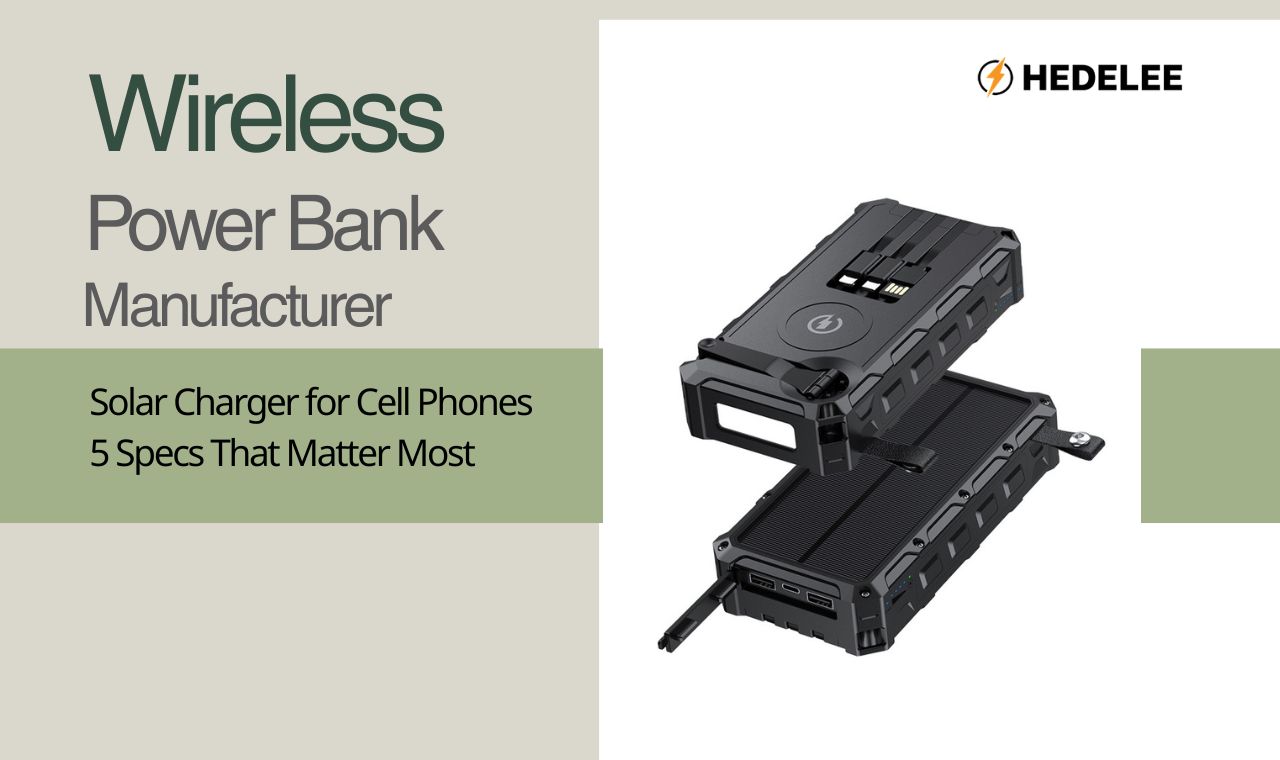
A dead phone in the middle of nowhere is more than an inconvenience — it can mean lost navigation, no emergency contact, and a stranded team. For procurement teams and product managers sourcing portable power solutions, a solar charger for cell phones addresses this gap by turning sunlight into reliable device charging capacity. Over the past decade, demand for solar power banks has grown steadily across outdoor retail, emergency preparedness, travel accessories, and promotional gifting channels. Understanding how these products work, what specifications matter, and how to evaluate suppliers helps buyers make informed decisions that protect both their customers and their margins.
Shenzhen Hedeli Technology Co., Ltd. has spent about 10 years manufacturing mobile accessories and consumer electronics, including solar power banks, TWS earbuds, Bluetooth speakers, USB chargers, and car phone holders. With a factory in Dongguan producing 50,000 units monthly and offices in Shenzhen and Guangzhou, we supply importers, distributors, and wholesalers with products designed for real-world use. This guide draws on that experience to walk you through everything you need to evaluate when sourcing a solar charger for cell phones.
What Is a Solar Charger for Cell Phones?
A solar charger for cell phones is a portable device that converts sunlight into electrical current through photovoltaic panels, then delivers that current to a phone’s battery via a USB output. The concept mirrors rooftop solar — silicon cells absorb photons from sunlight, generating a flow of electrons that becomes usable DC power. The difference is scale: a phone-sized solar panel produces 1 to 5 watts, compared to the hundreds of watts a rooftop array generates.
Most solar chargers fall into one of two categories:
-
Solar panel chargers (no battery): A bare solar panel with a USB output. These are lightweight and foldable, designed to charge devices directly in sunlight. They stop producing power when the sun goes down.
-
Solar power banks (panel + battery): A solar panel paired with an internal lithium battery that stores energy for later use. The panel feeds the battery during the day, and the battery charges your phone anytime — day or night.
For buyers evaluating product lines, solar power banks are generally more versatile because they decouple energy capture from energy use. A customer can leave the device in the sun all day and charge their phone at night, which matches how people actually use their devices outdoors.
How Does a Solar Power Bank Work?
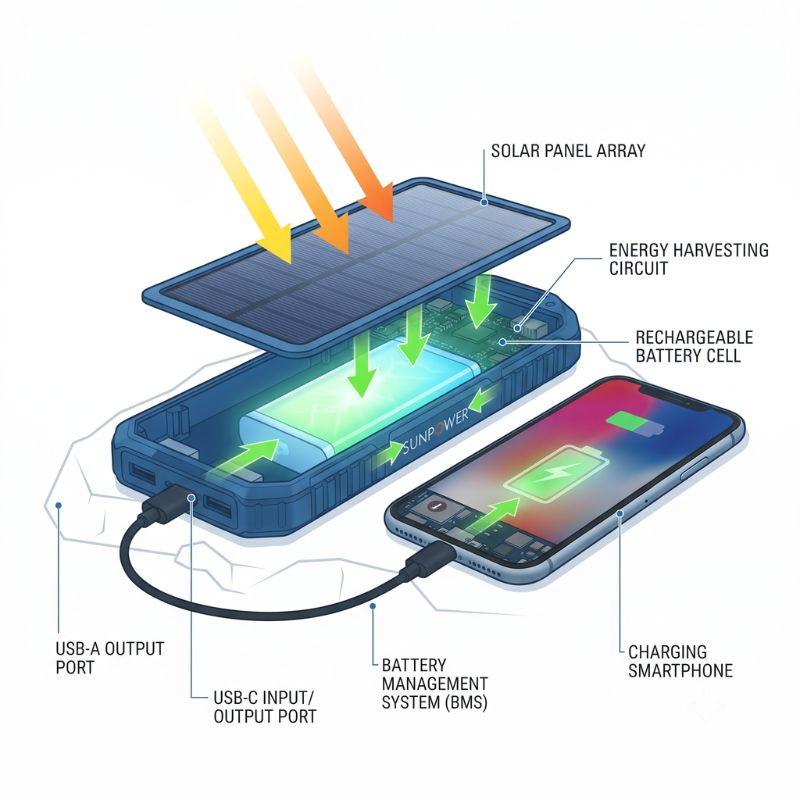
A solar powered power bank operates through a three-stage process: capture, store, and deliver.
Stage 1 — Capture: The built-in solar panel (typically monocrystalline or polycrystalline silicon) absorbs sunlight and converts it into electrical current. Panel wattage on portable solar power banks usually ranges from 1W to 5W. Higher wattage means faster solar charging, but also a larger panel surface area.
Stage 2 — Store: The generated current flows into an internal lithium polymer or lithium-ion battery. Capacities range from 10,000mAh to 42,000mAh depending on the model. The battery acts as a reservoir — it holds the energy collected during daylight hours so it can be used at any time.
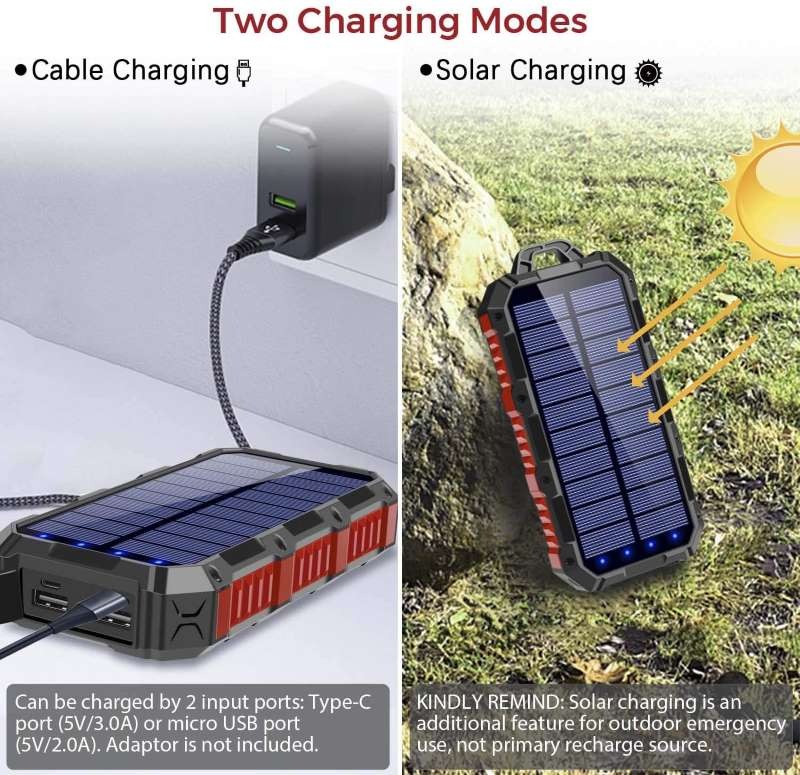
Stage 3 — Deliver: When you connect a phone or other USB device, the battery discharges through the output port. Most modern solar power banks offer USB-A outputs at 5V/2.1A, USB-C inputs/outputs supporting up to 5V/3A, and some include Qi wireless charging at up to 15W.
One detail buyers often overlook: the solar panel on a portable power bank is small, so solar charging is slow. A 1.5W panel under direct sun may deliver only 150–300mA — enough to trickle-charge the internal battery but not enough to charge a phone directly in real time. For this reason, solar charging on a power bank is best treated as a supplementary or emergency feature, with primary charging done via wall outlet.solarpowerbank+1
Why Choose a Solar Phone Charger for Outdoor and Emergency Use?
A solar phone charger fills a specific gap that wall chargers and standard power banks cannot: it generates its own power from an unlimited, free energy source. This matters most in scenarios where grid power is unavailable for extended periods.
Emergency Preparedness
During natural disasters, power outages, or remote travel, a charged phone becomes a lifeline — for calling emergency services, receiving alerts, using GPS navigation, and accessing first-aid information online. A solar power bank battery charger ensures that even after the internal battery is depleted, there is a way to slowly replenish charge from sunlight.
Outdoor Activities
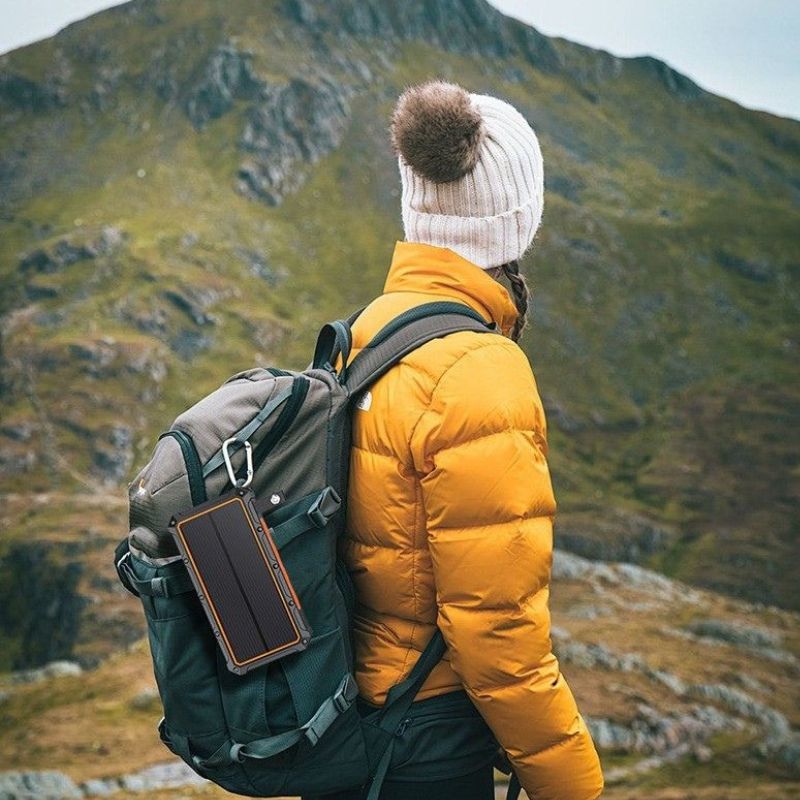
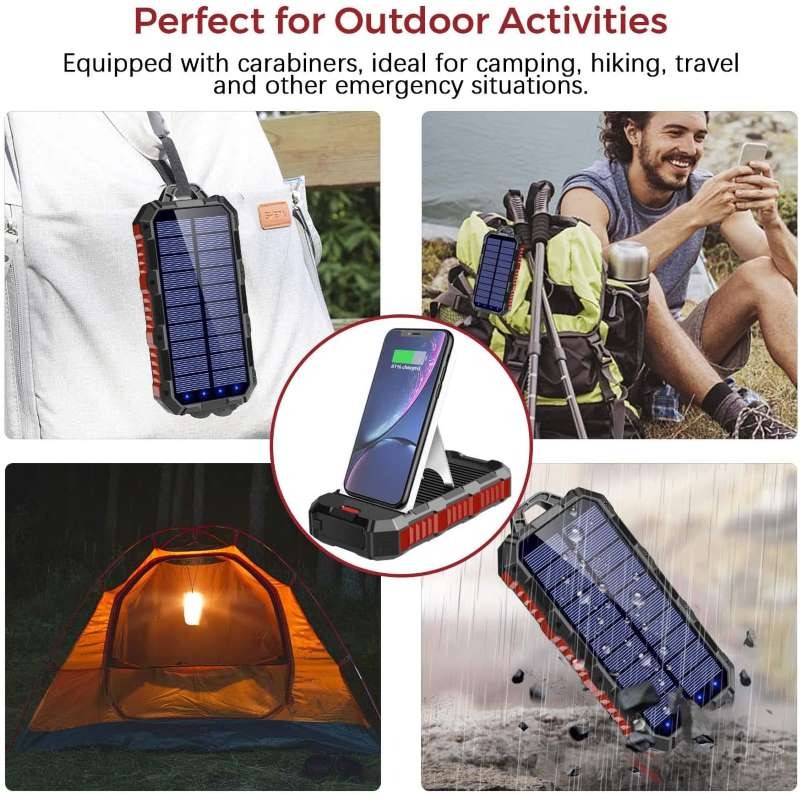
Camping, hiking, hunting, and fishing trips can last several days. Carrying enough pre-charged power banks for a multi-day trip is heavy and impractical. A solar phone charger lets users extend their power supply by harvesting energy during the day while they’re on the move — many models include carabiner clips or loops for attaching to a backpack.
Travel and Daily Backup
For travelers moving between airports, trains, and remote areas, a solar mobile phone charger provides a safety net. Even a partial solar charge can extend a phone’s usable time by several hours when outlets are scarce.
Promotional and Retail Applications
Solar chargers appeal to outdoor brands, emergency kit retailers, travel accessory stores, and corporate gifting programs. Their combination of practical utility and eco-friendly positioning makes them strong sellers in seasonal and year-round catalogs.
Key Specifications to Consider When Sourcing a Solar Power Bank
When evaluating solar power bank models for your product line, several specifications determine performance, safety, and customer satisfaction. Here is a breakdown of what to check.
Battery Capacity (mAh)
Capacity determines how many times a power bank can recharge a phone. A 10,000mAh unit provides roughly 2 full charges for a typical smartphone (accounting for conversion losses of about 30%). A 20,000mAh unit provides 4–5 charges, and a 30,000mAh+ unit can handle multiple devices or extended trips. Higher capacity means more weight, so there is always a trade-off between power and portability.
Solar Panel Wattage
The solar panel wattage determines how quickly the internal battery recharges from sunlight. Most portable solar power banks feature panels rated between 1W and 5W. A 1.5W monocrystalline panel is common on 20,000mAh models and provides a trickle charge that supplements wall charging. Buyers should set realistic expectations: solar charging on portable power banks is an emergency backup, not a primary charging method.solarpowerbank+1
Output Ports and Charging Speed
Modern solar power banks typically include:
-
USB-A outputs: 5V/1A and 5V/2.1A dual ports for charging two devices simultaneously
-
USB-C input/output: Supporting up to 5V/3A for faster charging and reversible connection
-
Qi wireless charging: Up to 15W for compatible phones, eliminating cable clutter
Models with dual inputs (USB-C + Micro-USB) give users flexibility in how they recharge the power bank itself.
Waterproof and Durability Ratings
For outdoor products, ingress protection matters. Common ratings include:
-
IP65: Protected against dust and water jets — suitable for rain and splashes
-
IP67: Protected against dust immersion and temporary water immersion — suitable for beach and water sports
-
IPX4: Splash-resistant only — adequate for light rain
Models with ABS+PC housings wrapped in flame-retardant soft leather or silicone offer better drop resistance and grip.
Built-in Cables and LED Lighting
Many models now include built-in charging cables (USB-C, Lightning, Micro-USB) to eliminate the need for carrying separate cords. Dual LED flashlights with multiple modes (strong, strobe, SOS) add emergency utility and are a common feature on outdoor-oriented models.
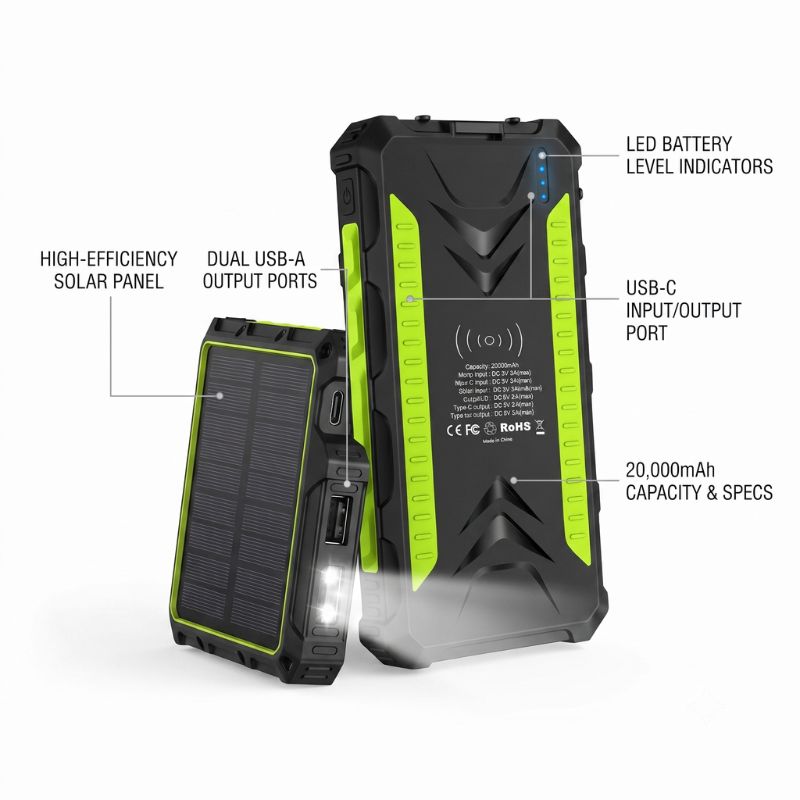
Solar Charger for Cell Phones: Capacity Guide and Product Options
Different market segments demand different capacities and feature sets. Here is a practical guide to matching products to use cases, referencing models from our current production line.
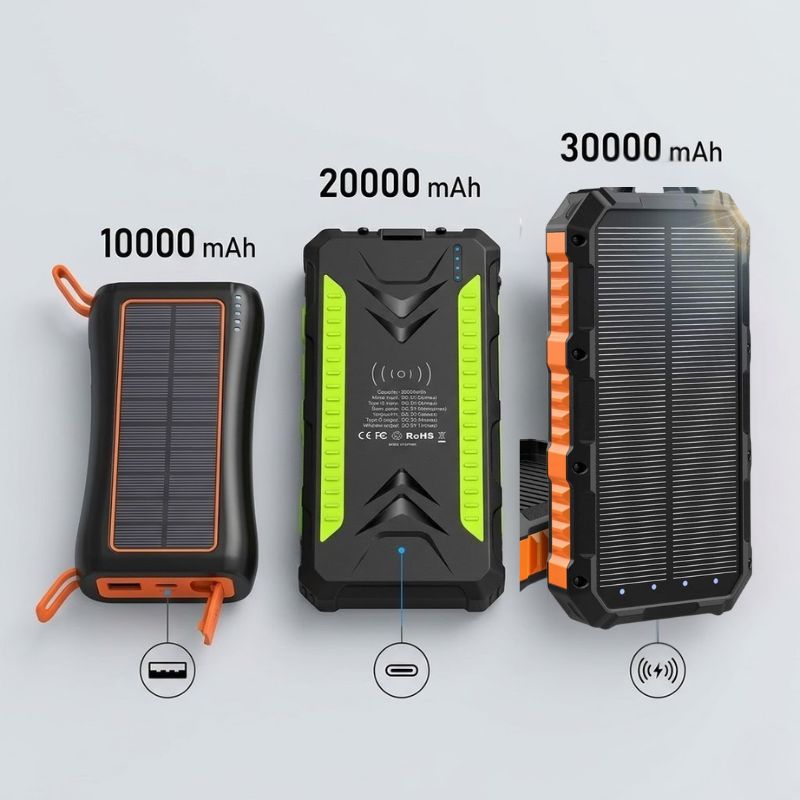
10,000mAh — Lightweight Daily Backup
The 10,000mAh outdoor solar power bank with wireless charging suits day-trippers, commuters, and emergency kit inclusion. It is light enough to carry daily and provides approximately 2 full phone charges. Wireless charging support adds convenience for modern phone users.
20,000mAh — The Versatile Middle Ground
A 20,000mAh solar power bank is the most balanced option for most buyers — enough capacity for a weekend trip without excessive weight. Several models cover this range:
-
20000mAh solar power bank with wireless charger, dual inputs, and flashlight (HDL-218) — waterproof with dual inputs and LED flashlight
-
Foldable outdoor solar charger 20000mAh with LED lights — foldable panel design for compact storage
-
Waterproof 20000mAh solar panel power bank with fast charging
-
New solar panel power bank 20000mAh with dual USB and LED light (HDL-519X)
25,000–30,000mAh — Extended Outdoor and Group Use
For multi-day trips, group travel, or markets focused on emergency preparedness, higher capacity models provide more headroom:
36,000–42,000mAh — Maximum Capacity for Base Camps
For buyers targeting serious outdoor retailers, disaster relief organizations, or bulk procurement for teams, the largest capacity models offer extended autonomy:
-
36,000mAh wireless solar power bank with three built-in cables (HDL-531)
-
36,000mAh solar power bank with built-in 4 cables and dual LED flashlight (HDL-529)
-
42,000mAh solar power bank with built-in 4 cables and dual LED flashlight (HDL-628)
You can browse our full solar power bank product category to compare all available models.
How to Choose the Right Solar Cell Phone Charger Supplier
Selecting the right manufacturing partner is just as important as choosing the right product specifications. Several factors distinguish reliable solar charger suppliers from those who cut corners.
Manufacturing Experience and Capacity
A supplier with a decade of production experience has likely refined their quality control processes, resolved common defect issues, and built relationships with component vendors. Shenzhen Hedeli Technology has been manufacturing for approximately 10 years, with a Dongguan factory producing 50,000 units monthly. This volume capacity ensures that order fulfillment stays on schedule even for large procurement runs.
Battery Safety and Compliance
Lithium batteries carry inherent safety risks. Reliable suppliers use cells from reputable manufacturers and build in multi-protection circuitry covering over-charge, over-current, short-circuit, and over-temperature protection. Buyers should request
-
UN38.3 test reports (required for lithium battery transport)
-
CE and FCC certifications for target markets
-
RoHS compliance documentation
-
MSDS (Material Safety Data Sheet)
For reference on international battery safety standards, the IEC 62133 standard governs safety requirements for portable sealed secondary cells — buyers should confirm their supplier tests to this specification.
Customization Options
For distributors building private-label brands, customization matters. Common options include:
-
Custom logo printing or embossing on the housing
-
Custom packaging design (retail boxes, blister packs)
-
Cable and accessory configuration (type, length, quantity)
-
Color options — for example, black/red, black/orange, black/blue, and all-black variants are available on many models, with full custom colors possible at higher order quantities
-
Pre-loaded firmware or capacity labeling per buyer specification
Sample Availability and Lead Times
Before committing to a production order, request samples to verify build quality, charging performance, and solar panel output under real conditions. Typical lead times from Chinese manufacturers range from 15 to 35 days depending on order volume and customization level. A supplier with a Dongguan factory and Shenzhen/Guangzhou offices can typically offer faster turnaround and in-person showroom visits for due diligence.
Quality Control Processes
Ask potential suppliers about their QC procedures:
-
Incoming material inspection (battery cells, PCBs, solar panels, housing materials)
-
In-line production testing (charging/discharging cycles, output voltage checks)
-
Final assembly inspection (cosmetic, functional, packaging)
-
Aging tests (units charged and discharged over 24–48 hours to identify early failures)
Suppliers who can document these processes — and provide inspection reports with each shipment — reduce the risk of receiving defective units that lead to customer returns and warranty claims.
Solar Power Bank Battery Charger: Real-World Performance Expectations
Setting accurate performance expectations prevents customer complaints and returns. Here is what buyers should communicate to their downstream customers.
Solar Charging Speed
The solar panel on a portable power bank produces a trickle charge — not a fast charge. Under direct midday sun, a 1.5W panel may deliver 150–300mA to the internal battery. This means fully recharging a 20,000mAh battery via solar alone could take 60–100+ hours of direct sunlight. Solar charging is best understood as an emergency supplement: it can add enough charge over a day to make one emergency call or send a few messages, but it cannot replace wall charging for daily use.solarpowerbank+1
Wall Charging Speed
When charged via wall adapter, most solar power banks recharge in 5–8 hours using a 5V/2A input. Models with USB-C input at 5V/3A can recharge faster — approximately 4–5 hours for a 20,000mAh unit.
Device Charging Output
Output performance is where solar power banks shine. A fully charged 20,000mAh unit can deliver:
-
4–5 full smartphone charges (typical 3,000–4,000mAh phone battery, accounting for ~30% conversion loss)
-
1.5–2 tablet charges
-
Several charges for smaller devices like wireless earbuds, e-readers, or GPS units
Fast-charging protocols (QC, PD) on higher-end models can charge compatible phones from 15% to 65% in about 30 minutes.
Temperature Sensitivity
Lithium batteries degrade faster in heat. Solar power banks left on a car dashboard in summer can reach internal temperatures that trigger thermal protection shutdown. Best practice is to position the solar panel in sunlight while keeping the battery portion in shade — such as under the panel or beneath a backpack flap.
Common Use Cases for Solar Mobile Phone Chargers
Understanding how end users deploy these products helps buyers select the right models and market them effectively.
Camping and Backpacking
Multi-day camping trips are the primary use case for solar power banks. A 20,000–30,000mAh unit provides enough stored capacity for a weekend, and the solar panel extends runtime by topping up during daylight hours. Foldable models are preferred because they pack flat and weigh less. Built-in LED flashlights double as camp lighting, reducing the number of devices a camper needs to carry.
Emergency Kits and Disaster Preparedness
Emergency management organizations, government agencies, and retail preparedness brands source solar chargers for inclusion in emergency kits. During power outages lasting several days, a solar power bank provides a renewable charging source that does not depend on grid availability. The SOS mode on dual-LED flashlights adds signaling capability for rescue situations.
International Travel
Travelers crossing multiple countries face inconsistent power infrastructure and outlet types. A solar mobile phone charger with built-in cables eliminates the need for country-specific adapters and provides backup power during long transit days. Models with USB-C PD are increasingly popular since they can also charge laptops and tablets.
Outdoor Sports and Adventure Racing
For ultralight hikers and adventure racers, every gram matters. A 10,000mAh solar power bank with a carabiner clip can attach to a pack and trickle-charge throughout the day while weighing under 300 grams.
Promotional Products and Corporate Gifting
Solar chargers are popular in corporate gifting programs because they combine practical utility with an eco-friendly message. Custom logo printing and branded packaging make them suitable for trade show giveaways, employee gifts, and client appreciation packages. The 10,000–20,000mAh range works well for this segment — enough capacity to be genuinely useful, at a price point that works for bulk orders.
Sourcing from the Original Manufacturer: What Sets Hedeli Apart
When you source solar chargers through trading companies or intermediaries, you add layers of markup and lose direct control over quality, customization, and production timelines. Working with the original manufacturer eliminates those layers.
Shenzhen Hedeli Technology Co., Ltd. operates its own factory in Dongguan with a monthly capacity of 50,000 units, a headquarters in Shenzhen, and a showroom in Guangzhou. Our product categories span solar power banks, TWS earbuds, Bluetooth speakers, USB chargers, USB cables, car chargers, and car phone holders — giving buyers the option to consolidate multiple product lines through a single supplier.
What this means for buyers:
-
Direct factory pricing without intermediary markups
-
Faster communication on customization requests and production adjustments
-
On-site quality control oversight and factory audit access
-
Flexible minimum order quantities and sample programs
-
Consolidated shipping for multi-product orders
If you are evaluating solar charger for cell phones models for your product line, we encourage you to request samples, review our compliance documentation, and compare specifications across our full solar power bank range. Our team can provide detailed spec sheets, capacity testing reports, and custom packaging mockups to support your procurement decision.
Frequently Asked Questions
1. What is the minimum order quantity for solar power banks?
Minimum order quantities vary by model and customization level. Standard models without customization typically have lower MOQs, while custom logo printing, packaging, or color options require higher volumes. Reach out to our team with your specific requirements for an accurate MOQ and pricing breakdown.
2. Can I request custom branding and packaging?
Yes. We offer custom logo printing (silk screen, embossing, or laser engraving), custom retail packaging design, and branded accessory kits. Color customization is available on most models at higher order quantities — for example, black/red, black/orange, black/blue, and all-black are standard options. Contact us to request branding samples and packaging mockups.
3. What compliance certifications are available?
Our solar power banks are tested to international standards including CE, FCC, RoHS, and UN38.3 for lithium battery transport. We can provide MSDS documentation and IEC 62133 test reports upon request. Specific certification availability varies by model — reach out for detailed compliance documentation for your target market.
4. What are typical lead times for production orders?
Standard production orders typically ship within 15–25 days after sample approval and deposit confirmation. Custom packaging or firmware modifications may extend lead times to 25–35 days. Our Dongguan factory’s 50,000-unit monthly capacity allows us to accommodate large-volume orders without extended delays. Contact us to confirm lead times for your specific order size.
5. Can I order samples before placing a production order?
Yes. We provide samples for evaluation before committing to a production run. Sample lead time is typically 3–7 days, and sample charges may be credited toward your production order. Requesting samples allows you to verify build quality, test solar panel output, and evaluate charging performance under real conditions before placing a bulk order.