

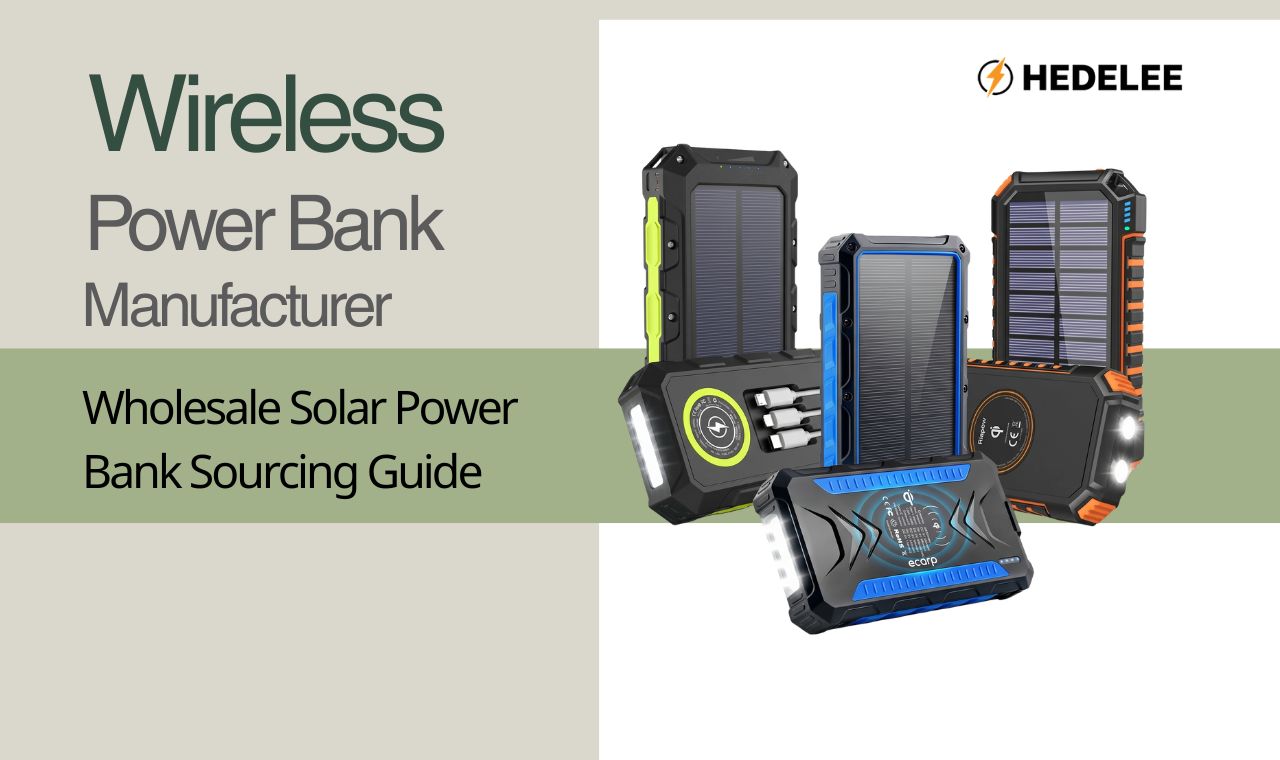
Shenzhen Hedeli Technology Co., Ltd. has spent around a decade in mobile accessories and consumer electronics, with solar power banks as a core category and a factory capacity of 50,000 units per month. As a buyer or product manager, you care less about slogans and more about consistent quality, safety compliance, and a supplier who can handle real‑world demand swings.
This guide explains how to source wholesale solar power bank inventory that sells, passes safety checks, and supports your long‑term roadmap—not just your next container. You’ll see how to choose technical specs, understand safety standards, compare models, and work with a manufacturer like Hedelee in a way that reduces problems and protects margin.
Why wholesale solar power bank demand is growing
Across outdoor, travel, and everyday carry categories, end users expect their phones and devices to stay powered anywhere—especially where outlets are scarce. Camping and off‑grid guides consistently recommend power banks and solar power stations as must‑have items for multi‑day trips, highlighting that it is better to overestimate power needs than risk drained batteries mid‑journey.
At the same time, more people want greener charging options, so they look for a solar power bank, solar phone charger, or even a solar powered iphone charger instead of a basic plastic brick that only charges from the wall. Outdoor‑oriented brands and telco channels respond by adding solar powered power bank lines that fit their customers’ lifestyle and sustainability expectations.
For you as a wholesale buyer, this shift means:
Extra demand for hybrid devices that combine a power bank for solar charging with regular USB‑C or Lightning input.
Stronger interest in rugged, waterproof designs for camping, trekking, and emergency kits.
More questions from distributors about safety reports, certifications, and long‑term reliability.
Hedelee’s focus on solar power banks places the company directly in this growth lane, allowing you to build assortments that speak to outdoor, travel, and general electronics channels without changing supplier each season.
Key specifications every wholesale solar power bank should meet
When you source wholesale solar power bank inventory, technical specifications are the first filter—and the fastest way to align a product with your channel.
1. Capacity and real‑world usage
Battery capacity is measured in milliampere‑hours (mAh), with common power bank sizes ranging from compact 5,000 mAh units up to 30,000 mAh or more for heavy outdoor use. Outdoor charger guides show that a 6,700 mAh power bank can recharge a 3,000 mAh smartphone roughly two times, giving you a simple rule of thumb when planning target capacities.
For solar power bank battery charger products, capacity planning is tied to user scenarios:
A product like Hedelee’s 20,000mAh solar power bank with wireless charger and flashlight (HDL‑218) fits neatly into the weekend and light‑camping segment.
2. Solar panel performance and charging behavior
Solar panels on a solar power bank are an auxiliary input, not a full replacement for wall charging in most user scenarios. Current guides recommend looking for panel designs with higher conversion efficiency and enough surface area to provide meaningful top‑ups in bright sunlight.
When you plan your assortment, it helps to position expectations clearly:
Keep marketing claims realistic for solar phone charger and solar mobile phone charger models.
Explain that wall charging is still the primary way to fill the battery, while solar adds resilience for outdoor and emergency use.
3. Ports, outputs, and wireless charging
Modern buyers expect:
USB‑C input/output, sometimes with Power Delivery.
Multiple USB‑A outputs for legacy devices.
Optional Qi wireless charging for phones and earbuds.
Power bank buying guides suggest that phones and tablets are fine with outputs of 5–18 W, while laptops and more demanding devices can require 30–50 W or higher for efficient charging. This is important when you design assortments with higher‑power SKUs, such as a high capacity solar power bank 30000mah model.
Hedelee’s range includes products like:
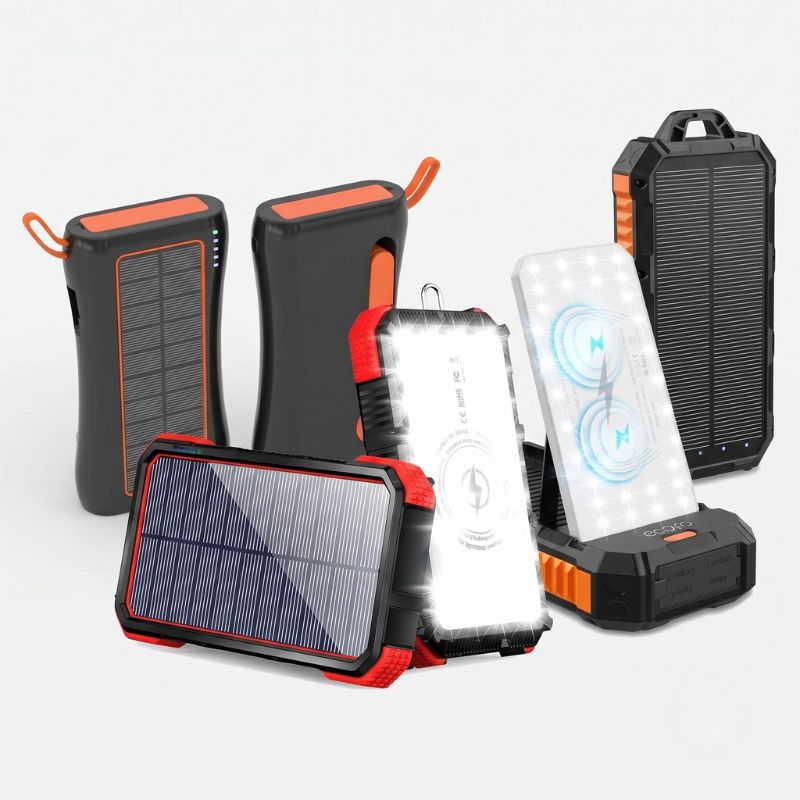
Foldable 20,000mAh outdoor solar charger with LED lights for camping and trekking.
30,000mAh solar charger power bank with Qi wireless and Type‑C for more demanding users.
4. Ruggedness, waterproofing, and design details
For outdoor and camping‑focused lines, you’ll often want:
IPX4 or higher water resistance.
Drop‑resistant housings and reinforced corners.
Integrated carabiner loops or lanyard holes.
Built‑in flashlights or SOS modes.
A model like Hedelee’s waterproof 20,000 mAh solar panel power bank with fast charging shows how these features combine in practice for outdoor channels.
Understanding solar power bank use cases and product mix
Planning a wholesale solar power bank range means thinking in use cases rather than only in pure specs. Outdoor power guides emphasize matching capacity and durability to the number of devices and trip length. Retail‑style buying guides also remind readers that larger power banks deliver more energy but come with extra weight and size.
Here are practical segments you can plan around:
Everyday carry and urban users
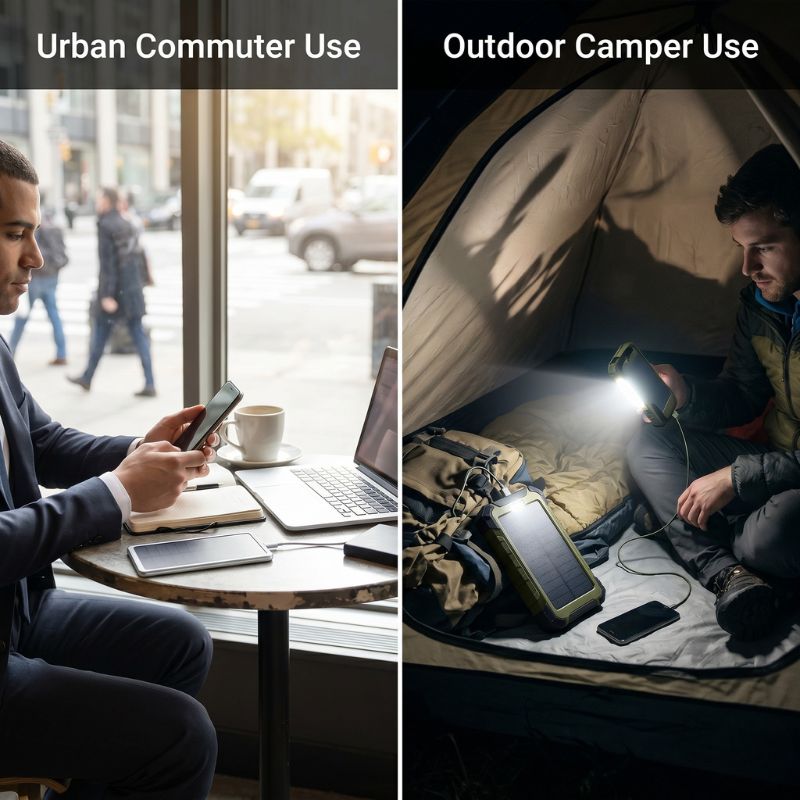
These buyers want slim, pocket‑friendly units that charge primarily from the wall but still carry a solar panel as backup. A compact solar powered power bank in the 10,000 mAh range with one or two outputs and basic water resistance is often enough. For this segment, you can position devices as:
Daily backup power for commuters and business travelers.
A simple solar cell phone charger that still looks good in an urban environment.
Outdoor, camping, and overlanding
Camping and hiking guides consistently stress the benefit of larger power banks with enough capacity for multiple phones, GPS devices, and sometimes lights. Here, you’re looking at 20,000–30,000 mAh units, often foldable or with more substantial panels, sometimes marketed as solar powered iphone charger or solar mobile phone charger for multi‑device use.
Hedelee’s products like the camping‑focused solar charger power bank (HDL‑519) and the outdoor solar power bank with 10,000 mAh and wireless charging are good examples you can use as reference points.
Emergency, disaster‑readiness, and gifting
For emergency kits, guides recommend over‑estimating capacity and pairing power banks with lanterns, radios, and other essentials. In this space, features like built‑in cables, strong lighting, and rugged housing add perceived value even if the device spends most of its time stored.
Hedelee’s solar power bank 24,000mAh with built‑in cables and wireless charging (HDL‑529) and 42,000mAh model with four cables and dual LED flashlight (HDL‑628) show how high‑capacity units can be positioned for emergency and gifting channels.
Safety standards, certifications, and legal compliance
Any wholesale solar power bank program should start with safety and compliance, especially when you sell into regulated markets or large retail channels. International safety standards like IEC 62368‑1 cover audio/video, IT, and communication equipment, including power banks, focusing on electrical shock, thermal safety, and mechanical hazards. Battery‑focused standards like IEC 62133 are also referenced, particularly for lithium cells inside portable devices.
Certification overviews show how these core standards get translated into regional requirements—for example EN 62368‑1 in the European Union, BS EN 62368‑1 in the United Kingdom, and GB/T 35590 for power banks in China. Transport and shipping rely heavily on UN 38.3 test standards for lithium batteries, which set conditions for vibration, temperature cycling, and impact during global logistics.
In the United States, guidance from compliance specialists highlights a mix of voluntary yet commercially necessary standards: UL 2056 for power banks, UL 1642 and UL 2054 for lithium batteries, plus FCC Part 15 for electromagnetic compatibility and wireless models. Marketplaces like Amazon often require that power banks either comply with UL 2056 combined with UN 38.3, or an equivalent combination including IEC/UL/CSA 62368‑1 and IEC/UL/CSA 62133‑2.
Consumer safety offices also stress practical safety features, such as over‑charge and over‑discharge protection, short‑circuit protection, temperature monitoring, and automatic cut‑off when fully charged. These features should be documented in your spec sheets and test reports so that procurement teams can evaluate the risk profile and compliance fit.
When you work with Shenzhen Hedeli Technology Co., Ltd., you can align required test standards by target market up front, then confirm through test reports from recognized labs before committing to large‑volume orders.
How to evaluate a solar power bank manufacturer in China
Wholesale power bank buying guides repeatedly recommend looking beyond price to factors like factory capability, certification readiness, and communication quality. That aligns tightly with how you should evaluate any solar power bank supplier in Shenzhen, Dongguan, or other hubs.
1. Factory capacity and experience
Hedelee has around 10 years of experience in mobile accessories and consumer electronics, with a factory in Dongguan and a head office in Shenzhen, plus a showroom in Guangzhou. Monthly output of 50,000 units gives enough headroom for most importer, distributor, and wholesaler demand profiles while still allowing for seasonal peaks.
When you qualify any manufacturer, ask for:
Product lines specific to solar power banks, not just generic power banks.
Details on SMT, assembly, and aging‑test processes.
Photos or virtual tours of the factory and showroom.
2. Product range and roadmap
A strong supplier gives you a coherent solar power bank catalog across multiple capacities, designs, and price tiers. You can explore Hedelee’s solar power bank category to see examples ranging from slim 10,000mAh units to rugged 42,000mAh models with wireless charging and built‑in cables.
For planning, it helps if your manufacturer can:
Refresh housings and colors seasonally.
Offer dedicated SKUs tuned for specific channels (camping stores, mobile accessories, telco, gift).
Support custom packaging and private label arrangements.
3. Testing, quality control, and documentation
Wholesale‑oriented guides emphasize verifying that suppliers can provide test reports and maintain consistent QC; relying only on low unit cost often leads to field failures and brand damage. When you screen a solar power bank manufacturer, look for:
Incoming inspection of battery cells and key components.
In‑line testing for capacity and output.
Aging tests at elevated temperature and continuous load.
Final inspection with functional checks for solar charging, USB‑C/USB‑A outputs, and wireless performance where applicable.
You should also confirm:
Availability of UN 38.3, IEC 62368‑1, and other market‑specific reports where needed.
Ability to maintain a fixed bill of materials for certified SKUs to keep test reports valid.
4. Communication and project handling
Finally, evaluate:
How quickly the sales or project team responds.
How clearly they explain technical points and certification status.
Whether they proactively suggest models that fit your market, instead of pushing random overstock.
Hedelee’s dedicated focus on solar power banks and experience serving importers, distributors, and wholesalers means project communication can be aligned closely with your go‑to‑market plan rather than handled as a one‑off transaction.
Matching models to channels: examples from Hedelee’s range
Instead of building an abstract line plan, it helps to map concrete products to channel‑specific roles. Guides on power bank sizing and camping use highlight the value of offering a few clearly differentiated tiers rather than many overlapping SKUs.
Here is a simple way to position selected Hedelee models:
When you plan your range, work with Hedelee’s team to align 3–6 core SKUs to your channels, then add a limited number of experimental models each year to test new features like higher wattage, different form factors, or advanced wireless charging.
Ordering, packaging, and logistics planning
Once you are comfortable with specs and supplier fit, the next step is to plan orders, packaging, and logistics in a way that works with your sales cycles.
1. MOQs, trial orders, and scaling
Wholesale buying guides recommend starting with trial orders that are big enough to test demand but small enough to adjust after real feedback. You might, for example:
Start with 500–1,000 units across 2–3 SKUs if you’re entering solar power banks for the first time.
Increase to container‑level shipments once you see clear sell‑through and stable quality.
Hedelee’s monthly capacity of 50,000 units leaves room for both smaller introductory runs and higher‑volume replenishment without long waits. Over time, you can agree on forecast windows so the factory can reserve cell stock and manage production more efficiently.
2. Packaging and branding
Solar products lend themselves well to storytelling on packaging: outdoor imagery, sustainability messaging, and clear use‑case icons. You can collaborate on:
Color boxes tailored to your retail channels.
Printed user guides that explain how to use the solar phone charger or solar power bank battery charger safely and effectively.
Custom logo printing on housings for brand campaigns or corporate gifting.
3. Logistics, labeling, and documents
Because solar power banks contain lithium batteries, they must comply with UN 38.3 for transportation, and carriers often require supporting documents during booking and customs clearance. In practice this means:
Test reports and summary documents ready before mass production.
Correct labeling on cartons and inner boxes, including battery warnings where needed.
Clear HS codes and country‑of‑origin marking for destination markets.
Plan enough lead time for certification and logistics; certification specialists estimate that obtaining documentation for power banks in some regions can take between 5 and 20 business days depending on the scheme. Aligning this timeline with your launch schedule prevents last‑minute delays.
Practical sourcing checklist for confident orders
To pull everything together, use this checklist whenever you consider a new wholesale solar power bank program or expand an existing range:
Technical and product fit
Confirm target use cases: everyday, outdoor, emergency, or mixed.
Select capacity tiers (e.g., 10,000 / 20,000 / 30,000+ mAh) based on how many full phone charges your customers need.
Decide on ports (USB‑C, USB‑A, wireless) and special features (built‑in cables, flashlights, foldable panels).
Ensure solar charging performance is presented as a resilience feature, not a promise of full off‑grid power.
Safety, compliance, and documentation
Align on target certifications and standards for your markets, including IEC 62368‑1, IEC 62133 where required, UN 38.3, and any regional equivalents.
Request recent test reports from recognized labs and confirm they match the exact model and bill of materials.
Check that safety features like over‑charge, over‑discharge, short‑circuit, and temperature protection are clearly specified.
Supplier evaluation and cooperation
Review factory capacity, focus categories, and product range, including a dedicated solar power bank collection.
Ask about QC processes, from cell selection to aging tests and final inspection.
Confirm responsiveness of the sales and project team, especially for custom packaging or private label work.
Orders, logistics, and long‑term planning
Start with trial orders across a compact range, then scale based on data.
Align on UN 38.3 and other logistics‑related documents early in the process.
Build a rolling forecast with your supplier as sales stabilize so they can secure components and maintain delivery times.
When you work directly with Shenzhen Hedeli Technology Co., Ltd., you are dealing with the original manufacturer, not a trading layer. That gives you some key advantages:
Direct input into product development and feature combinations.
Faster response when you need adjustments for a specific channel or project.
Better visibility into lead times, inventory, and any component changes that might affect compliance.
If you are planning a new assortment or want to refine an existing one, you can review Hedelee’s full solar power bank product range and highlight the models that match your market profile. Sharing your target capacities, channels, and certification requirements will allow the team to propose a tailored shortlist and provide quotations, sample plans, and timelines that fit your launch schedule.
Image for this section
Image title: Buyer using a solar power bank sourcing checklist
Image description: A procurement manager checking off a printed sourcing checklist next to solar power bank samples and a laptop.
File name: wholesale-solar-power-bank-sourcing-checklist-1×1.png
Alt text: procurement manager reviewing wholesale solar power bank sourcing checklist and product samples
AI image prompt (1:1):
A procurement manager at a desk with several solar power bank samples, a printed checklist with items being ticked off, and a laptop showing supplier information, clean corporate style, 1:1 aspect ratio.
Frequently Asked Questions
How should I choose capacity for my market?
Start from your end users: commuters typically do well with 10,000 mAh, while campers and emergency users benefit from 20,000–30,000 mAh or more so they can recharge phones and small devices several times. Share your channels and price targets with Hedelee so the team can suggest capacity tiers that match both user needs and retail positioning.
What safety tests should wholesale solar power banks pass?
Common reference standards include IEC 62368‑1 for general IT equipment safety, IEC 62133 for lithium batteries, and UN 38.3 for transportation of lithium cells. Depending on your markets and channels, you might also need UL 2056 or regional derivatives like EN 62368‑1 in the EU, so always confirm requirements with your compliance partners and request matching test reports for each model.
Can I customize housing, colors, and logo on solar power banks?
Yes, many manufacturers, including Hedelee, can support custom housing colors, printed logos, and tailored packaging once minimum order quantities are met. Wholesale power bank buying guides recommend aligning these customizations with your long‑term assortment so artwork, compliance labels, and product codes stay consistent across reorder cycles.
How long does certification and testing usually take?
Certification timelines vary by region and scheme, but overviews of power bank standards suggest that testing and registration can take around 5–20 business days once documents and samples are ready. To avoid delays, discuss required standards with Hedelee early, so testing can run in parallel with design finalization and packaging work.
Do solar phone chargers work without wall charging at all?
Solar phone chargers and solar powered power bank models can recharge using sunlight, but most specialist guides position solar input as a backup or top‑up rather than the only energy source. For best user experience, instruct customers to charge from the wall before trips and use solar as an extra layer of resilience, especially in bad weather or during extended use.