

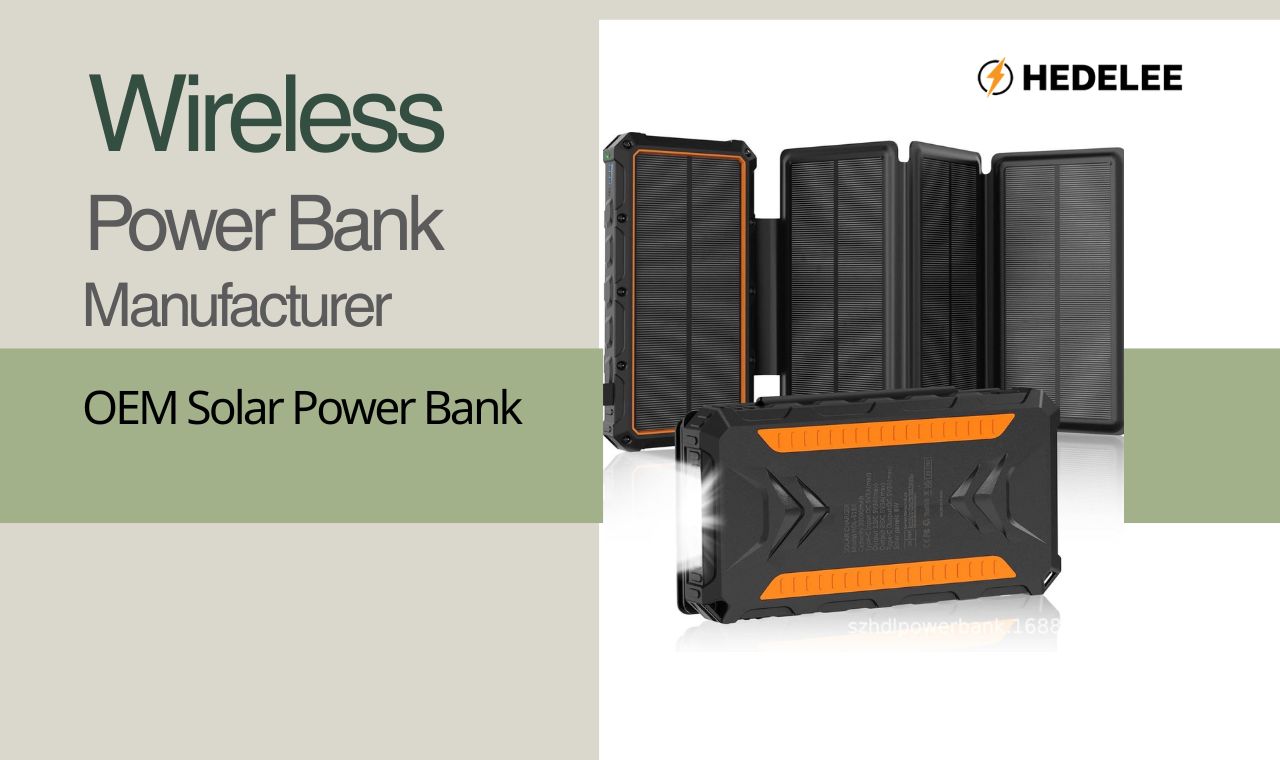
A buyer orders a batch of solar power banks rated at 30,000mAh. The units arrive on schedule. Yet capacity tests show barely half that number, and the panels trickle in power so slowly that they feel decorative. Returns climb, support tickets pile up, and trust drops fast.
This happens far more often than most buyers expect. The fix starts well before the order, with the right factory and the right questions.
Choosing an OEM solar power bank partner is less about price and more about proof. You want real cells, honest capacity numbers, working panels, and clean compliance papers. Get those right, and the rest of the deal tends to follow.
The checks below protect both your margin and your reputation. They cover the battery, the panel, the certifications, and the customization. Run through them with any supplier you meet, and the weak options reveal themselves quickly.
What Does OEM Solar Power Bank Mean?
OEM stands for Original Equipment Manufacturer. So an OEM solar power bank is a unit built by a factory and then sold under your brand name. You supply the brand, and the factory supplies the engineering, the parts, and the production.
This setup gives you control without the cost of running a plant. You skip tooling, staffing, and component sourcing. Instead, you focus on selling, while the factory handles the hardware.
People often mix up three terms, so here is a quick guide:
| Model | Who designs it | Who brands it | Best for |
|---|---|---|---|
| OEM | Factory builds to your spec or its base design | You | Custom branding on proven hardware |
| ODM | Factory designs the full product | You | Fast launch with little engineering input |
| White label | Generic stock product | You | Lowest cost, least control |
Most buyers want OEM because it balances speed and control. You get a working solar power bank battery charger platform, then shape it with your logo, colors, and feature mix. That way, your product feels yours, not generic.
Why a Solar Power Bank Belongs in Your Product Range
Demand for portable charging keeps growing, and solar adds a clear hook. Campers, hikers, festival-goers, and travelers all want backup power when outlets run out. A solar power bank speaks to that need in one glance.
The appeal is simple. People fear a dead phone on a trip, so a charger that pulls energy from the sun feels reassuring. Even when buyers rely mostly on wall charging, the panel sells the idea of freedom.
Retail data backs this up. Outdoor gear, emergency kits, and travel accessories all pull these units into their lineups. A solar phone charger fits camping shelves, while a slim solar cell phone charger suits travel and gift sections.
Here is where buyers usually place them:
- Outdoor and camping retailers, often beside tents and headlamps
- Travel and luggage brands, as a carry-on extra
- Promotional and gift suppliers, with a printed logo
- Emergency and prepper stores, paired with flashlights
Because the use cases span so many niches, a single solar mobile phone charger model can serve several customers at once. That flexibility helps you spread one order across many sales channels. You can browse a full solar power bank collection to see how the formats vary by capacity and feature.
Seasonality works in your favor too. Sales lift in spring and summer, when camping and travel peak. They lift again in late autumn, when emergency kits and holiday gifts move fast. So a steady stock plan lets you ride both waves without overordering. Plan the bulk of your volume ahead of those windows, and your cash stays efficient.
Margins hold up well here as well. A solar feature lets a unit sit a step above a plain charger on the shelf. Buyers accept a higher price for the backup the panel promises. So the right model can lift both your basket size and your perceived value.
Battery Cells and Real Capacity: The First Thing to Verify
Capacity is where most cheap units fail. A label may say 30,000mAh, yet the real output falls short. So your first check is always the cell, not the sticker.
Two cell grades dominate the market. A-grade cells come fresh from a known maker and hold their rated capacity well. B-grade or recycled cells cost less, but they fade fast and run hotter. Ask which grade your factory uses, and ask for the cell brand in writing.
You also need to understand two numbers. mAh measures charge at the cell voltage, usually 3.7V. Wh measures real energy. A useful check is the watt-hour figure, since it cuts through inflated mAh claims.
Here is the rough math buyers can use:
- Wh = (mAh × 3.7) ÷ 1000
- A 20,000mAh cell pack holds about 74Wh
- Real phone charges land lower, because conversion loses some energy
So a 20,000mAh power bank for solar charging will not deliver 20,000mAh to your phone. Output sits closer to 60 to 70 percent after conversion. A factory that explains this openly is a factory worth trusting.
When you test samples, watch for these signs of honest capacity:
- Rated output matches a sensible Wh figure
- The unit charges two phones fully without dying early
- The case stays cool under load
- The cell brand appears on the spec sheet
The protection circuit deserves a look too. A good board guards against overcharge, over-discharge, short circuit, and heat. Cheap units sometimes skimp here, which raises the risk of failure in the field. So ask whether the unit carries a full protection board, and confirm it on the spec sheet.
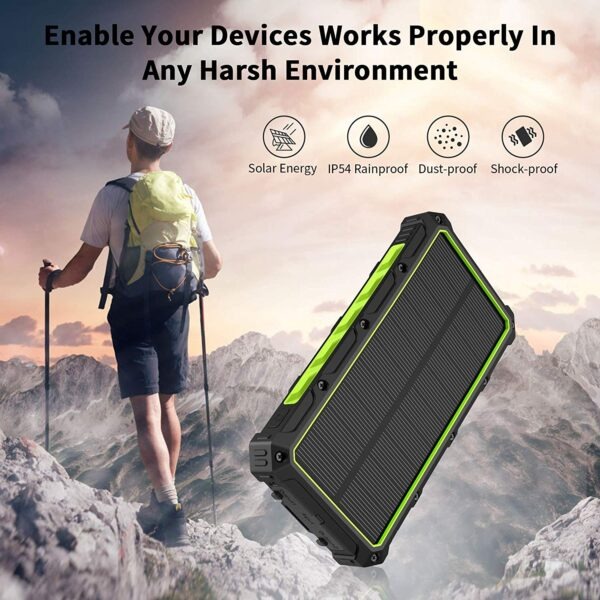
A reliable model like this 20,000mAh waterproof solar power bank with flashlight lists its real specs clearly, which makes capacity claims easy to verify. Cross-check the listed cell, the Wh figure, and the protection features against any sample you receive.
Solar Panel Quality and Honest Charging Claims
The panel sells the product, yet it also fuels the biggest myths. So buyers need a clear view of what a panel can and cannot do. Set the right expectation, and your returns drop.
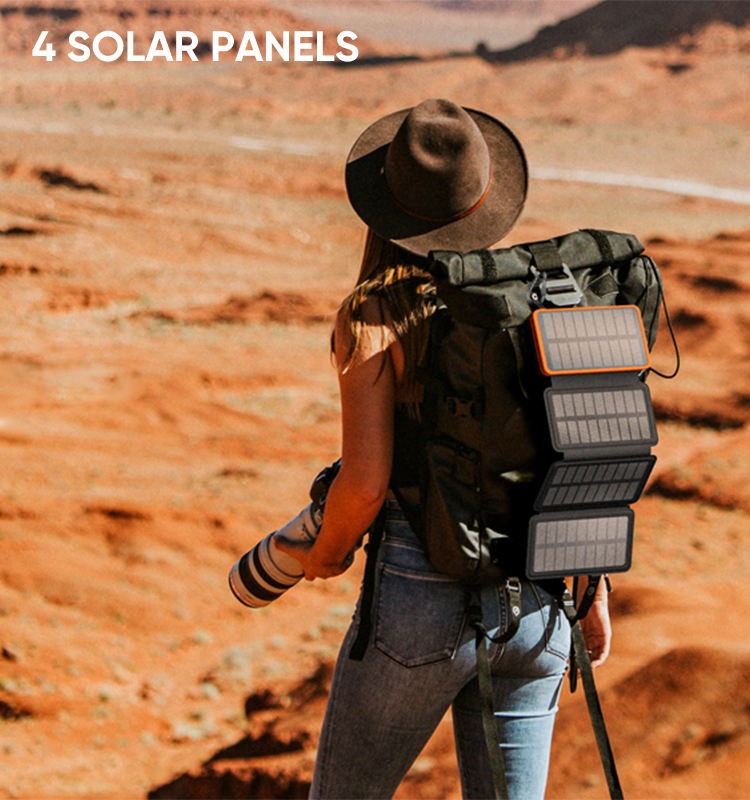
Two panel types appear most often. Monocrystalline panels convert sunlight better and suit smaller surfaces. Polycrystalline panels cost less but work a little slower. For folding units, several panels join to lift the total wattage.
| Panel type | Efficiency | Cost | Common use |
|---|---|---|---|
| Monocrystalline | Higher | Higher | Compact and folding models |
| Polycrystalline | Lower | Lower | Budget pocket models |
| Foldable multi-panel | Highest total | Higher | Camping and fast field charging |
Now the honesty part. A small built-in panel charges slowly, so it works as a top-up, not a main source. Direct sunlight, the right angle, and a clear sky all change the speed. A folding model with several panels charges far faster than a single small one.
When you market a solar powered power bank, frame the panel as emergency backup for outdoor use. That framing keeps buyers happy and keeps reviews fair. A foldable outdoor solar charger with LED lights shows how added panel area speeds up field charging.
Ask your factory these panel questions:
- What is the panel wattage under full sun?
- How long does solar-only charging take?
- Is the panel monocrystalline or polycrystalline?
- Does the unit charge while in sunlight and in use?
Clear answers here protect your brand from angry reviews. Vague answers are a warning sign.
Safety, Certifications, and Compliance to Check Before You Import
Compliance is not paperwork you skip. Customs, retailers, and carriers all ask for it. So missing papers can stall a shipment or block a listing. Check every document before money changes hands.
Lithium cells count as dangerous goods during transport. Because of that, your units must pass a transport safety test before they ship by air or sea. The main one is UN 38.3, which checks how cells handle altitude, heat, shock, and short circuits. You can read the test scope on Intertek’s UN 38.3 testing overview.
Product safety is a separate matter. For portable lithium cells, the key standard is IEC 62133-2, which covers safe operation and reasonable misuse. Many markets treat it as a baseline for selling battery products.
Here are the documents buyers should request:
- UN 38.3 test summary for transport of the cells
- IEC 62133 report for cell safety
- CE for sales in Europe
- FCC for the United States
- RoHS for restricted substances
- MSDS for shipping the battery
Markets differ, so match the papers to where you sell. A solar power bank battery charger sold in the EU needs CE, while a US listing needs FCC. Missing the right mark can lead to pulled listings or fines.
One more check matters. Ask whether the certificate covers the exact model and capacity you order. A report for a different unit does not protect you. Match the model number, the cell, and the capacity to the paperwork, every time.
Customization Options for Your OEM Solar Power Bank
Branding is where a stock unit becomes your product. So the customization menu often decides which factory you pick. The wider the menu, the more your OEM solar power bank can stand apart on the shelf.
Most factories offer several layers of custom work. Start with the simple ones, then add depth as your order grows.
Branding and look
- Logo printing or laser engraving
- Custom body color and finish
- Printed or molded patterns
- Custom retail box and inserts
Function and parts
- Choice of capacity, from 10,000mAh to 40,000mAh and up
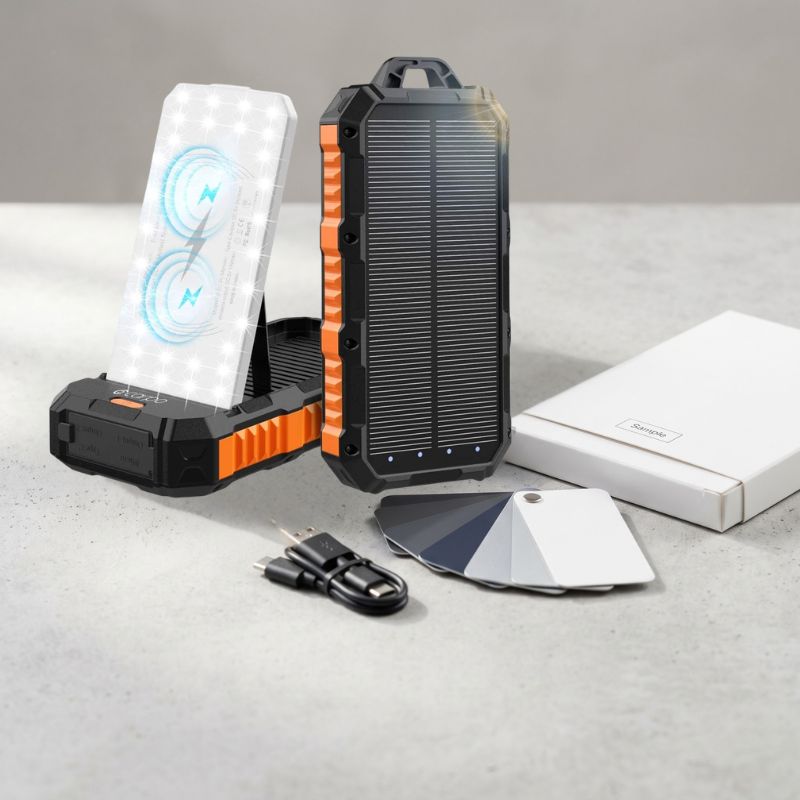
- Port mix, such as USB-A, USB-C, and wireless charging
- Built-in cables for a cable-free design
- Added LED flashlight or camp light
Packaging and papers
- Custom user manual in your language
- Barcode and label printing
- Gift box or eco kraft packaging
A model with built-in cables and a wireless charger shows how feature choices change the final unit. You can also lean toward a slim build for travel or a rugged build for outdoor sales.
Think about your buyer first. A travel brand may want a light solar mobile phone charger with a sleek case. An outdoor brand may want a tough, camping-ready solar charger with a strap and bright light. Match the feature set to the channel, and sales follow.
Ask about minimum order quantity for each custom layer. Logo printing often starts low, while custom molds need larger runs. Knowing these limits early helps you plan budget and timing.
Production Capacity, Lead Times, and Samples
A great spec means little if the factory cannot deliver on time. So capacity and lead time deserve real attention. Ask hard questions, and confirm answers with samples and dates.
Start with monthly output. A factory with steady volume can hold your schedule during busy seasons. For context, Shenzhen Hedeli Technology runs a Dongguan plant with a monthly capacity of 50,000 units, which keeps importers, distributors, and wholesalers supplied on time.
Next, pin down the timeline. A clear schedule keeps your retail dates safe. Typical stages look like this:
- Sample approval, often 7 to 15 days
- Mass production, often 20 to 35 days after deposit
- Quality check and packing
- Shipping by sea or air
Samples come before any large order. Always test a real unit, not a photo. Check capacity, panel speed, port output, and build feel. A factory that sends samples fast usually runs a tight operation.
Quality control matters at every step. Ask about these checks:
- Incoming cell inspection
- In-line testing during assembly
- Full charge and discharge test before packing
- Random batch sampling
A model such as this 30,000mAh wireless solar charger with IP65 rating should pass each of these checks before it ships. Confirm the process in writing, then hold the factory to it.
Packaging, Shipping, and Warranty Terms
Two parts of a deal often get ignored until they cause trouble: how the goods arrive, and what happens if one fails. So settle both before you sign. A little clarity here saves a lot of friction later.
Start with packaging. Retail boxes protect the unit and sell it on the shelf, while bulk cartons keep freight tidy. Confirm box size, weight, and units per carton early. That data feeds your freight quote and your warehouse planning.
Shipping batteries adds rules. Lithium cells travel as dangerous goods, so they need proper labeling and packing. Ask whether the factory ships by sea, by air, or both, and ask who arranges the dangerous goods paperwork. A maker that handles this smoothly keeps your timeline intact.
Cost clarity matters here too. Confirm the trade terms, such as EXW, FOB, or CIF, so you know where your cost starts and stops. Each term shifts who pays for freight, duties, and insurance. Match the term to your logistics setup, then build it into your landed cost.
Warranty closes the loop. A solid warranty shows the factory stands behind its build. Ask these questions before you order:
- How long is the warranty period?
- What faults does it cover?
- Who pays for replacement units and freight?
- What is the expected defect rate per batch?
A model with a sturdy build, like this 20,000mAh dual USB waterproof solar charger with LED light, should come with clear warranty terms in writing. Spare parts and replacement stock also help, since a fast fix keeps your own customers happy. Settle these details up front, and your after-sales process runs smooth instead of tense.
Comparing Solar Power Bank Models for Different Markets
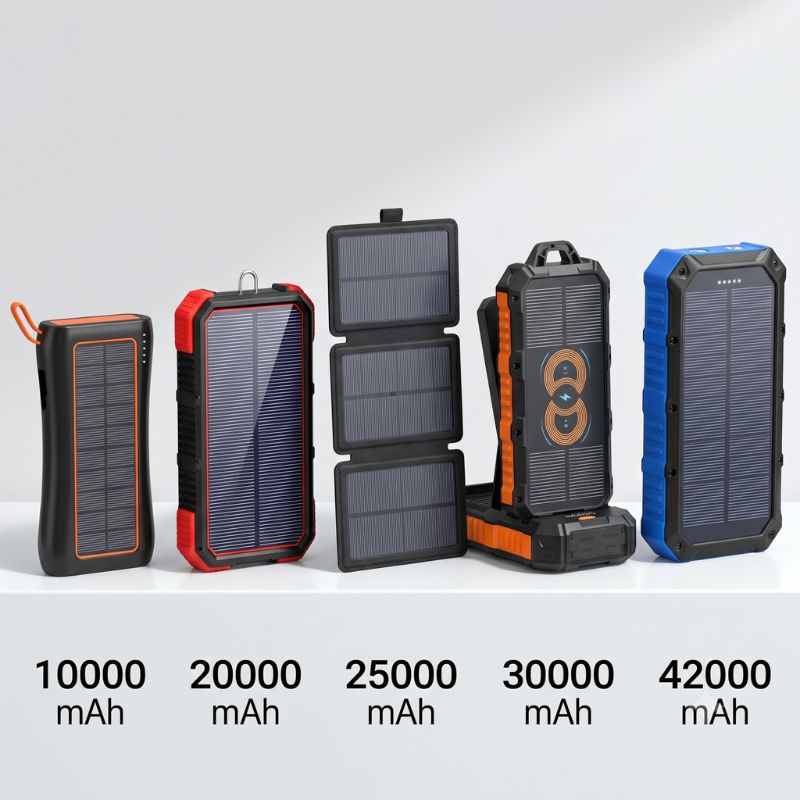
No single model fits every shelf. So matching capacity and features to a market helps you sell faster. Here is a quick map of formats and the buyers they suit.
| Capacity | Format | Best fit | Example use |
|---|---|---|---|
| 10,000mAh | Slim, wireless | Travel, gifts | Light daily carry as a solar phone charger |
| 20,000mAh | Rugged, waterproof | Outdoor, camping | Trail backup with flashlight |
| 24,000–30,000mAh | Multi-cable, wireless | Family, road trips | Charge several devices at once |
| 36,000–42,000mAh | Heavy-duty | Emergency, expedition | Long off-grid trips |
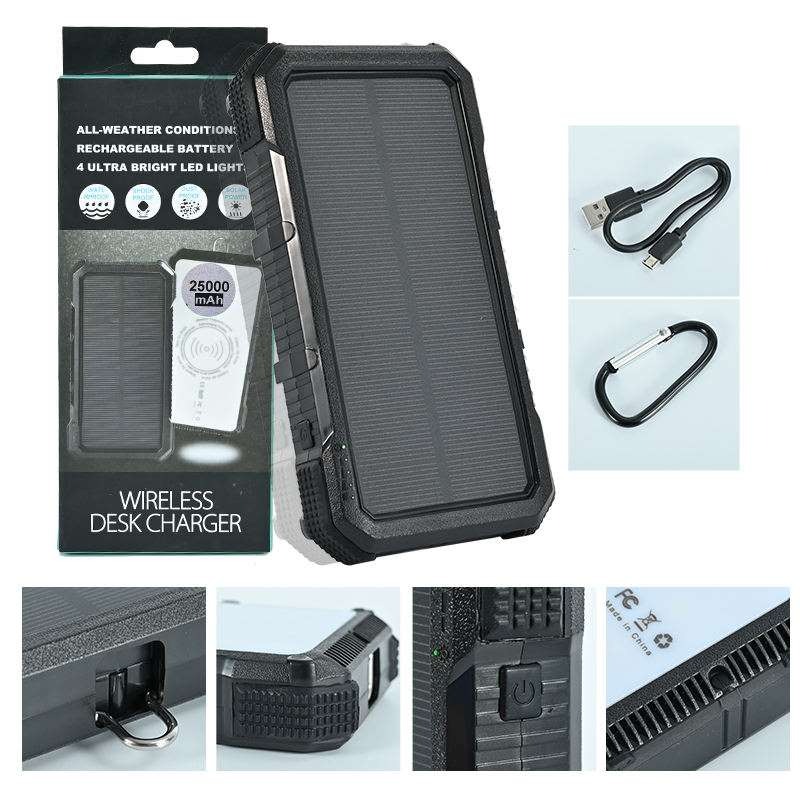
A travel buyer often wants a slim unit that doubles as a solar powered iphone charger for short trips. An outdoor buyer wants more capacity and a tougher case, like this 25,000mAh waterproof solar charger with dual USB.
For larger needs, a high-capacity unit shines. A 42,000mAh solar power bank with four built-in cables suits emergency kits and long expeditions. Meanwhile, a compact 10,000mAh wireless model fits gift sets and city travel.
The lesson is simple. Stock a small range, then match each unit to a clear buyer. That keeps your catalog tight and your sell-through strong.
Red Flags That Signal a Weak Supplier
Some warning signs show up early, well before you place an order. So learning to spot them saves both money and stress. Here are the patterns that should slow you down.
A price that looks too good. Real cells, working panels, and clean papers cost money. A quote far below the market often hides recycled cells or skipped tests. When the number feels too easy, ask what corner got cut.
Vague answers on cells and capacity. A factory that dodges the cell brand question is hiding something. The same goes for capacity claims with no Wh figure. Honest makers give numbers, not slogans.
Certificates that do not match the model. A report for a different unit gives you no cover at customs. Check the model number, the cell type, and the capacity on every document. A mismatch is a hidden liability waiting to surface, and it can stall a whole shipment.
No sample, or a slow sample. A factory that resists sending a unit may fear your test. A maker proud of its work ships samples quickly. So treat a stalled sample request as a real signal.
Shifting lead times. Dates that change with each message point to a shaky plan. A steady factory commits to a schedule and holds it. Get the timeline in writing, then watch whether the words stay the same.
Hidden costs deserve a look too. Some suppliers quote a low unit price, then add fees for logos, packaging, testing, or certificates. Ask for an all-in quote that lists every charge. That way, the final cost holds no surprises.
One more area trips up new buyers: shipping rules for batteries. Lithium units count as dangerous goods, so they need the right packing and papers. A factory that handles this well protects your timeline. A factory that shrugs at it can leave your goods stuck at a port.
When you weigh these flags together, a clear picture forms. A strong supplier answers fast, shares real numbers, and welcomes your tests. A weak one stalls, dodges, and hopes you stop asking. Trust the pattern, not the promise.
How to Vet a Solar Power Bank Manufacturer Step by Step
A clear process beats a gut feeling. So follow these steps with every new factory. Each one filters out a weak option before it costs you.
- Confirm the factory is real. Ask for the address, photos, and a video call from the floor. A true maker shows the line without hesitation.
- Request the cell brand and grade. Get it in writing on the spec sheet. Vague answers point to recycled cells.
- Order a sample and test it. Check capacity, panel speed, and port output. Trust the test, not the label.
- Review the certificates. Match each report to your exact model and capacity. Confirm UN 38.3, IEC 62133, CE, and FCC where they apply.
- Check capacity and lead time. Ask for monthly output and a stage-by-stage schedule. Hold the dates in writing.
- Map the customization. List logo, color, ports, and packaging options with their order minimums.
- Run a small trial order. Start modest, judge the quality, then scale once the factory proves itself.
Work through these seven steps, and you avoid most sourcing traps. A waterproof 20,000mAh solar power bank with fast charging gives a solid starting point for that first trial run.
Working Directly With the Source
Every check above leads to one goal: a factory you can trust with your brand. That is the value of buying from the maker, not a middleman. You get clearer specs, faster answers, and a price without an extra markup.
Shenzhen Hedeli Technology has spent about ten years in mobile accessories and consumer electronics, with a focus on solar power banks. The team runs over 100 staff, with a headquarters in Shenzhen and an office and showroom in Guangzhou. The Dongguan plant turns out 50,000 units a month, which keeps importers, distributors, and wholesalers stocked on time.
Buying from the source means your questions reach the people who build the product. So you can confirm cells, panels, and certificates without a guessing game. You can also shape your own solar mobile phone charger line with the colors, ports, and packaging your market wants.
If you are weighing capacity, custom options, or compliance for your next order, reach out for full specifications and a sample. Share your target market and volume, and you will get clear, model-matched answers from the factory floor. Request a quote on the model that fits your buyers, and start your sourcing with facts rather than guesses.
Frequently Asked Questions
What is the minimum order for an OEM solar power bank?
Minimums vary by custom layer. Logo printing often starts at a few hundred units. Custom molds need larger runs. Share your target volume, and you will get an exact figure for your chosen model.
Can I customize the capacity and ports on each unit?
Yes. You can pick capacity from 10,000mAh upward, plus USB-A, USB-C, wireless charging, or built-in cables. Body color, logo, and packaging are also open to custom work.
Which certifications come with a solar power bank battery charger?
Common reports include UN 38.3 for transport, IEC 62133 for cell safety, plus CE, FCC, and RoHS for market access. Always match each certificate to your exact model and capacity.
How long does production take after I approve a sample?
Mass production usually runs 20 to 35 days after the deposit. Sampling takes about 7 to 15 days. Shipping time then depends on your sea or air choice.
Can I request a sample before placing a large order?
Yes, and you should. Test a real unit for capacity, panel speed, and port output. Reach out to request samples and detailed specifications before you commit to volume.