

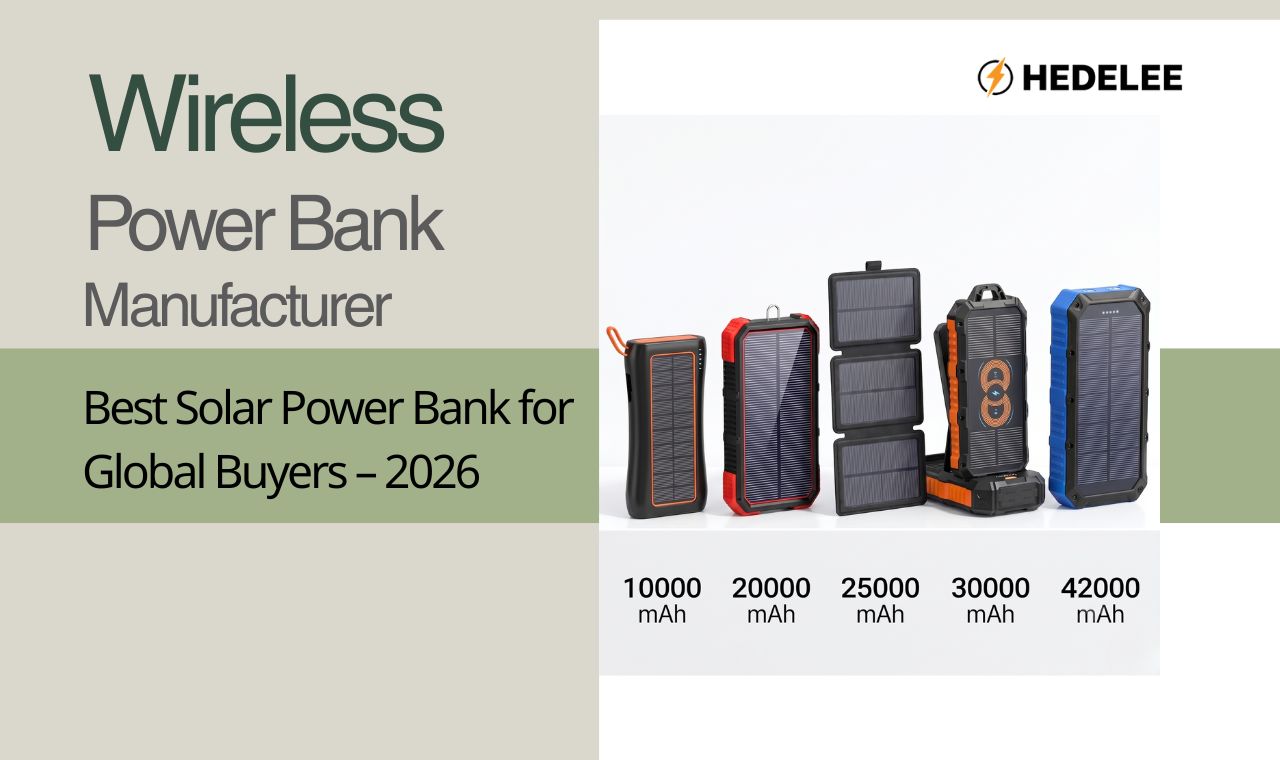
A buyer choosing the best solar power bank is not only comparing battery capacity. The real choice includes charging speed, solar panel design, casing strength, safety documents, packaging, and whether the supplier can support repeat orders without delays.
For importers, distributors, and wholesale customers, a solar power bank is more than a consumer gadget. It can be a travel accessory, camping product, emergency backup item, retail gift, or seasonal outdoor product. A good sourcing decision protects your brand, your delivery schedule, and your customer reviews.
Shenzhen Hedeli Technology Co., Ltd. has worked in mobile accessories and consumer electronics for about 10 years. Our Hedelee product categories include power banks, TWS earbuds, Bluetooth speakers, USB chargers, USB cables, car chargers, and car phone holders. With more than 100 employees, a Shenzhen headquarters, a Guangzhou office and showroom, and a Dongguan factory with monthly capacity of 50,000 units, we support importers, distributors, and wholesalers with stable production and direct factory communication.
Best solar power bank: What Global Buyers Compare First
The first mistake many buyers make is looking only at mAh. Capacity is useful, but it does not tell the full story. A 20,000mAh product with slow output, weak casing, or poor labeling can create more problems than a smaller model with better design and cleaner specifications.
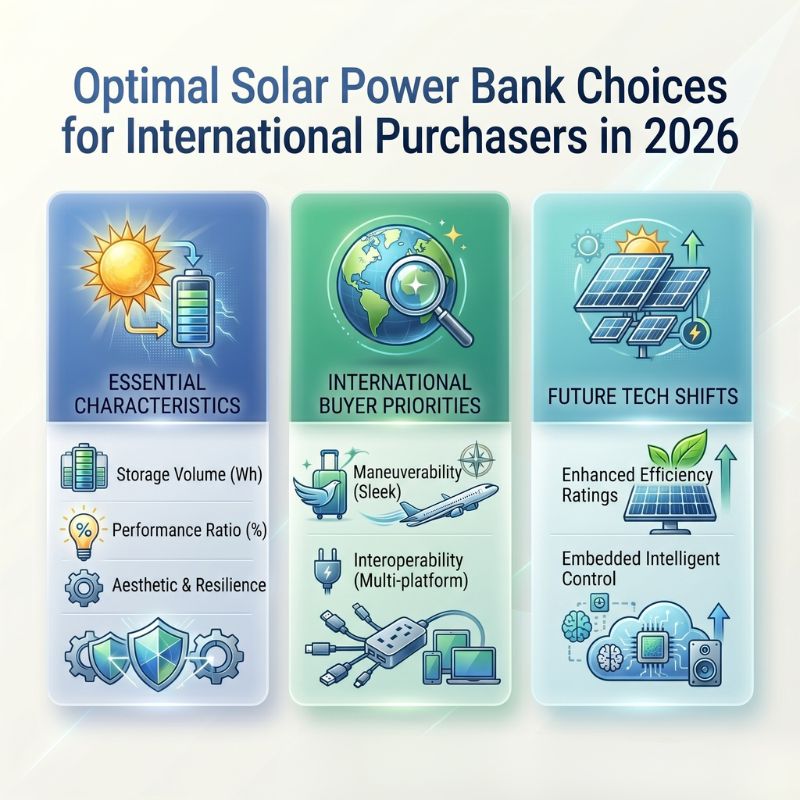
A solar power bank should be judged by its whole product system. That means battery cell type, circuit protection, input/output options, solar panel layout, waterproof level, flashlight function, built-in cable design, wireless charging support, and packaging quality.
For professional sourcing, the best choice is usually the model that fits your sales channel, not the model with the largest printed number.
Key questions buyers should ask
- What battery capacity is realistic for the target market?
- Does the model support USB-C input or output?
- Is wireless charging needed for this customer group?
- Will the product be used outdoors, in cars, in travel bags, or in emergency kits?
- Does the supplier provide clear product labels and test documents?
- Can the factory support logo printing, packaging design, and repeat production?
Some buyers search using mixed terms like “bank power solar,” but the intent is usually simple: they want a portable charger that offers battery backup and solar recharging support in one unit.
Quick buyer comparison table
| Buyer Need | Recommended Feature | Why It Helps |
|---|---|---|
| Outdoor retail | Waterproof casing, LED light | Better fit for camping and travel |
| Gift market | Built-in cables, compact design | Easier for daily use |
| Distributor stock | 20,000mAh to 30,000mAh range | Broad market acceptance |
| Emergency use | Large battery, strong light | More useful during power cuts |
| Online sales | Clear specs, strong images | Reduces buyer confusion |
| Wholesale orders | Stable factory supply | Helps delivery planning |
A solar powered power bank also needs realistic product education. The solar panel is useful for backup charging, but most small built-in panels charge slowly under normal sunlight. Buyers should not market small solar panels as the main daily charging method. A more honest message is better: USB charging for regular use, solar support for outdoor backup.
For more model options, buyers can review the full solar power bank product category and compare capacity, casing, cable, and flashlight designs.
How Solar Power Bank Technology Works
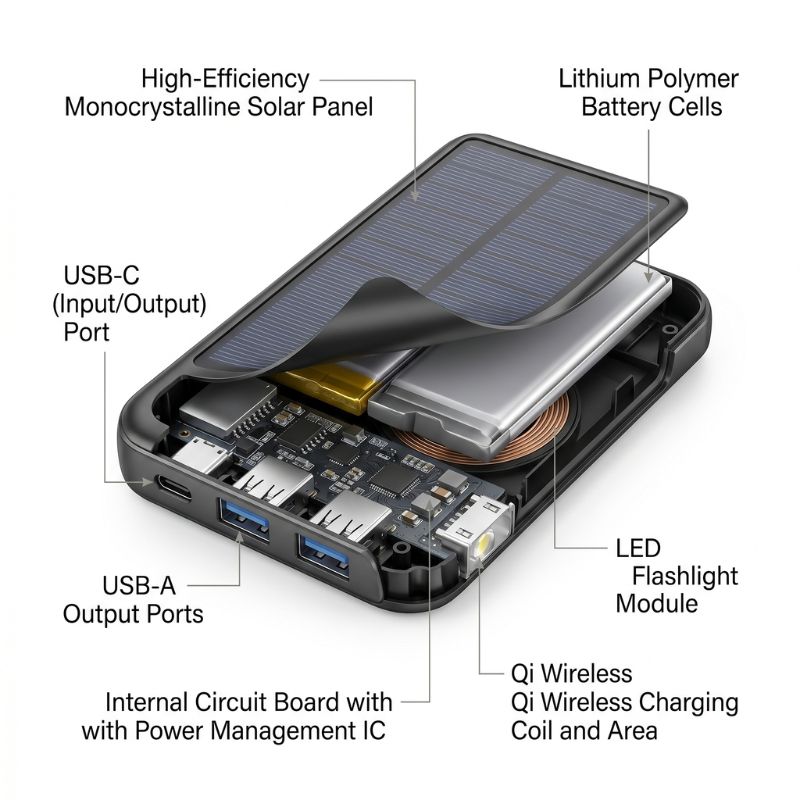
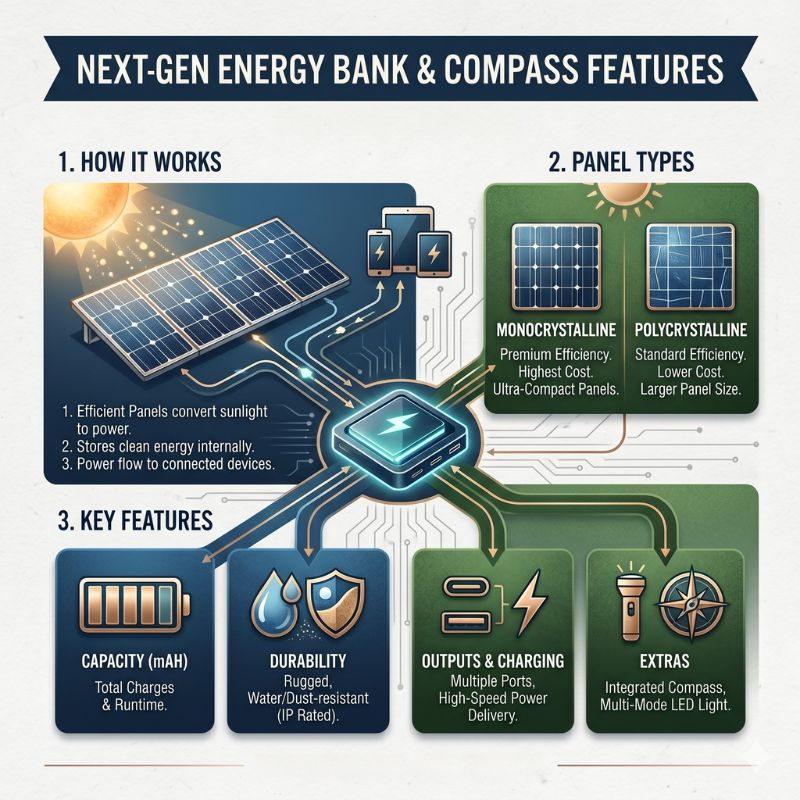
A solar power bank combines a rechargeable battery, a charging circuit, output ports, and one or more solar panels. The battery stores power. The USB or Type-C port charges the battery faster from a wall charger. The solar panel provides extra input from sunlight.
For most small and medium models, solar charging is a backup function. It is useful during hiking, camping, emergency travel, and outdoor work. Yet the panel area is limited, so charging time depends on sunlight strength, panel size, angle, and weather.
A solar power bank battery charger often includes:
- Lithium battery cells
- Solar panel or foldable solar panels
- USB-A and USB-C ports
- LED flashlight or warning light
- Waterproof or splash-resistant casing
- Charging indicator lights
- Built-in cables in some models
- Wireless charging coil in selected designs
Built-in panel vs foldable panel
| Type | Main Benefit | Best Use Scenario | Buyer Note |
| Built-in single panel | Compact and easy to carry | Travel, gifts, emergency backup | Solar input is limited |
| Foldable panels | Larger solar area | Camping, outdoor retail, long trips | Higher cost and larger size |
| Wireless solar model | Cable-free phone charging support | Modern retail, gift market | Must confirm phone compatibility |
| Built-in cable model | Fewer loose accessories | Daily use, travel, online sales | Check cable durability |
A solar phone charger with foldable panels may appeal to outdoor customers because it looks more functional. A compact solar cell phone charger with built-in cables may sell better in travel and gift channels because it is easy to explain.
When selecting a model, buyers should match the product to the end customer’s main habit. A hiker may value solar panels and flashlight strength. A commuter may care more about slim size and built-in cables. A distributor may want several capacity levels to cover different price points.
For a compact wireless option, the 20,000mAh solar power bank portable wireless charger is suitable for buyers who want waterproof housing, dual inputs, and flashlight function in one product line.
For buyers who want more solar surface area, the 20,000mAh foldable outdoor solar charger fits camping and travel product ranges.
Choosing the best solar power bank by Capacity and Use
Capacity is often the first specification buyers request. Still, printed capacity must be matched with size, weight, output power, and customer expectation.
Common capacity ranges include 10,000mAh, 20,000mAh, 24,000mAh, 25,000mAh, 30,000mAh, 36,000mAh, and 42,000mAh. Higher capacity can support longer use, but it also increases product weight, shipping cost, and sometimes approval requirements for transport.
10,000mAh models
A 10,000mAh model is useful for light travel, daily backup, gift boxes, and entry-level retail. It is easier to carry and usually more price friendly.
The 10,000mAh outdoor solar power bank with wireless charging is a good fit for buyers who want a lighter option with strong light support.
20,000mAh models
The 20,000mAh range is widely accepted because it balances capacity, size, and price. It works well for online retail, travel accessories, supermarket programs, and promotional orders.
Buyers can compare:
- Waterproof 20,000mAh solar panel power bank
- New solar panels dual USB 20,000mAh power bank
- Camping gear solar charger power bank HDL519
These models are suitable when buyers need a practical solar mobile phone charger for outdoor retail and general consumer use.
24,000mAh to 36,000mAh models
This range is stronger for customers who want longer backup power. It is often used for camping stores, emergency supplies, and outdoor gift sets.
Product options include:
- 24,000mAh standard 30,000/36,000mAh wireless solar power bank
- 24,000mAh standard 36,000 solar power bank with four cables
Built-in cables can reduce accessory loss and make the product easier to sell as a ready-to-use charging solution.
30,000mAh and above
A 30,000mAh or 42,000mAh model can attract outdoor buyers who want longer backup time. These products are often larger and should be positioned as camping, emergency, or heavy-use portable chargers.
Examples include:
Before choosing larger capacity models, buyers should check packaging weight, carton quantity, shipping method, and battery transport requirements.
Charging Speed, Ports, and Cable Design
Charging performance is one of the main reasons customers leave positive or negative reviews. A solar power bank may look strong, but if the output is slow or the port layout is outdated, the product may not fit current phone habits.
Buyers should check:
- USB-A output power
- USB-C input and output support
- Total output when charging several devices
- Wireless charging support
- Built-in Lightning, Type-C, or Micro USB cables
- Cable thickness and pull strength
- Charging indicator accuracy
A solar powered power bank with Type-C input is easier to sell now because many phones, earbuds, tablets, and chargers have moved toward Type-C. Wireless charging can add value, but buyers must confirm the charging standard and expected output.
For wireless models, the Wireless Power Consortium explains that Qi certified products are listed in its product database for safety and interoperability. Buyers can use the official WPC Qi Certified Product Database as a reference when evaluating wireless charging claims.
Built-in cables or separate cables?
Built-in cable models are popular because customers do not need to carry extra cords. This design is strong for travel, school, outdoor events, and gift sales. Yet built-in cables must be tested carefully because cable breakage can lead to returns.
Separate-cable models offer more flexibility and may be easier to repair or replace. They can also reduce product thickness.
| Cable Design | Buyer Advantage | Possible Concern |
| Built-in cables | Easy daily use, fewer accessories | Cable strength must be tested |
| Separate cable | Flexible and simple structure | Customer may lose the cable |
| Wireless charging | Clean phone charging experience | Slower than cable in many cases |
| Multi-port output | Charges several devices | Must check heat and total output |
A solar phone charger with built-in cables can be a strong retail item when the packaging clearly shows compatible devices. A solar cell phone charger with wireless support may work better for higher-price outdoor or travel ranges.
The 25,000mAh portable solar charger with dual USB ports is a practical option for buyers who want dual USB output and waterproof outdoor positioning.
Image for this section
- Image title: Solar Power Bank Ports and Built-In Cables
- Image description: Close-up of solar power bank charging ports, built-in cables, wireless charging mark, and LED indicators.
- SEO friendly file name: solar-phone-charger-ports-built-in-cables.jpg
- Alt text: Solar phone charger with USB ports, built-in cables, and wireless charging area
- AI image generation prompt: Create a 1:1 close-up commercial photo of a solar power bank showing USB-A ports, USB-C port, built-in charging cables, wireless charging symbol, and LED battery indicators, clean background, sharp product detail, realistic lighting.
Safety, Compliance, and Travel Rules Buyers Should Check
Battery products need careful handling because they include lithium cells and electronic circuits. For wholesale buyers, safety is not only about the product itself. It also affects shipping, customs, platform approval, and customer trust.
Buyers should ask suppliers about:
- Battery cell grade and supplier information
- Overcharge protection
- Over-discharge protection
- Short-circuit protection
- Temperature control
- Aging test process
- Drop test or casing check
- Labeling and rated capacity
- Transport documents
For air travel, the FAA states that lithium ion rechargeable batteries are generally limited to 100 watt-hours per battery without airline approval. Spare lithium batteries and power banks should be carried in cabin baggage, not checked baggage. Buyers can review the official FAA PackSafe lithium battery guidance when preparing product labels and customer instructions.
Why watt-hours matter
Many customers understand mAh but not Wh. For battery shipping and travel, Wh is often the more useful number.
A simple formula is:
Wh = Ah × V
For example, a 20,000mAh battery is 20Ah. If the rated voltage is 3.7V, the energy is about 74Wh. This is why many common 20,000mAh models can fit under the 100Wh travel limit, depending on exact rating.
Buyers should always confirm the final printed label with the factory before mass production. The product label should match the approved specification, battery cell, instruction manual, and carton documents.
Safety documents to discuss
The required documents depend on the destination market and sales channel. Common requests may include UN38.3, MSDS, CE, FCC, RoHS, and other battery or electronic product documents. Requirements can vary, so buyers should confirm with their importer, customs broker, and platform account team before placing a large order.
A strong supplier does not only send a catalog. The supplier should help buyers match product design with needed documents, packaging warnings, and transport labels.
Outdoor Features That Help Products Sell
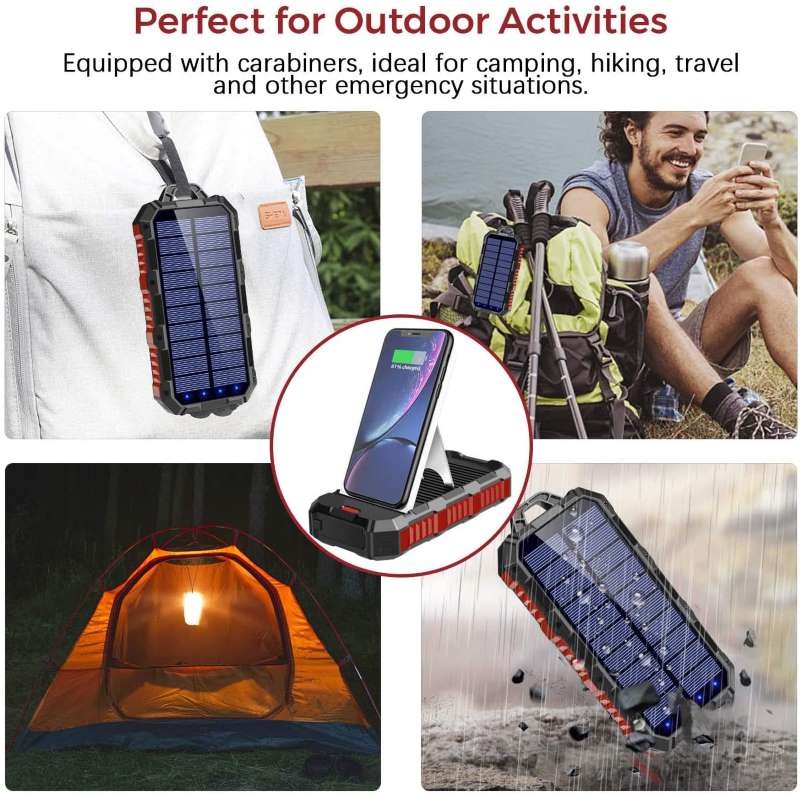
Outdoor buyers often look for features beyond charging. A solar power bank can become more attractive when it includes useful design details for camping, hiking, fishing, travel, and emergency kits.
Common outdoor features include:
- Waterproof or splash-resistant housing
- Rubber corner protection
- Dust cover for ports
- LED flashlight
- SOS or warning light
- Carabiner or hanging point
- Anti-slip surface
- Foldable solar panel design
- Built-in compass on selected models
Still, every feature should have a reason. Adding too many functions can raise cost, weight, and defect risk. A better sourcing strategy is to choose features that match the sales channel.
Outdoor positioning table
| Sales Channel | Useful Product Features | Suggested Positioning |
| Camping store | Foldable panels, LED light, waterproof housing | Outdoor charging backup |
| Travel shop | Built-in cables, compact size | Portable phone backup |
| Emergency kit | Large capacity, strong flashlight | Power cut and storm backup |
| Online marketplace | Clear specs, lifestyle images | Easy comparison for shoppers |
| Corporate gift | Logo area, gift box, built-in cables | Useful branded accessory |
A solar mobile phone charger for camping may need a stronger shell and brighter light. A travel-focused model may need a cleaner design, lighter weight, and several cable options.
The HDL519 camping gear solar charger power bank is a useful reference for outdoor product lines. Buyers can also compare the IP65 waterproof 30,000mAh Qi wireless solar charger for a larger-capacity outdoor option.
Packaging for outdoor models
Packaging should explain the product clearly. Good packaging helps reduce return questions and supports sales teams.
Useful packaging points include:
- Capacity and rated energy
- Input and output details
- Solar charging reminder
- Waterproof level explanation
- Built-in cable icons
- Wireless charging support
- Flashlight function
- Safety warning
- Included accessories
Avoid making the solar panel sound faster than it is. A fair message protects the brand and sets the right customer expectation.
Customization for Importers, Distributors, and Wholesalers
Customization can help a solar power bank fit a brand, market, or retail program. The most common requests include logo printing, packaging design, color selection, cable setup, manual language, barcode labels, and carton marks.
Shenzhen Hedeli Technology Co., Ltd. supports product sourcing from the factory side. Our team can discuss model selection, logo placement, packaging artwork, product specification sheets, and sample preparation. Because our Dongguan factory has a monthly capacity of 50,000 units, buyers can plan trial orders and repeat orders with clearer production communication.
Common customization options
| Custom Option | Typical Use | Buyer Benefit |
| Logo printing | Brand programs, gifts | Builds brand recognition |
| Custom color | Retail collections | Matches product line design |
| Gift box design | Store and online sales | Improves shelf presentation |
| Manual language | Export markets | Helps local customer use |
| Barcode label | Retail and warehouse | Supports stock control |
| Carton mark | Import logistics | Easier receiving and storage |
What to prepare before requesting a quote
A clear quote request saves time. Buyers should prepare:
- Target capacity, such as 10,000mAh or 20,000mAh
- Needed ports, cables, and wireless charging
- Waterproof level preference
- Logo and packaging requirements
- Target market or destination country
- Estimated order quantity
- Preferred delivery schedule
- Needed certificates or test reports
- Shipping method
If you want to compare many models at once, start from the solar power bank wholesale category and send your preferred models for specification review.
A direct factory discussion can also help buyers avoid over-ordering features. For example, a distributor selling to travel stores may not need the largest capacity model. A camping product manager may accept a larger size if the light and panel design are stronger.
How to Source the best solar power bank Directly
Direct sourcing gives buyers better access to product details, samples, production updates, and customization discussion. It also reduces confusion between trading layers when specifications, packaging, or shipment timing need adjustment.
A strong sourcing process should be practical and step based.
Step 1: Define your sales channel
Start with where the product will sell. Online marketplace, camping store, travel shop, supermarket, gift program, and emergency supply distributor may each need a different model.
Step 2: Choose the capacity range
For broad sales, 20,000mAh is often a safe middle range. If the target is a lighter gift program, 10,000mAh can work well. Outdoor and emergency use cases usually call for 30,000mAh or higher
Step 3: Confirm charging features
Decide whether you need USB-C, wireless charging, built-in cables, dual USB output, or foldable panels. More features can help sales, but they also affect cost and testing.
Step 4: Review samples
Samples should be checked for charging speed, cable feel, casing strength, light brightness, solar panel placement, printing quality, and packaging fit. Take photos and record test notes so your team can compare models fairly.
Step 5: Confirm documents and labeling
Ask for battery rating, product label artwork, export documents, and compliance support before mass production. This is especially useful for products shipped by air or sold through online channels.
Step 6: Approve packaging and carton details
Packaging should match the final product. Confirm the box, manual, barcode, carton size, gross weight, and quantity per carton.
Step 7: Plan repeat orders
A good first order is useful, but stable repeat supply is better. Buyers should discuss production lead time, monthly capacity, and model availability before launching a product line.
Working with the original manufacturer gives buyers direct access to the people who understand the product structure, production schedule, sample details, and packaging options. Shenzhen Hedeli Technology Co., Ltd. welcomes inquiries from buyers who need a reliable solar power bank supplier for outdoor, travel, emergency, and wholesale product programs.
Send your target capacity, market, order quantity, and preferred product links. Our team can review matching models, prepare specifications, discuss sample options, and quote directly from the source.
Frequently Asked Questions
What MOQ is available for orders?
MOQ depends on the selected model, packaging, and customization level. Contact us with your preferred solar power bank model and target quantity so we can check the most suitable order plan.
How can buyers request product samples?
You can request samples by sending the model link, capacity preference, and shipping address. Reach out for detailed specifications, sample cost, and delivery options before confirming a larger order.
Do you support logo and packaging customization?
Yes, logo printing and packaging customization are available for many models. Buyers can share artwork, color needs, barcode details, and manual language requirements for review.
What compliance documents can be discussed?
Common documents may include battery transport and electronic product test reports, depending on the market. Please tell us your destination country and sales channel so we can review the required document support.
Can buyers compare several models first?
Yes, buyers can compare several solar power bank options before ordering. Send the product links you like, and we can help compare capacity, ports, cables, waterproof level, and packaging options.