

A dead phone in the field is more than an annoyance. For hikers, drivers, and emergency kits, it can mean lost contact at the worst moment. That is why demand for the solar cell phone charger keeps growing across outdoor, travel, and safety product lines. Retailers see it too. Search interest in the solar power bank category has climbed steadily, and buyers now expect these products on shelves next to standard chargers.
But here is the problem. The market is full of devices that look identical and perform very differently. Panel quality varies. Battery cells vary. Waterproof claims vary even more. So this guide explains how these chargers actually work, which specifications to verify, and how to pick models that won’t come back as returns. You can also browse our full solar power bank product range as you read.
What Is a Solar Cell Phone Charger?
A solar cell phone charger is a portable device that converts sunlight into electricity to charge a phone. It uses photovoltaic (PV) panels, the same basic technology found on rooftop solar systems, but scaled down to pocket or backpack size.
Most products in this category fall into two groups:
- Direct solar chargers. These are panels with a USB output and no battery. Sunlight goes straight to the phone. They only work while the sun is shining.
- Solar power banks. These combine a panel with a built-in battery. The panel charges the battery, and the battery charges the phone. So the user can store power during the day and use it at night.
The second group dominates retail demand. Because the battery acts as a buffer, a solar powered power bank works in any weather and at any hour. Many also charge by USB at home, then use solar as a backup top-up outdoors. That mix of reliability and independence is what end customers are paying for.
You will also see scattered search phrasings for the same product, including solar phone charger, solar mobile phone charger, and even reversed terms like bank power solar. They all point to one category: portable solar charging for phones and small devices.
How Does a Solar Phone Charger Work?
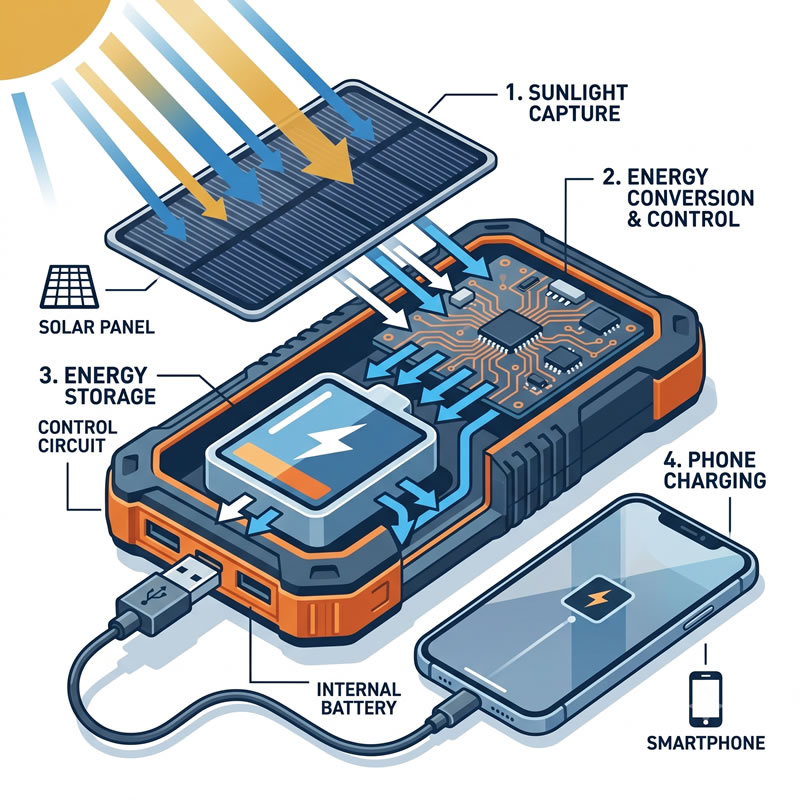
The science behind a solar phone charger is simple to explain, and that helps when training retail or sales teams. The process has four stages.
- Sunlight hits the panel. The panel contains photovoltaic cells, usually monocrystalline or polycrystalline silicon. Photons knock electrons loose inside the silicon, which creates a direct electric current. The U.S. Department of Energy offers a clear primer on how photovoltaic technology works.
- A charge controller manages the current. Sunlight is not steady. Clouds pass, angles change, and output jumps around. So a small control circuit smooths the current and protects the battery from overcharging.
- The battery stores the energy. Most models use lithium-ion or lithium-polymer cells, rated in milliamp-hours (mAh). Common retail capacities run from 10,000mAh to 42,000mAh.
- The output ports deliver power. USB-A, USB-C, or wireless Qi charging passes stored energy to the phone at a regulated voltage, typically 5V.
Two details separate good products from weak ones. First, panel efficiency. Monocrystalline cells convert more sunlight per square centimeter, which matters on a device this small. Second, conversion circuitry. Cheap boards waste energy as heat, so two chargers with the same panel can deliver very different real-world results.
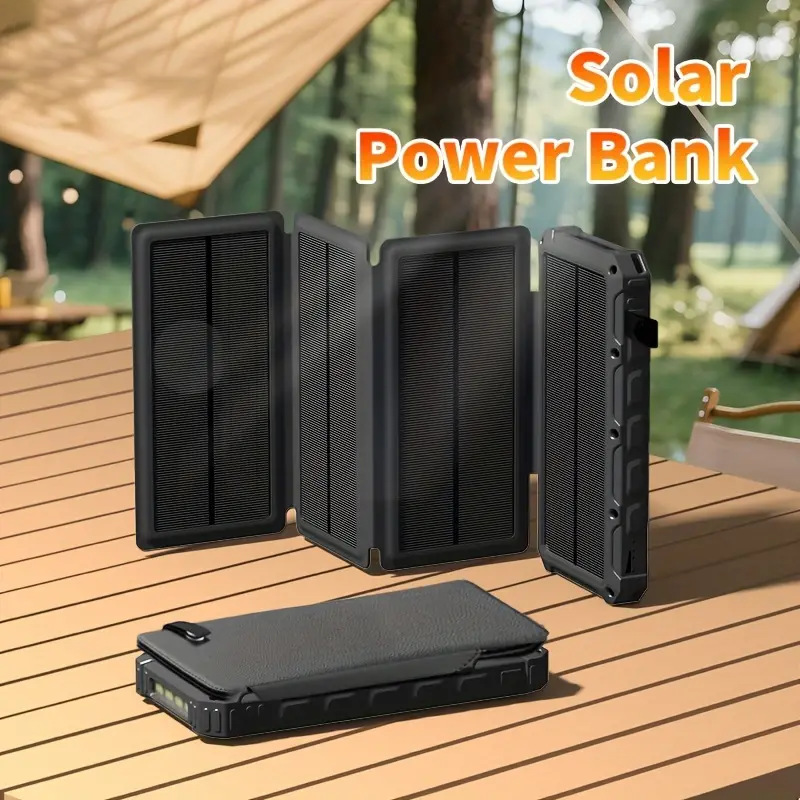
One honest note for your product descriptions: the small panel on a solar power bank is designed for emergency and maintenance charging, not as the only power source. Foldable multi-panel models close that gap, because they offer far more surface area. We cover both formats below.
Solar Panel Chargers vs. Solar Power Banks
Buyers often ask which format sells better. The honest answer: it depends on the end customer. The table below compares the two formats side by side.
| Feature | Direct Solar Panel Charger | Solar Power Bank |
|---|---|---|
| Built-in battery | No | Yes (10,000–42,000mAh) |
| Works at night / indoors | No | Yes |
| Solar charging speed | Faster (larger panel area) | Slower (compact panel) |
| Typical use | Long treks, base camps | Daily carry, travel, emergency kits |
| Extra features | Usually none | Flashlight, wireless charging, multi-port |
| Retail price band | Mid to high | Low to high, wide spread |
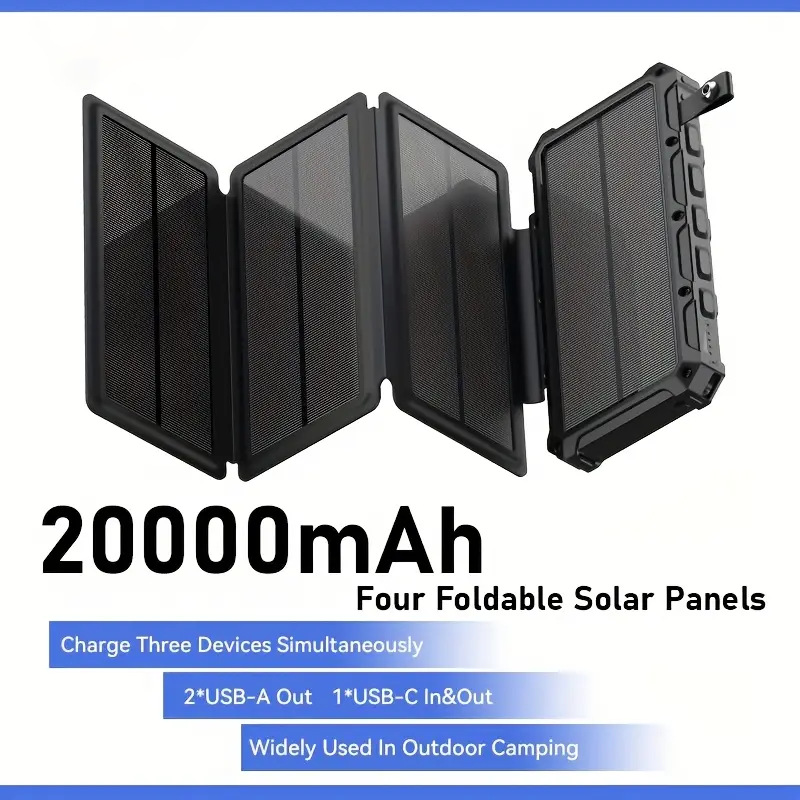
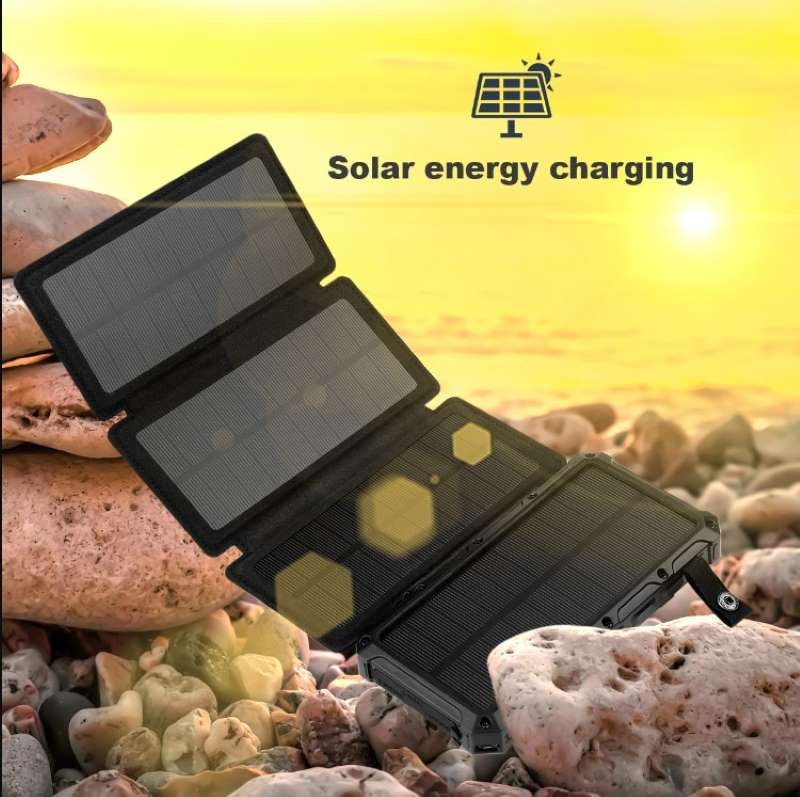
For most general retail and promotional programs, the solar power bank wins on versatility. It behaves like a normal power bank day to day, and the panel adds an off-grid safety net. Foldable hybrids split the difference. For example, our foldable 20,000mAh outdoor solar charger with LED lights pairs a large unfolding panel array with a full battery, so it charges meaningfully faster in the sun than single-panel designs.
When you brief your sales channels, frame it this way: single-panel models suit everyday users who want backup power, while foldable models suit campers and field workers who will rely on the sun for real recharging.
Image for this section
- Image title: Panel Charger vs Solar Power Bank Comparison
- Image description: A foldable four-panel solar charger unfolded in sunlight next to a compact single-panel solar power bank, photographed from above on rocky terrain.
- File name: solar-power-bank-vs-panel-charger.jpg
- Alt text: Foldable solar charger and compact solar power bank compared outdoors
- AI image prompt: Overhead flat-lay photo, 1:1 aspect ratio, unfolded four-panel solar charger beside a compact solar power bank, rocky hiking trail surface, bright midday sun, crisp shadows, realistic product photography, no people.
Key Specs to Check Before You Order
Spec sheets in this category can mislead. Inflated capacity numbers and vague waterproof claims are common, so a careful checklist protects your margin and your brand. Here are the six points we recommend verifying on every model.
1. Real battery capacity. Capacity should be stated for the cell, with rated output capacity available on request. A quality solar power bank battery charger will list both. If a supplier cannot explain the difference, treat that as a warning sign.
2. Panel type and wattage. Monocrystalline panels are the better choice at this size. Wattage tells you how fast the unit can harvest sunlight under ideal conditions.
3. Ingress protection (IP) rating. Outdoor products face rain, dust, and splashes. Ratings such as IPX4, IP65, or IP67 define exactly what a device can survive. The IEC explains the full system in its official IP ratings guide. Insist on the tested rating in writing.
4. Output options. Dual USB-A is the baseline. USB-C input/output and Qi wireless charging now drive purchasing decisions, because customers want one device that fits everything they own. Our 30,000mAh Qi wireless solar charger with USB-C and IP65 rating (HDL528) is a good reference point for a fully equipped spec.
5. Built-in extras. LED flashlights, SOS strobe modes, compasses, and carabiner loops cost little to add but lift perceived value. Built-in cables also reduce customer friction.
6. Cell safety and certification. Lithium cells must carry proper protection circuits and transport documentation. Ask for test reports covering overcharge, short-circuit, and temperature protection.
| Spec | Entry Level | Strong Mid-Range | Top Tier |
|---|---|---|---|
| Capacity | 10,000mAh | 20,000–25,000mAh | 30,000mAh+ |
| Waterproofing | Splash resistant | IPX4 | IP65–IP67 |
| Outputs | Dual USB-A | + USB-C | + Qi wireless, built-in cables |
| Panel | Polycrystalline | Monocrystalline | Mono, foldable multi-panel |
How to Choose a Solar Cell Phone Charger for Your Market
Choosing the right solar cell phone charger starts with one question: who is the end user? Different channels need different builds, and matching the spec to the audience keeps sell-through high. Here is how we typically map it.
Outdoor and camping retail. These customers value durability and light. A model like the camping-ready HDL519 solar charger power bank fits this shelf, and the dual-USB 20,000mAh waterproof version with LED light (HDL519X) adds visible safety features customers can test in-store.
Travel and everyday carry. Compact size and wireless charging matter here. The 10,000mAh wireless fast-charging outdoor model keeps weight down while still covering two to three full phone charges.
Emergency preparedness and safety kits. Capacity rules this segment. Multi-day blackouts call for 24,000mAh and above. Options include the 24,000mAh wireless solar power bank with three built-in cables (HDL531), the IPX4-rated 24,000mAh pack with four cables and dual flashlight (HDL529), and the flagship 42,000mAh four-cable wireless model (HDL-628) for family-sized kits.
Promotional and gift programs. Branding space and a balanced spec sheet win here. The 25,000mAh dual-USB waterproof solar charger and the 20,000mAh waterproof fast-charging panel power bank both offer broad print surfaces for logos.
A few extra selection tips apply across every channel:
- Order samples first. Bench-test capacity, solar input, and waterproofing before committing to volume.
- Check the warranty and defect policy. A clear replacement process protects your customer service costs.
- Confirm packaging options. Retail boxes, blister packs, and eco packaging each suit different shelves.
- Plan for seasonality. Demand peaks before summer and around emergency-awareness periods, so book production early.
Realistic Charging Times: Set the Right Expectations
Returns in this category usually come from one cause: customers expected the panel to refill the battery in an afternoon. So accurate product copy is a commercial decision, not just an honesty exercise.
Here is what realistic performance looks like:
- Phone charging from the battery: about 1.5–2 hours per phone, same as a standard power bank. A 20,000mAh unit charges most phones four to five times.
- Battery refill via USB: roughly 6–10 hours depending on capacity and input wattage. USB-C fast input cuts this down.
- Battery refill via the panel: a single compact panel adds emergency power over a full sunny day. Foldable multi-panel models recharge several times faster, because surface area scales output directly.
Tell this story clearly on packaging and product pages. Position the panel as a backup and survival feature, and position USB as the daily charging method. Customers who buy with that understanding leave better reviews. In fact, well-set expectations are one of the cheapest review-score improvements available in this category.
Two more practical notes for your listings. First, advise users to charge the panel in direct sunlight, not behind window glass, which blocks part of the spectrum. Second, remind them to top up stored units every three months, since lithium cells self-discharge slowly in storage.
Ordering From the Source: What Direct Manufacturing Changes
Most solar chargers on marketplaces pass through two or three trading layers before reaching the buyer. Each layer adds cost and removes information. Working with the factory itself reverses both problems.
Shenzhen Hedeli Technology Co., Ltd. has built mobile accessories and consumer electronics for about ten years, including power banks, TWS earbuds, Bluetooth speakers, USB chargers, cables, car chargers, and phone holders. Our team of more than 100 people runs from a Shenzhen headquarters, with an office and showroom in Guangzhou. Production happens at our Dongguan factory, which ships up to 50,000 units per month to importers, distributors, and wholesalers worldwide.
Direct sourcing gives you several concrete advantages:
- Spec transparency. You see the actual cell brand, panel type, and circuit design, because the people answering your questions built the product.
- Customization control. Logos, colors, packaging, cable sets, and capacity options can be tuned to your market without a middleman translating requirements.
- Faster problem-solving. Sampling feedback goes straight to engineering, so revisions take days instead of weeks.
- Honest pricing. Factory pricing removes trading margins, which widens your room on retail price.
Pick two or three models that match your channels, then request samples and a quotation. Our team will confirm specifications, share test documentation, and walk you through customization options for your brand. Since every unit ships from our own production line, you deal with the source from first sample to final container — reach out through solarpowerbank.cn and we will prepare a tailored offer for your order volume.
Frequently Asked Questions
1. What is the minimum order quantity for solar power banks?
MOQ depends on the model and customization level, and standard models start at accessible volumes. Custom logos, colors, or packaging usually carry a slightly higher minimum. Contact us with your target quantity and we will confirm options.
2. Can you print our logo on the chargers?
Yes. We support logo printing, custom colors, and branded retail packaging on most models. Our Guangzhou showroom team can share printing methods and artwork templates. Reach out for detailed specifications and a sample with your branding.
3. Do your solar chargers carry safety certifications?
Our products are built to meet the certification requirements of major markets, with test reports covering battery protection and electrical safety. Tell us your destination market, and we will confirm the exact documentation available for each model.
4. How long do production and delivery take?
Standard models from stock ship quickly, while customized orders typically need a few weeks of production time. With a monthly capacity of 50,000 units, our Dongguan factory keeps lead times stable even in peak season. Ask for a current schedule when you request a quote.
5. Can we test samples before placing a bulk order?
Yes, and we encourage it. Samples let your team verify capacity, solar input, and waterproof performance firsthand. Contact us to request samples of any model, including pre-production samples with your branding applied.