

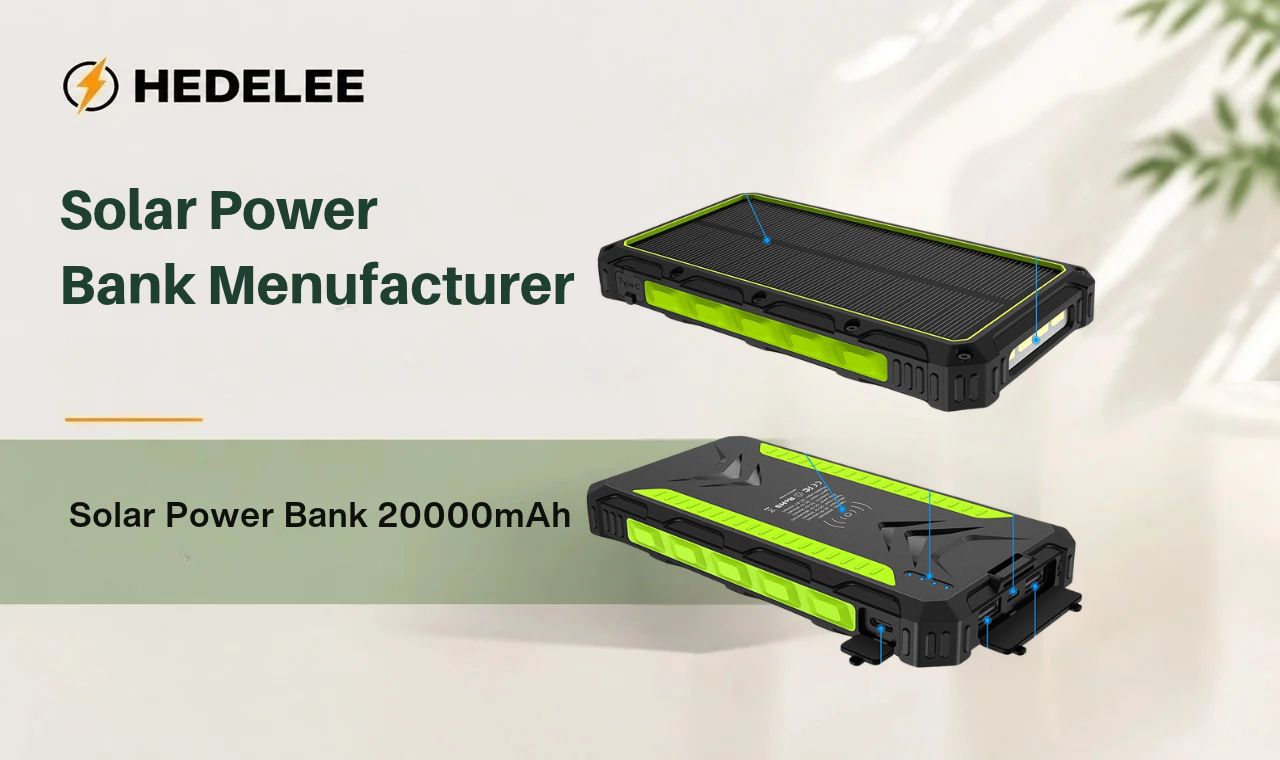
A camper buys a solar power bank 20000mAh for a long weekend. On day two, the panel faces the sky for hours, yet the battery level barely moves. By Monday, a one-star review says the solar doesn’t work.
For importers and retailers, that review hurts more than the refund. And in most cases, the unit worked exactly as designed. Nobody told the buyer what the solar panel can and can’t do.
This guide closes that gap. You’ll see how many phone charges a 20000mAh unit gives, how fast sunlight refills it, and which customers it suits. You’ll also get a spec checklist for ordering, plus a side-by-side look at three models from our Dongguan factory.
We’re Shenzhen Hedeli Technology. Our team has built power banks, chargers, and other mobile accessories for about ten years. So the numbers here come from real production specs, not marketing copy.
7 quick facts buyers should know
- A 20000mAh pack stores about 74Wh of energy.
- Expect roughly 3 to 3.5 full charges for a mid-size phone.
- A built-in 1.5W panel adds about 150–220mAh per hour in strong sun.
- Refilling the whole battery by sunlight alone takes around 100 hours of strong light.
- A 5V/2A wall charger refills the same unit in about 10 hours.
- At 74Wh, it sits under the common 100Wh carry-on limit for flights.
- Water ratings, safety circuits, and certificates shape return rates more than panel size.
What Is a Solar Power Bank 20000mAh Good For?
A solar power bank 20000mAh is a portable battery pack with a small solar panel built into its case. It stores about 74 watt-hours of energy. That’s enough for three to four full charges of a typical phone.
The panel plays a supporting role. It adds a slow trickle of power when no outlet is nearby. So the battery does the heavy work, and the sun stretches it a little further.
It helps to see the product as three tools in one shell:
- The battery – the main job. It stores power from a wall charger and hands it to phones, earbuds, cameras, and lights.
- The solar panel – the backup. It keeps a phone alive for calls, maps, and messages when the battery runs low far from a socket.
- The extras – most outdoor models add an LED torch, a carabiner, and a sealed, shock-resistant shell.
Sellers who promote “free power from the sun” set the wrong expectation. Sellers who promote “a large, tough battery that won’t leave you stranded” get happier customers. The product is the same; only the promise changes.
Who actually buys one?
The end users share one trait: they spend time away from wall power. Typical buyers include:
- Hikers, campers, and anglers on trips of two days or more
- Families building home emergency kits for storms and outages
- Field crews in farming, surveying, construction, and utilities
- Festival goers, road-trippers, and overland travelers
- Companies ordering useful branded gifts for staff or clients
For these groups, a solar power bank answers a simple question: “What happens if my phone dies and there’s no plug?” That’s a strong reason to buy. It’s also a clear message for your product page.
One product, many names
Listings call it many things: solar charger, solar energy bank, power bank for solar, or solar battery pack. The core product stays the same. Using two or three of these names in your titles and descriptions helps more shoppers find the same SKU.
How Many Charges Does a 20000mAh Solar Powered Power Bank Give?
The 20000mAh label describes the cells inside, measured at 3.7 volts. Phones, however, charge at 5 volts or more. So the power bank must raise the voltage, and some energy turns into heat along the way.
Here’s the simple math:
- 20,000mAh × 3.7V = 74Wh of stored energy.
- About 70–85% of that reaches the device after conversion and cable losses.
- That leaves roughly 52–63Wh of usable power.
A mid-size phone battery holds about 15Wh. The phone also loses a little energy while it charges. Because of this, one full phone charge usually costs the power bank 17–19Wh.
| Device type | Typical battery | Approx. full charges from a 20000mAh solar powered power bank |
|---|---|---|
| Compact phone | ~3,300mAh | 3.5–4.3 |
| Mid-size phone | ~4,000mAh | 2.9–3.6 |
| Large phone | ~5,000mAh | 2.3–2.8 |
| 10-inch tablet | ~8,000mAh | 1.5–1.8 |
| Action camera | ~1,700mAh | 7–8 |
| Wireless earbuds case | ~500mAh | 20+ |
These are estimates for cable charging at room temperature. Real results shift with three factors:
- Wireless charging: Qi pads lose more energy as heat. Expect roughly 20–30% fewer charges when using a 5W wireless pad.
- Cold weather: Lithium cells give less power below about 10°C. A cold morning on the trail can cut usable capacity noticeably.
- Battery age: Our HDL618 cells are rated for 500 cycles. After that, capacity drops slowly, which is normal for lithium polymer.
Reading capacity on a spec sheet
Two capacity figures often appear on a spec sheet. Rated capacity is the cell figure, for example 20000mAh at 3.7V. Rated output capacity is what the pack delivers at 5V, usually about 10,000–12,500mAh for this size.
Both numbers are honest. They simply measure different points in the circuit. Ask your supplier to show both on the label and the spec sheet. Customers who test with a USB meter will then see results that match the box.
A tip for your listings: quote charges for one or two named phone sizes. “About 3 full charges for a 4,000mAh phone” builds more trust than “charges your phone many times.” Clear numbers also cut return rates.
How Fast Does a Solar Phone Charger Refill Itself in the Sun?
This is where most complaints start, so it pays to be precise.
Built-in panels on pocket-size units are small. Our HDL618, for example, uses a 1.5W monocrystalline panel rated at about 220mA. In strong, direct midday sun, that adds roughly 150–220mAh per hour to the battery.
Now do the math. 20,000mAh ÷ about 200mAh per hour = roughly 100 hours of strong sun. Even with six good hours a day, a full solar refill takes more than two weeks.
Compare that with a wall charger. At 5V/2A, the same unit refills in about 10–10.5 hours.
| Light condition | Approx. solar input per hour | What six hours of this light adds |
|---|---|---|
| Direct midday sun, panel aimed | 150–220mAh | 15–22% of one phone charge |
| Bright haze or thin cloud | 50–120mAh | 5–12% of one phone charge |
| Heavy overcast | 10–50mAh | A few percent at most |
| Behind a window or windshield | Very low | Little gain, high heat risk |
So what is a solar phone charger good for? It’s an emergency reserve. A day of good sun can give a dead phone enough charge for calls, texts, and a map check. That can save a hiker or a family during a blackout. It just won’t replace the wall charger.
Why built-in panels stay small
Why not fit a bigger panel? The case sets the limit. A pack measuring 172×87mm offers about 150 square centimeters of surface. Even efficient cells produce only 1–2W on that area in full sun. A bigger panel needs a bigger, heavier case, and that’s why foldable designs exist.
Do more panels mean faster charging?
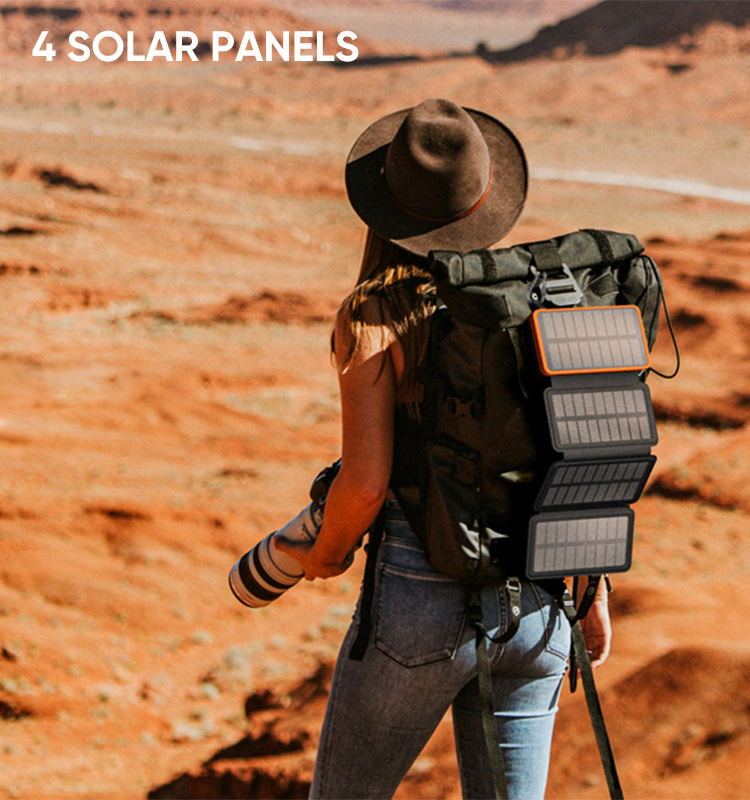
Partly. Total panel area and cell type decide the input, not the number of segments. Foldable models open extra panels to gather more light, so they usually refill faster than a single built-in panel. Monocrystalline cells also turn more light into power than polycrystalline cells of the same size.
When you compare samples, ask for the total panel wattage and current. Those two numbers tell you far more than “4 panels” printed on a box.
Heat is the hidden enemy
Solar panels lose output as they get hot. Lithium cells also dislike heat. Our units are designed to work between 0°C and 45°C. A power bank left on a car dashboard in summer can pass that limit fast. Good packaging inserts should warn users about this.

Where a Solar Power Bank 20000mAh Fits Best, and Where It Doesn’t
Matching the product to the right customer is the easiest way to protect your reviews. Shoppers type many different searches, from “solar cell phone charger” to “bank power solar.” Underneath, they want the same thing: power when no outlet exists.
| Use scenario | Fit | Why |
|---|---|---|
| Multi-day camping and hiking | Strong | The large battery covers the trip; solar adds a reserve |
| Home emergency kits | Strong | Holds charge in storage; solar helps during long outages |
| Outdoor work crews | Strong | A tough shell, torch, and water resistance suit job sites |
| Festivals and road trips | Good | Several phone charges between outlets |
| Branded corporate gifts | Good | A large print area and year-round usefulness |
| Daily city commuting | Weak | 450–550g is heavy for a pocket; a slim 10000mAh unit suits better |
| Laptop charging | Weak | Most laptops need 45W or more through USB-C PD |
A note for travel-focused buyers
Flight rules come up often. A 20000mAh pack holds about 74Wh. The U.S. FAA allows power banks up to 100Wh in carry-on bags without airline approval. It also bans spare lithium batteries from checked luggage. You can review the details in the FAA PackSafe lithium battery guidance. Rules vary by country and airline, so remind customers to check before they fly.
Printing “74Wh” clearly on the shell helps here. Security staff look for the watt-hour figure, and a clear label saves travelers time at the gate.
Seasonal demand patterns
In most northern markets, outdoor gear sells fastest from spring through summer. Emergency-kit demand often climbs before hurricane and typhoon seasons. Placing orders well before these windows keeps stock on shelves when shoppers start searching.
Solar Power Bank vs. Standard Power Bank vs. Separate Solar Panel
Shoppers who want off-grid power usually pick from three setups. Knowing the trade-offs helps you plan a small range instead of a single product.
| Setup | Strengths | Limits | Suits |
|---|---|---|---|
| Solar power bank 20000mAh | One device, tough shell, carries its own backup | Small panel and slow solar input | Hikers, emergency kits, gifts |
| Standard 20000mAh power bank | Lighter, often faster charging, lower cost | No backup once the battery runs flat | Commuters and city travelers |
| Power bank plus a foldable 10–20W panel | Much faster solar input | Two items to carry and a higher price | Long expeditions and overlanding |
Many retailers stock all three. The standard pack covers daily needs, and the solar model fills the outdoor shelf. The panel kit then serves serious campers who need real solar input.
This mix lets each customer choose by use, which keeps returns down. If you can only stock one, the solar power bank is often the easiest sell. It answers the “what if my battery dies” worry in a single box.
Key Specs to Check Before Ordering a Solar Power Bank Battery Charger
A solar power bank battery charger can look identical across ten suppliers. The differences hide inside the shell. Use this checklist when you request quotes or test samples.
1. Battery cells and real capacity
- Ask for the cell type. Lithium polymer is common for slim, shaped packs.
- Request the actual cell capacity in writing, plus the rated cycle life.
- Ask for a discharge test report from a sample unit. It shows how much energy reaches the output port.
2. Output ports and charging speed
- USB-C 5V/3A (15W) charges phones faster than older 5V/2A ports.
- Quick-charge support helps with newer phones. Confirm which protocols the board supports.
- Wireless charging, usually 5W Qi, is handy for cable-free top-ups, though it’s slower.
- Dual inputs, for example USB-C plus Micro USB, help in markets where older cables are still common.
3. Solar panel type and output
- Monocrystalline cells give better output per square centimeter.
- Ask for panel wattage and current, for example “1.5W / 220mA.”
- Check how the panel is sealed. A poorly bonded panel can lift or let moisture in.
4. Water and dust protection
IP ratings follow the IEC 60529 standard. The first digit covers dust, and the second covers water. You can see the full scale in this overview of IP code ratings.
| Rating | What it means for users |
|---|---|
| IPX4 | Resists splashes from any direction |
| IPX5 | Resists low-pressure water jets, like heavy rain |
| IPX7 | Survives temporary immersion (1 meter for 30 minutes) |
| IP6X | Fully dust-tight |
Remember that ratings apply with the port covers closed. Tell end users to seal the rubber flaps before rain or river crossings.
5. Safety protection
Ask the factory to confirm each protection on the circuit board:
- Overcharge and over-discharge
- Short circuit
- Over-voltage and over-current
- Over-temperature
A flame-retardant shell adds another layer. For example, our waterproof model uses an ABS+PC housing with a V0 fire rating.
6. Certifications and shipping documents
Match certificates to your sales region:
- CE and RoHS for the EU
- FCC for the United States, plus UL where retailers require it
- PSE for Japan
- UN38.3 and an MSDS for shipping lithium batteries by air or sea
Without UN38.3, many freight forwarders won’t accept the cargo. So confirm documents before the deposit, not after production.
Comparing Three 20000mAh Solar Cell Phone Charger Designs
Different customers need different designs. Below are three 20000mAh-class models from our production line. Each one is built for a slightly different buyer.
| Feature | HDL618 wireless model | Foldable LED model | Waterproof fast-charging model |
|---|---|---|---|
| Solar panel | Built-in 1.5W monocrystalline | Fold-out multi-panel | Built-in panel |
| Outputs | USB 5V/1A, USB 5V/2.4A, USB-C 5V/3A, 5W wireless | USB-C and 2× USB, each 5V/3A | Quick charge up to 15W |
| Inputs | USB-C 5V/3A and Micro USB 5V/2A | 5V/3A | Confirm on spec sheet |
| Extras | Torch, caution, and SOS LED; carabiner | LED lights; LED display | LED display |
| Shell | ABS+PC with soft leather wrap | PC+TPU | ABS+PC V0 fire-rated with silicone |
| Size and weight | 172×87×28mm, 450g | 155×85×35mm folded, 550g | 155×85×35mm, 500g |
| Tests and certificates | CE, FCC, RoHS; IP6X, IPX7, and 2.5m drop tests | CE, RoHS, UL, PSE, UN38.3, FCC, BSCI, MSDS | CE, RoHS, FCC, MSDS, UN38.3 |
| Suits | Outdoor retail and gift sets | Camping and emergency kits | Wet-weather and marine lines |
HDL618: the all-rounder with wireless charging. This model suits outdoor retail and gift sets. It combines a 1.5W monocrystalline panel, 5W wireless charging, and a three-mode LED for torch, caution, and SOS. In our in-house tests, it passes IP6X dust, IPX7 immersion, and a 2.5-meter drop. See the full specs of the 20000mAh solar power bank with wireless charging and SOS flashlight.
Foldable model: more panel area for longer trips. The fold-out panels collect more sunlight, which helps campers and emergency-kit buyers. It offers three 5V/3A outputs and carries a wide certificate set, including UL, PSE, and UN38.3. Check the details of the foldable 20000mAh solar charger with LED lights.
Waterproof fast-charging model: built for wet weather. The silicone-wrapped, V0 fire-rated shell targets rugged and marine-style product lines. It supports quick charging up to 15W and ships with CE, FCC, RoHS, MSDS, and UN38.3 documents. View the waterproof 20000mAh solar power bank with fast charging.
Want to compare more capacities and styles? Browse our full range of solar power banks, from compact 10000mAh units to high-capacity designs with built-in cables.
How End Users Get More From a Solar Mobile Phone Charger
Good results depend on how people use a solar mobile phone charger. These tips work well on packaging inserts, manuals, and product pages:
- Charge it fully at home first. Start every trip at 100% from a wall outlet.
- Use solar to top up, not to fill. Treat sunlight as a reserve for emergencies.
- Aim the panel at the sun. Lay it flat at midday, and adjust the angle every hour or two.
- Keep it out of hot cars. Dashboards and closed vehicles can push the unit past 45°C.
- Charge phones in the shade. Charging while sitting in hot sun adds extra heat to the cells.
- Close the port covers. Water ratings only count when the flaps are sealed.
- Use a 3A cable. A weak cable holds the 15W output back to slower speeds.
- Store it half full. For long storage, keep it near 50% and top up every two to three months.
Customers who know what to expect leave better reviews. So these eight short lines may protect your ratings more than any spec upgrade.
For promotional and gift orders, the same tips fit on a small printed card inside the box. It costs very little to add, and it gives the recipient a reason to keep the brand’s gift in their bag.
Sourcing Solar Power Banks Directly From the Factory
Buying from the source changes how fast you can solve problems. When a spec needs adjusting or a test report is missing, you speak to the team that builds the product.
Here’s what working with us looks like:
- Experience: Shenzhen Hedeli Technology has served the mobile accessories and consumer electronics industry for about ten years.
- People and places: More than 100 employees, headquarters in Shenzhen, an office and showroom in Guangzhou, and a factory in Dongguan.
- Capacity: Around 50,000 units per month, so importers, distributors, and wholesalers receive goods on schedule.
- Range: Solar power banks sit alongside our wireless power banks, TWS earbuds, Bluetooth speakers, USB chargers and cables, car chargers, and car phone holders.
- Systems: OEM and ODM service, backed by ISO9001 and ISO14001 certification.
Customization options
- Logo printing or laser marking on the shell
- Custom shell colors for larger orders
- Branded retail boxes, inserts, and manuals in your language
- Cable and accessory bundles, like carabiners or lanyards
Testing before shipment
Every batch runs through aging machines and battery testers. Our lab also uses multi-protocol load testers, vibration testers, and electrostatic discharge generators. Sample units go through drop, dust, and water tests that match the ratings on the spec sheet.
What to include in your inquiry
A detailed inquiry gets a faster, more accurate quote. Try to share:
- Your target market and sales channel, for example retail, online, or promotional
- Estimated order quantity per model
- Must-have features, like wireless charging, foldable panels, or a water rating
- The certificates your market requires
- Logo, color, and packaging needs
- Your target delivery window
With these details, our sales team can match models and price them in one reply.
From sample to bulk order
Start with samples, so your team can check charging speed, panel output, and finish. Once you approve them, we confirm artwork, packaging, and the production schedule. Exact lead times depend on quantity and customization, and we confirm them on your quotation.
If you’re planning a solar line for the coming season, share your target market, order quantity, and must-have features. Because we’re the original manufacturer, you’ll deal directly with the people who design, build, and test each unit. There’s no trading layer in between and no guessing about specs. Send your inquiry or request samples, and we’ll reply with matched models, pricing, and the certificates your market needs.
Frequently Asked Questions
1. What is the MOQ for custom solar power banks?
MOQ depends on the model and how much you customize. Logo-only orders on a standard shell usually need fewer units than custom colors or new tooling. Share your target quantity, and we’ll confirm the exact MOQ on your quote.
2. Can you customize the logo, color, and packaging?
Yes. We offer logo printing or laser marking, custom shell colors on larger orders, and branded boxes with manuals in your language. Send your artwork, and we’ll prepare a digital proof before sampling.
3. Which certifications come with your solar power banks?
It depends on the model, but our range covers CE, FCC, RoHS, UL, PSE, UN38.3, and MSDS. Tell us your sales region, and we’ll match models that already hold the right documents.
4. How long does a solar power bank 20000mAh take to charge?
About 10–10.5 hours from a 5V/2A wall charger for our HDL618. By sunlight alone, a full refill needs roughly 100 hours of strong sun. That’s why solar works best as a top-up.
5. Can we get samples before placing a bulk order?
Yes, samples are available for all listed models. Testing them first lets your team check panel output, charging speed, and finish. Reach out with the models you want, and we’ll arrange shipment.