

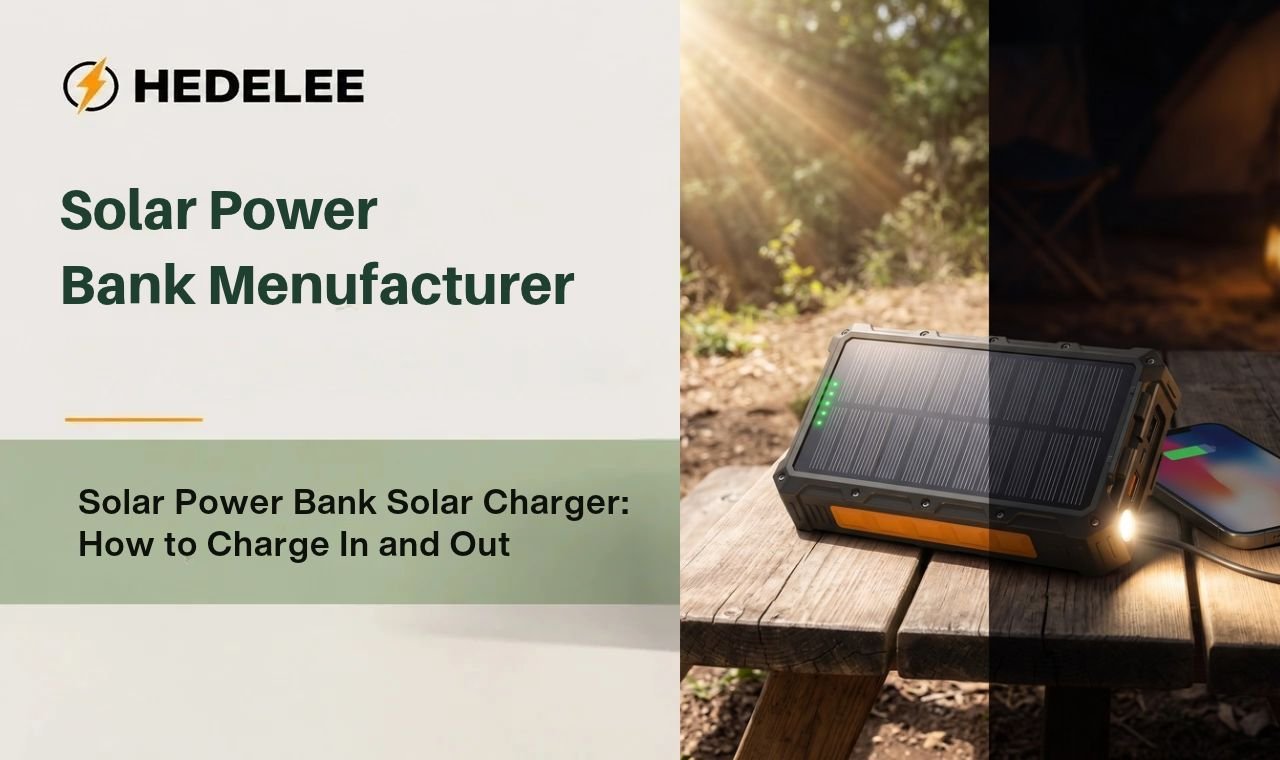
A customer leaves a new solar charger on a sunny windowsill for a full day. By evening, only one light out of four is blinking. The review says “faulty,” and the return lands on your desk.
A slow charge does not necessarily mean the product is broken. The buyer may not understand how a solar power bank solar charger takes power in and sends power out. That gap can cost importers and wholesalers money in returns, support time, and lost repeat orders.
This guide explains how charging works from a wall outlet and from the sun. It also covers how the power bank charges phones and other devices, along with realistic charging times. To help your customers use it correctly, you’ll find seven practical tips and the specs to check before placing a bulk order.
What Is a Solar Power Bank Solar Charger?
A solar power bank solar charger is a portable battery pack with a solar panel built into its case. It stores energy first. Then it gives that energy out through USB ports, built-in cables, or a wireless pad.
Think of it as two products in one shell:
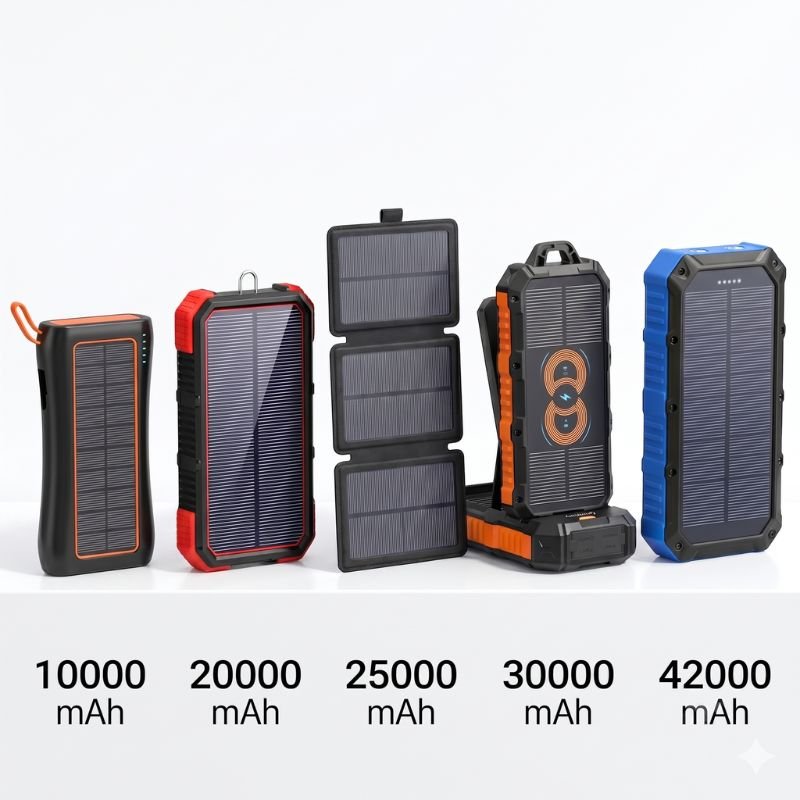
- The power bank is the battery. It holds the energy, usually between 10,000 and 42,000mAh.
- The solar charger is the panel. It feeds the battery slowly whenever light hits it.
People search for this product under many names. Some type “solar powered power bank.” Others type “solar energy bank” or even “bank power solar.” They all mean the same device.
Two types that buyers often mix up
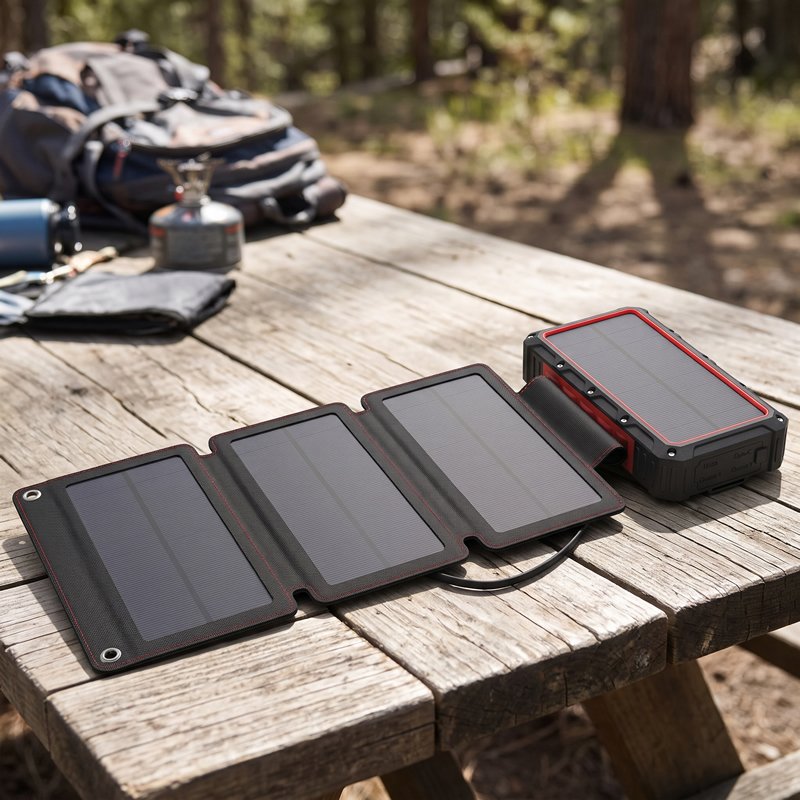
There are two ways to charge a phone from the sun, and they suit different users. The first is a battery pack with a panel on board. The second is a standalone folding panel with no battery at all.
| Feature | Solar power bank (battery + panel) | Standalone folding solar panel |
|---|---|---|
| Stores energy | Yes | No |
| Works at night or under cloud | Yes, from stored power | No |
| Solar input | Low, about 1.5–8W | Higher, often 20W or more |
| Size | Fits a pocket or bag | Larger; hangs on a pack or tent |
| Typical use | Travel, camping, emergency kits | Long off-grid trips, base camps |
For most retail and promotional channels, the battery-and-panel type is easier to sell. It works on day one, straight from the box, even with no sun. A standalone panel gives more power, but it stops the moment the light goes.
Who buys this product, and why?
Demand comes from several channels at once. That spread keeps the category steady through the year.
- Outdoor and travel retail. Hikers, campers, and anglers want power far from a socket.
- Emergency preparedness. Households keep one in a storm kit or a car.
- Regions with unstable grid power. A solar mobile phone charger keeps a phone alive through outages.
- Promotional and corporate gifts. A branded unit stays in use for years.
Each channel values a different feature. So a range with two or three capacities usually sells better than a single model.
How Does a Solar Powered Power Bank Work?
A solar powered power bank works in three stages: collect, store, and deliver.
- Collect. The panel converts light to a small electric current.
- Store. A charge controller passes that current to the lithium battery. It stops when the battery is full.
- Deliver. A second circuit raises the battery’s 3.7V to the 5V or more that USB devices need.
All three stages sit on one circuit board inside the case. That board also holds the protection circuits, so its design decides how safe the product is.
What’s inside the case?
| Part | What it does | What to check |
|---|---|---|
| Solar panel | Converts light to current | Rated wattage and number of panels |
| Lithium cells | Store the energy | Real capacity and cell grade |
| Control board | Manages charging and protection | Overcharge, short-circuit, and temperature protection |
| Housing | Guards against drops, dust, and water | Material and IP rating |
| Ports and pad | Send power to devices | Type-C, USB-A, built-in cables, wireless |
Ask your supplier about each row. The answers tell you more than the headline capacity does.
Why the panel is slow, and why that’s normal
Solar output depends on panel area. A panel the size of a phone can only catch so much light.
Here is the simple math. A single built-in panel rated 5V/300mA makes about 1.5W in strong sun. A wall charger gives 10 to 18W. So the wall is roughly ten times faster.
That’s physics, not a defect. Folding models with three or four panels raise the solar input to around 6W or more. Therefore, they refill much faster outdoors.
A quick way to read capacity
Capacity in mAh tells you how much the battery holds. But airline and freight rules use watt-hours instead. The conversion is easy:
Wh = mAh × 3.7 ÷ 1,000
So a 20,000mAh unit holds about 74Wh, and a 30,000mAh unit holds about 111Wh. Keep these numbers nearby, because they come back in the shipping section.
Charge In: How to Fill a Solar Power Bank Battery Charger
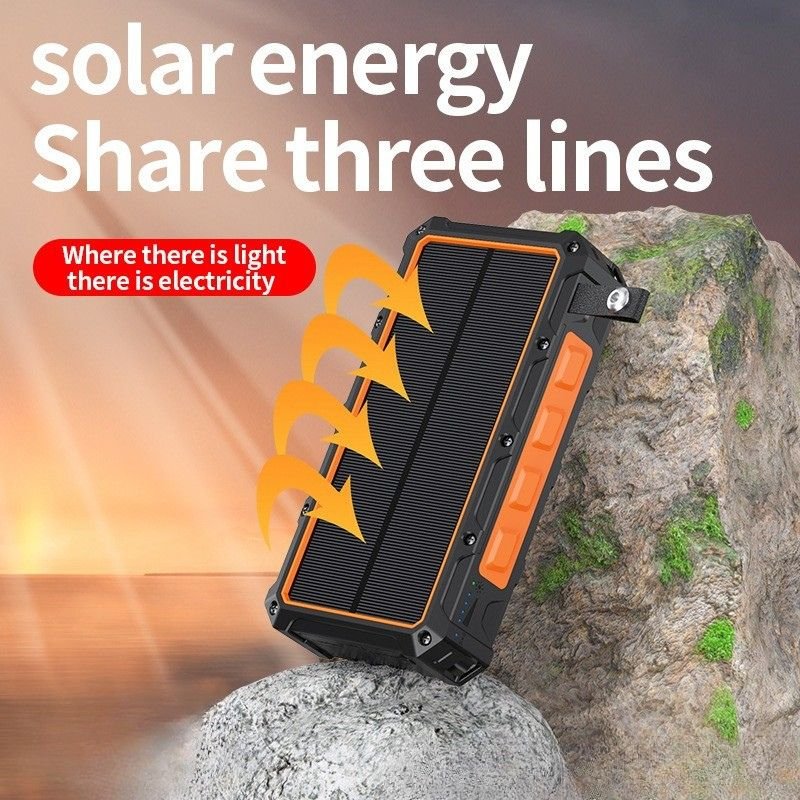
“Charge in” means putting energy into the battery. A solar power bank battery charger has two inputs, the USB port and the panel. The order you use them in decides how happy the end user will be.
Step 1: Fill it from the wall first
Treat the USB port as the main input.
- Plug the cable into the Type-C or Micro USB input.
- Use a 5V/2A or stronger wall adapter. A weak 1A adapter doubles the wait.
- Watch the LED indicators. Each light equals roughly 25% of capacity.
- Unplug when all four lights stay solid.
Models with dual inputs accept either cable type. Our 20000mAh wireless solar power bank HDL-218 is one example. That helps in markets where users still own both kinds of cable.
Step 2: Top it up from the sun
Use the sun to add energy during the day and to hold the charge on long trips.
- Place the panel in direct sunlight, not behind glass. Window glass cuts the light that reaches the cells.
- Tilt the panel to face the sun. Flat works at noon, but a tilt works better in the morning and late afternoon.
- Keep the panel clean and free of shade. Even a strap’s shadow across one cell lowers the output.
- Look for the solar indicator, usually a green light. It confirms the panel is charging.
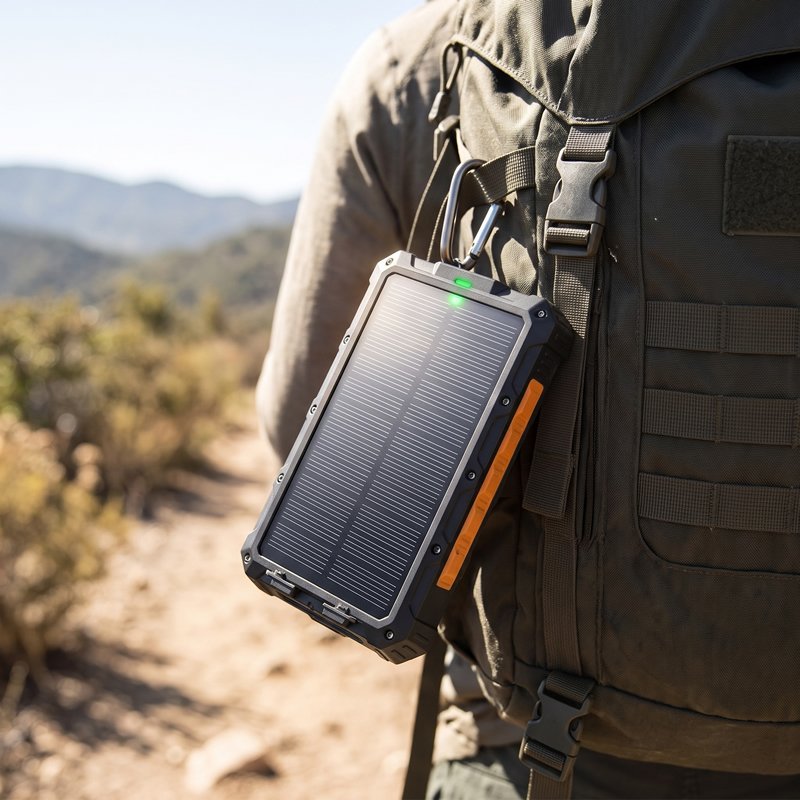
- Keep the battery body cool. Hang the unit on a backpack instead of laying it on hot rock or a dashboard.
How long does charging in take?
Here are working estimates. They assume about 80% charging efficiency and strong, direct sun. Real results change with season, latitude, and cloud.
| Capacity | Energy | Wall input (about 10W) | Single panel (about 1.5W) | Folding panels (about 6W) |
|---|---|---|---|---|
| 10,000mAh | 37Wh | 4–5 hours | 30+ sun hours | 7–8 sun hours |
| 20,000mAh | 74Wh | 9–10 hours | 60+ sun hours | 15–16 sun hours |
| 30,000mAh | 111Wh | 13–14 hours | 90+ sun hours | 23–24 sun hours |
The message for your product pages is short: wall for speed, sun for reserve. One sunny day on a single panel adds roughly 10–13% to a 20,000mAh unit. That’s enough for emergency calls, a map check, or a few hours of light.
Some buyers need a faster solar refill. For them, a multi-panel design is the answer. Our foldable 20000mAh outdoor solar charger with LED lights opens out to catch more sun. Then it folds flat for the bag.
What do the indicator lights mean?
Most units use four LEDs for battery level. One solid light means about 25%, and four mean full. A blinking light shows the level that is filling now.
A separate light, often green, shows solar input. It tells the user that the panel sees enough light. However, it does not mean the battery is filling fast. Explain this in the manual, because many “faulty” claims start here.
Can it charge in and out at the same time?
Some models allow it, and some don’t. So check the spec sheet before you promise it. Even where it works, it warms the battery and slows both sides. Therefore, the safer advice is one job at a time.
Charge Out: Using It as a Solar Phone Charger
“Charge out” means sending stored energy to a device. This is the part end users care about. As a solar phone charger, the unit works the same by day or by night.
Charging by cable
- Connect the phone to a USB output, or pull out a built-in cable.
- Press the power button once if charging doesn’t start by itself.
- Check the phone screen for the charging icon.
- Unplug when done. Most units switch off after a short idle time.
Built-in cables remove the most common complaint in this category: the forgotten cable. The 24000mAh solar power bank with 4 built-in cables HDL529 carries its cables in the body. So does the 42000mAh solar battery pack with dual LED flashlight HDL-628.
Charging without a cable
Wireless models work as a solar cell phone charger with no cord at all. Place a Qi-compatible phone on the marked pad and press the button. Also keep these points in mind:
- Remove thick or metal cases, because they block the charge.
- Center the phone on the pad.
- Expect slower speeds than a cable, and a little more heat.
The 30000mAh Qi wireless solar charger HDL528 pairs the pad with Type-C input and 5V/3A output. So one unit covers both habits.
How many phone charges will users get?
Not every mAh reaches the phone. Voltage conversion and heat use up part of it. A fair rule is that about 60–70% of the rated capacity arrives at the device.
| Power bank capacity | Usable output (about 65%) | Charges for a 5,000mAh phone |
|---|---|---|
| 10,000mAh | 6,500mAh | About 1.3 |
| 20,000mAh | 13,000mAh | About 2.6 |
| 30,000mAh | 19,500mAh | About 3.9 |
| 42,000mAh | 27,300mAh | About 5.5 |
Print honest numbers like these on your packaging and listings. Buyers who get what they were promised leave better reviews. Buyers who were promised “10 charges” do not.
More than phones
A solar mobile phone charger also runs other small USB devices. These include earbuds, speakers, GPS units, headlamps, action cameras, and e-readers.
Most models also add an LED flashlight, often with SOS and strobe modes. For camping and emergency kits, that light is a selling point of its own.
Why does charging stop or slow down?
Most output problems have simple causes. Share this short list with your support team:
- The unit shut off. Earbuds and other small devices draw little current, so some units switch off. Press the button again.
- The cable is worn. Swap it for a short, sound one.
- The battery is nearly empty. One blinking light means it needs a refill first.
- The unit is too hot or too cold. Protection circuits pause charging outside safe temperatures. Move it to the shade and wait.
- Too many devices are connected. Total output is shared, so each device charges more slowly.
How to Choose a Solar Power Bank Solar Charger for Your Market
The right solar power bank solar charger depends on who will carry it and where. So start with the end user. Then work back to the spec sheet.
Five specs to check
- Capacity. 10,000mAh suits daily carry. 20,000 to 25,000mAh suits weekend trips. 30,000mAh and above suits groups, long trips, and emergency kits.
- Panel design. One panel keeps the unit slim. Folding panels refill faster outdoors.
- Outputs. Count the USB ports and check for Type-C. Then decide on built-in cables and wireless charging.
- Protection rating. IP codes describe tested resistance to dust and water. The IEC guide to IP ratings explains the two digits. The first covers solids, and the second covers liquids. IPX4 handles splashes, while IP65 is dust-tight and handles water jets.
- Extras. Flashlight modes, a carabiner, and clear indicator lights all help the product sell in outdoor channels.
Single panel or folding panels?
This choice shapes price, weight, and user reviews. So it deserves a clear answer.
A single-panel model is slim, light, and lower in cost. It suits city users who charge by USB and treat solar as a reserve. A folding model weighs more and costs more. But it refills several times faster outdoors, so it suits multi-day trips.
Many importers stock both. They sell the single-panel unit as the everyday pick and the folding unit as the outdoor upgrade.
Match the model to the end user
| End user | What they need | Models to review |
|---|---|---|
| Commuters and students | Light weight, wireless pad | 10000mAh outdoor solar power bank with wireless charging |
| Hikers and campers | Water resistance, LED light, dual USB | 20000mAh waterproof dual USB solar power bank HDL519X, camping solar charger power bank HDL519, waterproof 20000mAh fast charging solar power bank |
| Road trips and families | Larger capacity, several ports | 25000mAh solar charger with dual USB ports |
| Emergency kits and work crews | Largest capacity, built-in cables | 24000mAh to 36000mAh wireless solar power bank with three cables HDL-531 |
You can also browse the full solar power bank range to compare panel layouts and housings side by side.
Questions to ask any supplier
- What is the real cell capacity, and is there a test report to show it?
- What is the rated wattage of the solar panel?
- Which protection circuits are on the board? Look for overcharge, over-discharge, short-circuit, and temperature protection.
- Which test reports are available for my market?
- Can the housing color, logo, packaging, and manual be customized?
A supplier who answers these quickly, with documents, usually controls the production line. A supplier who can’t answer them is often reselling someone else’s product.
Care, Safety, and Shipping Rules Buyers Should Know
Lithium batteries are safe when they’re handled within their limits. A few clear rules protect your customers and your brand.
Heat is the main risk
- Don’t leave the unit on a car dashboard or in a closed car.
- Don’t charge it behind a window in full sun.
- Stop using any unit that swells, smells, or gets too hot to hold.
- Store it half charged in a cool, dry place. Then top it up every three months.
It sounds odd for a solar product, but the panel wants sun while the battery wants shade. Good usage advice explains both. Face the panel to the light, and keep air moving around the body.
Lithium cells also wear a little with every full cycle, and heat speeds that up. So a unit kept cool holds more of its capacity over the years.
Water resistance has limits
A rating like IPX4 or IP65 covers rain and splashes with the port covers closed. However, it doesn’t cover swimming. So tell users to close the rubber flaps and dry the ports before charging.
Air travel and the 100Wh line
Airline rules follow watt-hours, not mAh. The UK Civil Aviation Authority publishes passenger rules for carrying power banks. Up to 100Wh, a power bank can travel in cabin baggage without airline approval. Above 100Wh and up to 160Wh, it needs the airline’s approval. Power banks also stay out of checked bags.
| Capacity | Energy | Cabin baggage status |
|---|---|---|
| 10,000mAh | 37Wh | Under 100Wh |
| 20,000mAh | 74Wh | Under 100Wh |
| 25,000mAh | 92.5Wh | Under 100Wh |
| 30,000mAh | 111Wh | 100–160Wh, airline approval needed |
| 42,000mAh | 155.4Wh | 100–160Wh, airline approval needed |
This affects your range planning. If your customers fly often, 20,000 to 25,000mAh models are the easier sell. Rules differ by airline and country, so advise users to check before they fly.
Freight documents
Bulk shipments of lithium battery products usually move with a UN38.3 test summary and a safety data sheet. So ask for both before you book freight. Also confirm the packing and labeling rules with your forwarder, because they differ by route and carrier.
7 Tips to Get More From a Solar Cell Phone Charger
These seven habits help customers use a solar cell phone charger correctly. Include them in your manual, on an insert card, or in your product listing.
1. Charge From the Wall Before Every Trip
Fully charge the power bank by USB before leaving home. Starting with a full battery reduces your dependence on sunlight.
2. Place the Panel in Direct Sunlight
Choose an open spot away from shade. Charging through a window can reduce solar input and may expose the unit to excessive heat.
3. Adjust the Panel Throughout the Day
Position the panel toward the sun and adjust it as the sun moves. Avoid spots where nearby objects cast shadows over the panel.
4. Avoid Excessive Heat
Keep the unit off hot surfaces and allow air to circulate around it. Follow the manufacturer’s operating temperature limits, especially when the panel and battery share one housing.
5. Charge the Power Bank Before Your Phone
Let the power bank store energy before connecting your phone. Only charge the bank and phone simultaneously if the manufacturer supports this function.
6. Use a Suitable Cable in Good Condition
Choose a cable compatible with your device and its charging requirements. Replace cables with frayed insulation, loose connectors, or unreliable charging.
7. Check the Battery During Storage
Follow the manufacturer’s storage instructions and check the charge periodically. Avoid leaving the power bank completely empty for long periods.
For sellers, add a clear instruction to the packaging: “Fully charge by USB before first use.” This helps buyers understand how to prepare the charger before relying on it outdoors.
Why Source Directly From the Original Manufacturer?
Usage advice only works when the product behind it is consistent. And consistency comes down to who builds it.
Shenzhen Hedeli Technology Co., Ltd. has worked in mobile accessories and consumer electronics for about 10 years. Our mission is to supply the world with well-made, innovative products. The Hedelee range covers power banks, TWS earbuds, Bluetooth speakers, USB chargers, USB cables, car chargers, and car phone holders.
Here are the facts buyers usually ask for:
- Team: more than 100 employees
- Headquarters: Shenzhen, China
- Office and showroom: Guangzhou
- Factory: Dongguan, with a monthly capacity of 50,000 units
Because we run our own factory, importers, distributors, and wholesalers deal with the people who build the product. So questions about cells, panels, housings, or packaging get answered at the source. Supply also stays on schedule, because nobody stands between your order and the production line.
What to send us
Planning a solar power bank line? Then tell us three things: your target market, your capacity range, and your expected order quantity. We’ll reply with suitable models, full specifications, and a quotation.
You can also request samples first. Test the charge-in and charge-out times yourself, and compare them with the tables above.
We are the original manufacturer, so every inquiry reaches the factory team directly. Send your request through the solar power bank product range, and let’s build a line your customers can rely on in sun or shade.
Frequently Asked Questions
1. How long does a solar power bank take to charge?
A 20,000mAh unit fills in about 9–10 hours from a 10W wall adapter. From a single built-in panel, it needs 60 or more hours of strong sun. Folding multi-panel models cut that to roughly 15–16 sun hours.
2. Can a solar phone charger work on cloudy days?
Yes, because it charges devices from stored battery power, not straight from the panel. Solar input drops sharply under cloud, though. So advise users to fill the unit by USB before they leave.
3. What order quantities and lead times should buyers expect?
Both depend on the model, the quantity, and the level of customization. Our Dongguan factory produces up to 50,000 units a month. Send us your quantity and target date, and we’ll confirm a schedule.
4. Can a solar powered power bank carry our own branding?
Yes, branding and packaging can be discussed for each project. The options depend on the model and the order size. Reach out for detailed specifications and artwork guidelines.
5. What compliance tests should buyers request before ordering?
Ask for the UN38.3 test summary and the safety data sheet first, because freight needs them. Then request the reports your market requires for the exact model. Contact us to request samples and the available documents.