

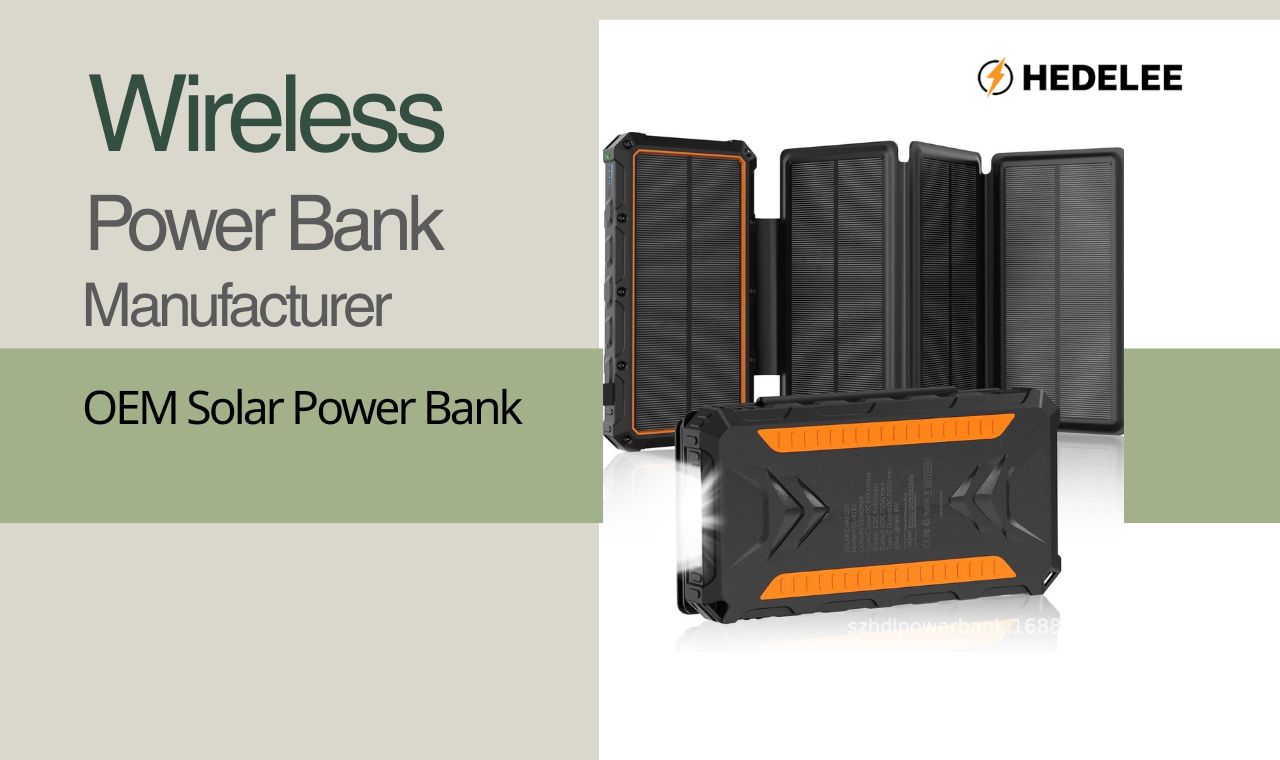
Importers looking for a solar power bank supplier often start with the same two questions: “Can you make my logo?” and “What is your price?” Those matter, but they are not enough. A power bank that works fine for a few weeks and then swells, fails capacity tests, or gets stopped at customs will cost far more than any upfront saving. This guide covers the checks distributors and brand owners should run before placing an order.
1. Check production capacity and factory background
Hedelee operates as a solar power bank manufacturer in China with about 10 years of experience, 100+ employees and a monthly output of about 50,000 units according to the company’s own About page. For a supplier of this size, that is usually enough to handle orders from a few hundred to several thousand pieces per batch without long delays. When you speak to a supplier, ask for the actual factory address, photos of the production floor, and whether they assemble in-house or outsource. A trading company can still be reliable, but you need to know who controls quality.
A practical approach is to request a video call with the production manager before committing. Ask how many lines they run, how they store lithium cells, and what happens if a batch fails QC. The answers tell you more than a polished catalogue.
2. Be realistic about solar charging
Solar power banks are often marketed as “charge anywhere in the sun,” but the solar panel is usually small—typically limited by the available surface area on a portable unit. Under full midday sun, that may add only a small amount of charge, depending on panel output and sunlight, to the battery in an hour. That is enough for emergency top-ups, not for fast charging a smartphone. Importers should sell the product honestly: the solar panel is a backup, while the main charging method is USB. Misleading claims lead to returns and bad reviews, even if the buyer initially likes the low price.
Many buyers report that their customers expect a 20,000 mAh solar power bank to fully charge a phone several times, but the actual output is lower because of voltage conversion. A 3.7V cell must be boosted to 5V for USB, which creates losses. For a 20,000 mAh battery, real delivered capacity at the USB port is usually around the figure measured in an output-capacity test; ask our sales team to confirm the model’s tested capacity and test conditions. That is still enough for three to four full phone charges, but it is not 20,000 mAh to the phone.
3. Require rated capacity documentation, not just marketing capacity
Battery capacity on a spec sheet is often the cell capacity, not the output capacity. A supplier should be able to tell you the rated capacity (sometimes called “effective capacity”) and the conversion efficiency. Ask for a test report from a recognized lab for the battery cells, such as IEC 62133-2. Do not accept a supplier that only shows a photo of the label. Many cheap power banks use recycled or lower-grade cells that degrade within months, causing swelling or capacity loss.
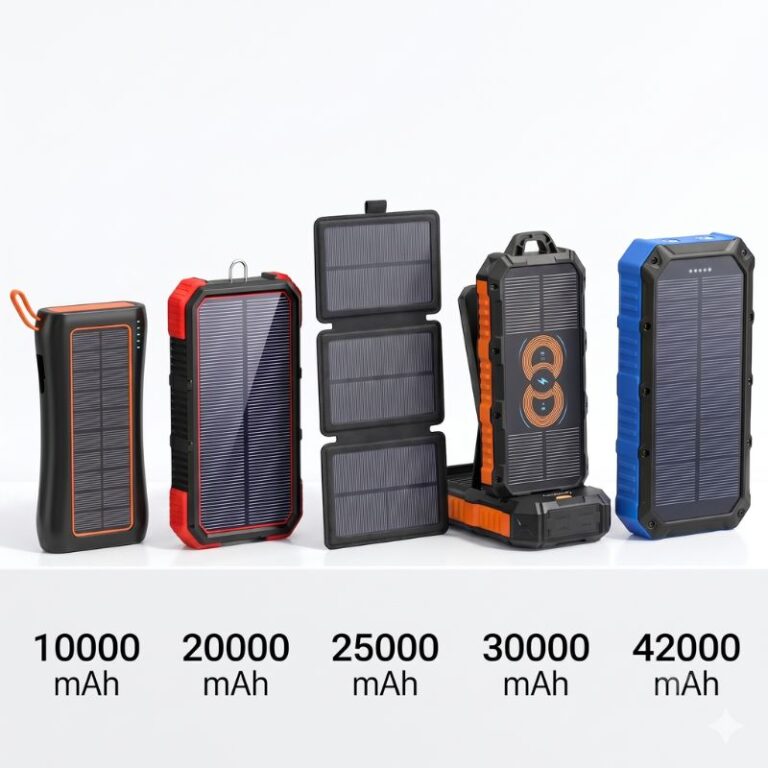
When you place an order, specify in the contract that the rated capacity must be at least the agreed proportion, based on defined test conditions, of the marked capacity after a full charge-discharge cycle, and that a random sample will be tested before shipment. This protects you from silent downgrades.
4. Understand market compliance before you order
Different markets require different certifications and markings. A solar power bank that is legal in China may not be sellable in Germany or Japan. Before you finalize a supplier, confirm which standards they can support with documentation:
- EU: CE marking, RoHS, and under the new Battery Regulation, producer registration and possibly battery passport requirements.
- US: UL 2056 or equivalent safety testing, and FCC for wireless charging if applicable.
- Japan: PSE mark for lithium-ion batteries.
- Korea: KC certification.
- Saudi Arabia: SABER and SASO registration.
These are not optional extras—customs and online platforms will ask for them. A serious supplier will already have test reports for their standard models and can help you with country-specific paperwork. If the supplier says “don’t worry, no one checks,” walk away.
For Amazon US sellers, the platform now requires proof of compliance such as UL 2056 and may ask for third-party verification. You should not assume that a cheap supplier’s “CE” certificate covers all markets.
5. OEM and ODM customization: what to ask
Hedelee offers OEM/ODM with custom logo and packaging for importers and brands. The typical process starts with choosing an existing housing or asking for a new mold. Tooling for a fully custom shell can cost more or less depending on complexity, but many buyers first use a stock design with silk-screen logo to test the market. Minimum order quantities for custom logo on a stock product are often based on the design and number of colors, though some suppliers accept less for a fee.
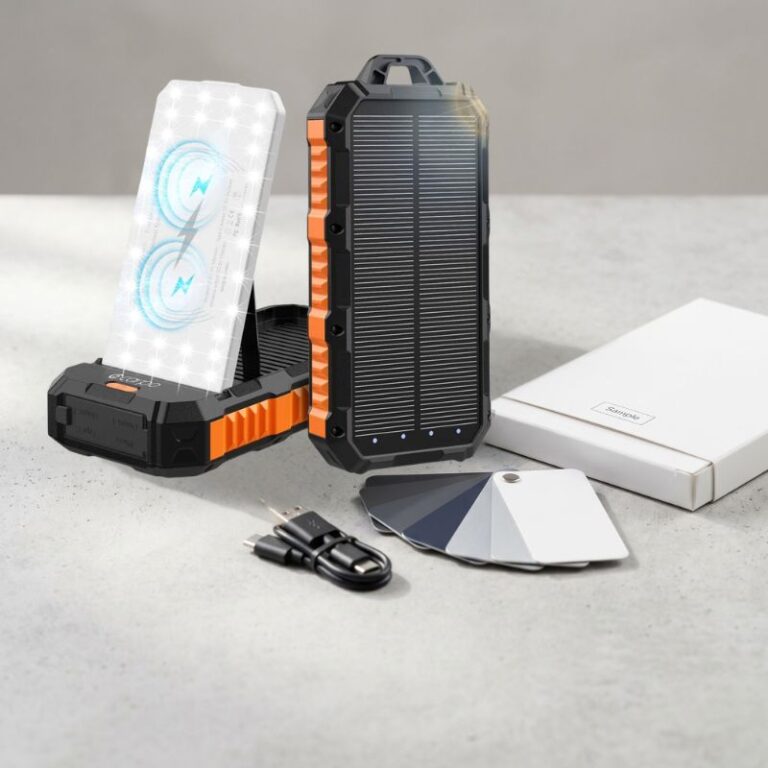
When you request customization, confirm these points:
- Logo printing method: silk screen, pad print, or laser. Each has different durability and cost.
- Packaging: do they provide retail box, user manual, and barcode? Is the manual in the target language?
- Color options: are they ready stock or require custom mixing?
- Lead time impact: adding a logo usually adds time for artwork approval and printing; custom packaging can add time for design, approval, and production.
Ask for digital proofs and a pre-production sample before mass production. A $50 sample fee is cheaper than receiving 2,000 units with a blurry logo.
Pricing for solar power banks depends on capacity, solar panel size, and certification. A basic 10,000 mAh model with a 1W panel might cost significantly less than a 20,000 mAh model with wireless charging and IP65 rating. When comparing quotes, ask for FOB price including packaging, not just ex-factory. Include the cost of compliance documentation and any custom logo setup.
6. Which solar power bank types should you stock?
Hedelee’s product lines include solar power banks, solar hand-crank emergency radios, wireless Qi power banks, hand warmer power banks, and power bank chargers. Choosing the right mix depends on your channel. Outdoor and emergency brands often lead with hand-crank radios and rugged solar banks. Amazon sellers usually prefer wireless Qi power banks with slim profiles. Promotional gift buyers look for low-cost hand warmer power banks in winter. A good supplier will help you pick the right base model and then customize it for your brand.
7. Logistics and lithium battery shipping rules
Every solar power bank contains a lithium-ion battery, so it is classified as dangerous goods for air transport in most cases. Your supplier must provide:
- UN38.3 test summary (required for air and sea).
- Material Safety Data Sheet (MSDS/SDS).
- Correct UN number: UN3480 for battery alone, UN3481 for battery packed with or contained in equipment.
Sea freight is more tolerant but still requires proper documentation and packaging. Air freight has stricter rules on state of charge (usually below the applicable shipping limit, which you should confirm with our sales team before booking) and may require a dangerous goods surcharge. If you plan to ship by air, confirm the supplier can provide the cargo-ready documents and will label the cartons correctly. Many delays happen because the factory used a generic label or forgot the test summary.
Build logistics into the unit cost before comparing prices. A supplier that quotes $0.50 less per unit but cannot handle UN38.3 paperwork can cost you weeks of delay.
8. Quality control before shipment
Do not rely on the supplier’s word that the goods are fine. Arrange a pre-shipment inspection, either by your own staff or a third-party QC company. For a first order, use AQL level II, normal inspection, with critical defects at zero tolerance. Check for:
- Correct logo, color, and packaging
- Output voltage and current at USB ports
- Solar panel output under a calibrated light source
- Battery capacity of a random sample (discharge test)
- No scratches, gaps, or loose buttons
Many importers skip this step and later find that the production batch used a different cell than the sample. A QC report with photos before payment protects your reputation.
FAQ
What is the minimum order quantity for a custom solar power bank?
Most Chinese suppliers set MOQ at a quantity based on the selected model and printing requirements for custom logo on a stock design. For fully custom tooling, the MOQ can be higher because the mold cost must be amortized. Some suppliers accept smaller trial orders at a higher unit price.
How long does it take from order to delivery?
Stock models with no customization can often ship within the dispatch window our sales team confirms based on stock availability after payment. Adding a logo or retail packaging typically adds time for artwork approval and setup for production. Sea freight to Europe or the US then takes the transit time quoted for the selected route and sailing schedule port to port, while air freight takes the transit time quoted for the selected service and flight schedule but costs much more.
Do solar power banks need special shipping documents?
Yes. They contain lithium-ion batteries, so you need a UN38.3 test summary, Material Safety Data Sheet, and depending on transport mode, a Dangerous Goods declaration. Air freight requires the state of charge to be below the applicable shipping limit; confirm the current limit with our sales team before booking. Without these documents, the shipment will be held.
Can I sell the same model in Europe, the US and Japan?
Not without checking market-specific regulations. Europe requires CE and RoHS, the US may require UL 2056 or FCC for wireless, and Japan requires PSE for lithium batteries. A supplier that has passed UN38.3 only has met the transport test, not the safety or EMC norms for each country.
How do I avoid inflated battery capacity claims?
Ask for the rated capacity and conversion efficiency, not just the cell capacity. Request a sample and have it tested by an independent lab. Specify in your purchase order that the delivered capacity must be at least the agreed proportion, based on defined test conditions, of the rated capacity, and enforce it with pre-shipment inspection.