

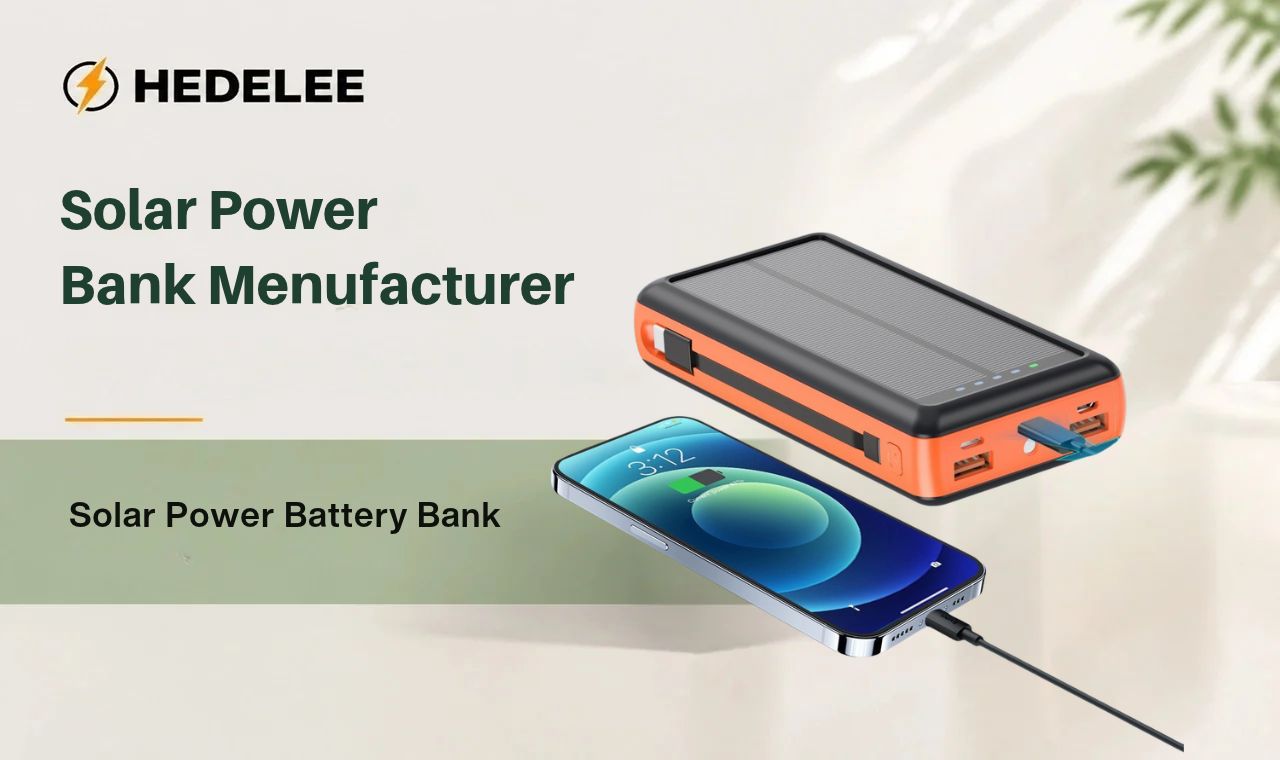
A buyer compares two solar power banks that look almost the same. One is quoted at $9 per unit. The other comes in at $16. So which one is the better deal?
That gap is common, and it confuses even experienced purchasing teams. A solar power battery bank can cost about $5 to $30 per unit at factory level. At retail, the same products sell for roughly $18 to $90. The spread comes from battery cells, panel size, charging features, certifications and order volume.
Below, you’ll find typical price ranges by capacity and the seven factors that move the price. You’ll also see real solar charging numbers, hidden costs like testing and freight, and four sourcing mistakes to avoid. These figures come from ten years of building solar chargers at our Dongguan factory, which turns out 50,000 units every month.
How Much Does a Solar Power Battery Bank Cost?
Short answer: most units cost $5 to $30 at the factory and $18 to $90 on store shelves. Capacity sets the base price. Then features and order size do the rest.
The table shows typical 2026 ranges. Factory prices assume FOB terms, a standard logo and orders of 1,000 pieces or more. Retail prices reflect common online listings in the US and EU.
| Product type | Capacity | Factory price, 1,000+ pcs (USD) | |
| Compact solar power bank | 10,000mAh | $ | |
| Standard dual-USB model | 20,000mAh | $ | |
| Qi wireless model | 20,000mAh | $ | |
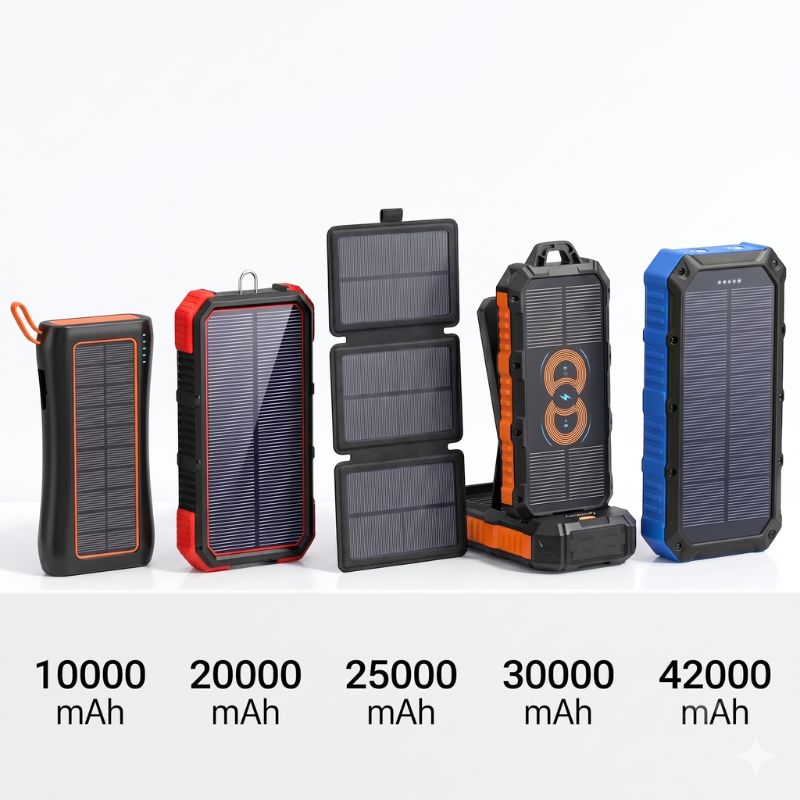
| High-capacity model | 24,000–30,000mAh | $ | |
| Built-in cable model | 36,000–42,000mAh | $ | |
| Foldable multi-panel model | 20,000–30,000mAh | $ |
Keep in mind, these are indicative ranges, not fixed quotes. A unit with grade-A cells and a larger panel sits at the top of its row. A unit with recycled cells and a tiny panel may fall below it.
Why retail prices run three to four times higher
A shelf price covers far more than the product. It includes import duty, freight, warehouse fees, platform commissions, ads and returns. Brand margin then sits on top. So a $10 factory unit often lands on a shelf at $30 to $40.
That math is normal. Still, it shows why buying from the source protects your own margin.
Price per watt-hour: a fairer way to compare
Comparing price per unit can mislead you. For example, a cheap 10,000mAh unit may cost more per stored watt-hour than a 20,000mAh one.
So divide the unit price by its energy in watt-hours (Wh). To get Wh, multiply mAh by 3.7 and divide by 1,000. A 20,000mAh pack holds about 74Wh. At $10, that works out to roughly $0.14 per Wh. Also, ask every supplier for the Wh figure printed on the label.
What Drives the Price of a Solar Power Bank?
Seven factors explain most of the gap between two similar quotes. Here they are, roughly in order of impact.
1. Battery cell grade and chemistry
Cells make up about 40% to 60% of the parts cost. Grade-A lithium polymer or 21700 cells from known makers cost more. However, they hold their rated capacity for 500 or more cycles.
Cheaper B-grade or recycled cells cut the price. But they often deliver far less than the label says. So always ask which cell brand and grade a quote uses.
2. True capacity vs. label capacity
Some low-cost units print 30,000mAh on a 20,000mAh pack. Also, real output is always lower than rated capacity, because voltage conversion loses 15% to 30%.
In practice, an honest 20,000mAh unit delivers about 13,000 to 15,000mAh to a phone. Pay for capacity you can test, not capacity on the box.
3. Solar panel size and cell type
Most panels on a solar power bank battery charger are small, often 1W to 2W. Monocrystalline panels convert sunlight better than polycrystalline ones, and they cost a little more.
Foldable designs with three to five panels cost the most. Yet they collect several times more energy per hour of sun.
4. Charging features
Each feature adds parts and cost. Typical added cost per unit:
- Qi wireless charging pad: about $1.50 to $3
- USB-C PD fast charging (18W to 22.5W): about $1 to $2
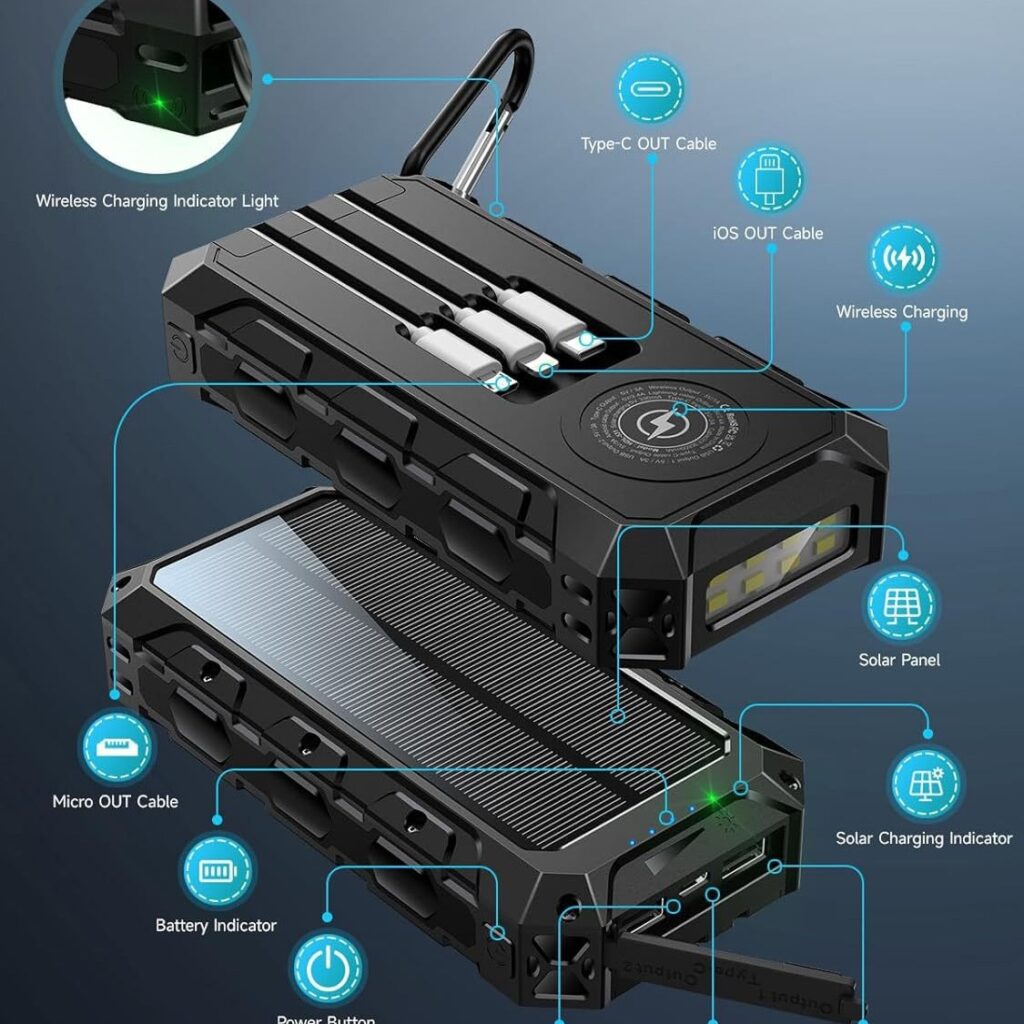
- Built-in cables (Lightning, USB-C, Micro-USB): about $0.80 to $1.50
- LED flashlight or camping light: about $0.30 to $0.80
- Digital battery display: about $0.30 to $0.60
5. Housing and waterproof rating
A plain ABS shell is the cheapest option. A rubberized shell with sealed ports costs more. An IP65 rating also needs better seals and lab testing, so it adds cost. Check whether the rating is tested or only claimed.
6. Certifications and safety testing
CE, FCC, RoHS, UN38.3 and MSDS make up the usual set. If a supplier already holds reports for a model, you share that cost.
But a new model or a new market can add $1,500 to $6,000 in lab fees. That cost then spreads across your order.
7. Order quantity and customization
Volume lowers the unit price. For example, a 500-piece order may cost 15% to 25% more per unit than a 3,000-piece order.
Custom colors, printed logos and branded packaging all add cost. Logo printing is cheap. A brand-new mold, however, can run $3,000 to $10,000.
Solar Power Battery Bank Types Compared by Price and Use
Different channels need different builds. A camping store, a promo gift buyer and a phone accessory brand will each pick a different model. The table matches common types to the channel they fit.
| Type | Key features | Factory price (USD) | Fits best for |
|---|---|---|---|
| Compact 10,000mAh | Light body, one panel, wireless option | $ | Gift programs, travel retail |
| 20,000mAh dual-USB | Two outputs, LED light, IPX4 to IP65 | $ | Outdoor and hardware stores |
| 20,000mAh wireless | Qi pad plus USB ports | $ | Phone accessory brands |
| 24,000–30,000mAh | USB-C input, Qi pad, IP65 | $ | Camping and emergency kits |
| 36,000–42,000mAh with cables | Four built-in cables, dual LED | $ | Overlanding, off-grid users |
| Foldable multi-panel | Three to five panels | $ | Hiking and field work |
Compact and mid-size models
These sell in the highest volumes because they balance price, weight and capacity. A 10,000mAh wireless solar power bank with fast charging suits gift and travel programs. It fits in a jacket pocket and still charges a phone about twice.
For general outdoor retail, 20,000mAh is the sweet spot. Our 20,000mAh dual-USB waterproof solar charger (HDL519X) and the waterproof 20,000mAh fast-charging solar phone charger are two common picks. Buyers who want a little more reserve often step up to the 25,000mAh dual-USB solar charger.
Wireless models for iPhone and Android users
If your customers want a solar powered iphone charger, Qi wireless is the feature to look for. iPhones from the iPhone 8 onward charge on Qi pads, and so do most flagship Android phones.
The 20,000mAh wireless solar power bank with dual inputs and flashlight (HDL-218) covers this need at a mid-range price. For heavier use, the 30,000mAh Qi wireless solar charger with IP65 rating (HDL528) adds a USB-C input and stronger water protection.
High-capacity models with built-in cables
Built-in cables remove the most common customer complaint: a forgotten cord. The 36,000mAh solar power bank with four built-in cables (HDL529) and the wireless model with three cables (HDL-531) both serve camping and emergency kits.
At the top end, the 42,000mAh solar battery pack with four cables (HDL-628) suits vehicles, base camps and job sites. However, note that capacities above about 27,000mAh pass 100Wh. That affects air travel, which we cover below.
Foldable models for long trips
Foldable units carry several panels, so they gather far more sunlight. The foldable 20,000mAh outdoor solar charger with LED lights and our portable solar charger for camping gear (HDL519) fit hikers and field crews. You can compare every model in our solar power bank product range.
Is a Solar Phone Charger Worth the Price? Real Charging Numbers
Yes, as long as everyone knows what the panel can do. The panel is a backup source. The main way to refill the battery is still a wall or car charger.
Here’s the math. A 20,000mAh pack stores about 74Wh. Meanwhile, a typical 1.5W built-in panel delivers roughly 0.6W to 1W in strong, direct sun after losses. So a full refill from empty takes 70 to 120 hours of good sun. That equals one to two weeks of clear weather.
The table compares common input options for the same 20,000mAh pack. Solar figures assume direct midday sun and a panel facing it.
| Charging source | Effective input | Time to fill 20,000mAh (74Wh) |
|---|---|---|
| Single built-in panel (1–2W rated) | 0.6–1.2W | 60–120 hours of sun |
| Foldable three-panel unit | 3–5W | 15–25 hours of sun |
| Foldable five-panel unit | 5–7W | 11–15 hours of sun |
| 5V/2A wall adapter | About 10W | 8–9 hours |
| 18W USB-C PD adapter | 15–18W | 5–6 hours |
Whether you list it as a solar cell phone charger or a solar mobile phone charger, the physics stays the same. Panel area limits solar input.
What solar charging does well
Even so, the panel earns its place in several real situations:
- It tops up a phone during a long day outdoors.
- It keeps a pack from going flat in a car, tent or boat.
- It provides emergency power when the grid is down for days.
When a power bank for solar input is the better buy
Some customers already own a portable solar panel. For them, a power bank for solar input with a strong USB-C port can be better value. It skips the small built-in panel and accepts far more watts from the larger panel.
How to set honest expectations
Overselling solar causes returns and poor reviews. So list charge times for both wall and sun input on your product page. A clear line like “Solar input for emergency top-ups; recharge fully by USB-C” sets the right expectation.
Hidden Costs Beyond the Unit Price
The unit price is only part of your landed cost. Several line items show up later, so it pays to plan for them early.
Freight and dangerous goods handling
Lithium batteries ship as dangerous goods. Air freight needs UN38.3 test reports, a safety data sheet and correct labels under the IATA lithium battery shipping rules. Because of this, air rates for batteries run higher than for general cargo.
Sea freight costs far less per unit. However, it takes about 25 to 40 days to reach most US and EU ports. So most buyers ship stock orders by sea and urgent top-ups by air.
Capacity limits for air travel
Your end users care about this, too. Under the FAA rules for lithium batteries in carry-on bags, power banks up to 100Wh may travel in carry-on luggage. Units from 101Wh to 160Wh need airline approval. Also, spare power banks are not allowed in checked bags at all.
| Capacity | Approx. energy at 3.7V | Carry-on status |
|---|---|---|
| 10,000mAh | 37Wh | Allowed |
| 20,000mAh | 74Wh | Allowed |
| 25,000mAh | 92.5Wh | Allowed |
| 30,000mAh | 111Wh | Airline approval needed |
| 36,000mAh | 133Wh | Airline approval needed |
| 42,000mAh | 155Wh | Airline approval needed |
Many airlines now set tighter limits than the baseline. So travel-focused brands often cap their range at 20,000 to 25,000mAh.
Testing, samples, packaging and duty
A few smaller costs round out the budget:
- Lab reports for a new model or market: about $1,500 to $6,000
- Samples: often $30 to $80 each plus express shipping, and many factories credit this against the first order
- Retail color box instead of a plain box: about $0.30 to $1.20 per unit
- Import duty: varies by country and HS code, so confirm with your customs broker
4 Costly Mistakes When Sourcing a Solar Powered Power Bank
A low quote can end up as the most expensive choice. These four mistakes cause most of the losses we see buyers suffer.
1. Choosing on unit price alone
A $2 saving per unit looks good on paper. But cheap cells fade fast, and faded cells bring returns. If even 5% of a $35 retail product comes back, the refund cost wipes out that saving. So compare quotes on cell grade and warranty, not just price.
2. Trusting capacity claims without a test
Inflated mAh labels are still common in this category. Ask for the cell spec sheet and a discharge test report. Then check a sample yourself with a simple USB power meter. A 20,000mAh unit should deliver at least 13,000mAh at 5V.
3. Skipping certification checks
Some suppliers share test reports that belong to another company or another model. Ask for report numbers, then confirm the model and company name match. Also, major marketplaces ask for UN38.3 reports and safety data sheets before they list battery products. Missing papers mean customs holds and blocked listings.
4. Buying through too many middlemen
Each trading layer adds a markup, often 10% to 30%. It also slows down answers when something goes wrong. A direct factory link puts you in touch with the engineers who choose the cells and test the boards. That makes quality fixes faster and cheaper.
How to Get an Accurate Solar Power Battery Bank Quote
A clear brief gets you a clear price. Vague requests get padded quotes, because the supplier has to guess. Follow these five steps instead.
- Set the capacity and usable output. State the rated mAh and the minimum output you expect at 5V.
- List the must-have features. Note wireless charging, built-in cables, USB-C PD, LED light and IP rating.
- Name your target markets. The US, EU, UK and Australia each need different certificates, and that changes cost.
- Share your quantity and timeline. Include the first order size, expected yearly volume and the date stock must land.
- Ask for samples before the bulk order. Test capacity, solar input and build quality, then approve a golden sample.
With those five details, a factory can quote within a day or two. Also, you can compare suppliers on equal terms, since every quote answers the same brief.
Why the source affects your final cost
Shenzhen Hedeli Technology has built mobile accessories and consumer electronics for about ten years. Our team of more than 100 people works from a Shenzhen headquarters and a Guangzhou office and showroom. Every solar power bank leaves our own Dongguan factory, which produces 50,000 units a month.
Because we are the original manufacturer, you work with the people who pick the cells, design the boards and run the tests. That means factory pricing without trading markups. It also means we can adjust capacity, panels, housing color, logo and packaging to fit your channel.
So if you are pricing a new solar power battery bank line, send us your target capacity, features and order size. We’ll reply with a detailed factory quote, matching test reports and sample options, straight from the production line.
Frequently Asked Questions
1. What is the minimum order for a solar power bank?
Most factories start at 500 to 1,000 pieces per model for logo orders. Stock models with a printed logo can start lower. Fully custom molds need larger volumes, so contact us with your quantity for exact terms.
2. How long does a bulk solar phone charger order take?
Mass production usually takes 25 to 35 days after sample approval. Samples take about 5 to 7 days. Sea freight then adds 25 to 40 days to most US and EU ports.
3. Can you customize the logo, color and packaging?
Yes, logo, housing color, gift box and user manual can all be customized. Reach out for detailed specifications and artwork guidelines.
4. Which certifications should a solar power bank have?
At minimum, ask for UN38.3 and a safety data sheet for shipping. Add CE for Europe, FCC for the US and RoHS for restricted materials. Always check that report numbers match the exact model.
5. Do solar power banks work with iPhone and Android phones?
Yes, USB ports and built-in cables charge both. Qi wireless models also work with iPhone 8 and later and most Android flagships. Contact us to request samples for your own testing.