

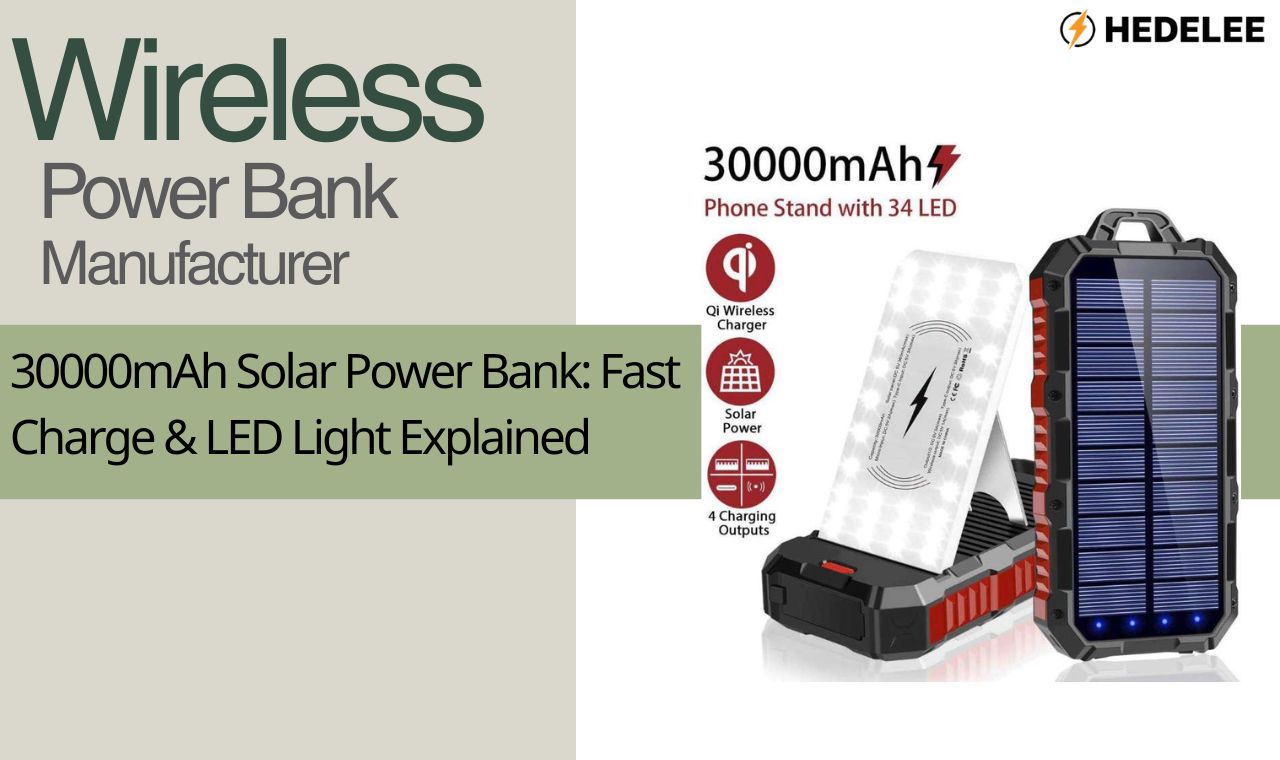
A 30000mah solar power bank can look simple from the outside, but buyers know the real value sits in the details: battery capacity, charging speed, safety design, waterproof rating, lighting function, casing strength, and supplier control.
For importers, distributors, wholesalers, and product managers, the goal is not only to find a power bank with a large number printed on the shell. The goal is to choose a product that can serve outdoor users, emergency buyers, travel retailers, and promotional programs with fewer returns and clearer selling points.
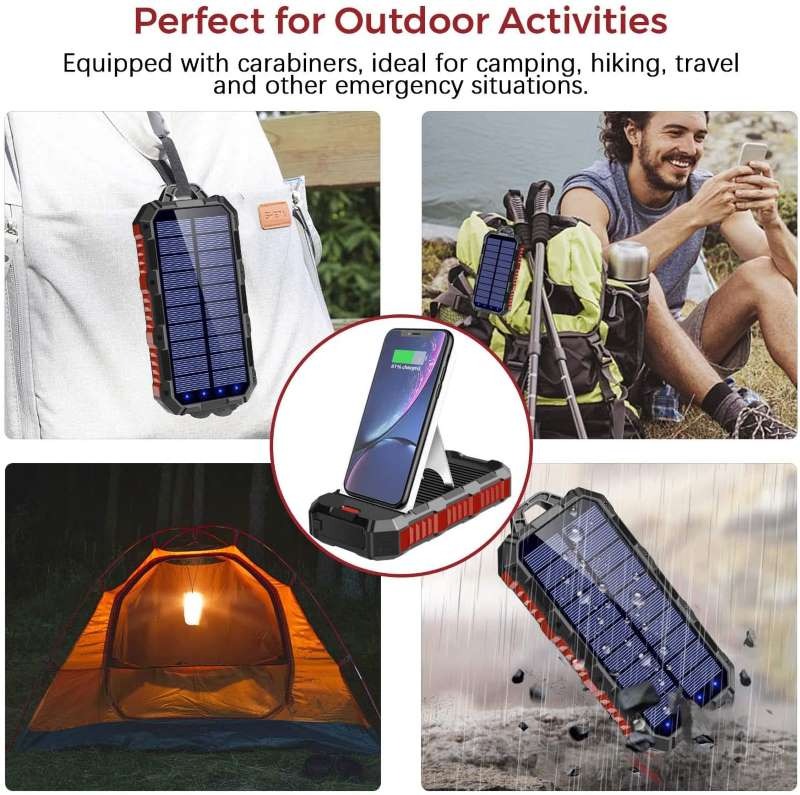
A 30000mAh model is usually positioned above entry-level portable chargers. It offers longer backup power for phones, tablets, Bluetooth speakers, GPS units, cameras, and other small USB devices. When a solar panel, LED light, wireless charging, Type-C input, and waterproof housing are added, the product becomes more suitable for camping, hiking, road trips, job sites, outdoor events, and power outage kits.
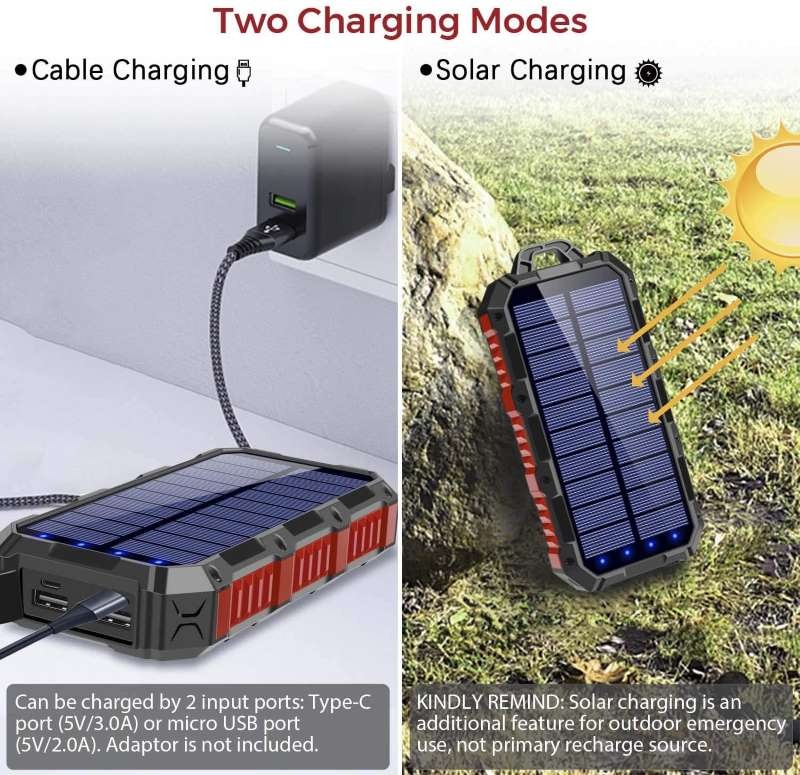
Still, buyers should treat the solar panel as a backup charging feature, not as the main charging method. A small built-in panel can help extend use in sunlight, but wall charging or USB-C charging will usually be far faster and more predictable. This detail should be clear in product pages, packaging, user manuals, and sales training.
A good sourcing decision starts with four questions:
- Is the real capacity supported by test data?
- Does the output meet current device charging needs?
- Is the safety design suitable for the target market?
- Can the supplier support stable orders, branding, and after-sales documents?
Shenzhen Hedeli Technology Co., Ltd. has worked in mobile accessories and consumer electronics for about 10 years. Hedelee focuses on solar power banks and related products. The company has more than 100 employees, a Shenzhen headquarters, a Guangzhou office and showroom, and a Dongguan factory with monthly capacity of 50,000 units. Buyers who need direct factory communication can use these points to reduce delays during sample review, packaging approval, and bulk order planning.
To explore more options, buyers can review the solar power bank product range. Those interested in a specific 30000mAh model with wireless charging, Type-C input, LED light, and IP65 housing can see the 30000mAh Qi wireless solar charger power bank.
Why LED Light and Fast Charging Raise Product Value
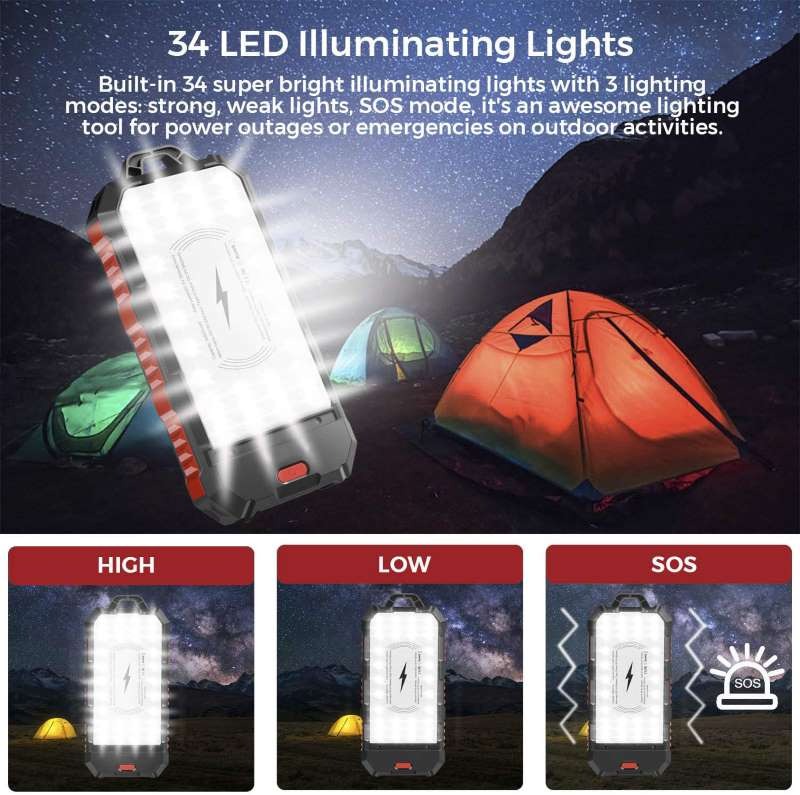
A solar power bank with LED light is often sold for outdoor and emergency use. The LED light may seem like a small feature, but it supports real user needs. People may use it during camping, fishing, roadside delays, warehouse work, power outages, or home emergency storage.
For retail and wholesale programs, LED lighting gives the product a clearer use case. A buyer can position it as more than a phone charger. It becomes part of an outdoor power kit or emergency backup set.
Fast charging also affects buyer perception. Many users now expect shorter charging times and better compatibility with newer phones. If a power bank only offers slow 5V/1A output, it may feel outdated in many markets. A fast charging solar power bank with USB-A and Type-C output can appeal to buyers who want stronger shelf value and fewer complaints from end users.
Common charging features to check include:
| Feature | Why buyers check it | Common buyer question |
|---|---|---|
| Type-C input | Faster recharging and wider compatibility | Can users recharge the bank by Type-C? |
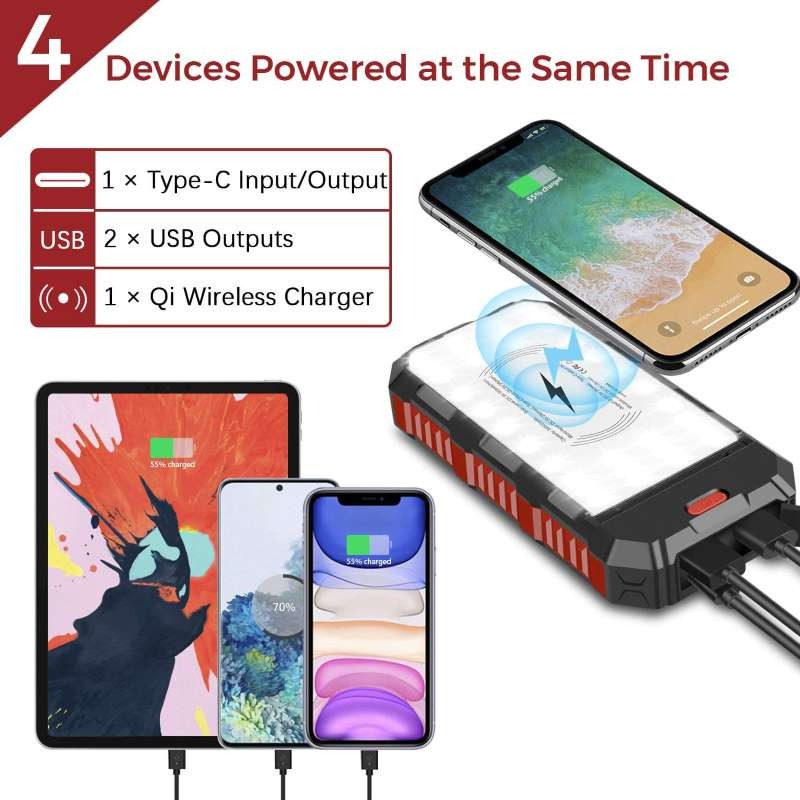
| USB-A output | Works with many older cables | How many devices can charge at once? |
| Wireless charging | Adds cable-free convenience | Is Qi wireless charging supported? |
| LED light | Supports outdoor and emergency use | How many lighting modes are included? |
| Solar panel | Backup charging in sunlight | Is solar charging for emergency top-up only? |
For many product managers, the stronger offer comes from combining functions in a way that feels useful, not crowded. A 30000mAh unit with LED light, wireless charging, and Type-C input can serve several markets at once, but the product copy must still be honest. Claims should match test results and user experience.
The phrase 30000 mah power bank solar may appear in search data because buyers search in different word orders. It can be used naturally in content when describing product demand, but it should not be repeated in a forced way. A good page can include the phrase once while still sounding natural.
For example: buyers comparing a 30000 mah power bank solar model should review capacity, casing, charging ports, LED lighting, and shipment rules before choosing a supplier.
30000mah solar power bank Specifications Buyers Should Check
A 30000mah solar power bank should be judged by more than capacity. Capacity is a headline feature, but it is not the whole sourcing decision. Buyers should review cell type, rated energy, input speed, output speed, safety circuit, material, size, weight, waterproof rating, and packaging.
The first detail is capacity marking. A 30000mAh rating often refers to the internal battery cell capacity at a nominal cell voltage, often around 3.7V. Device output is usually 5V, 9V, or 12V depending on the charging protocol. Energy loss happens during voltage conversion, so the usable output capacity will not equal the printed number.
This is normal for power banks, but it must be explained clearly. Buyers should ask for:
- Cell capacity test data
- Rated energy in watt-hours
- Input and output specifications
- Charging efficiency data where available
- Product weight and dimensions
- Full user manual
- Label artwork with battery marking
- Safety and transport documents
A simple comparison can help teams judge whether a 30000mAh model fits their program.
| Buyer need | Lower capacity model | 30000mAh solar model |
|---|---|---|
| Daily pocket charging | Easier to carry | Heavier for pocket use |
| Outdoor backup | Limited runtime | Longer backup time |
| Emergency kit value | Basic | Stronger perceived value |
| Retail shelf story | Simple charging | Charging, light, solar, outdoor use |
| Shipping review | Usually easier | Needs careful watt-hour review |
Capacity also affects shipping and travel rules. The FAA states that lithium-ion rechargeable batteries are generally limited to 100Wh per battery for air travel, with airline approval needed for larger spare lithium-ion batteries from 101Wh to 160Wh. Buyers should check the exact watt-hour rating on each model and confirm air transport rules with the carrier or freight forwarder before shipment planning.
A 30000mAh power bank may be near or above 100Wh depending on how the rating is calculated and marked. This does not mean the product cannot be sold, but it does mean the label, manual, carton marks, and logistics documents need care. Buyers serving travel retail or airline-related channels should be even more careful with watt-hour claims.
For output, buyers should check both peak output and practical charging behavior. A product may list several ports, but total output may drop when multiple devices charge at the same time. Ask the supplier whether the power bank can charge two or three devices at once, and at what total wattage.
For wireless charging, confirm the charging wattage, coil alignment, foreign object detection, and whether phone cases affect performance. For LED lighting, ask about brightness level, working time, lighting modes, and button control.
Safety, Compliance, and Battery Marking
Safety checks are part of responsible sourcing. Power banks contain rechargeable lithium batteries, so buyers should ask for documents before confirming large orders. The exact documents depend on the target market, sales channel, and logistics route.
Common documents may include:
- UN38.3 transport test report
- MSDS or SDS
- Air and sea transport documents
- CE or FCC related reports where applicable
- RoHS related documents where applicable
- Battery cell test data
- Drop, heat, overcharge, over-discharge, and short-circuit test information
- Product label and user manual review
Power bank safety is not only about passing one test. It is also about design choices. Buyers should ask about protection against overcharge, over-discharge, short circuit, overload, overheating, and wrong cable use.
UL describes UL 2056 as a dedicated safety standard for power banks, covering areas connected with fire and explosion risk, and noting that it also covers products with built-in photovoltaic cells as a power source. Buyers should review whether a specific product and watt-hour rating fit the relevant standard scope for their market.
For products with chargers, ports, electronics, and consumer device compatibility, some buyers may also review broader electrical equipment safety requirements. IEC 62368-1 applies to audio, video, information, and communication technology equipment safety, using a hazard-based approach to energy sources.
If the product is promoted as IP65, ask for the test basis and report. IEC explains that IP ratings under IEC 60529 rate and grade enclosure resistance against dust and liquids. This helps buyers avoid vague “waterproof” claims and use clearer product language.
For product pages, avoid broad claims that may create returns. Better wording includes:
- “IP65 rated housing” if supported by test data
- “Water resistant for outdoor use” where suitable
- “Solar charging for emergency top-up”
- “LED light for outdoor and emergency use”
- “Rated capacity and output may vary by device and conditions”
This kind of copy helps sales teams explain the product without overstating performance.
Solar Charging: Useful Backup, Not the Main Charging Method
Solar charging is a valuable feature when explained correctly. A built-in solar panel can help users top up power during outdoor activities, but it should not be promoted as the main charging source for a 30000mAh battery.
A small panel on a power bank has limited surface area. Sunlight strength changes during the day. Clouds, glass windows, panel angle, and temperature can all reduce charging speed. Buyers should ask suppliers for realistic guidance on solar input, not only ideal lab figures.
The most honest message is simple: solar charging is for backup and emergency use. Main charging should happen through USB or Type-C input.
This helps avoid complaints from end users who expect the solar panel to refill the full battery quickly. It also makes the product more credible. Outdoor users usually understand that solar top-up is helpful during long trips, but they still want a fast wall-charge option before leaving home.
A practical user flow may look like this:
- Fully charge the power bank by Type-C before travel.
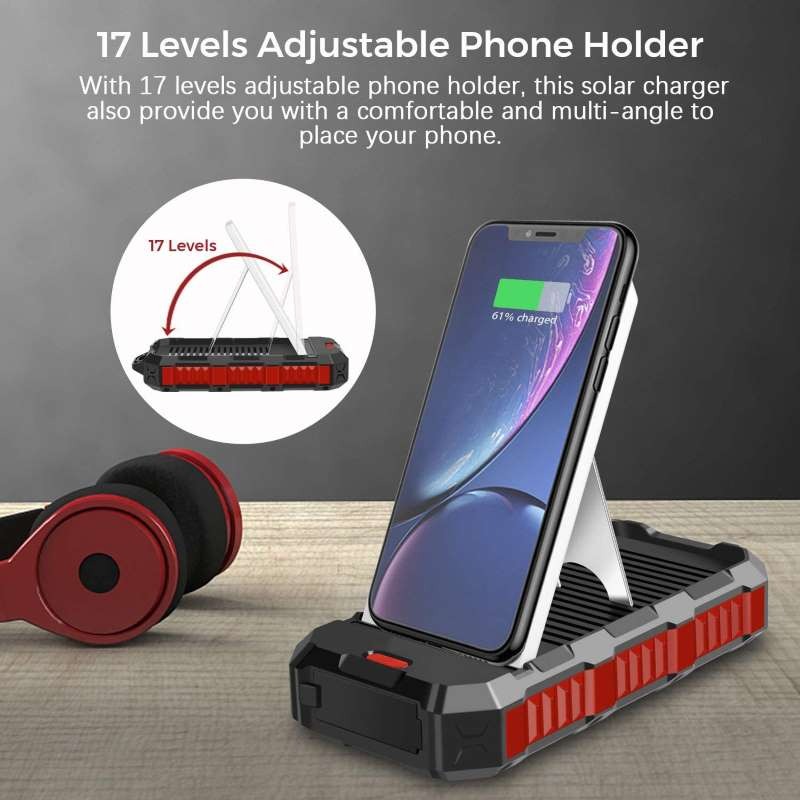
- Use USB or wireless output to charge phones and small devices.
- Use the LED light for camping, repair work, or emergency lighting.
- Place the panel in direct sunlight during the day for backup top-up.
- Keep the ports covered when near dust or water.
For buyers, this usage message should appear in the manual, packaging, Amazon or marketplace copy, and retail sales sheet. Clear use guidance reduces returns and makes customer support easier.
A fast charging solar power bank with honest solar claims can perform better in the long run than a product with overpromised solar speed. Procurement teams should ask for input data, charging test photos, and sample testing under real conditions.
Customization, Packaging, and Wholesale Supply Planning
For wholesale customers, customization often affects the final buying decision. A 30000mAh solar power bank may need different logo methods, colors, gift boxes, retail packaging, barcodes, manuals, warning labels, and carton marks.
Before quoting, buyers should prepare a clear request. This saves time and reduces misunderstanding during sample production.
Useful details include:
- Target market and sales channel
- Expected order quantity
- Logo position and logo artwork
- Preferred color and casing style
- Packaging type
- Manual language
- Required certifications or reports
- Barcode and label needs
- Delivery schedule
- Shipping method
- Sample quantity and deadline
Packaging should support the product story. Since this product has several functions, the box should not feel crowded. A good retail box can highlight capacity, solar panel, LED light, Type-C input, wireless charging, USB outputs, and IP65 housing in a clean layout.
For online sales, product images should show scale and use cases. Buyers should prepare images for:
- Front and back product view
- Port close-up
- LED light in use
- Wireless charging view
- Solar panel view
- Outdoor scenario
- Packaging image
- Size comparison with a phone
For importers and distributors, supply planning also needs factory capacity. Shenzhen Hedeli’s Dongguan factory has monthly capacity of 50,000 units, which supports regular wholesale orders and seasonal campaigns. The Guangzhou showroom can help buyers review product appearance and packaging options, while the Shenzhen headquarters supports coordination, sales communication, and documentation.
The goal is to make the product easy to source, easy to explain, and easy to sell across several channels.
How Shenzhen Hedeli Supports Solar Power Bank Orders
Supplier choice affects more than unit price. Buyers need communication, production control, sample speed, document support, packaging coordination, and steady delivery.
Shenzhen Hedeli Technology Co., Ltd. has around 10 years of experience in mobile accessories and consumer electronics. Hedelee focuses on solar power banks, with more than 100 employees and a production base in Dongguan. The company’s monthly capacity of 50,000 units supports importers, distributors, and wholesalers who need repeat supply.
The Shenzhen headquarters supports business communication and order coordination. The Guangzhou office and showroom give buyers a place to review product styles, compare models, and discuss packaging. This structure helps when buyers need several rounds of sample checks before confirming a bulk order.
For a 30000mAh product, supplier support may include:
- Product model recommendation
- Capacity and output guidance
- Sample preparation
- Logo placement review
- Packaging artwork support
- User manual support
- Test document coordination
- Carton mark confirmation
- Production schedule planning
- Pre-shipment inspection support
A supplier should also be clear about what can and cannot be changed. For example, logo printing may be easy, but changing mold shape or battery structure may require more time, higher quantity, and extra testing. Buyers should ask early if they need private color, special packaging, different cable sets, or local language manuals.
For product teams, direct manufacturer access can help shorten discussion cycles. Instead of sending every technical question through several trading layers, buyers can ask the source about battery cells, output design, waterproof housing, LED modes, and production schedule.
This is useful for solar power bank programs where one model may be adapted for outdoor retail, emergency kits, corporate gifts, travel accessories, or telecom promotions.
Requesting Samples and Quotes from the Original Manufacturer
A sample request should do more than ask for price. Buyers get better answers when they share the target market, order plan, and feature needs. This allows the manufacturer to recommend the right model, packaging, document set, and lead time.
For a 30000mAh solar power bank inquiry, include:
- Target country or region
- Estimated order quantity
- Required logo or packaging customization
- Preferred charging ports
- Wireless charging need
- LED light requirement
- IP rating requirement
- Certification or test report needs
- Desired delivery date
- Shipping method
- Retail or promotional use case
A clear inquiry helps the sales and engineering team respond with the right information. It also helps buyers compare suppliers fairly. If one supplier quotes without asking any technical questions, and another asks about watt-hours, reports, packaging, and transport documents, the second supplier may be easier to work with on a serious order.
For buyers comparing models, the 30000mAh Qi wireless solar charger power bank with USB Type-C input is a useful reference point. It combines large capacity, solar backup charging, wireless charging, USB and Type-C use, LED lighting, and IP65 housing.
When you send an inquiry to Shenzhen Hedeli, you are speaking with the original manufacturer. That means you can request product details, sample options, packaging support, and quote information directly from the source. Share your market, target quantity, logo needs, and delivery plan, and the team can help prepare a clear offer for review.
Frequently Asked Questions
1. What MOQ is available for wholesale orders?
MOQ depends on model, logo method, packaging needs, and current production schedule. Contact us with your target quantity and market so we can confirm sample options and bulk order terms.
2. How fast can samples be prepared?
Sample timing depends on stock status and customization details. Plain samples are usually faster than logo or packaging samples, so reach out with artwork and product requirements.
3. Can we customize logo and packaging?
Yes, logo and packaging customization can be arranged based on order quantity and artwork files. Send your logo, packaging idea, and target market for review.
4. Do you provide compliance documents?
Available documents depend on the product model and destination market. Reach out for detailed specifications, test reports, transport documents, and labeling support.
5. Why choose a 30000mAh model?
A 30000mAh model gives longer backup power for outdoor, emergency, travel, and retail programs. It works well when buyers need a solar power bank with LED light, fast charging, and strong product value.