

Should you stock a hand crank power bank, a solar power bank, or a model that has both? For most distributors the answer is: solar power banks for the outdoor and travel shelf, and hand crank models for emergency preparedness buyers who want a charging method that works at night and indoors. Neither one replaces wall charging. Both are backup methods, and the way you describe them decides whether customers are happy or send them back.
This comparison is for wholesalers, emergency-kit companies, outdoor retailers and online sellers deciding which charging technology to put in their range. It uses our own product data where we have it and simple energy math where we don’t. It will not help if you need to power laptops or appliances. For that you need a portable power station, not a handheld power bank.
The Short Answer in One Table
| Factor | Solar power bank | Hand crank power bank | Hybrid (solar + crank) |
|---|---|---|---|
| Main recharge method | USB wall charging | USB wall charging | USB wall charging |
| Backup method | Sunlight on the panel | Turning the crank by hand | Both |
| Works at night or indoors | No | Yes | Yes, by crank |
| Needs user effort | No, just placement | Yes, continuous cranking | Optional |
| Speed of backup charging | Slow, depends on sun and panel size | Slow, a few watts while cranking | Slow either way |
| Moving parts | None | Gearbox and handle | Gearbox and handle |
| Best buyer | Campers, hikers, travelers | Emergency kits, disaster preparedness | Preparedness buyers who want both |
How Each Backup Method Really Performs
Solar: free energy, but only in good light
The panel on a handheld solar power bank is small. In direct sun it adds energy slowly and keeps adding it as long as the unit lies in the light. Cloud, shade, a window or the wrong angle cut the output sharply, and at night it produces nothing. A single panel can take days of good sun to refill a large battery. Foldable models with several panels charge faster but add bulk.
We explain the details, including cloudy weather, in our articles on solar charge time and charging in clouds.
Hand crank: works anywhere, but costs effort
A hand crank dynamo produces power only while someone is turning it, usually a few watts at most depending on speed and steadiness. That is enough to put a small amount of energy into the battery for an emergency call or to run a flashlight. It is not a practical way to fill a large battery.
The value of the crank is that it does not depend on weather, time of day or location. In a basement during a storm, at night after a power cut, or in a region with long dark winters, it is the only backup that still works.
Do the Energy Math Before You Write the Listing
Battery energy in watt-hours (Wh) is capacity in amp-hours multiplied by the nominal cell voltage. Most lithium power bank cells are rated at 3.6–3.7 V.
- A 20,000 mAh power bank at 3.7 V stores about 74 Wh.
- A typical current smartphone battery holds roughly 12–20 Wh.
- Conversion losses mean the phone receives less than the power bank stores.
Now compare that with a backup source that delivers a few watts. Cranking at a few watts for ten minutes adds well under one watt-hour after losses. That is useful in an emergency, but filling 74 Wh by hand is not realistic. Solar on a small panel has the same scale problem, spread over hours of sunlight instead of minutes of effort.
So the honest way to sell both is: “Charge it from the wall before you go. Solar or crank keeps you going when the wall isn’t there.”
A Hybrid Example from Our Range
Our HDL-536 is a multi-function emergency power bank that combines both backup methods. Its listed features are:
- 20,000 mAh lithium-polymer battery
- Solar panel and hand-crank generator
- Wireless charging pad
- Built-in cables and several USB outputs
- QC2.0 charging protocol
- LED flashlight and hanging buckle
- Dust-resistant, drop-resistant design
- Size 166.5 × 85.5 × 35 mm
- Colors: red, orange, black, blue; CE, FCC and RoHS listed
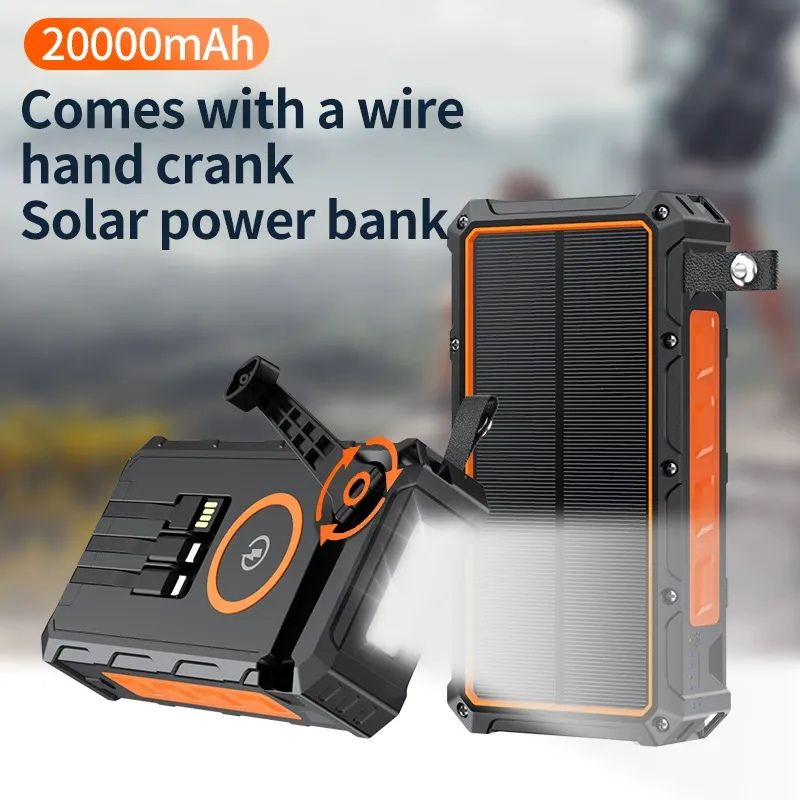
Products like this suit buyers who want one device in an emergency kit that can be recharged in any condition. The trade-off is size, weight and a moving part that must survive storage.
Which to Stock for Each Customer Type
| Your customer | Recommended product | Why |
|---|---|---|
| Camping and hiking retail | Solar power bank, waterproof | Outdoor users have daylight and value no-effort charging |
| Travel retail | Solar or standard power bank under 100 Wh | Light, carry-on friendly, no crank needed |
| Emergency kit assemblers | Hand crank or hybrid power bank, or a hand crank radio | Must work at night and indoors after a power cut |
| Disaster-prone regions (hurricane, typhoon, earthquake) | Hybrid power bank plus a radio | Power cuts can last days, and weather is often poor |
| Corporate and promotional gifts | Solar or wireless power bank | Everyday use, logo area, lower return risk |
For emergency buyers, a solar hand crank radio often makes sense alongside the power bank, because it covers news and weather information as well as light and a small charging output.
Quality Checks That Differ Between the Two
For solar power banks
- Measure solar input on the sample in real sun, not just under a lamp
- Check panel lamination and edge sealing
- Confirm the waterproof or dustproof claim and the test behind it
- Confirm that the stated capacity is the real cell capacity
For hand crank power banks
- Crank the sample for several minutes and check for noise, wobble or slipping in the gearbox
- Check that the handle folds and locks securely
- Confirm the crank actually feeds the battery, not only the flashlight
- Drop-test the sample, because the crank mechanism adds a weak point
For both
- UN38.3 test summary and SDS/MSDS for shipping
- Market compliance: CE for the EU, FCC for the US
- Battery protection: overcharge, over-discharge, short circuit, temperature
Our OEM checklist for importers covers these checks in more depth.
What to Send Us for an Accurate Quote
- Your customer type and target market
- Preferred technology: solar, hand crank or hybrid
- Models from our solar power bank range, or the functions you need
- Quantity per model and color
- Branding and packaging requirements
- Documents you need for your market and forwarder
- Delivery terms and destination
Contact our sales team and we will recommend models, quote and arrange samples so you can test both charging methods yourself.
Frequently Asked Questions
Is a hand crank power bank better than a solar power bank?
Neither is better in general. Solar needs no effort but needs daylight. A hand crank works anywhere but needs continuous effort. Choose by where and when your customers will use it.
Can a hand crank fully charge a power bank?
In practice, no. A crank produces a few watts at most while turning, and a 20,000 mAh power bank stores about 74 Wh. Use the crank for emergency top-ups and charge the battery from the wall before storage.
Do hybrid solar and hand crank power banks cost more?
They usually cost more than a solar-only model of similar capacity, because of the dynamo, gearbox and larger housing. Send us your quantity for a quote on the exact model.
Which is better for emergency kits?
A hand crank or hybrid model, often paired with an emergency radio. Kits are used during power cuts, at night and in bad weather, when solar may not be available.
Can I customize the logo and colors?
Yes. Logo printing, color options and custom packaging are available for volume orders on our power bank range.