

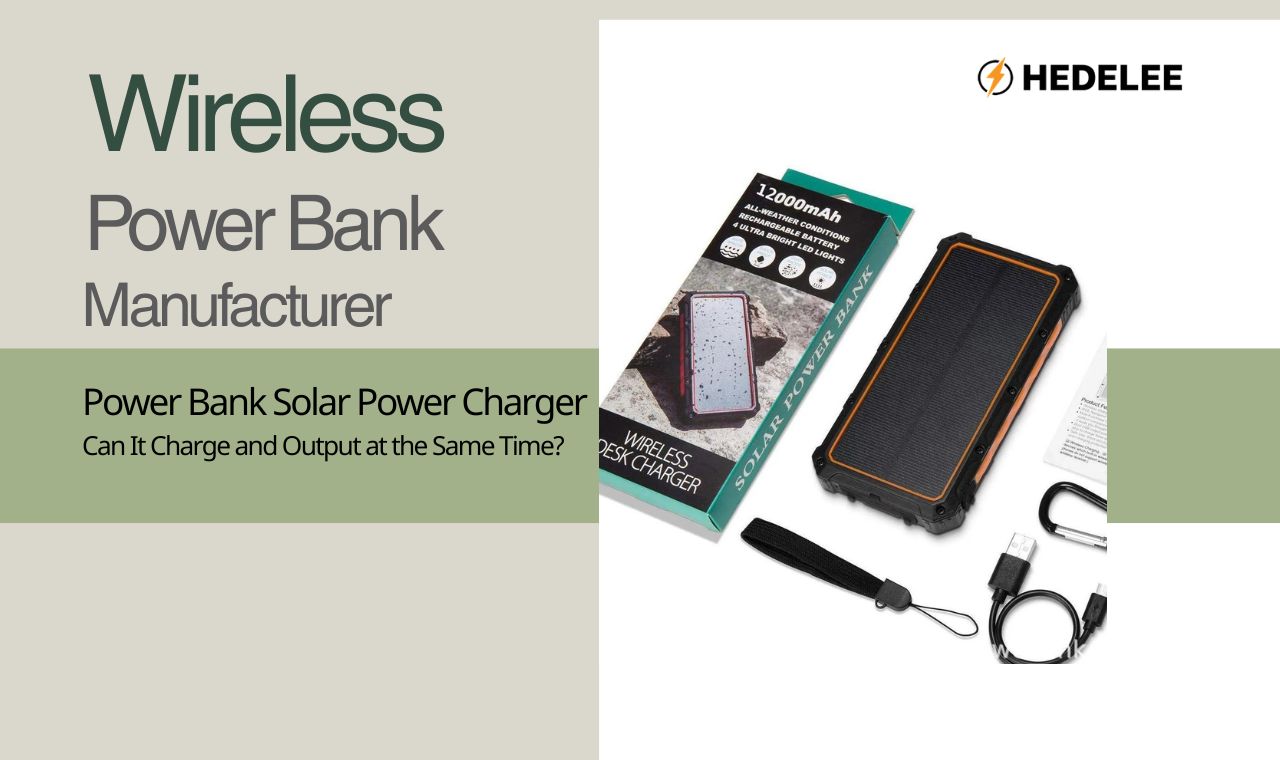
A buyer often asks a simple question: can a power bank solar power charger collect solar energy while it is also charging a phone? In many cases, the short answer is yes. However, the real answer depends on the circuit design, input power, heat control, battery protection, and output load.
This topic is easy to misunderstand because a product photo may show solar panels, USB ports, wireless charging, and LED lights. Still, these features do not always mean the unit can handle solar input and phone output at the same time in a stable way. Therefore, buyers should check the product specification before using this claim in listings, packaging, or customer guidance. For importers, distributors, wholesalers, and product teams, this detail affects user experience, return rates, packaging claims, and product positioning.
Shenzhen Hedeli Technology Co., Ltd. has worked in mobile accessories and consumer electronics for about 10 years. Under the Hedelee solar power bank category, our team supports buyers who need practical product choices, clear specifications, and direct factory communication from the source.
Can a power bank solar power charger charge and output together?
Yes, a power bank solar power charger can support solar charging and output at the same time when the internal design allows pass-through charging. In simple terms, pass-through charging means the power bank can receive power from one side and deliver power from another side during the same use period.
However, there are three details buyers should check before using this claim in product listings or packaging:
- The solar panel input must be connected through a suitable charging management circuit.
- The battery protection board must control voltage, current, and temperature.
- The output power must remain stable enough for the phone or device being charged.
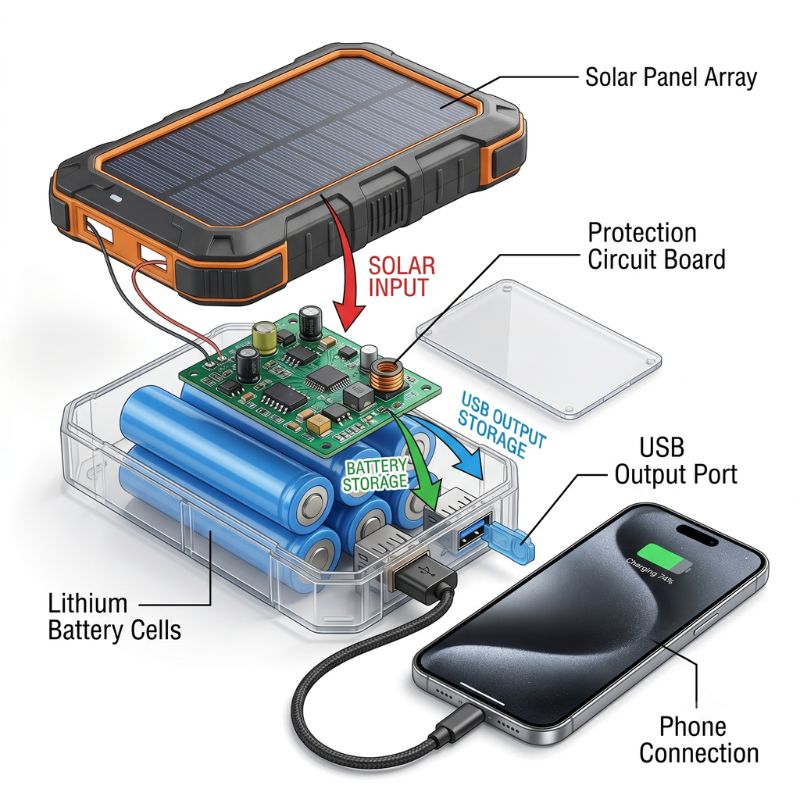
A solar power bank is not just a battery with a solar panel attached. Inside the housing, there are battery cells, a protection system, an input control circuit, a boost output circuit, USB ports, cables, and sometimes wireless charging coils. If the product has foldable panels, the input side can provide more usable current than a single small panel. Still, sunlight changes every minute, so output can rise and fall.
Because of this, many solar powered power bank models can work in three different ways:
| Use Mode | What Happens | Buyer Expectation |
|---|---|---|
| Solar input only | Sunlight charges the internal battery | Slow but useful outdoors |
| Output only | Battery charges a phone or device | Normal power bank function |
| Solar input + output | Solar panel provides input while output charges a device | Possible only with proper circuit design |
For daily consumer use, the safest message is this: solar input can support charging, but the built-in battery remains the main power source. The solar panel helps recharge or extend outdoor use; it should not be presented as a wall-charger replacement.
For example, a hiker may place a solar power bank on a backpack during the day while the unit charges from sunlight. Later, the battery can charge a phone, light, GPS device, or small USB fan. If the model supports pass-through function, the user may also connect a phone while the solar panel is receiving sunlight. Yet the phone may charge slower if sunlight is weak.
The U.S. Department of Energy explains that photovoltaic cells convert sunlight into electrical energy. This basic principle supports solar charging, but the power level depends on panel size, sunlight angle, weather, and conversion efficiency. For a portable product, that means the real charging speed is always lower than ideal lab conditions. A helpful external reference is the U.S. Department of Energy solar photovoltaic technology basics.
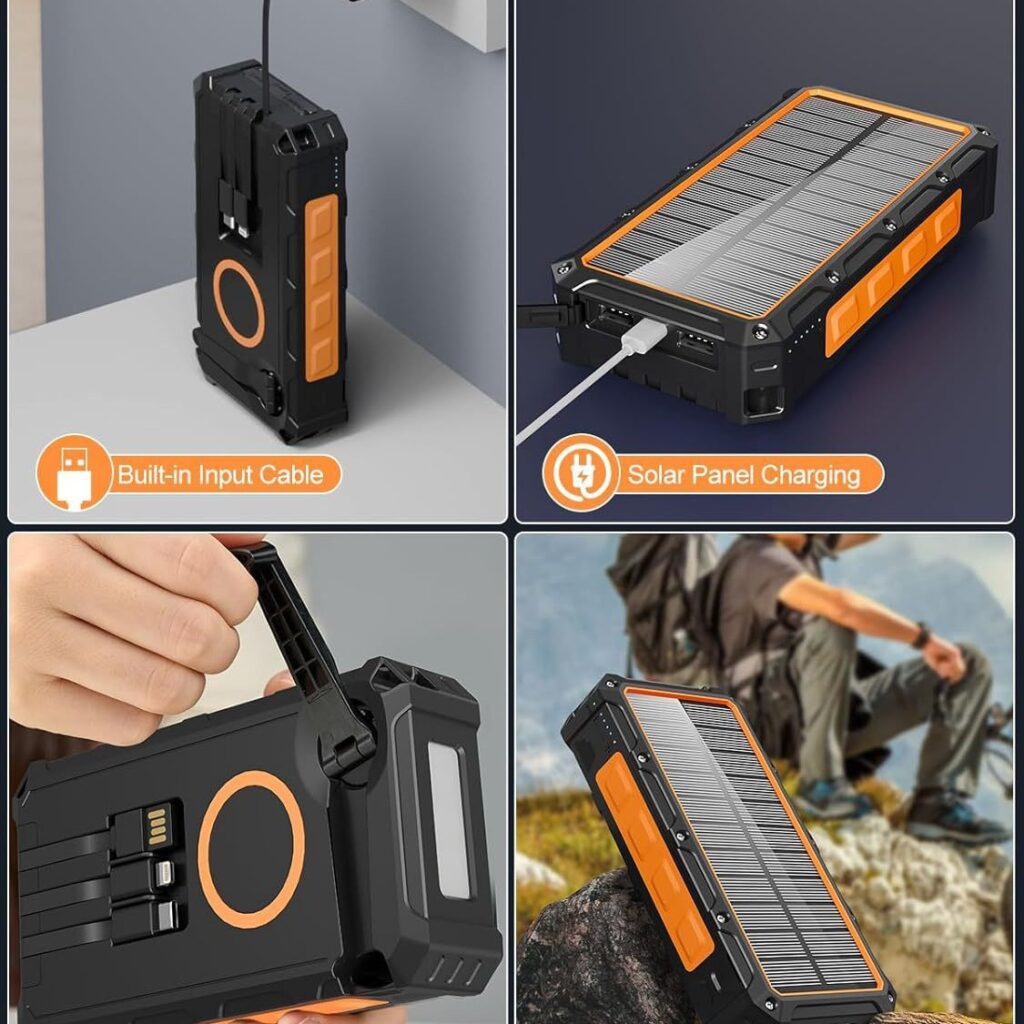
How pass-through charging works in a solar power bank
Pass-through charging sounds simple, but it needs careful engineering. The product must manage two power paths at the same time: incoming power and outgoing power.
Incoming power can come from:
- A built-in solar panel
- Foldable solar panels
- USB-C input
- Micro USB input, depending on the model
- Wall adapter, when used indoors
Outgoing power can go through:
- USB-A output
- USB-C output
- Built-in cables
- Wireless charging
- LED lighting circuit
When both sides work together, the circuit must decide how to handle power flow. In many designs, the input power first supports the battery charging circuit. The battery then supports output to the phone. In other designs, part of the input power may help output directly while the battery fills the gap.
For buyers, the key point is not only whether pass-through charging exists. The key point is whether it is stable, safe, and suitable for the target use case.
A small solar panel on the front of a compact power bank usually provides limited input. It may help in emergency use, but it will not rapidly recharge a 20,000mAh or 30,000mAh battery. Foldable solar panels have more surface area, so they can provide stronger input in good sunlight.
That is why product positioning should be honest and practical. A solar mobile phone charger with a larger foldable panel system can be more useful for camping, outdoor work, and emergency kits. A compact single-panel unit is better for light backup, travel, and daily phone charging.
Here is a simple comparison:
| Design Type | Solar Input Strength | Portability | Better For |
| Single-panel solar power bank | Lower | Higher | Emergency backup, travel |
| Foldable solar charger power bank | Higher | Medium | Camping, outdoor charging |
| High-capacity solar battery pack | Medium to higher | Lower | Longer trips, group use |
| Wireless solar power bank | Depends on panel size | Medium | Cable-free phone charging |
A product manager should also check whether the product allows output while charging from USB input, solar input, or both. Some models support pass-through only when using cable input, not solar input. Others support limited output while solar input is active. Therefore, the datasheet should describe the function clearly.
For example, buyers reviewing Hedelee product options can compare different structures through the solar power bank product category, including compact designs, foldable solar charger models, wireless units, and outdoor models with LED lighting.
Power bank solar power charger specs buyers should check
A power bank solar power charger should not be selected only by battery capacity. Capacity is useful, but it is only one part of the product decision. For sourcing teams, the better approach is to review the full specification set.
Start with these items:
| Specification | Why It Counts | What to Ask |
| Battery capacity | Affects total charging cycles | Is capacity nominal or rated output capacity? |
| Solar panel type | Affects solar input performance | Single panel or foldable panels? |
| USB output power | Affects phone charging speed | 5V/2A, 5V/3A, QC, PD, or other output? |
| USB-C input/output | Affects modern phone compatibility | Is USB-C only input or both input and output? |
| Wireless charging | Adds convenience | What wattage is supported? |
| Waterproof rating | Supports outdoor positioning | Is the rating tested or only described? |
| Built-in cables | Reduces accessory needs | Which cable types are included? |
| LED light | Useful for outdoor kits | How many lighting modes? |
| Protection functions | Reduces risk | Overcharge, over-discharge, short circuit, temperature protection? |
For iPhone users, buyers often search for a solar powered iphone charger. The product should support a suitable output method, including USB-A to Lightning cable, USB-C to Lightning cable, built-in cable options, or wireless charging for compatible models. However, iPhone compatibility should be described based on real output specs, not only product photos.
For Android users, USB-C output is now a strong selling point. Many customers also expect fast charging. A solar phone charger with USB-C output may perform better in modern retail listings than older models with only USB-A output, depending on the target market.
A buyer may also ask for a power bank for solar projects, emergency kits, outdoor promotions, or travel product lines. In that case, the sourcing decision should include:
- Cell type and supplier level
- Battery capacity tolerance
- Housing material
- Drop resistance requirements
- Waterproof or splash-resistant structure
- Cable durability
- Packaging strength
- Instruction manual language
- Barcode and carton mark requirements
- Sample testing plan
The Hedelee range includes multiple models with different capacities and features. For example, buyers can review the 20,000mAh wireless waterproof solar power bank HDL-218 for a compact multi-output concept, or compare it with the foldable 20,000mAh outdoor portable solar charger when a larger solar charging surface is preferred.
For buyers who need higher capacity positioning, options like the 24,000mAh standard 30,000/36,000mAh wireless solar power bank HDL-531 or the 42,000mAh built-in cable solar power bank HDL-628 can support a stronger outdoor value message.
Solar charging speed: what buyers should expect
Solar charging speed is the area where many listings create too much expectation. A solar power bank can charge from sunlight, but the speed depends on panel area, sunlight strength, angle, heat, and battery size.
A small built-in panel may provide useful emergency support, but it often takes a long time to fully recharge a large battery. This is normal. The panel surface is small, and the sunlight conditions are not always ideal.
For a buyer, the better sales angle is not “fully charge anytime from the sun.” A more accurate and stronger message is:
- Supports outdoor emergency charging
- Helps extend use time during sunlight exposure
- Offers backup power away from wall outlets
- Useful for camping, travel, hiking, fishing, field work, and power outage kits
- Works as a normal power bank indoors and a solar backup outdoors
A solar power bank battery charger with foldable panels can usually collect more energy than a single-panel unit. Still, buyers should request real test data under clear test conditions. For example:
| Test Item | Suggested Test Condition |
| Solar input test | Outdoor sunlight, clear weather, panel facing sun |
| USB output test | Phone or electronic load at rated output |
| Pass-through test | Solar input active while USB output charges a device |
| Heat test | Direct sun exposure during active charging |
| Capacity test | Full discharge through rated output |
| Cable test | Built-in cable bending and connection stability |
For procurement teams, this testing approach helps avoid unclear claims. It also supports better product manuals and more accurate online listings.
Hedelee solar models can be selected based on the target customer’s real use. For outdoor stores, camping kits, and emergency product lines, a foldable panel design may create a clearer user benefit. For travel retail or gift sets, a compact waterproof power bank with LED light can be easier to carry and package.
Buyers can compare models including the 20,000mAh waterproof solar panel power bank, the 25000mAh portable solar charger with dual USB ports, and the 30,000mAh Qi wireless solar charger power bank HDL528.
Safety, heat, and lithium battery protection
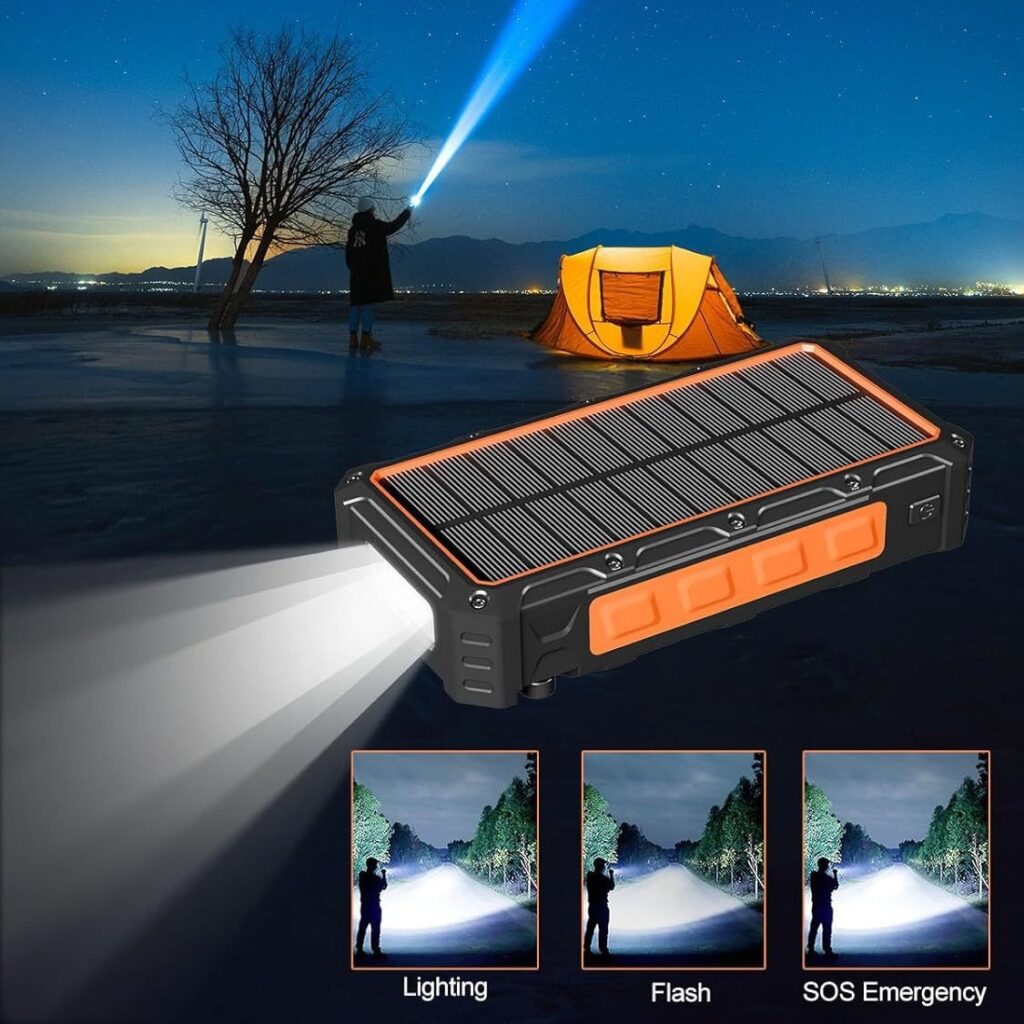
Solar charging and output at the same time can create heat. Sunlight already warms the housing, and battery charging adds more heat. If a phone is connected at the same time, the output circuit also creates heat. This is why protection design is a serious product detail.
A reliable solar power bank should include protection against:
- Overcharge
- Over-discharge
- Overcurrent
- Short circuit
- Overheating
- Reverse current, depending on design
- Input voltage problems
- Output voltage instability
The user manual should also guide customers not to leave the power bank under extreme heat for long periods, especially inside a closed car or on very hot surfaces. Outdoor products need stronger housing and better protection, but no lithium battery product should be treated carelessly.
For travel and airline use, power banks are treated as spare lithium batteries. The FAA PackSafe lithium battery guidance states that spare lithium batteries and power banks must be kept in carry-on baggage, not checked baggage. Buyers who sell to travel markets should make product packaging and user instructions clear enough for end users.
For sourcing, ask the factory for available test reports and documentation based on target market needs. Common buyer requests may include:
- CE
- FCC
- RoHS
- UN38.3
- MSDS
- Battery transportation documents
- Model-specific test reports
- Packaging and carton information
The exact requirements depend on the destination market, sales channel, battery capacity, transport method, and customer request. Therefore, it is better to confirm documentation before bulk order production rather than after goods are ready.
Shenzhen Hedeli Technology Co., Ltd. supports solar power bank buyers with direct manufacturer communication. With more than 100 employees, a Shenzhen headquarters, a Guangzhou office and showroom, and a Dongguan factory with monthly capacity of 50,000 units, Hedelee can support product review, sample discussion, customization, and order planning from the source.
Choosing between single-panel and foldable solar models
The right solar powered power bank depends on the user’s real setting. A buyer selling outdoor gear may need a different model from a buyer selling phone accessories in retail stores. The difference is not only capacity; it is the full use scenario.
A compact single-panel solar power bank is easy to carry. This compact design fits travel bags, emergency kits, and gift boxes. Along with basic backup charging, it can also support LED lighting for outdoor or emergency use. The smaller size also helps keep product packaging more controlled.
A foldable solar power bank has a larger panel area. It can be better for camping and outdoor use because the solar input potential is higher. The trade-off is size, weight, and cost.
A high-capacity model can support longer output time, but it also needs more charging time. If the capacity is high and the solar panel area is small, buyers should avoid promising fast solar recharging. A balanced product message will reduce complaints and improve customer trust.
Here is a practical selection table:
| Buyer Goal | Suitable Product Style | Message to Use |
| Travel accessory line | Compact solar power bank | Portable phone backup with solar support |
| Camping product range | Foldable solar charger power bank | Outdoor charging support with larger solar surface |
| Emergency kits | Waterproof model with LED light | Backup battery with light and solar input |
| Phone accessory retail | Wireless solar phone charger | Cable-free charging plus outdoor backup |
| Promotional product | Built-in cable solar power bank | Useful daily charger with outdoor value |
Buyers can position the dual USB 20,000mAh solar panel power bank HDL519X for outdoor backup use. Meanwhile, the outdoor 10,000mAh wireless fast charging solar power bank fits buyers who want a smaller portable model.
Camping gear ranges may benefit from the portable outdoor solar charger power bank HDL519 because it has a clear outdoor use direction. Buyers who need more built-in convenience can also review the 24,000mAh standard 36,000 built-in cable wireless solar power bank HDL529.
How to use solar input and phone output correctly
A solar cell phone charger works better when users follow the right steps. Poor use can lead to slow charging, heat, and weak output. Clear user guidance helps reduce complaints and returns.
For outdoor use, users should:
- Place the solar panel directly toward sunlight.
- Avoid shade from trees, windows, bags, or hands.
- Keep the panel surface clean and dry.
- Use a short, suitable cable for phone output.
- Avoid covering the power bank while charging.
- Stop use if the unit becomes too hot.
- Charge the internal battery fully through USB before long trips.
- Treat solar input as backup support, not the only charging method.
This guidance is especially useful for a solar powered iphone charger, since iPhone users often expect stable charging behavior. If sunlight drops and output becomes unstable, some phones may stop and restart charging. A power bank with a charged internal battery can reduce that problem because the battery provides a buffer.
For a solar mobile phone charger used in camping, it is often better to charge the power bank during the day and charge phones later in the evening. When pass-through charging is needed, use it for light loads first. For example, charging one phone is easier than charging two phones plus using an LED light at the same time.
Product teams should also prepare clear packaging text. Good wording can include:
- “Solar charging supports outdoor backup use.”
- “Charging speed depends on sunlight conditions.”
- “For faster charging, use USB input.”
- “Keep the product ventilated during charging.”
- “Fully charge before travel.”
Poor wording can create trouble. Avoid claims that promise full solar recharge in a short time unless the claim has real test data. Also avoid using only capacity numbers as the main selling point. Buyers are becoming more careful, and customers compare features quickly.
For online listings, use product-specific language. A solar phone charger with built-in cables should mention cable types. A wireless model should mention wireless wattage. A waterproof model should mention the exact rating if tested. A foldable model should show panel count and input expectations.
Customization, packaging, and order planning
For buyers, product function is only part of the order. The final market result also depends on branding, packaging, documentation, and production control.
Hedelee can support solar power bank customization discussions based on the buyer’s target channel and quantity. Common customization points include:
- Logo printing
- Color selection
- Capacity option
- Cable type
- Packaging design
- User manual language
- Carton marks
- Barcode label
- Gift box structure
- Product bundle with cable or pouch
- Outdoor kit packaging concept
Before confirming a bulk order, buyers should request samples and test them in real conditions. For a power bank solar power charger with pass-through function, sample testing should include both indoor USB charging and outdoor solar charging. If the product will be sold as a solar power bank battery charger for travel or camping, the test should include LED light use, multiple output ports, and cable durability.
A simple order planning flow can look like this:
| Stage | Buyer Action | Factory Support |
| Product selection | Share target capacity, market, and features | Recommend suitable models |
| Sample request | Test input, output, solar, and appearance | Provide available samples |
| Branding review | Confirm logo, color, and packaging direction | Prepare artwork guidance |
| Specification approval | Check battery, ports, ratings, and documents | Confirm datasheet and test support |
| Production planning | Confirm quantity, carton details, and timeline | Arrange production schedule |
| Quality control | Inspect function, packaging, and labeling | Support inspection process |
| Shipment | Confirm documents and packing list | Coordinate export preparation |
Because Shenzhen Hedeli Technology Co., Ltd. is the original manufacturer, communication is direct. Buyers can ask product questions without passing through several trading layers. This is useful when you need to confirm details like pass-through charging, solar panel structure, output power, built-in cable options, and sample availability.
The company’s production base in Dongguan supports a monthly capacity of 50,000 units. The Shenzhen headquarters, Guangzhou office, and showroom also help buyers review products, discuss OEM needs, and compare design options with more context.
Ready to source directly from the manufacturer
A power bank with solar input and output at the same time can be a strong product, but only when the function is supported by the right circuit design, battery protection, and practical user guidance. For buyers, the safest path is to review the datasheet, request samples, test real use conditions, and confirm the exact claims before packaging or listing.
A power bank solar power charger should be sold with clear expectations: the battery provides the main stored energy, while solar input supports outdoor backup charging. Foldable panels can improve solar input. Built-in cables, wireless charging, LED lights, and waterproof housing can add value when they match the customer’s real use.
Shenzhen Hedeli Technology Co., Ltd. gives buyers direct access to the source for Hedelee solar power banks. With about 10 years in mobile accessories and consumer electronics, more than 100 employees, a Shenzhen headquarters, a Guangzhou office and showroom, and a Dongguan factory with 50,000 units monthly capacity, we can support product selection, sample review, OEM customization, packaging discussion, and order planning.
Send your target capacity, preferred charging ports, solar panel style, logo needs, packaging plan, and quantity. Our team can help you match the right solar power bank model and prepare a clear quotation from the original manufacturer.
Frequently Asked Questions
1. Can solar input charge phones directly?
Yes, some models can support solar input while charging a phone, but performance depends on circuit design and sunlight strength. For stable use, the internal battery should already have charge. Reach out for detailed specifications before using this claim in product listings.
2. How do buyers request samples?
Buyers can share target capacity, output ports, solar panel style, logo needs, and quantity. Hedelee can then recommend available models and sample options. Contact us to request samples for testing before bulk order planning.
3. What compliance documents are available?
Available documents depend on the model and destination market. Buyers commonly ask about CE, FCC, RoHS, UN38.3, MSDS, and battery transport documents. Reach out with your market requirements so our team can confirm the right document set.
4. Do solar power banks support customization?
Yes, customization can include logo printing, color, packaging, manual language, cable selection, carton marks, and product bundles. The final options depend on model structure and order quantity. Send your branding plan for factory review.
5. Why choose foldable solar panels?
Foldable solar panels offer more surface area than compact single-panel designs, so they can collect more sunlight in outdoor conditions. They are useful for camping, emergency kits, and outdoor product ranges where solar charging support is a stronger selling point.