

Your phone battery always seems to die at the worst moment. Maybe you’re hiking a remote trail, sitting through a long flight delay, or riding out a power outage at home. A reliable solar power bank charger for phone use solves this problem in a simple way. It stores energy from the sun and turns it into backup power whenever you need it. So instead of hunting for an outlet, you just plug in and keep moving.
This guide walks through everything you should know before buying one. We’ll cover the features that actually matter, compare solar chargers to regular power banks, and show you which options fit different lifestyles. By the end, you’ll know exactly what to look for in a portable solar phone charger that won’t let you down.
What Is a Solar Power Bank Charger for a Phone?
A Solar Power Bank Charger for Phone combines a rechargeable lithium battery, a charge controller, output ports, and one or more photovoltaic panels. The battery stores energy from a wall adapter, USB charger, or solar panel. You can then use that stored energy to charge a smartphone through USB-A, USB-C, a built-in cable, or wireless charging.
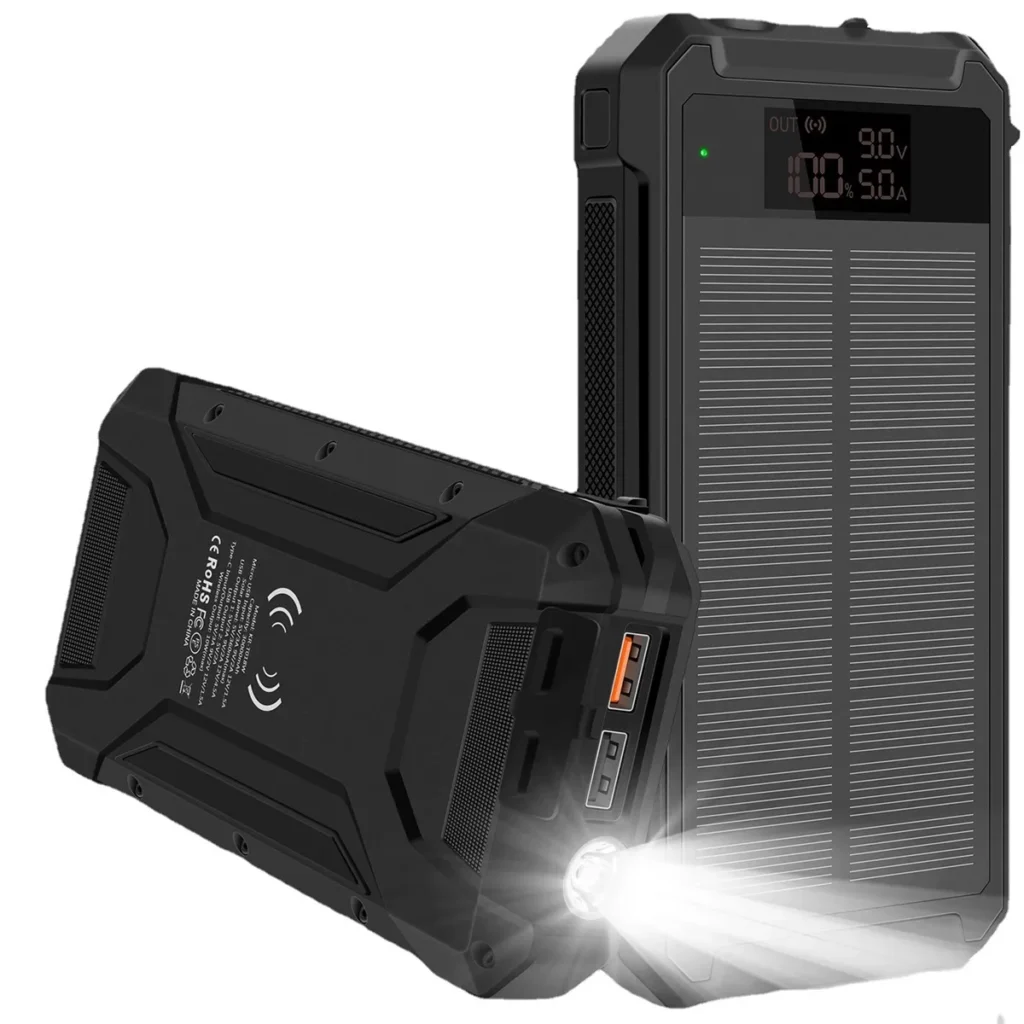
Unlike a standalone panel, a solar power bank stores generated electricity. That allows phone charging after sunset or when sunlight becomes inconsistent.
The photovoltaic process itself is well established. The U.S. Department of Energy’s explanation of solar photovoltaic technology notes that connected solar cells form modules or panels that produce usable electrical output. Yet real-world performance changes with sunlight intensity, panel angle, temperature, shade, and weather.
How Does a Solar Power Bank Charger for a Phone Work?
The solar panel converts incoming light into direct-current electricity. A controller regulates the current before sending it to the internal battery. Later, another circuit converts the battery’s voltage into a stable output for your phone.
In practice, the charging process has two distinct stages. First, you charge the power bank. Second, the power bank charges your phone. This buffered design is useful because passing clouds can make direct solar output unstable.
Most compact products offer two charging methods. USB charging serves as the primary method because it is faster and more predictable. Solar input works as a secondary source during hiking, camping, fieldwork, or emergencies.
The limits come from surface area. For example, Hedelee’s HDL519 outdoor model lists a 1.5W monocrystalline panel. Its own product guidance recommends fully charging the bank by cable before traveling and treating solar charging as backup.
Main Benefits of a Solar Power Bank Charger for Phone
The strongest benefit is energy resilience. A regular power bank becomes less useful after its stored energy runs out. A solar battery charger for mobile devices can still collect limited power when no wall outlet is available.
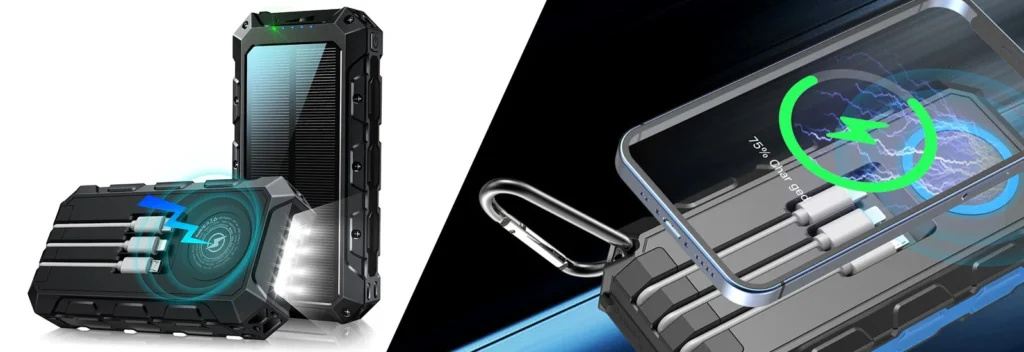
Portability also matters. One unit can combine a battery pack, flashlight, and basic solar charger. Models with carabiners attach easily to backpacks or tents, supporting hiking, fishing, fieldwork, and emergency preparation.
A portable solar phone charger can also reduce dependence on public charging points. That helps travelers avoid waiting beside outlets in airports, stations, and cafés. For trip-specific advice, read this guide to choosing a solar phone charger power bank for travelers.
Solar power banks also fit outdoor gear, mobile accessories, emergency kits, and corporate gifts. Buyers building a wider range can compare solar radios, wireless power banks, and hand-warmer power banks.
Solar Power Bank Charger for Phone Features to Check
1. Battery Capacity and Usable Energy
Capacity appears in milliamp-hours, usually written as mAh. Common sizes include 10,000mAh, 20,000mAh, and 30,000mAh. Bigger numbers suggest more stored energy, but they do not tell the whole story.
Power banks usually rate cells at their internal voltage. Voltage conversion, cable resistance, heat, battery age, and wireless transfer reduce usable output. Therefore, do not estimate phone charges by simply dividing two mAh figures. Compare watt-hours and ask whether a listing shows cell capacity, rated capacity, or usable output.
A compact 10,000mAh Solar Power Bank Charger for Phone suits daily backup and short trips. A 20,000mAh unit gives more flexibility for weekends outdoors. Higher-capacity models work better for several devices, although added cells increase weight and charging time.
2. Solar Panel Wattage
Panel wattage determines how quickly the unit can collect energy under strong sunlight. Unfortunately, many listings emphasize battery capacity while hiding panel power.
That omission matters. A 1W or 1.5W panel can provide emergency energy, but it cannot quickly refill a large battery. Heat, clouds, dust, shade, and poor orientation reduce output. The Department of Energy notes that standard photovoltaic testing uses 1,000 W/m² irradiance and a 25°C cell temperature, conditions that often differ from outdoor use.
For realistic expectations, read the detailed explanation of using a solar power bank charger for phone in cloudy weather. Clouds do not always stop generation completely, but output can fall sharply and fluctuate.
3. Wired Charging Speed
A fast-charging solar power bank should clearly state its output voltage, current, wattage, and supported protocol. “Fast charging” alone is not a useful specification.
For a basic 5V output, 2A equals 10W and 3A equals 15W. Higher rates often require a shared protocol. The USB Implementers Forum’s USB Power Delivery overview explains how compatible USB-C devices negotiate power through USB PD.
Check whether the USB-C port is input-only or supports both input and output. Also confirm whether the advertised wattage applies to one port or all ports combined.
4. Wireless Charging
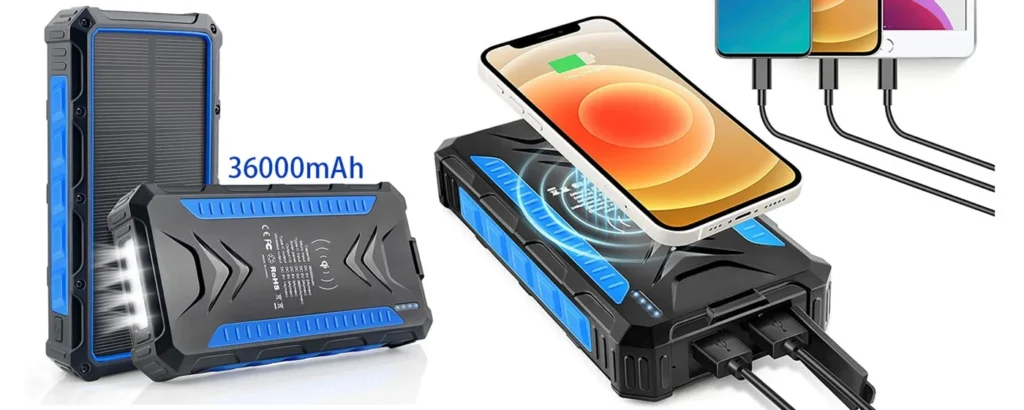
A wireless solar power bank provides convenient cable-free charging for compatible smartphones. It is useful when a cable is missing, damaged, or inconvenient.
Still, wireless charging usually loses more energy than a wired connection. Phone alignment also affects performance. Thick cases, metal plates, and excessive movement can interrupt charging.
Choose wireless output for convenience, not maximum efficiency. Hedelee’s compact HDL514 wireless solar battery charger lists a 10,000mAh capacity, dual 5V/2A outputs, 5W wireless charging, a 1.5W panel, and an LED flashlight.
5. Ports, Cables, and Compatibility
A practical solar USB phone charger should match your devices. USB-C supports many newer phones, while USB-A remains useful for older accessories. Built-in cables reduce clutter, but detachable cables are easier to replace.
Confirm simultaneous output and pass-through behavior before ordering. Some products reduce power when several devices connect. This guide explains whether a power bank solar power charger can charge and output together.
6. Water and Dust Resistance
A waterproof solar power bank needs a verified IP rating, not vague words such as “outdoor,” “rugged,” or “rainproof.”
The IP code separates solid-particle protection from water protection. For example, IP65 indicates dust-tight construction and resistance to low-pressure water jets. It does not mean the device is safe for swimming or prolonged immersion. Port covers must also close properly.
The HDL528 30,000mAh-class Qi model lists IP65 protection, USB-C input and output up to 5V/3A, a 1.5W panel, and a 448g product weight. Its page also distinguishes the marketed capacity from a stated 20,000mAh actual capacity, so commercial buyers should clarify capacity definitions before ordering.
7. Safety, Materials, and Certifications
A safe Solar Power Bank Charger for Phone needs more than a large battery label. Look for overcharge, overcurrent, short-circuit, overtemperature, and over-discharge protection.
For wholesale orders, request current test reports rather than accepting logo images alone. Documents may include UN38.3, an SDS or MSDS, and market-specific conformity records. Requirements vary, so importers should confirm them for the destination market.
Inspect samples for strong housings, protected ports, secure cells, heat control, water resistance, and repeatable charging before approving mass production.
Solar Power Bank Charger for Phone Capacity Comparison
| Capacity class | Typical role | Main advantage | Main trade-off |
|---|---|---|---|
| 5,000mAh | Emergency pocket backup | Light and compact | Limited reserve |
| 10,000mAh | Daily carry and short trips | Good balance of size and energy | Solar refill remains slow |
| 20,000mAh | Weekend camping and multiple devices | More reserve for off-grid use | Heavier and slower to recharge |
| 30,000mAh class | Group trips and emergency kits | High stored-energy potential | Capacity claims need careful verification |
| Foldable panel plus separate bank | Extended off-grid use | More solar collection area | More equipment to carry |
This table provides a use-case framework, not a promise of exact phone charges. Actual results depend on the phone battery, conversion efficiency, temperature, cable quality, output protocol, and battery condition.
Solar Power Bank Charger for Phone Models Worth Comparing
| Model | Best suited for | Notable listed features |
| HDL514 wireless solar charger | Compact everyday and outdoor backup | 10,000mAh, 5W wireless charging, dual USB, LED light |
| HDL519 portable outdoor solar charger | Camping and rugged travel ranges | Monocrystalline panel, USB outputs, wireless charging, carabiner, LED light |
| HDL528 IP65 wireless power bank | Higher-capacity outdoor positioning | IP65, USB-C input/output, 5V/3A listed output, Qi charging |
| HDL533 10,000mAh solar charger | Emergency and multi-function product lines | 10,000mAh listed capacity, built-in cable options, hand-powered feature, LED modes |
Specifications can change between production runs. Confirm the final datasheet, sample performance, packaging details, certifications, and labeling before purchase.
Best Use Cases for a Portable Solar Power Bank
Camping and Hiking
Trail life means no outlets for days. A rugged, outdoor solar phone charger clipped to your backpack captures sunlight while you hike. That keeps your phone charged for navigation, photos, and emergency calls. For gear built specifically for this purpose, check out this solar charger power bank for camping. It pairs a strong solar panel with a durable, weather-ready shell.
Travel and Commuting
Long flights, train rides, and unfamiliar cities all drain your phone fast, and outlets aren’t always available. Many travelers now prefer a compact solar phone charger power bank they can toss in a daypack. This guide for travelers lists model suggestions suited to frequent flyers.
Emergency Preparedness
Storms and blackouts happen without warning. Keeping a charged solar power bank charger for phone in your emergency kit matters. It means you can still call for help or check weather updates, even if the grid goes down for days. Even on overcast days, quality panels still collect usable energy. This breakdown of solar charging performance during cloudy weather explains why.
How to Choose the Right Solar Power Bank Charger for Phone
Picking the right model comes down to matching features to your actual habits. Ask yourself these questions first.
How often will you use it outdoors versus at home? If you’re mostly indoors, prioritize charging speed and wireless support over solar panel size. If you’re frequently outside, prioritize panel efficiency and water resistance instead.
How much weight can you carry? Higher capacity means more weight. A 30,000mAh portable solar power bank is great for van life but overkill for a daily commute.
What devices will you charge besides your phone? Many buyers also need to top off tablets, cameras, or wireless earbuds. Multiple output ports and higher wattage matter here.
Do you need a flashlight built in? Several models include LED flashlights for emergency use, which adds real value without much extra bulk. This solar power charger guide breaks down which features suit which lifestyle in more detail.
For shoppers focused purely on camping trips, this dedicated portable solar charger guide for camping helps narrow the choice down. It looks at trail length and pack weight.
Budget also plays a role, so it helps to think in terms of cost per year rather than upfront price alone. A cheaper unit with a weak panel or a fragile shell often needs replacing within a season. A sturdier solar power bank charger for phone, however, can last several years of regular outdoor use. So it usually pays off to spend a bit more on proven build quality. Read a few verified reviews first, and check the warranty length. Also confirm the exact mAh rating before you commit, since some listings round capacity up in misleading ways.
Solar Power Bank Charger for Phone Buying Mistakes
Do not treat a small integrated panel as a wall-charger replacement. Also, never trust mAh alone; the label does not reveal conversion efficiency, cell quality, or usable output.
Check watts and protocols before accepting a “fast charging” claim. Finally, do not confuse water resistance with immersion protection. Even an IP65 product needs closed port covers and sensible handling.
Many customers also ignore air-travel rules. The U.S. Federal Aviation Administration’s lithium-battery guidance states that power banks count as spare lithium batteries and must travel in carry-on baggage. Its general guidance limits standard lithium-ion batteries to 100Wh unless specific airline approval applies. Always check the airline’s latest policy before flying.
Is a Solar Power Bank Charger for Phone Worth Buying?
Yes, when you buy it for the right reason. It works well as a portable power bank with an additional solar safety net. It is especially useful for outdoor activities, travel, fieldwork, emergency preparation, and regions with unreliable electricity.
It is less suitable for users expecting a pocket-size panel to refill a large battery quickly every day. In that case, choose a larger foldable solar panel and pair it with a separate power bank.
For most buyers, the best Solar Power Bank Charger for Phone is not the model with the biggest printed capacity. It is the model with transparent specifications, enough usable energy, compatible outputs, verified protection, and a panel that matches realistic expectations.
Solar Power Bank Charger for Phone is most valuable as a dependable battery pack with solar-assisted backup. Choose capacity according to real device needs, check panel wattage, verify USB output, and distinguish water resistance from immersion protection.
Choosing the right solar power bank charger for your phone comes down to matching capacity, speed, and durability to how you actually live. Campers need rugged, waterproof builds. Travelers want something compact and fast-charging. And anyone building an emergency kit should prioritize reliability above all else. Whichever path fits you, this kind of charger offers something a standard power bank never can. It keeps going, no matter where you are or how long you’ll be there.
For outdoor retail, wholesale, OEM, or private-label inquiries, contact Hedelee directly to request current specifications, samples, minimum order quantities, and certification documents.
FAQs
Can a solar power bank fully charge a smartphone?
A Solar Power Bank Charger for Phone can fully charge a smartphone when its internal battery has enough usable energy. The solar panel may replenish part of that energy, but a compact panel usually charges slowly. Pre-charge the bank through USB, then use sunlight for emergency top-ups or battery maintenance during outdoor use.
How long does solar charging take?
A Solar Power Bank Charger for Phone may need many hours or several days of strong sunlight to recharge fully through a small integrated panel. Time depends on panel wattage, battery size, angle, temperature, clouds, and shade. Manufacturers should publish panel power so buyers can estimate performance instead of relying on vague claims.
Does a solar power bank work on cloudy days?
A Solar Power Bank Charger for Phone can generate some power in bright cloudy conditions, but output usually drops and becomes less stable. Place the panel in the brightest open area, avoid shade, and treat cloudy-weather charging as supplemental. A cable-charged battery reserve remains more dependable.
What capacity is best for travel?
A 10,000mAh Solar Power Bank Charger for Phone offers a practical balance for many travelers, while 20,000mAh provides more reserve for long journeys. Check watt-hours, weight, and airline rules before flying. Keep the power bank in carry-on baggage and verify any airline-specific restrictions.
Is wireless charging better than USB charging?
A wireless Solar Power Bank Charger for Phone is more convenient, but wired charging is usually more efficient and easier to keep aligned. Use wireless output when convenience matters. Use a compatible USB-C or USB-A cable when you need better energy efficiency, steadier charging, or the highest supported speed.
What should wholesale buyers verify before ordering?
Wholesale buyers should verify the Solar Power Bank Charger for Phone capacity definition, cell quality, solar wattage, output protocol, IP rating, safety protections, test reports, packaging, warranty terms, and production consistency. Request samples and compare measured results with the datasheet before approving mass production or private-label artwork.